
Brain CT Scan - definition, indications , which disorder by seeing ct learning trick with images
Reading File
Searching for comprehensive Brain CT scan information and images in parallel.
search_medical_text
Brain CT scan definition indications technique interpretation
Harrison's Principles of Internal Medicine, Twenty First Edition
Page 11947
search_medical_image
Brain CT scan normal and abnormal findings stroke hemorrhage tumor
Hugging Face pmc clinical VQA raw
Page 0
GradeResponse
GradeResponse
search_medical_text
CT scan brain hyperdense hypodense lesions interpretation disorders
Harrison's Principles of Internal Medicine, Twenty First Edition
Page 12566
search_medical_image
brain CT ischemic stroke epidural subdural hemorrhage midline shift
Hugging Face pmc clinical VQA raw
Page 0
GradeResponse
GradeResponse
Here is a comprehensive guide to Brain CT Scans:
🧠 Brain CT Scan — Complete Guide
1. Definition
A Brain CT (Computed Tomography) Scan is a non-invasive imaging technique that uses X-rays and computer processing to generate cross-sectional (axial) images of the brain and skull. It measures the attenuation (density) of X-ray beams passing through different tissues and displays them on a Hounsfield Unit (HU) scale:
| Tissue | Appearance on CT | HU Value |
|---|---|---|
| Bone / Calcification | Bright White (Hyperdense) | +400 to +1000 |
| Fresh Blood | White (Hyperdense) | +50 to +80 |
| Brain (Grey Matter) | Light Grey | +35 to +45 |
| Brain (White Matter) | Slightly darker grey | +25 to +35 |
| CSF / Water | Dark Grey | 0 |
| Fat | Near Black | −50 to −100 |
| Air | Black | −1000 |
2. Indications
(Harrison's Principles of Internal Medicine, p. 11947)
CT is the primary/first-line study for:
- ✅ Acute change in mental status
- ✅ Focal neurologic deficits (sudden weakness, speech disturbance, facial droop)
- ✅ Acute head trauma / TBI (rule out bleed, fracture)
- ✅ Suspected subarachnoid hemorrhage (thunderclap headache)
- ✅ Stroke (hemorrhagic vs ischemic differentiation)
- ✅ Seizures — first episode or change in pattern
- ✅ Raised intracranial pressure (papilledema, vomiting, bradycardia)
- ✅ Brain tumor surveillance / mass lesions
- ✅ Pre-lumbar puncture (to rule out mass effect / herniation risk)
- ✅ Conductive hearing loss (evaluation of osseous structures)
- ✅ Hydrocephalus (ventricular size assessment)
- ✅ Intracranial infections (abscess, meningitis complications)
CT vs MRI: CT is preferred in acute emergencies due to speed and availability. MRI is preferred for posterior fossa lesions, early ischemic stroke (<6h), white matter diseases, and spinal cord pathology.
3. Recognizing Disorders on Brain CT — The Learning Trick (Shape + Location + Density)
🧠 The Master Mnemonic: "BISC-HT"
Blood Is Sharp & Crescent — Hyperdense Triangle
Use 3 questions to identify any lesion:
- Shape — What shape is the hyperdensity?
- Location — Where is it relative to the brain/dura?
- Effect — Is there midline shift, sulcal effacement, or herniation?
📊 CT Findings by Disorder
| Disorder | Density | Shape | Location | Key Trick |
|---|---|---|---|---|
| Epidural Hematoma (EDH) | Hyperdense (white) | Biconvex / Lens-shaped 🏈 | Between skull & dura | Does NOT cross sutures; "rugby ball" shape |
| Subdural Hematoma (SDH) | Hyperdense (acute) → Isodense (subacute) → Hypodense (chronic) | Crescent-shaped 🌙 | Between dura & arachnoid | Crosses sutures; follows brain contour |
| Subarachnoid Hemorrhage (SAH) | Hyperdense | Fills sulci & cisterns (star/spoke pattern) | Subarachnoid space | "Bright star" pattern in basal cisterns; thunderclap headache |
| Intraparenchymal Hemorrhage (IPH) | Hyperdense | Irregular, large blob | Within brain tissue | Surrounded by hypodense edema halo |
| Intraventricular Hemorrhage (IVH) | Hyperdense | Cast of ventricle | Inside ventricles | Blood fills/casts the ventricle |
| Ischemic Stroke | Hypodense (dark) | Wedge-shaped | Vascular territory | Loss of grey-white differentiation; "hyperdense MCA sign" |
| Brain Tumor | Variable (iso/hypo/hyperdense) | Round mass | Anywhere | Ring enhancement on contrast; surrounding edema |
| Brain Abscess | Hypodense center, ring | Ring-enhancing lesion | Anywhere | "Smooth thin ring" on contrast CT |
| Hydrocephalus | Enlarged ventricles (dark CSF) | Dilated ventricles | Ventricular system | Temporal horn dilation is earliest sign |
| Cerebral Edema | Hypodense (diffuse) | Sulcal effacement, compressed ventricles | Diffuse | Loss of grey-white matter distinction |
| Calcification / Old bleed | Hyperdense (very bright) | Punctate or irregular | Basal ganglia, cerebellum | Stable, very high HU |
4. Visual Learning — CT Images
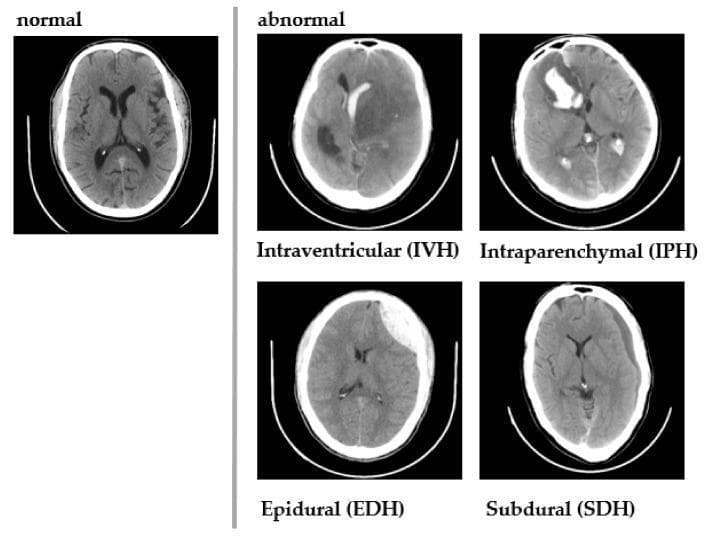
Normal vs. Hemorrhage Types
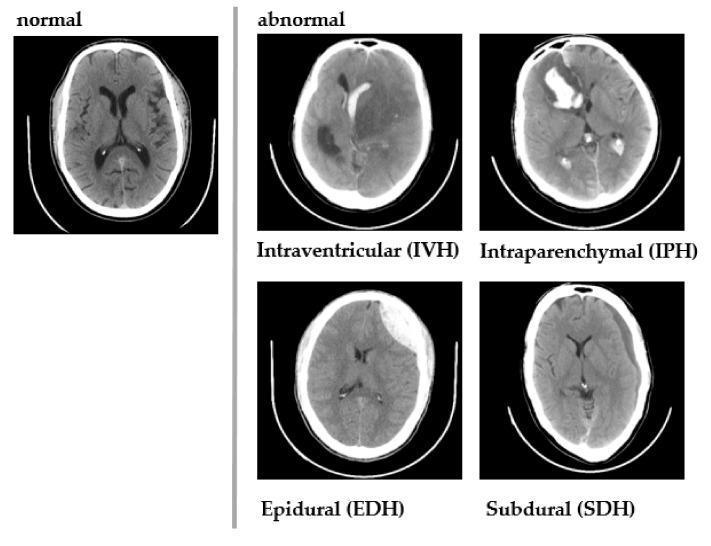
Key findings in the image above:
- Normal: Symmetric ventricles, clear grey-white differentiation, no midline shift
- IVH: Hyperdense blood casting inside ventricles
- IPH: Large irregular hyperdense lesion within parenchyma + surrounding edema
- EDH: Classic biconvex/lens-shaped hyperdensity — does not cross sutures
- SDH: Crescent-shaped hyperdensity along inner skull table — follows brain contour
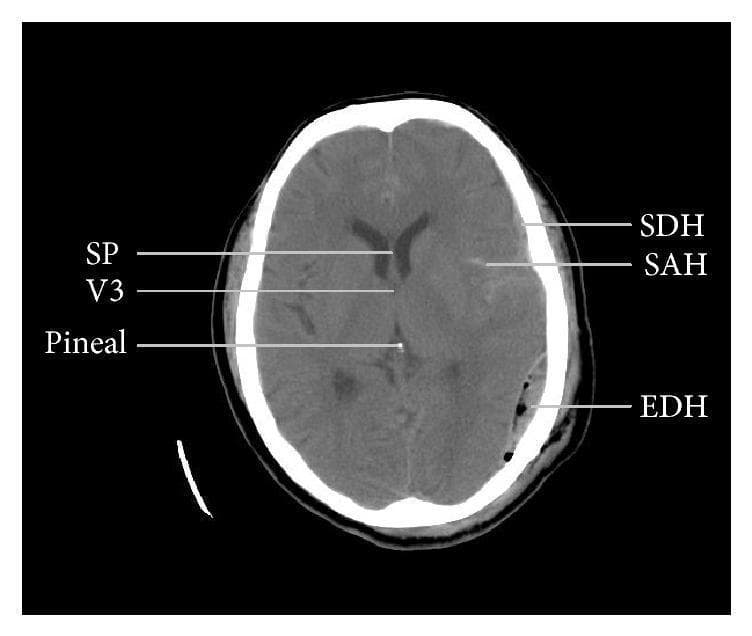
Midline Shift + Multiple Hemorrhage Types
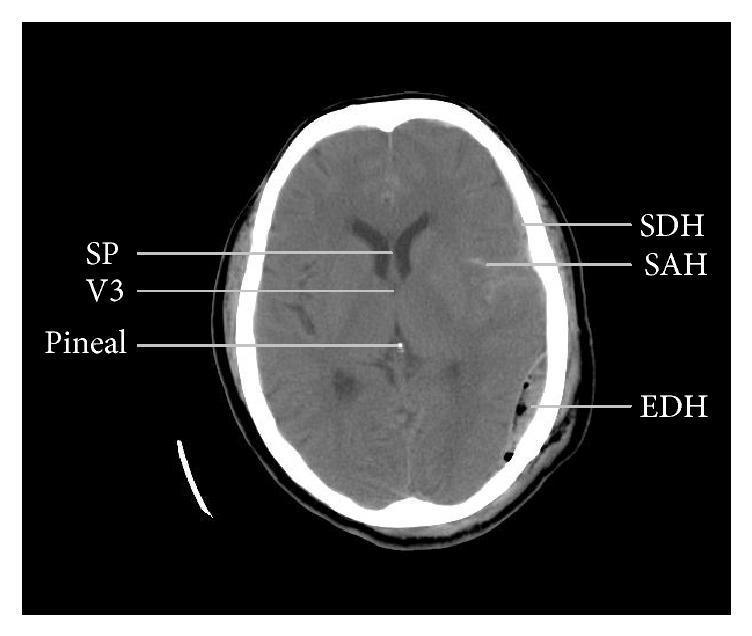
Key findings in the image above:
- SDH (right side): Crescent-shaped hyperdensity along inner skull
- EDH (posterior): Lens/biconvex hyperdensity
- SAH: Linear hyperdensities within cerebral sulci
- Midline Shift: Displacement of septum pellucidum from midline (measured in mm) — indicates mass effect and herniation risk
5. Quick Memory Tricks (Mnemonics)
Shape Trick:
| Shape | Think of... | Diagnosis |
|---|---|---|
| 🏈 Lens / Rugby ball | "Fits between skull bones, can't cross sutures" | EDH |
| 🌙 Crescent / Banana | "Wraps around brain like a banana peel" | SDH |
| ⭐ Star burst in sulci | "Blood fills all the grooves" | SAH |
| 🔵 Blob in brain | "Punched into the parenchyma" | IPH |
| 🫁 Wedge in territory | "Follows a vascular territory, goes dark" | Ischemic Stroke |
Density Trick:
"Fresh blood is WHITE, old blood goes dark, dead tissue is DARK from the start"
- Acute blood → Hyperdense (white) (protein-rich clot)
- Subacute blood (1–3 weeks) → Isodense (blends with brain — easy to miss!)
- Chronic blood (>3 weeks) → Hypodense (dark)
- Ischemia/infarct → Always hypodense (dark)
6. Systematic Approach to Reading a Brain CT
Use the mnemonic "B-C-I-A-V-E":
- B — Bone: Check skull for fractures, erosions
- C — Cisterns: Basal cisterns effaced? SAH?
- I — Intracranial hemorrhage: Any hyperdensities? Where?
- A — Asymmetry / Midline: Midline shift? Which side?
- V — Ventricles: Size, symmetry, blood in ventricles?
- E — Edema / Effacement: Sulcal effacement, grey-white loss?
This framework gives you a systematic, pattern-based approach to reading brain CTs confidently. The key principle: density + shape + location = diagnosis.
This is a shared conversation. Sign in to Orris to start your own chat.