
I Am a MD dermatology resident Studying for my final exams Write a short more on ehler Danilo’s syndrome
Reading File
Now let me search the medical library and PubMed in parallel for Ehlers-Danlos syndrome content.
Finding Sources
Searching PubMed
"Ehlers-Danlos syndrome"[MeSH Terms] AND dermatology
Excellent - Fitzpatrick's and Andrews' both have dedicated EDS sections. Let me read them in parallel.
Reading File
Reading File
Reading File
Excellent - I have rich content from Fitzpatrick's, Andrews', and Robbins. The Fitzpatrick's content was truncated - let me read more of that, plus fetch the clinical images.
Reading File
Loading Image
Loading Image
I now have comprehensive content from three major textbooks plus clinical images. Let me compile the full study note.
Ehlers-Danlos Syndromes (EDS) - Dermatology Study Note
Sources: Fitzpatrick's Dermatology (9th ed.), Andrews' Diseases of the Skin, Robbins & Kumar Basic Pathology
Overview
EDS is a group of genetically and clinically heterogeneous inherited connective tissue disorders characterized by defects in collagen synthesis or structure. The collective frequency is ~1 in 5,000 births worldwide. The 2017 International Classification recognizes 13 subtypes, each defined by distinct genetic mutations, inheritance patterns, and clinical criteria.
The triad unifying all subtypes:
- Skin hyperextensibility and fragility
- Joint hypermobility
- Abnormal wound healing with atrophic/dystrophic scarring
Pathogenesis
All subtypes ultimately disrupt collagen integrity:
| Subtype | Defect |
|---|---|
| Classical (cEDS) | Mutations in COL5A1/COL5A2 (Type V collagen) - AD |
| Vascular (vEDS) | Mutations in COL3A1 (Type III collagen) - AD |
| Kyphoscoliotic | Deficiency of lysyl hydroxylase (impairs crosslinking) - AR |
| Classical-like | Mutations in TNXB (tenascin-X) - AR |
| Cardiac-valvular | Mutations in COL1A2 (Type I collagen) - AR |
| Arthrochalasia | Mutations in COL1A1 or COL1A2 (Type I collagen) - AD |
| Dermatosparaxis | Mutations in ADAMTS2 (procollagen protease) - AR |
Key concept: ~30 distinct types of collagen exist; the clinical heterogeneity of EDS maps directly onto which collagen gene is mutated and in which tissues that collagen predominates. - Robbins & Kumar
The 3 Most Exam-Relevant Subtypes
1. Classical EDS (cEDS) - Most Common
- Gene: COL5A1 (most common), COL5A2, rarely COL1A1
- Inheritance: Autosomal dominant
- Incidence: 1:10,000-20,000
Cutaneous features:
- Skin hyperextensibility: assessed at the volar forearm - positive if stretched >1.5 cm (Remvig criteria)
- Skin recoils to normal position (unlike cutis laxa, which does not recoil)
- Soft, velvety, doughy texture
- Easy bruising
- Wounds heal as wide, atrophic, papyraceous ("cigarette paper") scars - particularly over bony prominences (shins, knees, forehead)
- Molluscoid pseudotumors - fleshy, pedunculated lesions over pressure points
- Spheroids (subcutaneous spherules) - small, hard, mobile calcified nodules along the shins and forearms
- Gorlin sign - ability to touch the tip of the nose with the tongue
Extracutaneous:
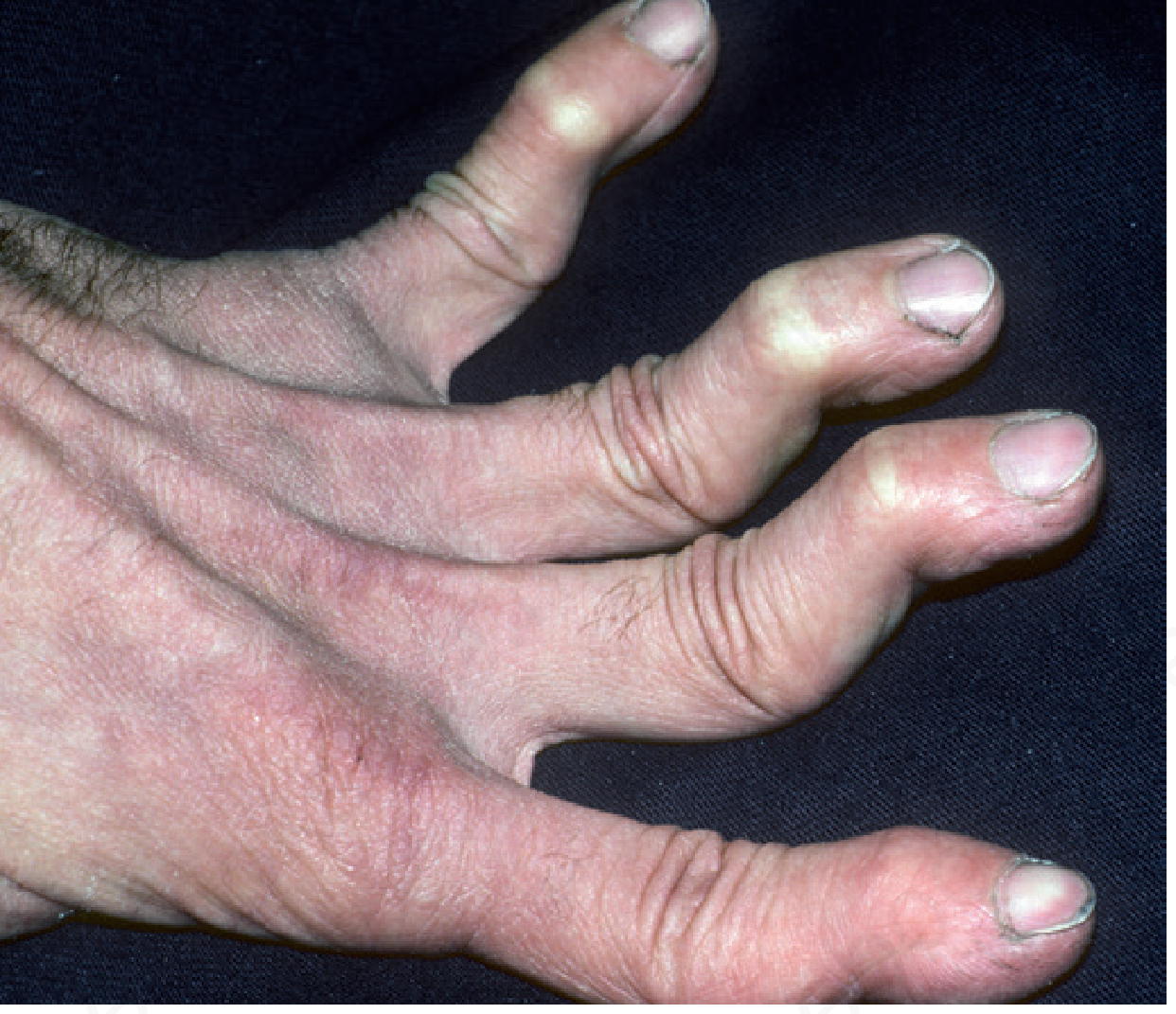
- Generalized joint hypermobility with dislocations
- Complications in pregnancy and delivery
- Hiatus hernia, diaphragmatic hernia
2. Vascular EDS (vEDS) - Most Life-Threatening
- Gene: COL3A1 (dominant-negative mutations; >320 mutations reported)
- Inheritance: Autosomal dominant
- Incidence: 1:50,000-200,000
Why so dangerous: Type III collagen is the major structural protein of blood vessel walls, hollow organs (bowel, uterus), and the upper dermis. Loss leads to catastrophic rupture.
Cutaneous features (often subtle):
- Thin, translucent skin with visible venous pattern (especially over chest/abdomen)
- Easy bruising with minimal trauma
- Characteristic facial features: large eyes, thin nose and lips, lobeless ears, hollow cheeks
Extracutaneous (life-threatening):
- Spontaneous arterial rupture (most commonly medium-to-large arteries: celiac, renal, iliac, aorta)
- Spontaneous bowel (sigmoid colon) perforation
- Uterine rupture during pregnancy - major cause of maternal mortality
- Median survival: ~48 years
- Skin hyperextensibility is NOT prominent (distinguishing feature from cEDS)
Lab diagnosis: Reduced Type III procollagen secretion by cultured fibroblasts; direct COL3A1 sequencing.
3. Hypermobile EDS (hEDS) - Most Common Overall
- Gene: Unknown in most cases (~5% show TNXB haploinsufficiency)
- Inheritance: Autosomal dominant
Clinical features:
- Generalized joint hypermobility (Beighton score used)
- Skin is soft/velvety but atrophic scarring is NOT present (key distinction from cEDS)
- Chronic musculoskeletal pain, fatigue, dysautonomia
- Overlaps significantly with hypermobility spectrum disorder (HSD)
Clinical Images
Fig 1 - Skin hyperextensibility in EDS (Andrews' Diseases of the Skin):
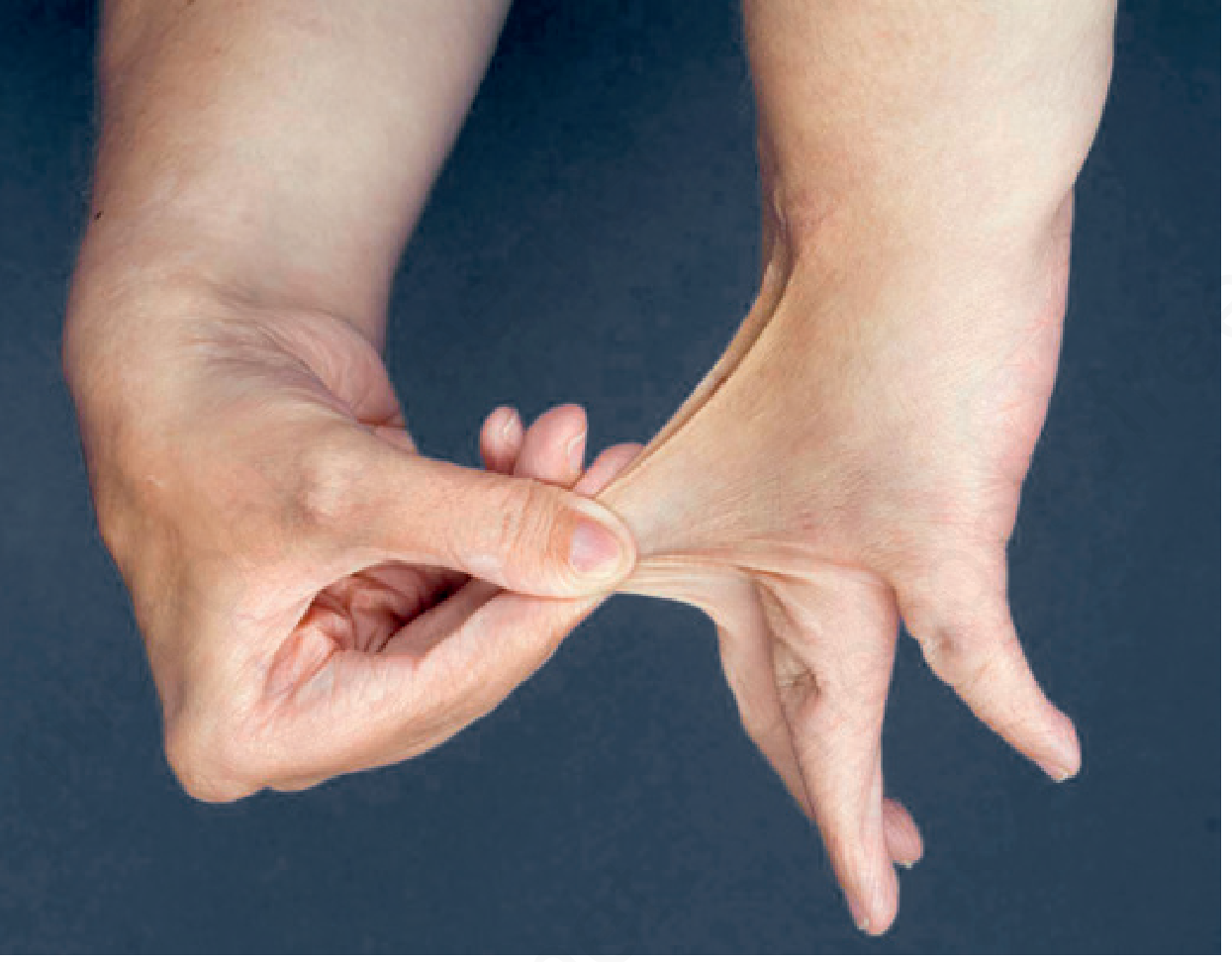
Fig 2 - Hyperextensible joints in EDS:
Dermatologist's Role
Per Andrews' Diseases of the Skin: "The dermatologist's role is to help identify people who may have EDS and guide them to workup by a geneticist and if necessary other specialties including cardiology."
Key clinical signals to recognize:
- Unexplained atrophic scars in a young patient
- Wound dehiscence out of proportion to trauma
- Skin that stretches dramatically but recoils
- Recurrent bruising without coagulopathy (platelet function and coagulation tests are normal in EDS)
Histopathology & Lab Findings
- Routine H&E: Usually normal
- Electron microscopy: Abnormal collagen fibril morphology (irregular diameter, "cauliflower" fibrils in dermatosparaxis)
- Platelet function / coagulation: Normal (important to remember - bruising is purely structural)
- Molecular testing: Next-generation sequencing (NGS) panels targeting known EDS genes are now standard; variants of uncertain significance (VUS) require correlation with clinical phenotype per ACMG guidelines
- Biochemical: Lysyl hydroxylase activity (kyphoscoliotic EDS), Type III procollagen fibroblast assay (vEDS)
Skin Hyperextensibility: EDS vs. Cutis Laxa
| Feature | EDS | Cutis Laxa |
|---|---|---|
| Recoil after stretching | Yes - recoils promptly | No - hangs loose |
| Texture | Soft, velvety | Lax, sagging |
| Scarring | Atrophic, papyraceous | Absent |
| Mechanism | Collagen defect | Elastin defect |
Key Exam High-Yield Points
- Most common subtype overall: Hypermobile EDS (hEDS)
- Most common subtype with defined molecular basis: Classical EDS (COL5A1)
- Most lethal subtype: Vascular EDS (COL3A1) - arterial/bowel/uterine rupture
- Atrophic cigarette-paper scars + molluscoid pseudotumors = Classical EDS
- Thin translucent skin + arterial rupture in a young person = Vascular EDS
- Congenital scoliosis + ocular fragility (corneal rupture, retinal detachment) = Kyphoscoliotic EDS (lysyl hydroxylase deficiency, AR)
- Coagulation is always normal - bruising is purely structural
- EDS skin recoils; cutis laxa skin does not - classic distinction
- 2017 classification: 13 subtypes
- Prevalence: ~1 in 5,000
Recent Literature
Two relevant 2023-2024 reviews from JAAD and Clinical & Experimental Dermatology specifically address dermatologic manifestations and skin fragility/wound management in EDS (PMIDs 36764582 and 38767179) - worth checking if your exam references recent guidelines on wound care, as this is an active area.
Good luck with your finals! The vascular subtype and the classical/cutis laxa distinction are classic exam setups - make sure you can quickly differentiate them at the bedside.
This is a shared conversation. Sign in to Orris to start your own chat.