
Anatomy
Asking for Preferences
What anatomy topic are you interested in?
Asking for Preferences
Which region? · What level of detail do you need?
Reading File
Finding Sources
Finding Sources
Finding Sources
Reading File
Finding Sources
Reading File
Reading File
Reading File
Reading File
Finding Sources
Reading File
Reading File
Searching Images
abdomen regions quadrants anatomy overview
Now I have enough to compile a comprehensive overview. Let me also fetch a key diagram.
Loading Image
Loading Image
Here is a comprehensive overview of abdominal anatomy, drawn from Gray's Anatomy for Students.
Overview of Abdominal Anatomy
Boundaries
The abdomen is bounded:
- Superiorly — xiphoid process and costal margins (diaphragm internally)
- Posteriorly — vertebral column and paravertebral muscles
- Inferiorly — upper parts of the pelvic bones; communicates with the pelvic cavity below the pelvic inlet
- Anterolaterally — the muscular abdominal wall
Abdominal Wall Layers (Anterior & Lateral)
From superficial to deep, the wall has these layers:
| Layer | Key Points |
|---|---|
| Skin | |
| Superficial fascia | Two sublayers below the umbilicus: Camper's (fatty) and Scarpa's (membranous) |
| Muscles | Three flat + two vertical muscles (see below) |
| Transversalis fascia | Continuous lining of the entire abdominal cavity |
| Extraperitoneal fascia | Loose connective tissue; subdivided into preperitoneal and retroperitoneal compartments |
| Parietal peritoneum | Innermost layer |
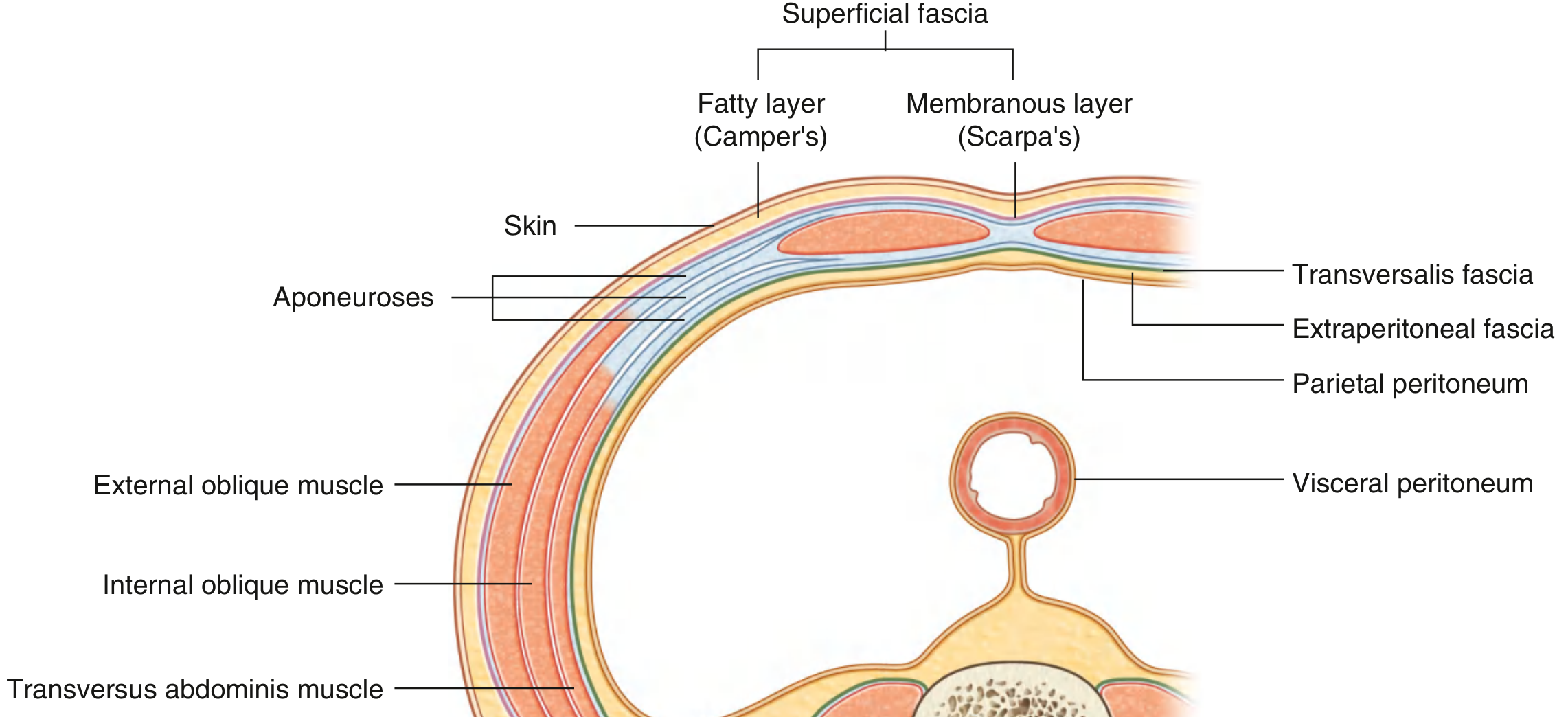
Abdominal Wall Muscles
Flat muscles (anterolateral group)
| Muscle | Fibre Direction | Origin | Innervation |
|---|---|---|---|
| External oblique | Inferomedial | Lower 8 ribs (V–XII) | T7–T12 |
| Internal oblique | Superomedial | Thoracolumbar fascia, iliac crest, inguinal lig. | T7–T12, L1 |
| Transversus abdominis | Transverse | Thoracolumbar fascia, iliac crest, lower 6 costal cartilages | T7–T12, L1 |
All three end in aponeuroses that meet at the linea alba in the midline.
Vertical muscles
- Rectus abdominis — runs from pubic crest/symphysis to costal cartilages V–VII and xiphoid; enclosed in the rectus sheath formed by the interdigitating aponeuroses of the flat muscles; crossed by 3–4 tendinous intersections
- Pyramidalis — small triangular muscle; may be absent; tenses the linea alba
Innervation of the wall
Skin, muscles, and parietal peritoneum are supplied by T7–T12 and L1 anterior rami running inferomedially between the internal oblique and transversus abdominis.
Peritoneum
- Parietal peritoneum lines the abdominal walls
- Visceral peritoneum covers the organs
- The space between them is the peritoneal cavity — closed in men, semi-closed in women (uterine tubes open to it)
- Viscera may be intraperitoneal (fully covered — stomach, jejunum, ileum, spleen) or retroperitoneal (secondarily or primarily fixed to the posterior wall — kidneys, duodenum, pancreas)
Key Vertical Planes & Reference Levels
| Plane / Level | Vertebral Level | Structures |
|---|---|---|
| Transpyloric plane | ~L1 (inferior) | Pyloric orifice, head of pancreas, renal hila, 9th costal cartilage |
| Celiac artery | Upper border L1 | Supplies foregut |
| Superior mesenteric artery | Lower border L1 | Supplies midgut |
| Inferior mesenteric artery | ~L3 | Supplies hindgut |
| Renal arteries | L1–L2 | Left slightly higher than right |
Three Major Arterial Trunks of the Abdomen
Three unpaired arteries branch from the anterior abdominal aorta to supply the GI tract and its derivatives:
- Celiac artery — foregut (stomach, proximal duodenum, liver, gallbladder, pancreas, spleen)
- Superior mesenteric artery (SMA) — midgut (distal duodenum → proximal 2/3 transverse colon)
- Inferior mesenteric artery (IMA) — hindgut (distal 1/3 transverse colon → upper rectum)
Key Viscera at a Glance
Kidneys
- Lie retroperitoneally on the posterior abdominal wall
- Hilum on the medial margin — site of entry/exit of renal vessels, lymphatics, nerves, and ureter
- Structure: outer cortex → renal columns → medulla (pyramids) → renal papillae → minor calices → major calices → renal pelvis → ureter
- Each supplied by a lateral branch of the aorta between L1–L2
- The left renal vein crosses anterior to the aorta and posterior to the SMA (vulnerable to aneurysmal compression)
GI Tract Organization
Rotations during development position:
- Stomach left of midline, with the lesser sac (omental bursa) posterior to it
- Duodenum (C-shaped loop) on the right, with the head enveloped by the pancreas; secondary fusion fixes it retroperitoneally
- Omental foramen (epiploic foramen) — restricted opening between greater and lesser sac, below the free edge of the lesser omentum
The Inguinal Region (Groin)
A structurally weak area in the anterolateral wall where several things pass between abdomen and thigh:
- External iliac artery/vein → femoral artery/vein
- Femoral nerve (innervates quadriceps)
- Lymphatics
- Distal psoas major and iliacus (flex thigh)
- Inguinal canal transmits the spermatic cord (men) or round ligament of uterus (women)
Source: Gray's Anatomy for Students — Chapter 4 (Abdomen)
This is a shared conversation. Sign in to Orris to start your own chat.