
Psd test in ortho
The Posterior Sag (Drawer) Test - also called the Posterior Sag Sign or Gravity Drawer Test - is used in orthopedics to assess posterior cruciate ligament (PCL) integrity in the knee.
Searching sources...
Reading File
Finding Sources
Finding Sources
Reading File
Reading File
Reading File
Loading Image
Finding Sources
Here is a complete overview of the Posterior Sag (Draw) Test in orthopedics - a key clinical test for Posterior Cruciate Ligament (PCL) injury:
Posterior Sag Test / Posterior Drawer Test - PCL Assessment
What it Tests
Both tests assess integrity of the Posterior Cruciate Ligament (PCL), the primary restraint to posterior tibial translation between 30° and 90° of knee flexion.
1. Posterior Sag Sign Test
Position: Patient supine; a pillow is placed under the distal thigh while the heel rests on the stretcher.
Angle: Knee flexed to 45° or 90°.
Positive finding: The tibia visibly sags (drops) backward on the femur - indicates PCL insufficiency.
Sensitivity: ~79% in the acute phase.
Important note: A false-positive anterior drawer test can occur if the examiner misses the posterior sag sign - the tibia translates forward from its already-posteriorly displaced position, mimicking an anterior drawer.
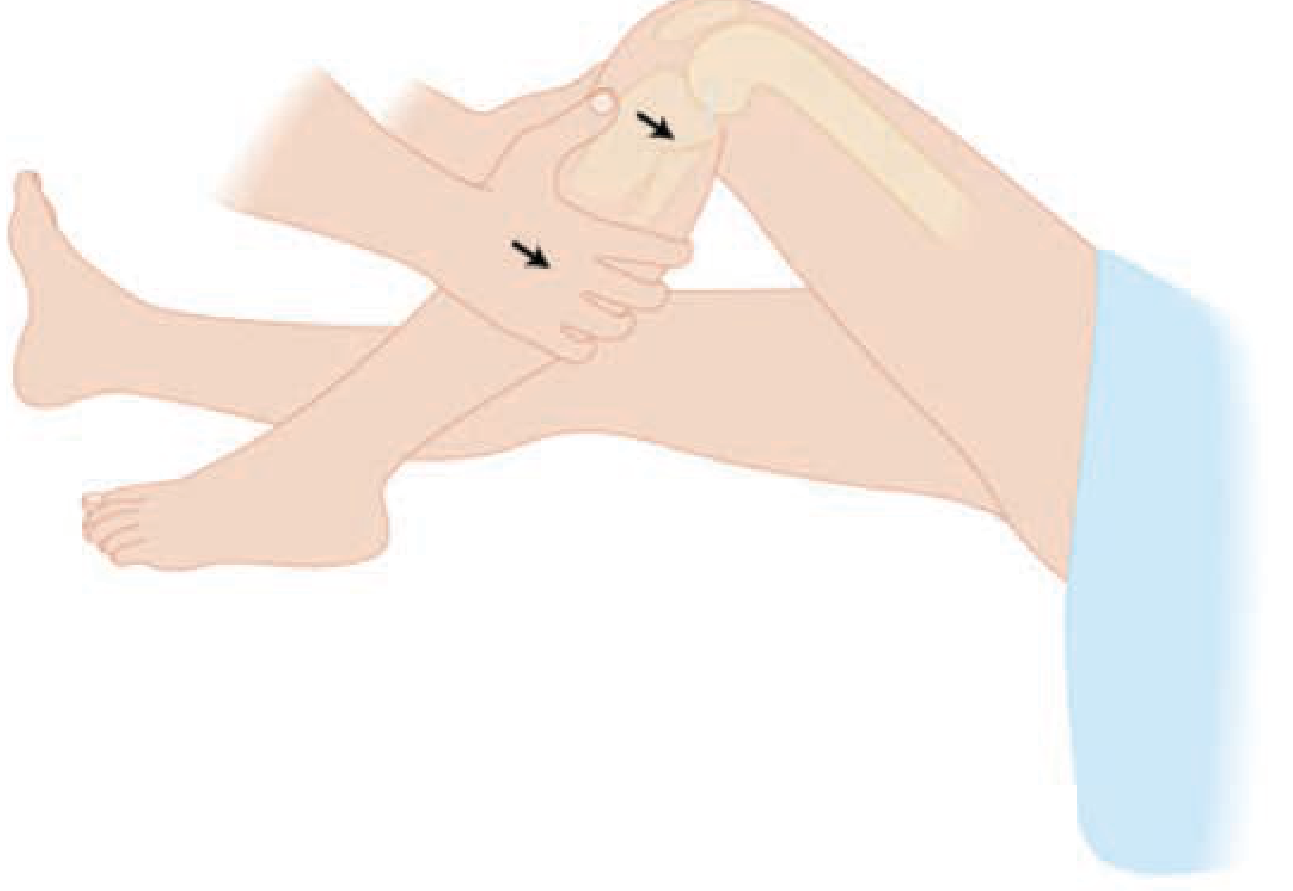
2. Posterior Drawer Test
The most reliable clinical test for PCL injury.
Position: Patient supine, knee flexed to 90°, foot stabilized by examiner.
Maneuver: Apply a smooth, firm backward (posterior) force to the anterior aspect of the proximal tibia / tibial tubercle.
Positive finding:
- Posterior tibial displacement > 5 mm, or
- A soft/absent end point
Sensitivity: ~85% in PCL-insufficient knees (55% in some ED series).
Grading of laxity:
| Grade | Displacement |
|---|---|
| Grade I | 0-5 mm |
| Grade II | 5-10 mm |
| Grade III | >10 mm |
If >10 mm of posterior translation is noted at 30° and/or 90°, a combined PCL + posterolateral corner injury must be suspected.
Clinical Pitfall
Always compare with the contralateral (normal) knee - baseline ligamentous laxity varies between patients. The PCL injury may also occur alongside other ligamentous injuries, especially in high-energy trauma.
Mechanism of PCL Injury
- Anterior-to-posterior force applied to the tibia (e.g., dashboard injury)
- Hyperextension of the knee
- Direct blow to a bent knee
Sources: Rosen's Emergency Medicine; Tintinalli's Emergency Medicine; Bailey and Love's Short Practice of Surgery, 28th Ed; Campbell's Operative Orthopaedics, 15th Ed 2026
This is a shared conversation. Sign in to Orris to start your own chat.