
Greater omenta
Reading File
The greater omentum is a large, apron-like fold of peritoneum that hangs from the greater curvature of the stomach. Let me search the medical library for detailed content.
Searching sources...
Finding Sources
Finding Sources
Good results. Now let me read the key sections from multiple sources in parallel.
Reading File
Reading File
Reading File
Excellent content from multiple sources. Let me fetch the anatomy diagram and read the clinical/surgical sections more fully.
Loading Image
Reading File
Reading File
I now have comprehensive content from multiple authoritative sources. Here is a full account of the greater omentum:
Greater Omentum
Definition and Overview
The greater omentum is a large, apron-like fold of peritoneum that attaches to the greater curvature of the stomach and the first part of the duodenum. It drapes inferiorly over the transverse colon and the coils of jejunum and ileum, then turns posteriorly and ascends to adhere to the superior surface of the transverse colon and the anterior layer of the transverse mesocolon before reaching the posterior abdominal wall.
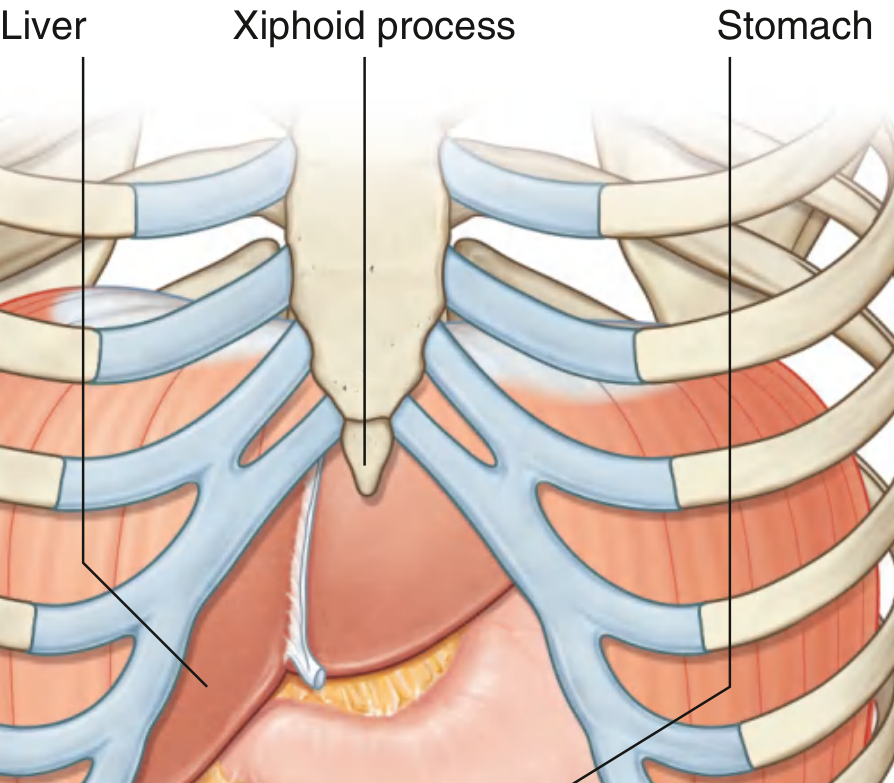
Fig. 4.60 - Gray's Anatomy for Students
Structure
- It is a four-layered peritoneal fold (as described in Grainger & Allison's diagnostic radiology) - descending from the greater curvature of the stomach, then turning superiorly to insert into the anterosuperior aspect of the transverse colon.
- Usually a thin membrane, but always contains some amount of fat - which may become substantial in obese individuals.
- In an adult, it lies between the abdominal wall and the hollow viscera, usually extending down into the pelvis.
Ligamentous Extensions
The greater omentum includes several named peritoneal ligaments:
| Ligament | Connects |
|---|---|
| Gastrocolic ligament | Stomach to transverse colon |
| Gastrosplenic ligament | Stomach to spleen |
| Gastrophrenic ligament | Stomach to diaphragm |
- Schwartz's Principles of Surgery, p. 1585
Blood Supply
- Derived from the right and left gastroepiploic (gastro-omental) arteries, which run between the double peritoneal layers just inferior to the greater curvature of the stomach.
- Venous drainage parallels the arterial supply and ultimately drains into the portal system.
- Gray's Anatomy for Students, p. 367; Schwartz's Principles of Surgery, p. 1585
Lymphatic Drainage
- Lymphatics drain via the subpyloric nodes (right side) or splenic nodes (left side), ultimately converging at the celiac nodes and then the thoracic duct.
- Schwartz's Principles of Surgery, p. 1585
The "Policeman of the Abdomen"
This famous phrase was coined by the British surgeon Rutherford Morison. It describes the omentum's remarkable defensive behavior:
- When bowel becomes inflamed, it ceases peristalsis (local paralytic ileus). The adjacent motile bowel "massages" the omentum toward the static, inflamed area.
- The omentum migrates to the site and adheres, walling off the infection.
- It forms fibrin adhesions at sites of inflammation, preventing diffuse peritonitis.
- It expresses chemotactic, inflammatory, and hemostatic factors to promote tissue repair.
- A fibrin bridge forms between the omentum and an injured site, allowing passage of immune cells.
Clinical examples:
- An acutely inflamed appendix is often found wrapped in omentum, protecting the patient from diffuse peritonitis.
- The omentum often plugs hernial sacs, preventing bowel strangulation.
- The Graham patch repair of a perforated peptic ulcer exploits the omentum's inflammatory/healing properties to improve leak rates.
- Bailey and Love's Short Practice of Surgery, 28th Ed.; Schwartz's Principles of Surgery, p. 1585-1586
Metabolic Functions
The visceral fat of the greater omentum is metabolically active:
- Increased omental fat is an independent risk factor for insulin resistance and hypertriglyceridemia.
- Omental adipose tissue secretes adipokines (cell-signaling molecules) that act on peripheral tissues.
- Visceral inflammation in intra-abdominal obesity contributes to systemic metabolic dysfunction.
- Schwartz's Principles of Surgery, p. 1586
Clinical / Surgical Relevance
Omental Cake
When metastatic tumor spreads to the greater omentum (particularly ovarian carcinoma via the transcoelomic route), the omentum becomes massively thickened. On CT and at laparotomy, this is called an "omental cake."
Omental Infarction
- A rare cause of acute abdominal pain.
- Primary causes: torsion from sudden movements, thrombosis, vasculitis, or venous outflow obstruction.
- Secondary causes: hernias, tumors, or adhesions.
- More common in male, obese patients.
- Mimics appendicitis, cholecystitis, or diverticulitis.
- CT shows a "streaking whirling pattern" of fatty tissue in the anterior abdomen.
- Treatment: laparoscopic resection of the infarcted tissue.
Omental Cysts
- Rare; thought to form from degeneration or inclusion of lymphatic structures.
- Present as vague abdominal pain, nausea, or vomiting - or found incidentally on imaging.
- Can serve as a lead point for omental torsion.
- CT and US reveal a well-circumscribed cystic lesion. Small malignant transformation risk.
- Usually resected if symptomatic.
Omental Neoplasms
-
Most are metastatic in origin.
-
Ovarian cancer is the most common primary to involve the omentum.
-
Others: GI tract tumors, melanoma, endometrial cancer, kidney cancer.
-
Schwartz's Principles of Surgery, pp. 1585-1587
First Structure Seen at Laparotomy
When the peritoneal cavity is opened during a laparotomy, the first structure encountered is almost always the greater omentum - a practical point of both anatomical and surgical importance. It can also be a cause of obstruction when it forms dense adhesions.
- Gray's Anatomy for Students, p. 368; Berek & Novak's Gynecology
Sources:
- Gray's Anatomy for Students (pp. 367-368)
- Schwartz's Principles of Surgery, 11th Ed. (pp. 1585-1587)
- Bailey and Love's Short Practice of Surgery, 28th Ed. (Ch. 65)
- Berek & Novak's Gynecology
- Grainger & Allison's Diagnostic Radiology
if we have to write in single sentese what should we write the greater omenata connect what structure to what
The greater omentum is a fold of peritoneum that connects the greater curvature of the stomach (and first part of the duodenum) to the transverse colon.
This is a shared conversation. Sign in to Orris to start your own chat.