

Answer the questions in detail
Section A - MCQ Answers (with brief rationale)
-
d) Drugs and their actions - Pharmacology is defined as the study of drugs and their interactions with living systems (mechanisms, effects, and actions of drugs on the body).
-
b) Toxicology - Toxicology is the specific branch of pharmacology dealing with the adverse/harmful effects of drugs and other chemicals on living organisms.
-
a) Cyclooxygenase (COX) - Aspirin is a non-selective, irreversible COX-1 and COX-2 inhibitor, which blocks prostaglandin and thromboxane synthesis, giving it its analgesic, antipyretic, anti-inflammatory, and antiplatelet effects.
-
b) Analgesic and antipyretic - Paracetamol (acetaminophen) has weak peripheral anti-inflammatory action but strong central analgesic and antipyretic effects (thought to involve central COX inhibition/prostaglandin synthesis inhibition in the CNS); it lacks significant anti-inflammatory, anticoagulant, or diuretic activity.
-
c) Loop diuretic - Furosemide inhibits the Na+-K+-2Cl- (NKCC2) cotransporter in the thick ascending limb of the loop of Henle, making it a high-efficacy loop diuretic (not thiazide, osmotic, or potassium-sparing).
Which question would you like me to answer in full exam-ready detail first?
Section A - MCQ Answers (with brief rationale)
-
d) Drugs and their actions - Pharmacology is defined as the study of drugs and their interactions with living systems (mechanisms, effects, and actions of drugs on the body).
-
b) Toxicology - Toxicology is the specific branch of pharmacology dealing with the adverse/harmful effects of drugs and other chemicals on living organisms.
-
a) Cyclooxygenase (COX) - Aspirin is a non-selective, irreversible COX-1 and COX-2 inhibitor, which blocks prostaglandin and thromboxane synthesis, giving it its analgesic, antipyretic, anti-inflammatory, and antiplatelet effects.
-
b) Analgesic and antipyretic - Paracetamol (acetaminophen) has weak peripheral anti-inflammatory action but strong central analgesic and antipyretic effects (thought to involve central COX inhibition/prostaglandin synthesis inhibition in the CNS); it lacks significant anti-inflammatory, anticoagulant, or diuretic activity.
-
c) Loop diuretic - Furosemide inhibits the Na+-K+-2Cl- (NKCC2) cotransporter in the thick ascending limb of the loop of Henle, making it a high-efficacy loop diuretic (not thiazide, osmotic, or potassium-sparing).
acetylcholine receptor cholinergic synapse diagram
proton pump inhibitor mechanism of action parietal cell H+/K+ ATPase diagram
coagulation cascade intrinsic extrinsic pathway diagram anticoagulant sites of action
phenytoin mechanism of action voltage gated sodium channel neuron
coagulation cascade diagram
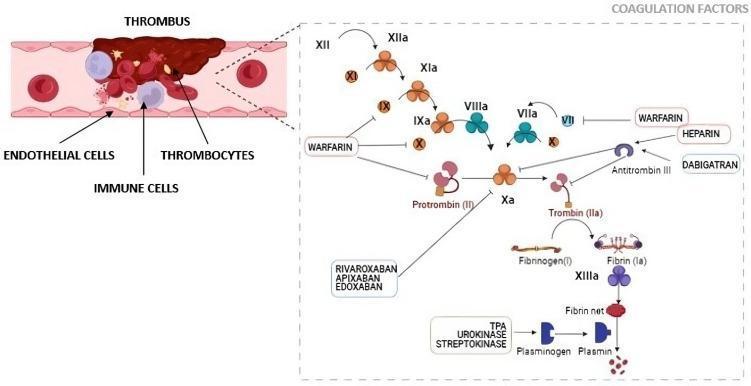
A multi-part medical illustration depicting thrombus formation and the associated coagulation cascade. The left panel shows a cross-section of a blood vessel where a dark thrombus is adhered to the endothelial cell lining. Internal components of the clot are labeled, including erythrocytes, thrombocytes (platelets), and immune cells. The right panel is a detailed signaling pathway diagram of the coagulation cascade. It illustrates the stepwise activation of factors XII, XI, IX, and VIII leading to the common pathway. Central nodes include the conversion of Prothrombin (II) to Thrombin (IIa) by Factor Xa, and Fibrinogen (I) to a Fibrin (Ia) net stabilized by Factor XIIIa. The diagram also maps pharmacological interventions, showing how Warfarin inhibits factors VII, IX, and X; Heparin and Antithrombin III target Thrombin and Xa; Dabigatran inhibits Thrombin; and Rivaroxaban, Apixaban, and Edoxaban target Factor Xa. The fibrinolytic pathway involving Plasminogen conversion to Plasmin via TPA, Urokinase, and Streptokinase is also shown.
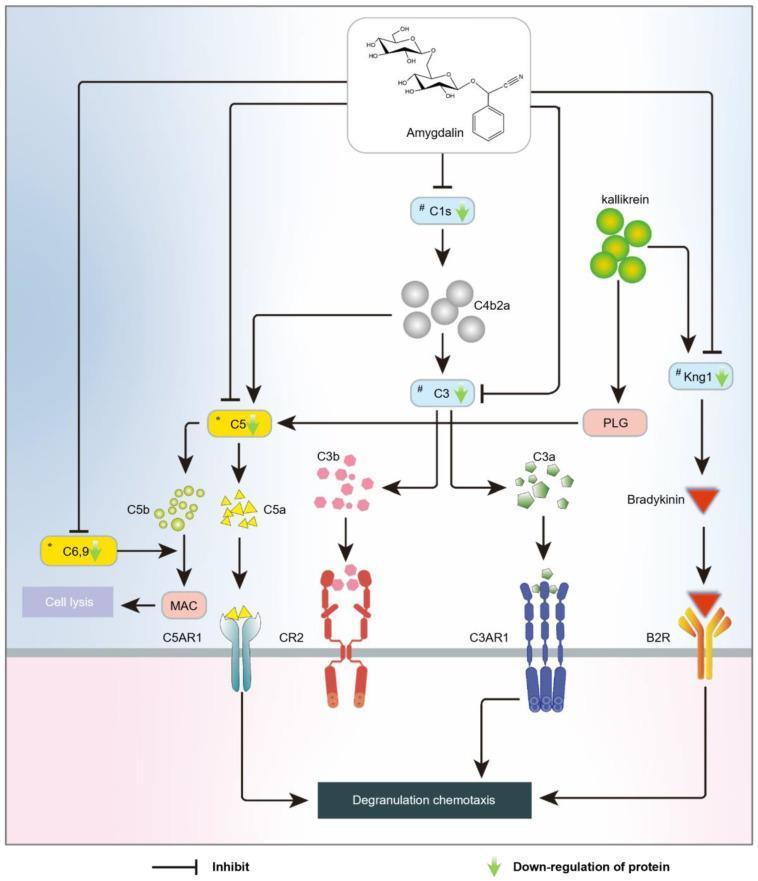
A pathophysiology diagram illustrating the hypothesized mechanism of amygdalin against rheumatoid arthritis (RA) via the modulation of complement and coagulation cascades. The flowchart originates with the chemical structure of amygdalin, which exerts inhibitory effects on key proteins including C1s, C3, and Kng1, indicated by green downward arrows and '#' notation (denoting verification by western blot). The central pathway details the complement cascade where C1s influences the C4b2a complex, leading to C3 activation. Downstream, C3 is cleaved into C3a and C3b, which bind to C3AR1 and CR2 receptors respectively. Simultaneously, the cascade progresses to C5, which yields C5a (binding C5AR1) and C5b. C5b interacts with C6 and C9 to form the Membrane Attack Complex (MAC), ultimately causing cell lysis. On the right, the coagulation-kinin pathway is shown where kallikrein acts on Kng1 to release Bradykinin, which binds to the B2R receptor. These combined receptor-mediated pathways (C5AR1, CR2, C3AR1, and B2R) converge on the cellular endpoint of degranulation chemotaxis. The diagram uses standard notation where blunt-ended lines signify inhibition.
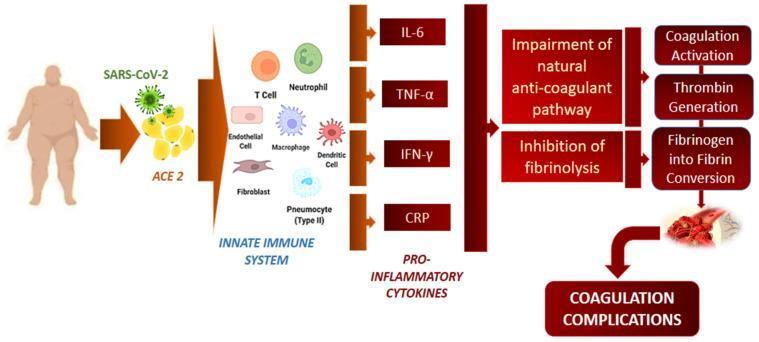
A pathophysiology diagram illustrating the link between SARS-CoV-2 infection, obesity, and coagulation complications. The flow begins with an obese human silhouette, highlighting the interaction between SARS-CoV-2 and ACE2 receptors in adipose tissue. This triggers the 'Innate Immune System,' depicted with icons for T cells, neutrophils, macrophages, endothelial cells, dendritic cells, fibroblasts, and Type II pneumocytes. The pathway leads to the release of 'Pro-Inflammatory Cytokines,' specifically listing IL-6, TNF-α, IFN-γ, and CRP. These cytokines cause two primary downstream effects: the impairment of the natural anti-coagulant pathway and the inhibition of fibrinolysis. This cascade results in a pro-thrombotic state characterized by coagulation activation, thrombin generation, and fibrinogen-to-fibrin conversion. The final outcome is 'Coagulation Complications,' represented by a visual cross-section of a blood vessel containing a thrombus. This diagram is designed for medical education regarding COVID-19-associated coagulopathy and the role of chronic inflammation in obese patients.
parietal cell acid secretion diagram
Section B - Short Answer Questions (5 marks each)
6. First-Pass Metabolism and Its Significance
- Gut wall (intestinal mucosa) - enzymes (e.g., CYP3A4, monoamine oxidase, sulfotransferases) in enterocytes metabolize the drug as it is absorbed.
- Gut lumen - bacterial and digestive enzymes may degrade the drug.
- Liver - the major site; the portal vein carries absorbed drug directly to the liver before it enters the systemic circulation, where hepatic microsomal enzymes (CYP450 system) extensively metabolize it.
- Lungs - for some drugs (e.g., propranolol has minor pulmonary extraction).
- Reduced oral bioavailability: Drugs with extensive first-pass metabolism have low oral bioavailability despite complete absorption (e.g., GTN has ~lt;10% oral bioavailability).
- Route selection: Such drugs are given by routes that bypass the portal circulation - sublingual (GTN), transdermal (GTN patches, nitroglycerin, fentanyl), rectal (partial bypass), intravenous, or inhalational - to avoid hepatic destruction.
- Dose adjustment: Oral doses of high first-pass drugs must be much larger than parenteral doses to achieve the same therapeutic effect (e.g., oral morphine dose is roughly 2-3 times the parenteral dose).
- Individual variability: Genetic polymorphisms in CYP enzymes, liver disease, and enzyme-inducing/inhibiting drugs alter the extent of first-pass metabolism, causing unpredictable oral bioavailability and drug interactions.
- Active metabolite formation: Sometimes first-pass metabolism converts a prodrug into its active form (e.g., enalapril to enalaprilat), which is a favorable consequence.
- Liver disease impact: In hepatic impairment or portosystemic shunting (e.g., cirrhosis), first-pass metabolism is reduced, so oral drugs reach systemic circulation in higher concentration, risking toxicity - dose reduction is needed.
7. Anticoagulants
| Class | Examples | Route |
|---|---|---|
| Parenteral anticoagulants | ||
| - Heparin (unfractionated) | Standard heparin | IV/SC |
| - Low molecular weight heparins (LMWH) | Enoxaparin, dalteparin, tinzaparin | SC |
| - Heparinoid | Danaparoid | SC |
| - Direct thrombin inhibitors | Lepirudin, bivalirudin, argatroban | IV |
| - Factor Xa inhibitor (parenteral) | Fondaparinux | SC |
| Oral anticoagulants | ||
| - Vitamin K antagonists (coumarins) | Warfarin, acitrom | Oral |
| - Direct oral anticoagulants (DOACs) - direct thrombin inhibitor | Dabigatran | Oral |
| - DOACs - direct factor Xa inhibitors | Rivaroxaban, apixaban, edoxaban | Oral |
- Heparin: Binds antithrombin III (ATIII) and accelerates its action ~1000-fold; the heparin-ATIII complex inactivates thrombin (IIa) and factor Xa (and IXa, XIa, XIIa). LMWHs preferentially inhibit factor Xa with less effect on thrombin.
- Warfarin: Inhibits vitamin K epoxide reductase in the liver, blocking the gamma-carboxylation (activation) of vitamin K-dependent clotting factors II, VII, IX, and X, and proteins C and S. Onset is delayed 3-5 days until existing factors are depleted.
- Direct thrombin inhibitors (dabigatran, bivalirudin): Directly bind and inhibit thrombin (factor IIa) without needing antithrombin.
- Direct Xa inhibitors (rivaroxaban, apixaban, fondaparinux): Directly inhibit factor Xa, blocking prothrombin to thrombin conversion.
8. Uses and Adverse Effects of Corticosteroids
- Addison's disease (primary adrenal insufficiency)
- Congenital adrenal hyperplasia
- Panhypopituitarism
- Allergic disorders: Anaphylaxis (adjunct), severe urticaria, angioedema, drug allergy, serum sickness
- Respiratory disease: Bronchial asthma (inhaled/oral), COPD exacerbations, ARDS
- Rheumatic/collagen disorders: Rheumatoid arthritis, SLE, polymyalgia rheumatica, vasculitis
- Skin disorders: Eczema, psoriasis, pemphigus, contact dermatitis (topical/systemic)
- Eye disease: Uveitis, allergic conjunctivitis, optic neuritis
- GI disease: Ulcerative colitis, Crohn's disease
- Hematological disorders: Autoimmune hemolytic anemia, ITP, leukemias/lymphomas (as part of chemotherapy)
- Renal disease: Nephrotic syndrome (minimal change disease)
- Transplant rejection: Prevention/treatment of organ transplant rejection
- Cerebral edema: Especially due to tumors (dexamethasone preferred - less mineralocorticoid activity)
- Infections: Adjunct in tuberculous meningitis, Pneumocystis pneumonia with HIV, septic shock, severe COVID-19 pneumonia
- Fetal lung maturation: Antenatal betamethasone/dexamethasone in preterm labor to prevent respiratory distress syndrome
- Diagnostic use: Dexamethasone suppression test for Cushing's syndrome
- Metabolic: Hyperglycemia/steroid-induced diabetes, protein catabolism (muscle wasting, myopathy), redistribution of fat (moon face, buffalo hump, truncal obesity) - Cushingoid appearance
- Musculoskeletal: Osteoporosis, avascular necrosis of femoral head, growth retardation in children
- GI: Peptic ulceration and GI bleeding (especially with NSAIDs), pancreatitis
- CVS: Hypertension, sodium and fluid retention (mineralocorticoid effect), hypokalemia
- Endocrine: Hypothalamic-pituitary-adrenal (HPA) axis suppression leading to adrenal insufficiency on abrupt withdrawal
- Immune: Increased susceptibility to infections (bacterial, viral, fungal, reactivation of TB), delayed wound healing
- CNS: Euphoria, insomnia, psychosis, mood changes
- Ocular: Posterior subcapsular cataract, glaucoma
- Skin: Thinning, striae, acne, delayed wound healing, easy bruising
- Other: Menstrual irregularities
Section C - Long Answer Questions (10 marks each)
9. Classification of Cholinergic Drugs and Pharmacological Actions of Acetylcholine
- Choline esters: Acetylcholine, methacholine, carbachol, bethanechol
- Natural alkaloids: Pilocarpine, muscarine, arecoline
- Reversible:
- Carbamates: Physostigmine, neostigmine, pyridostigmine, rivastigmine
- Acridine: Tacrine
- Others: Edrophonium (short-acting), donepezil, galantamine
- Irreversible:
- Organophosphates: Dyflos, echothiophate, parathion, malathion (insecticides), and nerve agents (sarin, tabun) - all cause irreversible inhibition requiring pralidoxime for reactivation.
- Muscarinic agonists: Muscarine, pilocarpine, bethanechol
- Nicotinic agonists: Nicotine, lobeline (at ganglia and neuromuscular junction)
- Mixed (muscarinic + nicotinic): Acetylcholine, carbachol
- Vasodilation of most blood vessels (via endothelial NO release, M3 receptors) causing fall in blood pressure
- Bradycardia - negative chronotropic effect on SA node (vagal-like action)
- Decreased conduction velocity through AV node (negative dromotropic)
- Decreased force of contraction (negative inotropic) mainly in atria
- GI tract: Increased tone, motility, and secretions; relaxation of sphincters - causing colic, diarrhea
- Urinary bladder: Contraction of detrusor muscle, relaxation of trigone/sphincter - promotes micturition
- Bronchi: Bronchoconstriction and increased bronchial secretions
- Eye: Contraction of sphincter pupillae (miosis) and ciliary muscle (accommodation for near vision, facilitates aqueous outflow - lowers IOP)
- Ganglionic stimulation (both sympathetic and parasympathetic ganglia) - complex, mixed effects
- Neuromuscular junction: Stimulates skeletal muscle contraction (Nm receptors) - at high doses can cause depolarization blockade
- CNS: Stimulation (does not cross BBB well when given peripherally, but centrally active nicotinic/muscarinic effects seen with direct CNS administration) - arousal, tremor
10. Classification of Antiepileptic Drugs and Pharmacology of Phenytoin
- Sodium channel blockers: Phenytoin, carbamazepine, oxcarbazepine, lamotrigine, valproate (mixed), topiramate (mixed)
- GABA enhancers:
- Enhance GABA-A receptor/chloride channel: Benzodiazepines (diazepam, clonazepam, clobazam), barbiturates (phenobarbitone)
- Inhibit GABA transaminase (increase GABA levels): Vigabatrin, valproate (partial)
- Inhibit GABA reuptake: Tiagabine
- Calcium channel blockers (T-type): Ethosuximide, valproate
- Glutamate (NMDA/AMPA) antagonists: Topiramate, felbamate, perampanel
- Drugs with multiple/unclear mechanisms: Valproate, topiramate, levetiracetam (binds synaptic vesicle protein SV2A), gabapentin, pregabalin (bind alpha-2-delta subunit of Ca channels)
- Generalized tonic-clonic seizures: Phenytoin, carbamazepine, valproate, phenobarbitone
- Absence seizures: Ethosuximide, valproate, lamotrigine (carbamazepine and phenytoin can worsen absence seizures)
- Partial (focal) seizures: Carbamazepine, phenytoin, oxcarbazepine, levetiracetam
- Myoclonic seizures: Valproate, clonazepam, levetiracetam
- Status epilepticus: IV diazepam/lorazepam (first line), followed by IV phenytoin/fosphenytoin, then phenobarbitone or general anesthesia
- Well absorbed orally (absorption can be erratic); highly protein bound (~90%)
- Metabolized in liver by CYP2C9/CYP2C19 to inactive metabolites (para-hydroxyphenytoin)
- Exhibits zero-order (saturation) kinetics at therapeutic doses - small dose increments can cause disproportionate rise in plasma levels, making it a drug requiring careful monitoring
- Narrow therapeutic index (therapeutic range 10-20 mcg/mL)
- Potent hepatic enzyme inducer (CYP450) - many drug interactions
- Generalized tonic-clonic (grand mal) seizures
- Partial (focal) seizures
- Status epilepticus (IV/fosphenytoin)
- Trigeminal neuralgia (second-line)
- Cardiac arrhythmias (digitalis-induced ventricular arrhythmias - class IB antiarrhythmic action)
- Dose-related/CNS: Nystagmus, ataxia, diplopia, sedation, vertigo (early signs of toxicity)
- Gum hyperplasia (gingival hyperplasia) - characteristic, seen especially in children/young patients
- Hirsutism, coarsening of facial features
- Megaloblastic anemia (interferes with folate absorption/metabolism)
- Osteomalacia (interferes with vitamin D metabolism, long term use)
- Hepatotoxicity
- Hypersensitivity: Skin rash, Stevens-Johnson syndrome (associated with HLA-B*1502 in some populations)
- Teratogenicity: "Fetal hydantoin syndrome" (cleft lip/palate, microcephaly, mental retardation) - contraindicated/used cautiously in pregnancy
- Cardiovascular: IV phenytoin - hypotension, arrhythmia if given too fast (should be given slowly, not exceeding 50 mg/min)
- Lymphadenopathy (pseudolymphoma)
11. Classification of Antiulcer Drugs and Mechanism of Action & Uses of Proton Pump Inhibitors
- H2 receptor antagonists: Cimetidine, ranitidine, famotidine, roxatidine
- Proton pump inhibitors (PPIs): Omeprazole, pantoprazole, lansoprazole, rabeprazole, esomeprazole, dexlansoprazole
- Anticholinergics (antimuscarinic): Pirenzepine, propantheline (largely obsolete due to side effects)
- Prostaglandin analogue: Misoprostol (also cytoprotective)
- Systemic: Sodium bicarbonate
- Non-systemic: Magnesium hydroxide, magnesium trisilicate, aluminium hydroxide, calcium carbonate
- Sucralfate
- Colloidal bismuth compounds (bismuth subsalicylate/CBS)
- Misoprostol (prostaglandin E1 analogue - increases mucus/bicarbonate secretion, reduces acid)
- Amoxicillin, clarithromycin, metronidazole, tetracycline, bismuth subsalicylate - given as triple/quadruple therapy along with a PPI
- Given as enteric-coated formulations (acid-labile) or as prodrugs
- Best taken 30-60 minutes before meals (need active pumps stimulated by food for maximal activation and binding)
- Metabolized by CYP2C19 and CYP3A4 - drug interactions (e.g., reduced clopidogrel activation with omeprazole)
- Peptic ulcer disease (gastric and duodenal ulcers) - healing and maintenance
- Gastroesophageal reflux disease (GERD) - most effective drug class
- H. pylori eradication - as part of triple therapy (PPI + 2 antibiotics)
- Zollinger-Ellison syndrome - high-dose PPIs to control severe hyperacidity from gastrinoma
- NSAID-induced ulcer prevention - prophylaxis in patients on chronic NSAID/aspirin therapy
- Stress ulcer prophylaxis - in critically ill/ICU patients
- Barrett's esophagus - long-term acid suppression
- Upper GI bleeding - IV PPI reduces rebleeding risk after endoscopic hemostasis (e.g., in bleeding peptic ulcer)