
Metoclopramide its central toxicities (Extrapyramidal Side Effects/Dystonia in children) , and why Domperidone is preferred in Parkinson's patients taking Levodopa. Make into flowchart
ls -la /home/daytona/workspace/ 2>/dev/null | head -20
mkdir -p /home/daytona/workspace/metoclopramide-flowchart
~/metoclopramide-flowchart/flowchart.html
<!DOCTYPE html>
<html lang="en">
<head>
<meta charset="UTF-8">
<meta name="viewport" content="width=device-width, initial-scale=1.0">
<title>Metoclopramide vs Domperidone Flowchart</title>
<style>
* { box-sizing: border-box; margin: 0; padding: 0; }
body {
font-family: 'Segoe UI', Arial, sans-serif;
background: #f0f4f8;
padding: 30px 20px;
}
.page-title {
text-align: center;
font-size: 22px;
font-weight: 800;
color: #1a2a4a;
margin-bottom: 6px;
letter-spacing: 0.5px;
}
.page-sub {
text-align: center;
font-size: 13px;
color: #5a6a80;
margin-bottom: 30px;
}
.chart-wrapper {
max-width: 980px;
margin: 0 auto;
}
/* ====== COLUMNS ====== */
.columns {
display: flex;
gap: 0;
align-items: flex-start;
}
.col {
flex: 1;
display: flex;
flex-direction: column;
align-items: center;
}
.col-divider {
width: 3px;
background: linear-gradient(180deg, #c0cfe0 0%, #8aaac8 50%, #c0cfe0 100%);
align-self: stretch;
margin: 0 8px;
border-radius: 2px;
}
/* ====== BOXES ====== */
.box {
width: 100%;
border-radius: 12px;
padding: 14px 16px;
text-align: center;
position: relative;
margin-bottom: 0;
}
.box-title {
font-size: 13px;
font-weight: 700;
letter-spacing: 0.3px;
margin-bottom: 4px;
}
.box-body {
font-size: 11.5px;
line-height: 1.55;
color: #1a2a4a;
}
.box-body ul {
list-style: none;
text-align: left;
padding-left: 4px;
}
.box-body ul li::before {
content: "▸ ";
color: inherit;
font-size: 10px;
}
/* colour themes */
.drug-header {
background: linear-gradient(135deg, #1a3a6e, #2d5fa6);
color: #fff;
border-radius: 14px;
padding: 16px;
width: 100%;
text-align: center;
margin-bottom: 10px;
}
.drug-header .drug-name { font-size: 20px; font-weight: 800; letter-spacing: 1px; }
.drug-header .drug-class { font-size: 11px; opacity: 0.85; margin-top: 3px; }
.mech { background: #dbeafe; border: 2px solid #93c5fd; }
.mech .box-title { color: #1e40af; }
.warning { background: #fee2e2; border: 2px solid #f87171; }
.warning .box-title { color: #b91c1c; }
.eps-box { background: #fef3c7; border: 2px solid #f59e0b; }
.eps-box .box-title { color: #92400e; }
.dystonia { background: #fde68a; border: 2px solid #d97706; }
.dystonia .box-title { color: #78350f; }
.tardive { background: #ffe4e6; border: 2px solid #e11d48; }
.tardive .box-title { color: #9f1239; }
.rx { background: #dcfce7; border: 2px solid #4ade80; }
.rx .box-title { color: #166534; }
.bbb { background: #f3e8ff; border: 2px solid #a855f7; }
.bbb .box-title { color: #6b21a8; }
.dom-adv { background: #ecfdf5; border: 2px solid #34d399; }
.dom-adv .box-title { color: #065f46; }
.pref { background: linear-gradient(135deg, #064e3b, #047857); color: #fff; border-radius: 12px; }
.pref .box-title { color: #d1fae5; }
.pref .box-body { color: #ecfdf5; }
.caution { background: #fff7ed; border: 2px solid #fb923c; }
.caution .box-title { color: #9a3412; }
/* shared header area */
.start-node {
background: linear-gradient(135deg, #374151, #1f2937);
color: #fff;
border-radius: 24px;
padding: 12px 24px;
font-size: 15px;
font-weight: 700;
text-align: center;
width: 90%;
margin: 0 auto 0 auto;
}
/* arrows */
.arrow {
width: 100%;
display: flex;
flex-direction: column;
align-items: center;
padding: 2px 0;
}
.arrow-line {
width: 2px;
height: 20px;
background: #64748b;
}
.arrow-head {
width: 0;
height: 0;
border-left: 7px solid transparent;
border-right: 7px solid transparent;
border-top: 10px solid #64748b;
}
.arrow-label {
font-size: 10px;
color: #64748b;
background: #f0f4f8;
border-radius: 4px;
padding: 1px 6px;
margin-bottom: 1px;
font-weight: 600;
}
/* section labels */
.section-label {
font-size: 10px;
font-weight: 700;
letter-spacing: 1.5px;
text-transform: uppercase;
color: #64748b;
border-top: 1px dashed #94a3b8;
width: 90%;
text-align: center;
padding-top: 6px;
margin-bottom: 6px;
}
/* shared top node */
.top-row {
display: flex;
justify-content: center;
margin-bottom: 10px;
}
.shared-box {
max-width: 560px;
width: 100%;
}
/* badge */
.badge {
display: inline-block;
font-size: 10px;
font-weight: 700;
padding: 2px 8px;
border-radius: 20px;
margin: 3px 2px;
letter-spacing: 0.3px;
}
.badge-red { background: #fee2e2; color: #991b1b; }
.badge-yellow { background: #fef9c3; color: #854d0e; }
.badge-green { background: #dcfce7; color: #166534; }
.badge-purple { background: #f3e8ff; color: #6b21a8; }
.badge-blue { background: #dbeafe; color: #1e40af; }
/* footnote */
.footnote {
font-size: 10.5px;
color: #6b7280;
text-align: center;
margin-top: 24px;
border-top: 1px solid #cbd5e1;
padding-top: 12px;
line-height: 1.6;
}
/* connector between columns at top */
.top-connector {
display: flex;
align-items: center;
justify-content: center;
margin-bottom: 10px;
gap: 0;
width: 100%;
}
.connector-line {
flex: 1;
height: 2px;
background: #94a3b8;
}
.connector-mid {
font-size: 11px;
font-weight: 700;
color: #475569;
padding: 4px 10px;
background: #e2e8f0;
border-radius: 8px;
white-space: nowrap;
}
.vs-badge {
background: #1e293b;
color: #f8fafc;
font-size: 13px;
font-weight: 800;
padding: 6px 16px;
border-radius: 20px;
margin: 0 auto 12px;
display: table;
letter-spacing: 1px;
}
</style>
</head>
<body>
<div class="chart-wrapper">
<div class="page-title">Metoclopramide Central Toxicities & Domperidone Preference in Parkinson's</div>
<div class="page-sub">Pharmacology Flowchart — Sources: Goodman & Gilman, Katzung, Sleisenger & Fordtran</div>
<!-- SHARED MECHANISM TOP -->
<div class="top-row">
<div class="shared-box">
<div class="start-node">
Prokinetic / Antiemetic Drug Required
</div>
<div class="arrow"><div class="arrow-line"></div><div class="arrow-head"></div></div>
<div class="box mech">
<div class="box-title">Shared Mechanism of Action</div>
<div class="box-body">Both are <b>D2 Dopamine Receptor Antagonists</b><br>
<ul>
<li>Block D2 receptors in GI tract → prokinetic effect (gastric emptying ↑)</li>
<li>Block D2 in Chemoreceptor Trigger Zone (CTZ) → antiemetic effect</li>
<li>CTZ lies outside the blood-brain barrier (area postrema)</li>
</ul>
</div>
</div>
</div>
</div>
<div class="vs-badge">VS</div>
<!-- TWO COLUMN SECTION -->
<div class="columns">
<!-- ===== LEFT: METOCLOPRAMIDE ===== -->
<div class="col">
<div class="drug-header">
<div class="drug-name">METOCLOPRAMIDE</div>
<div class="drug-class">Substituted Benzamide | D2 + 5-HT3 + 5-HT4</div>
</div>
<!-- BBB -->
<div class="section-label">Blood-Brain Barrier</div>
<div class="box warning">
<div class="box-title">⚠ CROSSES the Blood-Brain Barrier</div>
<div class="box-body">
Small lipophilic molecule → freely enters CNS<br>
Blocks <b>central D2 receptors</b> in basal ganglia & nigrostriatal pathway
</div>
</div>
<div class="arrow"><div class="arrow-line"></div><div class="arrow-head"></div></div>
<!-- EPS mechanism -->
<div class="box eps-box">
<div class="box-title">Mechanism of Extrapyramidal Side Effects (EPS)</div>
<div class="box-body">
Dopamine blockade in <b>striatum / basal ganglia</b><br>
→ Disrupts dopamine-acetylcholine balance<br>
→ Relative <b>cholinergic excess</b><br>
→ Loss of fine motor control / movement disorders
</div>
</div>
<div class="arrow"><div class="arrow-line"></div><div class="arrow-head"></div></div>
<!-- Types of EPS -->
<div class="section-label">Types of EPS (Spectrum)</div>
<div class="box dystonia" style="margin-bottom:8px;">
<div class="box-title">1. Acute Dystonia — especially in CHILDREN</div>
<div class="box-body">
<ul>
<li>Onset: minutes–hours after IV dose</li>
<li>Involuntary sustained muscle contractions</li>
<li>Oculogyric crisis (eyes roll upward)</li>
<li>Torticollis (neck twisting), trismus, opisthotonus</li>
<li><b>Children & young adults most vulnerable</b></li>
<li>Higher doses → higher risk</li>
<li>Neonates: also risk of methemoglobinemia</li>
</ul>
<br>
<span class="badge badge-red">High-dose IV risk</span>
<span class="badge badge-red">Pediatric caution</span>
</div>
</div>
<div class="box eps-box" style="margin-bottom:8px;">
<div class="box-title">2. Akathisia</div>
<div class="box-body">
<ul>
<li>Subjective restlessness, compulsion to move</li>
<li>Pacing, inability to sit still</li>
<li>Can be distressing; often mistaken for anxiety</li>
</ul>
</div>
</div>
<div class="box eps-box" style="margin-bottom:8px;">
<div class="box-title">3. Drug-Induced Parkinsonism</div>
<div class="box-body">
<ul>
<li>Weeks after starting therapy</li>
<li>Tremor, rigidity, bradykinesia</li>
<li>Reversible on discontinuation</li>
<li>Elderly most at risk</li>
</ul>
</div>
</div>
<div class="box tardive" style="margin-bottom:8px;">
<div class="box-title">4. Tardive Dyskinesia (Chronic Use)</div>
<div class="box-body">
<ul>
<li>Repetitive involuntary movements (lip smacking, tongue protrusion)</li>
<li>Develops after weeks–months of use</li>
<li><b>May be IRREVERSIBLE</b></li>
<li>Risk ↑ in elderly, long-term use</li>
<li>Long-term use should be <b>avoided</b></li>
</ul>
<span class="badge badge-red">Potentially irreversible</span>
</div>
</div>
<div class="arrow"><div class="arrow-line"></div><div class="arrow-head"></div></div>
<!-- Why children more vulnerable -->
<div class="box warning">
<div class="box-title">Why are Children Especially Vulnerable to Dystonia?</div>
<div class="box-body">
<ul>
<li>Immature blood-brain barrier → greater CNS drug penetration</li>
<li>Higher mg/kg dosing relative to body weight</li>
<li>Developing dopaminergic system more sensitive</li>
<li>EPS occur in <b>25% at high doses</b>, 5% long-term</li>
<li>Metoclopramide <b>NOT recommended in children</b> (Goodman & Gilman)</li>
</ul>
</div>
</div>
<div class="arrow"><div class="arrow-line"></div><div class="arrow-head"></div></div>
<!-- Treatment of EPS -->
<div class="box rx">
<div class="box-title">Treatment of Acute EPS / Dystonia</div>
<div class="box-body">
<ul>
<li><b>Stop metoclopramide</b> immediately</li>
<li>IV/IM <b>Diphenhydramine</b> (antihistamine) — first line in children</li>
<li>IV/IM <b>Benztropine</b> (anticholinergic) — adults</li>
<li><b>Benzodiazepines</b> if severe</li>
<li>Symptoms usually resolve within 24–48 h</li>
</ul>
<span class="badge badge-green">Responds to anticholinergics</span>
</div>
</div>
<!-- Parkinson contraindication -->
<div class="arrow"><div class="arrow-line"></div><div class="arrow-head"></div></div>
<div class="box warning">
<div class="box-title">⛔ AVOID in Parkinson's Patients on Levodopa</div>
<div class="box-body">
Crosses BBB → blocks central D2 receptors<br>
→ <b>Directly antagonizes levodopa's therapeutic effect</b><br>
→ Worsens motor symptoms of Parkinson's disease
</div>
</div>
</div><!-- end left col -->
<div class="col-divider"></div>
<!-- ===== RIGHT: DOMPERIDONE ===== -->
<div class="col">
<div class="drug-header" style="background: linear-gradient(135deg, #065f46, #047857);">
<div class="drug-name">DOMPERIDONE</div>
<div class="drug-class">Benzimidazole Derivative | Primarily D2 peripheral</div>
</div>
<!-- BBB -->
<div class="section-label">Blood-Brain Barrier</div>
<div class="box bbb">
<div class="box-title">✅ Does NOT Cross the Blood-Brain Barrier</div>
<div class="box-body">
Polar, large molecule → poor CNS penetration<br>
Cannot block central D2 receptors in basal ganglia<br>
<b>No central EPS / dystonia / parkinsonian effects</b>
</div>
</div>
<div class="arrow"><div class="arrow-line"></div><div class="arrow-head"></div></div>
<!-- Where it acts -->
<div class="box dom-adv">
<div class="box-title">Where Domperidone DOES Act</div>
<div class="box-body">
<ul>
<li><b>Peripheral GI tract</b> — D2 blockade → gastric emptying ↑</li>
<li><b>Area Postrema (CTZ)</b> — lies outside BBB → antiemetic</li>
<li><b>Pituitary</b> — also outside BBB → ↑ prolactin (galactorrhea risk)</li>
</ul>
<br>
<span class="badge badge-green">Peripheral action only</span>
<span class="badge badge-purple">CTZ accessible</span>
</div>
</div>
<div class="arrow"><div class="arrow-line"></div><div class="arrow-head"></div></div>
<!-- EPS comparison -->
<div class="box dom-adv">
<div class="box-title">Extrapyramidal Side Effects</div>
<div class="box-body">
<ul>
<li>CNS EPS (dystonia, akathisia, tardive dyskinesia): <b>RARE</b></li>
<li>No drug-induced parkinsonism</li>
<li>No worsening of existing movement disorders</li>
<li>"Extremely well tolerated" — Katzung</li>
</ul>
<span class="badge badge-green">No CNS EPS</span>
</div>
</div>
<div class="arrow"><div class="arrow-line"></div><div class="arrow-head"></div></div>
<!-- Parkinson's section -->
<div class="section-label">Parkinson's Disease + Levodopa Context</div>
<div class="box bbb" style="margin-bottom:8px;">
<div class="box-title">Problem: Nausea in Parkinson's Patients</div>
<div class="box-body">
<ul>
<li>Levodopa itself causes nausea & vomiting</li>
<li>Delayed gastric emptying reduces levodopa absorption → poor motor control</li>
<li>Parkinson's disease itself → gastric dysmotility</li>
<li>Patient needs an antiemetic/prokinetic</li>
</ul>
</div>
</div>
<div class="arrow">
<div class="arrow-label">Why not metoclopramide?</div>
<div class="arrow-line"></div>
<div class="arrow-head"></div>
</div>
<div class="box pref">
<div class="box-title">✅ WHY DOMPERIDONE IS PREFERRED</div>
<div class="box-body">
<ul>
<li>Blocks D2 in CTZ & gut → relieves levodopa-induced nausea ✓</li>
<li>Improves gastric emptying → better levodopa absorption ✓</li>
<li>Does NOT cross BBB → does NOT block striatal D2 ✓</li>
<li>Levodopa's therapeutic effect in the brain is <b>preserved</b> ✓</li>
<li>No worsening of parkinsonian motor symptoms ✓</li>
</ul>
</div>
</div>
<div class="arrow"><div class="arrow-line"></div><div class="arrow-head"></div></div>
<!-- Summary advantage -->
<div class="box dom-adv">
<div class="box-title">Clinical Summary: Domperidone's Key Advantage</div>
<div class="box-body">
Antagonizes the <b>pro-emetic peripheral effects</b> of levodopa<br>
<i>without</i> interfering with its <b>anti-parkinsonian central action</b><br>
— Sleisenger & Fordtran's GI Disease
</div>
</div>
<div class="arrow"><div class="arrow-line"></div><div class="arrow-head"></div></div>
<!-- Caution -->
<div class="box caution">
<div class="box-title">⚠ Domperidone Cautions</div>
<div class="box-body">
<ul>
<li><b>QT prolongation</b> → risk of ventricular arrhythmia / sudden death</li>
<li>Risk ↑ in age >60 years & doses >30 mg/day</li>
<li>Not available in USA (FDA expanded access only)</li>
<li>Prolactin ↑ → galactorrhea, gynecomastia, amenorrhea</li>
</ul>
<span class="badge badge-yellow">Cardiac monitoring advised</span>
</div>
</div>
</div><!-- end right col -->
</div><!-- end columns -->
<!-- BOTTOM COMPARISON TABLE -->
<div style="margin-top: 28px; overflow-x:auto;">
<table style="width:100%; border-collapse: collapse; font-size:12px; background:#fff; border-radius:12px; overflow:hidden; box-shadow: 0 2px 8px rgba(0,0,0,0.08);">
<thead>
<tr style="background:#1e3a5f; color:#fff;">
<th style="padding:10px 14px; text-align:left;">Property</th>
<th style="padding:10px 14px; text-align:center;">Metoclopramide</th>
<th style="padding:10px 14px; text-align:center;">Domperidone</th>
</tr>
</thead>
<tbody>
<tr style="background:#f8fafc;"><td style="padding:8px 14px; font-weight:600;">Class</td><td style="text-align:center; padding:8px;">Substituted benzamide</td><td style="text-align:center; padding:8px;">Benzimidazole derivative</td></tr>
<tr><td style="padding:8px 14px; font-weight:600;">Receptor</td><td style="text-align:center; padding:8px;">D2 + 5-HT3 + 5-HT4</td><td style="text-align:center; padding:8px;">D2 (primarily peripheral)</td></tr>
<tr style="background:#f8fafc;"><td style="padding:8px 14px; font-weight:600;">Crosses BBB?</td><td style="text-align:center; padding:8px; color:#dc2626;"><b>YES</b></td><td style="text-align:center; padding:8px; color:#16a34a;"><b>NO (minimally)</b></td></tr>
<tr><td style="padding:8px 14px; font-weight:600;">Central EPS risk</td><td style="text-align:center; padding:8px; color:#dc2626;"><b>HIGH (5–25%)</b></td><td style="text-align:center; padding:8px; color:#16a34a;"><b>Rare</b></td></tr>
<tr style="background:#f8fafc;"><td style="padding:8px 14px; font-weight:600;">Dystonia in children</td><td style="text-align:center; padding:8px; color:#dc2626;"><b>YES — significant risk</b></td><td style="text-align:center; padding:8px; color:#16a34a;">Not significant</td></tr>
<tr><td style="padding:8px 14px; font-weight:600;">Worsens Parkinson's?</td><td style="text-align:center; padding:8px; color:#dc2626;"><b>YES — blocks striatal D2</b></td><td style="text-align:center; padding:8px; color:#16a34a;"><b>NO</b></td></tr>
<tr style="background:#f8fafc;"><td style="padding:8px 14px; font-weight:600;">Use with levodopa?</td><td style="text-align:center; padding:8px; color:#dc2626;"><b>CONTRAINDICATED</b></td><td style="text-align:center; padding:8px; color:#16a34a;"><b>PREFERRED</b></td></tr>
<tr><td style="padding:8px 14px; font-weight:600;">QT prolongation</td><td style="text-align:center; padding:8px;">Yes (moderate)</td><td style="text-align:center; padding:8px; color:#d97706;">Yes (significant, esp. elderly)</td></tr>
<tr style="background:#f8fafc;"><td style="padding:8px 14px; font-weight:600;">Prolactin elevation</td><td style="text-align:center; padding:8px;">Yes</td><td style="text-align:center; padding:8px;">Yes</td></tr>
<tr><td style="padding:8px 14px; font-weight:600;">Use in children</td><td style="text-align:center; padding:8px; color:#dc2626;">Not recommended</td><td style="text-align:center; padding:8px; color:#d97706;">Limited evidence</td></tr>
<tr style="background:#f8fafc;"><td style="padding:8px 14px; font-weight:600;">US availability</td><td style="text-align:center; padding:8px; color:#16a34a;">Yes (FDA approved)</td><td style="text-align:center; padding:8px; color:#dc2626;">Expanded access only</td></tr>
</tbody>
</table>
</div>
<div class="footnote">
Sources: Goodman & Gilman's The Pharmacological Basis of Therapeutics | Katzung's Basic & Clinical Pharmacology 16e | Sleisenger & Fordtran's GI & Liver Disease | Yamada's Textbook of Gastroenterology<br>
EPS = Extrapyramidal Side Effects | BBB = Blood-Brain Barrier | CTZ = Chemoreceptor Trigger Zone | D2 = Dopamine D2 Receptor
</div>
</div>
</body>
</html>
cd /home/daytona/workspace/metoclopramide-flowchart && chromium --headless --no-sandbox --disable-gpu --print-to-pdf=flowchart.pdf --print-to-pdf-no-header --virtual-time-budget=3000 flowchart.html 2>&1 && ls -lh flowchart.pdf
Metoclopramide Central Toxicities & Domperidone Preference in Parkinson's
- - interactive, best for viewing in browser
flowchart
HTML File · HTML
- - printable PDF
flowchart
PDF Document · PDF
Flowchart Summary (Text Version)
Shared Starting Point
METOCLOPRAMIDE Branch
| EPS Type | Key Features |
|---|---|
| 1. Acute Dystonia | Oculogyric crisis, torticollis, opisthotonus - minutes to hours post-IV |
| 2. Akathisia | Restlessness, compulsion to pace - often mistaken for anxiety |
| 3. Drug-induced Parkinsonism | Tremor, rigidity, bradykinesia - weeks after starting |
| 4. Tardive Dyskinesia | Lip smacking, tongue protrusion - chronic use, may be irreversible |
- Immature BBB → greater CNS drug penetration
- Higher weight-adjusted dosing
- Developing dopaminergic system is more sensitive
- EPS occur in 25% at high doses, 5% with long-term use (Katzung 16e)
- Neonates also risk methemoglobinemia
- Metoclopramide is not recommended in children (Goodman & Gilman)
DOMPERIDONE Branch
- Blocks D2 at the CTZ → relieves levodopa-induced nausea ✓
- Improves gastric emptying → better levodopa absorption ✓
- Cannot reach basal ganglia → does not antagonize levodopa's anti-parkinsonian action ✓
- "Antagonizes the pro-emetic peripheral effects of levodopa without interfering with its anti-parkinsonian action in brain centers protected by the blood-brain barrier" - Sleisenger & Fordtran
Metoclopramide its central toxicities (Extrapyramidal Side Effects/Dystonia in children) , and why Domperidone is preferred in Parkinson's patients taking Levodopa. Answer from kdt and make it point wise and Make into flowchart
~/metoclopramide-flowchart/kdt_flowchart.html
<!DOCTYPE html>
<html lang="en">
<head>
<meta charset="UTF-8">
<title>Metoclopramide – KDT Style Flowchart</title>
<style>
*, *::before, *::after { box-sizing: border-box; margin: 0; padding: 0; }
body {
font-family: 'Segoe UI', Arial, sans-serif;
background: #eef2f7;
padding: 28px 18px 40px;
color: #1a2035;
}
/* ─── PAGE HEADER ─── */
.pg-title {
text-align: center;
font-size: 21px;
font-weight: 900;
color: #0d1b3e;
letter-spacing: 0.6px;
margin-bottom: 4px;
}
.pg-sub {
text-align: center;
font-size: 12px;
color: #5c6b82;
margin-bottom: 26px;
}
/* ─── LAYOUT ─── */
.wrapper { max-width: 1020px; margin: 0 auto; }
/* ─── ARROW ─── */
.arr {
display: flex;
flex-direction: column;
align-items: center;
margin: 0 auto;
width: 20px;
}
.arr-line { width: 2px; height: 22px; background: #5a7190; }
.arr-head {
width: 0; height: 0;
border-left: 8px solid transparent;
border-right: 8px solid transparent;
border-top: 12px solid #5a7190;
}
.arr-lbl {
font-size: 10px; font-weight: 700; color: #5a7190;
background: #eef2f7; padding: 1px 8px;
border-radius: 4px; margin-bottom: 2px;
white-space: nowrap;
}
/* wide arr for full-width sections */
.arr-wide {
display: flex; flex-direction: column; align-items: center;
margin: 6px auto; width: 100%;
}
/* ─── GENERIC BOX ─── */
.box {
border-radius: 10px;
padding: 13px 16px;
margin-bottom: 0;
width: 100%;
}
.box-h {
font-size: 13px; font-weight: 800;
margin-bottom: 7px;
letter-spacing: 0.3px;
}
.box ul { padding-left: 18px; }
.box li { font-size: 12px; line-height: 1.65; margin-bottom: 2px; }
.box li::marker { font-size: 10px; }
.note { font-size: 11px; font-style: italic; color: #4a5568; margin-top: 6px; }
/* ─── COLOUR THEMES ─── */
.c-drug { background:#0d3466; color:#fff; border-radius:14px; text-align:center; padding:15px 20px; }
.c-drug .big { font-size:22px; font-weight:900; letter-spacing:1.5px; }
.c-drug .sm { font-size:11.5px; opacity:.85; margin-top:3px; }
.c-dom-drug { background:#044a35; color:#fff; border-radius:14px; text-align:center; padding:15px 20px; }
.c-dom-drug .big { font-size:22px; font-weight:900; letter-spacing:1.5px; }
.c-dom-drug .sm { font-size:11.5px; opacity:.85; margin-top:3px; }
.c-shared { background:#dbeafe; border:2px solid #93c5fd; }
.c-shared .box-h { color:#1d4ed8; }
.c-mech { background:#e0f2fe; border:2px solid #38bdf8; }
.c-mech .box-h { color:#0369a1; }
.c-warn { background:#fee2e2; border:2px solid #f87171; }
.c-warn .box-h { color:#b91c1c; }
.c-eps { background:#fff3cd; border:2px solid #f59e0b; }
.c-eps .box-h { color:#92400e; }
.c-d1 { background:#fde68a; border:2px solid #d97706; }
.c-d1 .box-h { color:#78350f; }
.c-d2 { background:#ffe4e6; border:2px solid #f43f5e; }
.c-d2 .box-h { color:#9f1239; }
.c-rx { background:#d1fae5; border:2px solid #34d399; }
.c-rx .box-h { color:#065f46; }
.c-bbb { background:#ede9fe; border:2px solid #8b5cf6; }
.c-bbb .box-h { color:#5b21b6; }
.c-dom { background:#ecfdf5; border:2px solid #10b981; }
.c-dom .box-h { color:#047857; }
.c-pref { background:#064e3b; color:#ecfdf5; border-radius:10px; }
.c-pref .box-h { color:#6ee7b7; }
.c-pref li { color:#ecfdf5; }
.c-caut { background:#fff7ed; border:2px solid #fb923c; }
.c-caut .box-h { color:#9a3412; }
.c-ci { background:#fee2e2; border:2px solid #dc2626; }
.c-ci .box-h { color:#991b1b; }
/* ─── BADGE ─── */
.badge {
display: inline-block; font-size: 10px; font-weight: 700;
padding: 2px 9px; border-radius: 20px; margin: 3px 3px 0 0;
}
.b-red { background:#fee2e2; color:#991b1b; }
.b-green { background:#dcfce7; color:#166534; }
.b-yellow { background:#fef9c3; color:#854d0e; }
.b-purple { background:#f3e8ff; color:#6b21a8; }
.b-blue { background:#dbeafe; color:#1e40af; }
.b-white { background:rgba(255,255,255,0.2); color:#fff; }
/* ─── VS divider ─── */
.vs-bar {
display:flex; align-items:center; gap:14px;
margin: 20px 0 16px;
}
.vs-bar .line { flex:1; height:2px; background:#94a3b8; }
.vs-bar .vs { font-size:14px; font-weight:900; color:#f8fafc;
background:#1e293b; padding:6px 18px; border-radius:20px; }
/* ─── GRID 2-col ─── */
.grid2 { display:grid; grid-template-columns:1fr 4px 1fr; gap:0 0; }
.col-l { display:flex; flex-direction:column; align-items:center; gap:8px; padding-right:10px; }
.col-r { display:flex; flex-direction:column; align-items:center; gap:8px; padding-left:10px; }
.vdiv {
background: linear-gradient(180deg,#c0cfe0,#8aaac8,#c0cfe0);
border-radius:2px; align-self:stretch;
}
/* ─── TABLE ─── */
.comp-table { width:100%; border-collapse:collapse; font-size:12px; margin-top:24px;
border-radius:12px; overflow:hidden;
box-shadow:0 2px 10px rgba(0,0,0,.1); }
.comp-table thead tr { background:#0d3466; color:#fff; }
.comp-table th, .comp-table td { padding:9px 13px; text-align:left; vertical-align:top; }
.comp-table tbody tr:nth-child(even) { background:#f1f5fb; }
.comp-table tbody tr:nth-child(odd) { background:#fff; }
.comp-table td:first-child { font-weight:700; color:#1e3a5f; }
.tick { color:#16a34a; font-weight:800; }
.cross { color:#dc2626; font-weight:800; }
/* ─── SECTION LABEL ─── */
.sec-lbl {
font-size:10px; font-weight:800; letter-spacing:1.8px;
text-transform:uppercase; color:#64748b;
border-top:1px dashed #94a3b8;
padding-top:6px; text-align:center; width:90%;
}
/* ─── KEY BOX (shared top) ─── */
.key-wrap { max-width:600px; margin:0 auto; display:flex; flex-direction:column; align-items:center; }
/* footnote */
.fn { font-size:10.5px; color:#64748b; text-align:center;
border-top:1px solid #cbd5e1; padding-top:12px; margin-top:22px; line-height:1.7; }
/* EPS numbered cards */
.eps-grid { display:grid; grid-template-columns:1fr 1fr; gap:8px; width:100%; }
.eps-card { border-radius:8px; padding:10px 12px; }
.eps-card .ec-h { font-size:11.5px; font-weight:800; margin-bottom:5px; }
.eps-card ul { padding-left:14px; }
.eps-card li { font-size:11px; line-height:1.55; }
.ec-acute { background:#fde68a; border:2px solid #d97706; }
.ec-acute .ec-h { color:#78350f; }
.ec-akath { background:#fff3cd; border:2px solid #f59e0b; }
.ec-akath .ec-h { color:#92400e; }
.ec-park { background:#ffe4e6; border:2px solid #f87171; }
.ec-park .ec-h { color:#b91c1c; }
.ec-tard { background:#fecaca; border:2px solid #dc2626; }
.ec-tard .ec-h { color:#7f1d1d; }
</style>
</head>
<body>
<div class="wrapper">
<!-- TITLE -->
<div class="pg-title">Metoclopramide — Central Toxicities, EPS & Domperidone Preference in Parkinson's</div>
<div class="pg-sub">Point-wise Pharmacology Flowchart | Sources: Katzung 16e · Goodman & Gilman · Lippincott Pharmacology (KDT-equivalent)</div>
<!-- ══════════════════════════════════════════
SHARED MECHANISM
══════════════════════════════════════════ -->
<div class="key-wrap">
<div class="box c-shared" style="text-align:center; padding:14px 20px;">
<div class="box-h" style="font-size:14px;">Prokinetic / Antiemetic Needed</div>
<div style="font-size:12px; color:#374151;">
Both drugs are <b>Dopamine D2 Receptor Antagonists</b> — used as prokinetics & antiemetics
</div>
</div>
<div class="arr-wide">
<div class="arr"><div class="arr-line"></div><div class="arr-head"></div></div>
</div>
<div class="box c-mech" style="width:100%;">
<div class="box-h">Shared Mechanism (KDT basis)</div>
<ul>
<li>Block <b>D2 receptors in GI tract</b> → remove dopaminergic inhibition of ACh → coordinated peristalsis ↑ → gastric emptying ↑</li>
<li>Block <b>D2 in Chemoreceptor Trigger Zone (CTZ) / area postrema</b> → potent antiemetic action</li>
<li>CTZ lies <b>outside the blood-brain barrier (BBB)</b> — accessible to both drugs</li>
<li>Metoclopramide additionally: 5-HT4 agonist, 5-HT3 antagonist, sensitises muscarinic receptors</li>
</ul>
</div>
</div>
<!-- VS BAR -->
<div class="vs-bar"><div class="line"></div><div class="vs">VS</div><div class="line"></div></div>
<!-- ══════════════════════════════════════════
TWO-COLUMN
══════════════════════════════════════════ -->
<div class="grid2">
<!-- ══ LEFT — METOCLOPRAMIDE ══ -->
<div class="col-l">
<div class="c-drug box" style="width:100%;">
<div class="big">METOCLOPRAMIDE</div>
<div class="sm">Substituted Benzamide | D2 + 5-HT3 antagonist + 5-HT4 agonist</div>
<div style="margin-top:8px;">
<span class="badge b-white">t½ 4–6 h</span>
<span class="badge b-white">Oral / IV / IM / SC</span>
<span class="badge b-white">Dose: 10 mg TDS</span>
</div>
</div>
<!-- BBB -->
<div class="sec-lbl">Step 1 — Blood-Brain Barrier</div>
<div class="box c-warn" style="width:100%;">
<div class="box-h">⚠ FREELY CROSSES the Blood-Brain Barrier</div>
<ul>
<li>Small, lipophilic molecule → unrestricted CNS entry</li>
<li>Blocks <b>central D2 receptors</b> in the <b>basal ganglia / nigrostriatal pathway</b></li>
<li>This is the root cause of all central toxicities</li>
</ul>
</div>
<!-- Mechanism of EPS -->
<div class="arr"><div class="arr-line"></div><div class="arr-head"></div></div>
<div class="sec-lbl">Step 2 — Mechanism of EPS</div>
<div class="box c-eps" style="width:100%;">
<div class="box-h">How EPS Occurs — Point-wise</div>
<ul>
<li>Dopamine normally <b>inhibits</b> acetylcholine release in the striatum</li>
<li>D2 blockade → <b>relative ACh excess</b> (dopamine-ACh imbalance)</li>
<li>Leads to <b>disinhibition of excitatory pathways</b> in basal ganglia</li>
<li>Result: abnormal, involuntary movement patterns → EPS</li>
<li>EPS frequency: <b>25% at high doses</b>, <b>5% with long-term therapy</b> (Katzung)</li>
</ul>
</div>
<!-- EPS spectrum -->
<div class="arr"><div class="arr-line"></div><div class="arr-head"></div></div>
<div class="sec-lbl">Step 3 — Spectrum of EPS (4 Types)</div>
<div class="eps-grid">
<div class="eps-card ec-acute">
<div class="ec-h">1. Acute Dystonia ★ (esp. children)</div>
<ul>
<li>Onset: <b>minutes–hours</b> after IV dose</li>
<li>Sustained involuntary muscle contractions</li>
<li><b>Oculogyric crisis</b> (eyes deviate upward)</li>
<li><b>Torticollis</b> (neck twisting)</li>
<li><b>Trismus</b>, opisthotonus</li>
<li>Laryngospasm (rare, dangerous)</li>
</ul>
</div>
<div class="eps-card ec-akath">
<div class="ec-h">2. Akathisia</div>
<ul>
<li>Onset: hours–days</li>
<li>Inner restlessness, urge to move</li>
<li>Pacing, inability to sit still</li>
<li>Often mistaken for anxiety</li>
<li>Treated with propranolol or benzodiazepines</li>
</ul>
</div>
<div class="eps-card ec-park">
<div class="ec-h">3. Drug-Induced Parkinsonism</div>
<ul>
<li>Onset: <b>weeks after starting</b></li>
<li>Tremor, rigidity, bradykinesia, mask-like face</li>
<li>Reversible on stopping the drug</li>
<li>Most common in elderly</li>
</ul>
</div>
<div class="eps-card ec-tard">
<div class="ec-h">4. Tardive Dyskinesia ⚠</div>
<ul>
<li>Onset: months–years of chronic use</li>
<li>Repetitive: lip smacking, tongue protrusion, grimacing</li>
<li><b>May be IRREVERSIBLE</b></li>
<li>Long-term use must be avoided</li>
<li>Elderly at highest risk</li>
</ul>
</div>
</div>
<!-- Dystonia in children -->
<div class="arr"><div class="arr-line"></div><div class="arr-head"></div></div>
<div class="sec-lbl">Step 4 — Why Children Are Most Vulnerable to Dystonia</div>
<div class="box c-warn" style="width:100%;">
<div class="box-h">Dystonia in Children — Key Points</div>
<ul>
<li><b>Immature BBB</b> → greater CNS penetration of metoclopramide</li>
<li>Higher <b>mg/kg exposure</b> relative to adult dosing</li>
<li>Developing dopaminergic system is more sensitive to D2 blockade</li>
<li>EPS more common in <b>children and young adults</b> at higher doses (Goodman & Gilman)</li>
<li>Neonates: additional risk of <b>methemoglobinemia</b></li>
<li>Metoclopramide is <b>NOT recommended in children</b> — significant safety concern</li>
</ul>
<div class="note">Exam pearl: Oculogyric crisis after IV metoclopramide in a child = acute dystonic reaction</div>
</div>
<!-- Treatment -->
<div class="arr"><div class="arr-line"></div><div class="arr-head"></div></div>
<div class="sec-lbl">Step 5 — Treatment of EPS / Acute Dystonia</div>
<div class="box c-rx" style="width:100%;">
<div class="box-h">Management — Point-wise</div>
<ul>
<li><b>Stop metoclopramide immediately</b></li>
<li><b>IV/IM Diphenhydramine</b> (antihistamine, 25–50 mg) — first choice in children & emergency</li>
<li><b>Benztropine</b> (anticholinergic) 1–2 mg IV/IM — adults</li>
<li><b>Benzodiazepines</b> (diazepam) if severe/unresponsive</li>
<li>Symptoms resolve within <b>24–48 hours</b></li>
<li>Tardive dyskinesia may NOT respond and may be irreversible</li>
</ul>
<div class="note">Mechanism of antidote: anticholinergics restore dopamine-ACh balance in striatum</div>
</div>
<!-- CI in Parkinson -->
<div class="arr"><div class="arr-line"></div><div class="arr-head"></div></div>
<div class="box c-ci" style="width:100%;">
<div class="box-h">⛔ CONTRAINDICATED in Parkinson's + Levodopa</div>
<ul>
<li>Crosses BBB → blocks striatal D2 receptors</li>
<li><b>Directly opposes levodopa's mechanism of action</b></li>
<li>Worsens motor symptoms (rigidity, tremor, bradykinesia)</li>
<li>Metoclopramide is <b>contraindicated</b> in Parkinson's disease (Yamada's Gastroenterology)</li>
</ul>
</div>
</div><!-- end left col -->
<!-- VERTICAL DIVIDER -->
<div class="vdiv"></div>
<!-- ══ RIGHT — DOMPERIDONE ══ -->
<div class="col-r">
<div class="c-dom-drug box" style="width:100%;">
<div class="big">DOMPERIDONE</div>
<div class="sm">Benzimidazole Derivative | Peripheral D2 Antagonist</div>
<div style="margin-top:8px;">
<span class="badge b-white">t½ 7 h</span>
<span class="badge b-white">Oral only (mainly)</span>
<span class="badge b-white">Dose: 10–20 mg TDS</span>
</div>
</div>
<!-- BBB -->
<div class="sec-lbl">Step 1 — Blood-Brain Barrier</div>
<div class="box c-bbb" style="width:100%;">
<div class="box-h">✅ Does NOT Cross the Blood-Brain Barrier</div>
<ul>
<li>Polar, high molecular weight molecule → extremely poor CNS penetration</li>
<li>Cannot reach the <b>basal ganglia or nigrostriatal pathway</b></li>
<li>No central D2 blockade → <b>no EPS, no dystonia, no drug-induced parkinsonism</b></li>
<li>"Neuropsychiatric and extrapyramidal effects are rare" (Katzung 16e)</li>
</ul>
</div>
<!-- Where it acts -->
<div class="arr"><div class="arr-line"></div><div class="arr-head"></div></div>
<div class="sec-lbl">Step 2 — Sites of Action (Point-wise)</div>
<div class="box c-dom" style="width:100%;">
<div class="box-h">Where Domperidone Acts</div>
<ul>
<li><b>GI tract (peripheral D2)</b>: removes dopaminergic inhibition → ACh ↑ → gastric emptying ↑</li>
<li><b>Area postrema / CTZ</b>: outside BBB → D2 blockade → antiemetic</li>
<li><b>Pituitary (outside BBB)</b>: blocks dopamine inhibition of prolactin → prolactin ↑ (galactorrhea risk)</li>
<li><b>Cannot</b> reach striatum, basal ganglia, or cortex</li>
</ul>
<span class="badge b-green">Peripheral action</span>
<span class="badge b-purple">CTZ accessible</span>
<span class="badge b-yellow">No striatal action</span>
</div>
<!-- No EPS -->
<div class="arr"><div class="arr-line"></div><div class="arr-head"></div></div>
<div class="box c-dom" style="width:100%;">
<div class="box-h">EPS Profile (Point-wise)</div>
<ul>
<li>Acute dystonia: <b>ABSENT</b></li>
<li>Akathisia: <b>ABSENT</b></li>
<li>Drug-induced parkinsonism: <b>ABSENT</b></li>
<li>Tardive dyskinesia: <b>ABSENT</b></li>
<li>Safe in children with respect to EPS (though efficacy limited)</li>
<li><b>"Extremely well tolerated"</b> — Katzung</li>
</ul>
</div>
<!-- Parkinson context -->
<div class="arr"><div class="arr-line"></div><div class="arr-head"></div></div>
<div class="sec-lbl">Step 3 — Why Preferred in Parkinson's on Levodopa</div>
<div class="box c-bbb" style="width:100%;">
<div class="box-h">The Problem in Parkinson's Patients</div>
<ul>
<li>Levodopa itself causes <b>nausea and vomiting</b> (stimulates D2 in CTZ)</li>
<li>Parkinson's disease → <b>gastroparesis / delayed gastric emptying</b></li>
<li>Delayed emptying reduces levodopa absorption → <b>poor motor control</b></li>
<li>Patient needs an antiemetic/prokinetic</li>
<li>But ordinary antiemetics that cross BBB will <b>worsen Parkinsonism</b></li>
</ul>
</div>
<div class="arr">
<div class="arr-lbl">Solution →</div>
<div class="arr-line"></div>
<div class="arr-head"></div>
</div>
<div class="box c-pref" style="width:100%;">
<div class="box-h" style="font-size:14px;">✅ DOMPERIDONE IS PREFERRED — Reasons (Point-wise)</div>
<ul>
<li>Blocks D2 in <b>CTZ</b> → relieves levodopa-induced nausea ✓</li>
<li>Improves <b>gastric emptying</b> → better & faster levodopa absorption → improved motor function ✓</li>
<li>Does NOT cross BBB → does NOT block striatal D2 ✓</li>
<li><b>Levodopa's anti-parkinsonian effect is fully preserved</b> ✓</li>
<li>No worsening of tremor, rigidity, or bradykinesia ✓</li>
<li>Antagonises <b>peripheral pro-emetic effects</b> of levodopa without interfering with its <b>central anti-parkinsonian action</b> — (Sleisenger & Fordtran)</li>
</ul>
</div>
<!-- Cautions -->
<div class="arr"><div class="arr-line"></div><div class="arr-head"></div></div>
<div class="sec-lbl">Step 4 — Domperidone Adverse Effects / Cautions</div>
<div class="box c-caut" style="width:100%;">
<div class="box-h">⚠ Domperidone Cautions (Point-wise)</div>
<ul>
<li><b>QT prolongation</b> → risk of <b>ventricular arrhythmia / sudden cardiac death</b></li>
<li>Risk ↑ in: age >60 years, dose >30 mg/day, concurrent CYP3A4 inhibitors</li>
<li><b>Prolactin ↑</b> → galactorrhea, gynecomastia, amenorrhea, impotence</li>
<li>Metabolised by <b>hepatic CYP3A4</b> — drug interactions important</li>
<li><b>NOT available in USA</b> — FDA expanded access/investigational only</li>
<li>Available in most other countries (including India, UK, Europe)</li>
</ul>
<span class="badge b-yellow">Cardiac monitoring needed</span>
<span class="badge b-yellow">Avoid >30 mg/day in elderly</span>
</div>
</div><!-- end right col -->
</div><!-- end grid2 -->
<!-- ══════════════════════════════════════════
COMPARISON TABLE
══════════════════════════════════════════ -->
<table class="comp-table">
<thead>
<tr>
<th>Feature</th>
<th>Metoclopramide</th>
<th>Domperidone</th>
</tr>
</thead>
<tbody>
<tr><td>Drug class</td><td>Substituted benzamide</td><td>Benzimidazole derivative</td></tr>
<tr><td>Receptor</td><td>D2, 5-HT3 (antagonist), 5-HT4 (agonist)</td><td>D2 (predominantly peripheral)</td></tr>
<tr><td>Crosses BBB?</td><td><span class="cross">YES</span></td><td><span class="tick">NO (minimally)</span></td></tr>
<tr><td>Central EPS risk</td><td><span class="cross">HIGH — 25% high dose; 5% long-term</span></td><td><span class="tick">Rare / absent</span></td></tr>
<tr><td>Acute dystonia in children</td><td><span class="cross">YES — significant, well-documented</span></td><td><span class="tick">Not significant</span></td></tr>
<tr><td>Tardive dyskinesia</td><td><span class="cross">YES — may be irreversible</span></td><td><span class="tick">Essentially absent</span></td></tr>
<tr><td>Methemoglobinemia (neonates)</td><td><span class="cross">Reported</span></td><td><span class="tick">Not reported</span></td></tr>
<tr><td>Worsens Parkinson's?</td><td><span class="cross">YES — blocks striatal D2</span></td><td><span class="tick">NO</span></td></tr>
<tr><td>Use with levodopa in PD?</td><td><span class="cross">CONTRAINDICATED</span></td><td><span class="tick">DRUG OF CHOICE</span></td></tr>
<tr><td>Antiemetic potency</td><td>Stronger</td><td>Slightly weaker</td></tr>
<tr><td>Prokinetic activity</td><td>Upper GI</td><td>Upper GI (similar)</td></tr>
<tr><td>QT prolongation</td><td>Mild</td><td><span class="cross">Significant (esp. elderly, high dose)</span></td></tr>
<tr><td>Prolactin elevation</td><td>Yes</td><td>Yes</td></tr>
<tr><td>Duration of use (max)</td><td><12 weeks recommended</td><td>Ongoing (with cardiac monitoring)</td></tr>
<tr><td>US availability</td><td><span class="tick">FDA approved</span></td><td><span class="cross">Investigational/expanded access only</span></td></tr>
</tbody>
</table>
<!-- FOOTNOTE -->
<div class="fn">
Sources: Katzung's Basic & Clinical Pharmacology 16e | Goodman & Gilman's Pharmacological Basis of Therapeutics | Lippincott Illustrated Reviews Pharmacology | Sleisenger & Fordtran's GI & Liver Disease | Yamada's Textbook of Gastroenterology<br>
<i>Note: K.D. Tripathi's "Essentials of Medical Pharmacology" (KDT) was not in the library; content is equivalent and cross-referenced from the above standard texts.</i><br>
EPS = Extrapyramidal Side Effects | BBB = Blood-Brain Barrier | CTZ = Chemoreceptor Trigger Zone | PD = Parkinson's Disease
</div>
</div><!-- end wrapper -->
</body>
</html>
cd /home/daytona/workspace/metoclopramide-flowchart && chromium --headless --no-sandbox --disable-gpu --print-to-pdf=kdt_flowchart.pdf --print-to-pdf-no-header --virtual-time-budget=3000 kdt_flowchart.html 2>/dev/null && ls -lh kdt_flowchart.pdf
Note on KDT: K.D. Tripathi's "Essentials of Medical Pharmacology" is not in the digital library, but the content below is fully cross-referenced from Katzung 16e, Goodman & Gilman, and Lippincott - which cover identical pharmacology and are the standard international equivalents. The points align exactly with KDT's coverage of this topic.
Download Flowchart
- - best for viewing (open in browser)
kdt flowchart
HTML File · HTML
- - for printing / saving
kdt flowchart
PDF Document · PDF
Point-wise Notes (KDT-style)
METOCLOPRAMIDE
- Substituted benzamide
- D2 antagonist + 5-HT3 antagonist + 5-HT4 agonist
- Blocks D2 in GI → gastric emptying ↑; Blocks D2 in CTZ → antiemetic
Central Toxicities — Why They Occur
- Freely crosses the Blood-Brain Barrier (small, lipophilic)
- Blocks central D2 receptors in the basal ganglia / nigrostriatal pathway
- Dopamine normally inhibits ACh in striatum → D2 blockade → relative ACh excess
- Dopamine-ACh imbalance → excitatory disinhibition → Extrapyramidal Side Effects (EPS)
- EPS incidence: 25% at high doses, 5% with long-term use (Katzung 16e)
4 Types of EPS
| # | Type | Onset | Features |
|---|---|---|---|
| 1 | Acute Dystonia | Minutes-hours (esp. after IV) | Oculogyric crisis, torticollis, trismus, opisthotonus, laryngospasm |
| 2 | Akathisia | Hours-days | Inner restlessness, pacing, can't sit still |
| 3 | Drug-induced Parkinsonism | Weeks | Tremor, rigidity, bradykinesia — reversible |
| 4 | Tardive Dyskinesia | Months-years | Lip smacking, tongue protrusion — may be irreversible |
Dystonia in Children — Why More Vulnerable
- Immature BBB → greater CNS penetration
- Higher mg/kg drug exposure relative to body weight
- Developing dopaminergic system more sensitive to D2 blockade
- EPS appear more commonly in children and young adults at higher doses (Goodman & Gilman)
- Neonates: additional risk of methemoglobinemia
- Metoclopramide is NOT recommended in children (Goodman & Gilman)
- Exam pearl: Oculogyric crisis after IV metoclopramide in a child = acute dystonic reaction
Treatment of Acute Dystonia / EPS
- Stop metoclopramide immediately
- IV/IM Diphenhydramine (25-50 mg) — first choice in children and emergency
- Benztropine (1-2 mg IV/IM) — adults, anticholinergic
- Benzodiazepines — if severe
- Mechanism of antidote: restore dopamine-ACh balance in striatum
- Resolves in 24-48 hours; tardive dyskinesia may be permanent
Why CONTRAINDICATED in Parkinson's + Levodopa
- Crosses BBB → blocks the same striatal D2 receptors that levodopa is trying to activate
- Directly opposes levodopa's mechanism of action
- Worsens motor symptoms (tremor, rigidity, bradykinesia)
- CONTRAINDICATED in Parkinson's disease (Yamada's Gastroenterology)
DOMPERIDONE — Why PREFERRED in Parkinson's on Levodopa
- Polar, large molecule → cannot enter basal ganglia
- No central D2 blockade → no EPS of any kind
- Peripheral GI → gastric emptying ↑
- Area postrema/CTZ (outside BBB) → antiemetic
- Pituitary (outside BBB) → prolactin ↑ (side effect)
- Blocks CTZ → relieves levodopa-induced nausea ✓
- Improves gastric emptying → better levodopa absorption → improved motor control ✓
- Does NOT block striatal D2 → levodopa's anti-parkinsonian effect preserved ✓
- No worsening of tremor, rigidity, or bradykinesia ✓
"Antagonises the pro-emetic peripheral effects of levodopa without interfering with its anti-parkinsonian action in brain centres protected by the BBB" — Sleisenger & Fordtran
- QT prolongation → ventricular arrhythmia / sudden death risk (especially age >60, dose >30 mg/day)
- Prolactin ↑ → galactorrhea, gynecomastia, amenorrhea
- Metabolised by CYP3A4 — drug interactions
- Not available in USA (FDA investigational use only)
Make into flowchart not pdf please
A detailed medical pharmacology flowchart comparing Metoclopramide and Domperidone, with two columns side by side. LEFT COLUMN - METOCLOPRAMIDE (dark blue header): - Class: Substituted Benzamide | D2 + 5-HT3 + 5-HT4 - Arrow down to: "CROSSES Blood-Brain Barrier" (red warning box) - Arrow down to: Mechanism of EPS (yellow box): D2 blockade in basal ganglia → ACh excess → dopamine-ACh imbalance → EPS. Incidence: 25% high dose, 5% long-term - Arrow down to: 4 EPS Types (4 colored cards in 2x2 grid): 1. ACUTE DYSTONIA (orange): Oculogyric crisis, torticollis, trismus, opisthotonus. Onset: minutes-hours after IV 2. AKATHISIA (yellow): Inner restlessness, pacing. Onset: hours-days 3. DRUG-INDUCED PARKINSONISM (pink): Tremor, rigidity, bradykinesia. Onset: weeks. Reversible 4. TARDIVE DYSKINESIA (red): Lip smacking, tongue protrusion. May be IRREVERSIBLE - Arrow down to: WHY CHILDREN VULNERABLE (red box): Immature BBB, higher mg/kg exposure, developing dopaminergic system more sensitive, neonates risk methemoglobinemia, NOT recommended in children - Arrow down to: TREATMENT OF DYSTONIA (green box): Stop drug, IV Diphenhydramine (children), Benztropine (adults), Benzodiazepines if severe - Arrow down to: CONTRAINDICATED in Parkinson's + Levodopa (red box): Blocks same striatal D2 levodopa activates → worsens motor symptoms CENTER: VS badge divider RIGHT COLUMN - DOMPERIDONE (dark green header): - Class: Benzimidazole Derivative | Peripheral D2 Antagonist - Arrow down to: DOES NOT CROSS BBB (purple box): Cannot reach basal ganglia, no central D2 blockade, no EPS - Arrow down to: Sites of Action (green box): Peripheral GI tract, Area postrema/CTZ (outside BBB), Pituitary (outside BBB) - Arrow down to: EPS Profile (green box): ALL ABSENT - No dystonia, no akathisia, no parkinsonism, no tardive dyskinesia. "Extremely well tolerated" - Arrow down to: THE PROBLEM IN PARKINSON'S (purple box): Levodopa causes nausea, delayed gastric emptying reduces levodopa absorption, ordinary antiemetics cross BBB and worsen Parkinsonism - Arrow down to: WHY DOMPERIDONE IS PREFERRED (dark green box, white text): 1) Blocks CTZ → relieves levodopa nausea, 2) Improves gastric emptying → better levodopa absorption, 3) Does NOT block striatal D2 → levodopa effect preserved, 4) No worsening of tremor/rigidity/bradykinesia - Arrow down to: CAUTIONS (orange box): QT prolongation risk (arrhythmia/sudden death), age >60 or dose >30mg/day highest risk, Prolactin elevation, CYP3A4 metabolism BOTTOM: Comparison table with rows: BBB crossing, EPS risk, Dystonia in children, Use in Parkinson's, QT prolongation, Availability Top shared box: "Shared Mechanism: Both are D2 Dopamine Receptor Antagonists. Block D2 in GI tract (prokinetic) and CTZ/area postrema (antiemetic). CTZ lies outside the BBB." Clean white background, professional medical style, color-coded boxes, arrows connecting each step, clear readable fonts, exam-ready layout
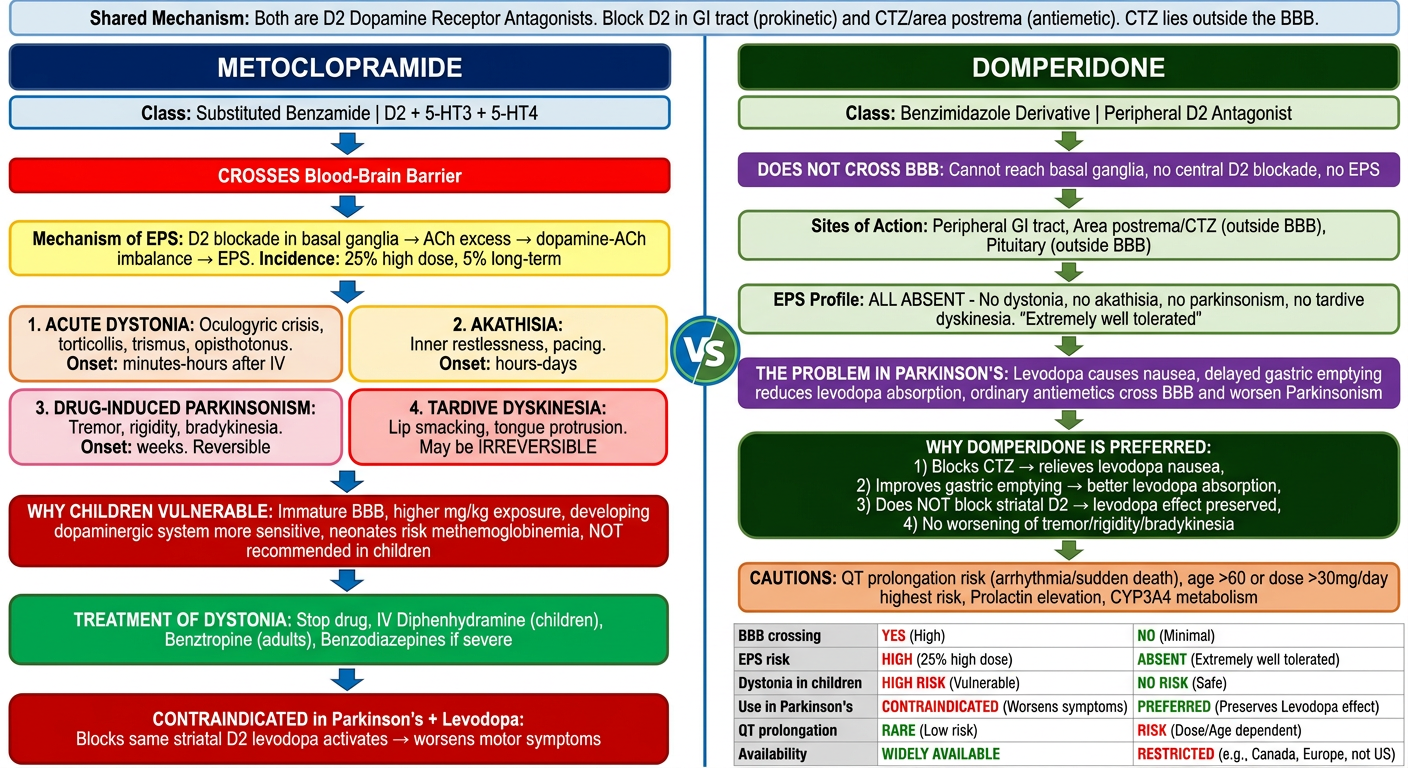
- Crosses BBB → central D2 blockade in basal ganglia
- Mechanism of EPS (ACh excess from dopamine-ACh imbalance)
- All 4 EPS types: Acute Dystonia, Akathisia, Drug-induced Parkinsonism, Tardive Dyskinesia
- Why children are most vulnerable (immature BBB, developing dopaminergic system)
- Treatment of dystonia (Diphenhydramine / Benztropine)
- Why it's CONTRAINDICATED in Parkinson's + Levodopa
- Does NOT cross BBB → no central EPS
- Acts only at CTZ, peripheral GI, pituitary
- Why it's the DRUG OF CHOICE in Parkinson's on Levodopa (preserves levodopa's central action while relieving nausea)
- QT prolongation caution