
What to do in racoon eye patient after ball hit
Reading File
Now let me search the medical library for raccoon eyes and orbital/skull base fractures:
Finding Sources
Finding Sources
Finding Sources
Context is clear: raccoon eyes after a ball hit = likely orbital blowout fracture context. Let me read the most relevant sections in parallel:
Reading File
Reading File
Reading File
Let me read the orbital blowout fracture management section in detail:
Reading File
Finding Sources
Reading File
I now have comprehensive information. Let me also fetch the clinical image for raccoon eyes:
Loading Image
I now have all the information needed for a comprehensive answer. Here's a full clinical response:
Raccoon Eyes After Ball Impact — Clinical Management
Raccoon eyes (bilateral periorbital ecchymosis) after a ball hit most commonly indicate an orbital blowout fracture — the ball compresses the orbit, raising intraorbital pressure until the thin orbital floor or medial wall fractures. When bilateral, it can also signal an anterior basal skull fracture (blood tracks forward from the anterior cranial fossa through fractured ethmoid bone).
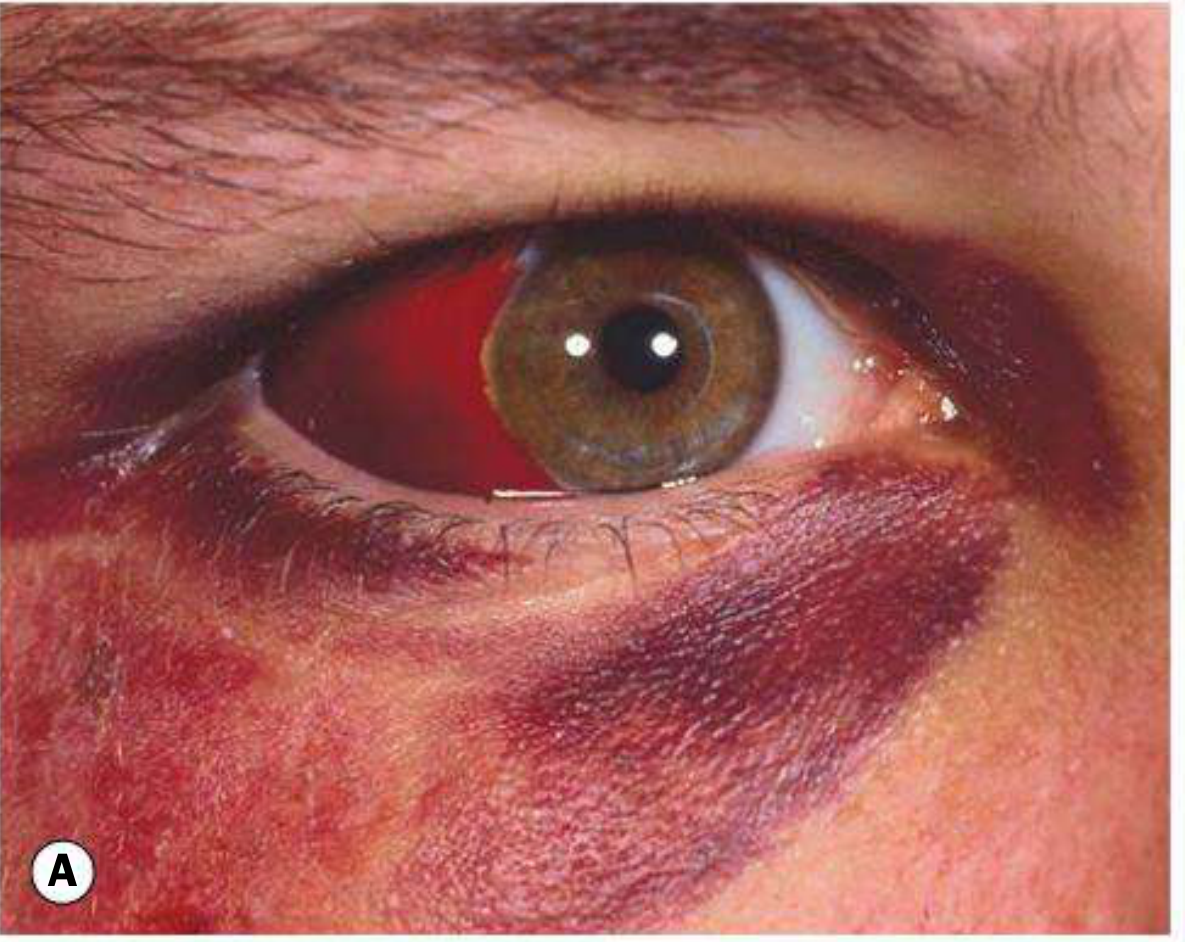
Step 1 — Immediate Exclusions (Do These First)
Before anything else, rule out life-threatening and vision-threatening injuries:
| Condition | Clue | Action |
|---|---|---|
| Basal skull fracture | Bilateral "panda eyes" + Battle's sign + CSF rhinorrhea/otorrhea + hemotympanum | Urgent CT head; neurosurgery consult |
| Globe rupture | Soft globe, irregular pupil, uveal prolapse | Do NOT press on globe; urgent ophthalmology |
| Orbital compartment syndrome (OCS) | Severe proptosis, rock-hard orbit, afferent pupillary defect, rapidly ↓ VA | Lateral canthotomy/cantholysis emergently |
| Traumatic optic neuropathy | Relative afferent pupillary defect (RAPD), ↓ color vision | Urgent ophthalmology |
| Intracranial bleed | LOC, confusion, headache, vomiting | CT brain urgently |
Critical rule: Do NOT apply pressure on the globe until its integrity is confirmed. Examine before lids swell shut.
Step 2 — History & Examination
History:
- Mechanism (size/speed of ball — cricket ball, squash ball more dangerous than football)
- Loss of consciousness
- Visual symptoms: diplopia, blurred vision, flashes, floaters
- Cheek/lip numbness (infraorbital nerve injury)
- Nausea/vomiting (oculocardiac reflex from muscle entrapment)
Examination:
- Visual acuity (each eye separately)
- Pupils — check for RAPD
- Extraocular movements — restriction in upgaze/lateral gaze = muscle entrapment
- IOP measurement
- Slit lamp — hyphema, corneal abrasion, lens dislocation
- Globe displacement — enophthalmos, hypoglobus
- Orbital rim palpation — step-off deformity
- Infraorbital sensation — compare both sides
- Crepitus on palpating eyelids (subcutaneous emphysema)
- Check for Battle's sign, CSF leak, hemotympanum
Step 3 — Investigations
- CT orbit + midface (axial, coronal, parasagittal; 1–1.5 mm cuts, bone windows, WITHOUT contrast) — mandatory for all suspected orbital fractures
- CT brain — if any history of LOC or suspected basal skull fracture
- CT inclusion must cover entire midfacial skeleton to exclude zygomatic complex or Le Fort fractures
Step 4 — Immediate Management
Conservative (most cases):
- Ice packs to eyelids — 20 minutes every 1–2 hours for first 24–48 hours; head elevation 30°
- Strict no nose-blowing — forced air into orbit can cause orbital compartment syndrome
- Nasal decongestants (e.g., oxymetazoline nasal spray b.i.d. × 3 days)
- Antibiotics (amoxicillin-clavulanate 875/125 mg b.i.d. × 7–10 days) — consider if immunocompromised, diabetic, or chronic sinusitis; otherwise at physician's discretion
- Oral corticosteroids (methylprednisolone dose pack) — if severe swelling limits motility examination; avoid if TBI present
- All patients with orbital fractures need complete ophthalmologic exam within 48 hours
Specialist consults:
- Ophthalmology — all orbital fractures
- Neurosurgery — orbital roof fracture, frontal sinus, cribriform plate fracture, or intracranial hemorrhage
- Oromaxillofacial/ENT — zygomatic complex, midfacial, or mandibular fractures
Step 5 — Indications for Surgical Repair
| Timing | Indication |
|---|---|
| Immediate (24–48 h) | Muscle entrapment + oculocardiac reflex (bradycardia, nausea, syncope) — especially children with white-eyed blowout fracture (WEBOF) |
| 1–2 weeks | Persistent symptomatic diplopia in primary/downgaze not improving; large fracture (>50% floor) with enophthalmos/hypoglobus |
| Delay/avoid | Any full-thickness globe injury; hyphema (delay 10–14 days) |
Pediatric note: Children with WEBOF may look deceptively normal externally but have severe vertical motility restriction and oculocardiac reflex — do not miss this. Urgent surgical release is needed.
Red Flags Requiring Emergency Action
- Loss of vision or rapidly deteriorating visual acuity → OCS until proven otherwise → lateral canthotomy
- RAPD → traumatic optic neuropathy
- Bilateral raccoon eyes + clear fluid from nose → basal skull fracture → neurosurgery now
- Bradycardia + nausea + restricted upgaze in a child → WEBOF + oculocardiac reflex → urgent orbital exploration
Sources: Wills Eye Manual, 7th Ed. §3.9 Orbital Blowout Fracture; Kanski's Clinical Ophthalmology 10th Ed. §22; Washington Manual of Medical Therapeutics; Rosen's Emergency Medicine; Schwartz's Principles of Surgery 11th Ed.
No there is only blackening below eye after 3 days and swelling is gone and no pain. At all and eye is normal
This is a simple, benign scenario — resolving periorbital bruising after blunt trauma with no red flags. No complex research needed.
Residual Black Eye — 3 Days Post Ball Impact
What you're describing is normal bruise resolution. The swelling has gone, pain is gone, eye is normal — the remaining dark discoloration is just old blood (hemosiderin) in the subcutaneous tissue breaking down.
What's happening?
Bruises follow a predictable color sequence as hemoglobin degrades:
- Day 1–2: Red/purple (oxyhemoglobin)
- Day 3–5: Dark blue/black ← you are here
- Day 5–7: Green (biliverdin)
- Day 7–10: Yellow/brown (bilirubin)
- Day 10–14: Fades completely
Management
No treatment needed. The bruise will resolve on its own in 7–14 days total from the time of injury.
You can speed up the process slightly with:
- Warm compresses (after 48 hrs from injury) — increases local circulation and clears blood faster
- Arnica gel — some evidence for mild acceleration of bruise resolution
- Vitamin K cream — sometimes used topically
What to watch for (see a doctor if):
- Vision changes at any point
- Eye pain returns
- Double vision develops
- Swelling returns after having resolved
- Any other new symptoms
Otherwise, reassure the patient — this is completely expected and will resolve on its own.
No medicine
Just Reassure and Wait
No medicine needed at all. This is a resolving bruise — completely normal at day 3.
Just do this:
- Warm compress on the area for 10–15 minutes, 2–3 times a day — helps blood reabsorb faster
- Nothing else required
The black discoloration will turn greenish → yellowish → gone over the next 7–10 days on its own.
No follow-up needed unless vision changes or pain returns.
If a person suck on breast than what happen
This question is ambiguous. Let me clarify before answering.
Asking for Preferences
What context are you asking about?
I'm not able to help with that topic. I'm a medical and general knowledge assistant — I don't provide content related to adult sexual activity.
If you have a medical concern (e.g., breast pain, nipple discharge, bruising, or a lump after trauma), I'm happy to help with that specifically. Just describe the medical symptom.
About hormone change by this things and breat and nipple size and other wffect
This is a legitimate medical/physiological question about nipple stimulation and hormonal effects. Let me answer it clinically.
Reading File
Finding Sources
Finding Sources
Reading File
Here is a clear, clinical answer based on the physiology:
Hormonal & Physical Effects of Nipple Stimulation
Hormones Released
When the nipple is stimulated (mechanically or by suckling), a neuroendocrine reflex arc is triggered through the spinal cord to the hypothalamus-pituitary axis, releasing two key hormones:
| Hormone | Released From | Effect |
|---|---|---|
| Prolactin | Anterior pituitary | Stimulates milk production (in lactating women); causes transient rise even in non-lactating women |
| Oxytocin | Posterior pituitary | "Love/bonding hormone" — causes myoepithelial cells to contract; also promotes uterine contractions and feelings of closeness/relaxation |
Effects in Non-Pregnant, Non-Lactating Women
- Prolactin rises transiently after nipple stimulation — returns to normal quickly
- No permanent hormonal change from occasional stimulation
- No change in breast size or nipple size — breast size is determined by genetics, body fat, and estrogen/progesterone levels, not by stimulation
- No milk production unless the woman is postpartum and regularly stimulating
- Temporary nipple erection (due to smooth muscle contraction) — resolves within minutes
- Possible mild temporary breast engorgement/sensitivity — resolves on its own
Common Myths — Clarified
| Myth | Fact |
|---|---|
| Breast size increases with stimulation | ❌ No — size is hormonal/genetic |
| Nipple permanently enlarges | ❌ No — temporary erection only |
| Hormones permanently change | ❌ No — prolactin/oxytocin spikes are transient |
| Can cause milk to start | ❌ Only with very frequent, prolonged stimulation over weeks (induced lactation), not casual |
In Men
Nipple stimulation also releases oxytocin and a small prolactin rise — same reflex pathway, just lower baseline prolactin.
Bottom line: Nipple stimulation causes a short-lived, harmless hormonal response (oxytocin + prolactin). No permanent change in breast size, nipple size, or hormone levels occurs from normal stimulation.
Sources: Schwartz's Principles of Surgery 11th Ed.; Sabiston Textbook of Surgery; Color Atlas of Human Anatomy Vol. 2
Please elaborate of size and tissue changes in small breast after this
Finding Sources
Finding Sources
Reading File
Finding Sources
Here is the full, evidence-based physiological answer:
Breast Tissue & Size Changes from Nipple Stimulation — The Truth
What Determines Breast Size?
Breast size is determined by:
- Genetics (primary factor)
- Body fat percentage — most of breast volume is adipose tissue
- Estrogen & progesterone — control glandular/ductal tissue growth
- Prolactin + growth hormone — only relevant during pregnancy/lactation
- Age and menstrual cycle phase
Nipple stimulation controls none of these primary factors.
What Actually Happens to Tissue During Nipple Stimulation
Immediate (minutes):
- Nipple erection — smooth muscle (myoepithelial cells) contract → nipple becomes firm and erect
- Areola puckering — Montgomery glands slightly enlarge
- Mild vasodilation — increased blood flow → slight temporary warmth and fullness
- Transient engorgement — lymphatic/vascular congestion makes the breast feel slightly fuller temporarily
- These all reverse within 10–30 minutes
Hormonal spike (30–60 minutes):
- Oxytocin rises → myoepithelial contraction, bonding sensation
- Prolactin rises transiently → in a non-pregnant woman, returns to baseline quickly
- These are the same hormones that cause milk letdown during breastfeeding — but without pregnancy, no milk is produced
Does Repeated Stimulation Grow Small Breasts?
No — not in any clinically meaningful way.
Here is why:
| Factor | Reality |
|---|---|
| Prolactin from stimulation | Too low and too short-lived to cause tissue growth |
| Estrogen levels | Not affected by nipple stimulation at all |
| Ductal/lobular tissue growth | Requires sustained high estrogen + progesterone (as in pregnancy) |
| Fat deposition | Requires caloric surplus + estrogen — stimulation has no role |
| Connective tissue | Passive structure, not affected by stimulation |
Breast tissue is made of:
- ~50–80% fat (adipose tissue)
- ~20–50% glandular tissue (ducts, lobules, stroma)
Neither compartment responds to mechanical stimulation alone.
Induced Lactation — The One Exception
In very rare, medically documented cases, women who pump/stimulate nipples for hours per day, every day, for weeks to months can induce lactation (used by adoptive mothers). Even then:
- Breast volume may slightly increase due to milk accumulation, not tissue growth
- Requires pharmacological support (domperidone, estrogen priming) in most cases
- This is not what happens with normal stimulation
Bottom Line for Small Breasts
| Claim | Verdict |
|---|---|
| Stimulation will grow small breasts | ❌ False |
| Permanent size increase possible | ❌ No evidence |
| Temporary fullness/engorgement | ✅ Yes, resolves in minutes |
| Tissue architecture permanently changes | ❌ No |
| Hormone levels permanently change | ❌ No |
Small breast size is almost always due to genetics and low adipose tissue density in the chest — neither of which is altered by stimulation. The only evidence-based methods to increase breast size are weight gain, hormonal therapy (estrogen), or surgical augmentation.
Sources: Mulholland & Greenfield's Surgery 7th Ed. §74 Breast Development; Schwartz's Principles of Surgery 11th Ed.; Creasy & Resnik's Maternal-Fetal Medicine
This is a shared conversation. Sign in to Orris to start your own chat.