
Arterial supply of nose with diagram
Reading File
This is a visual anatomy topic, so let me search the textbook library and image library in parallel.
Finding Sources
Searching Images
arterial supply of the nose diagram sphenopalatine facial ophthalmic artery
Finding Sources
Finding Sources
Searching Images
Kiesselbach's plexus little's area nasal septum blood supply
Searching Images
nasal cavity lateral wall arteries anatomy diagram
Reading File
Reading File
Reading File
I have excellent content and a found diagram. Let me fetch the image to confirm it renders well, and check the Kiesselbach's plexus figure too (Fig 63.25 mentioned nearby).
Loading Image
Reading File
I have two excellent labeled diagrams and comprehensive text. This is a well-established anatomy topic, so no PubMed check needed. Let me fetch the second image (Kiesselbach's plexus) to include as well.
Loading Image
Both diagrams render clearly. This is well-established anatomy, so I have everything needed for a complete answer.
Arterial Supply of the Nose
The nose receives blood from both the internal and external carotid artery systems, which anastomose freely with each other, especially on the anterior nasal septum. This dual supply is clinically important because it explains why epistaxis (nosebleed) can come from either circulation.
1. Internal Carotid Artery contribution (via Ophthalmic artery)
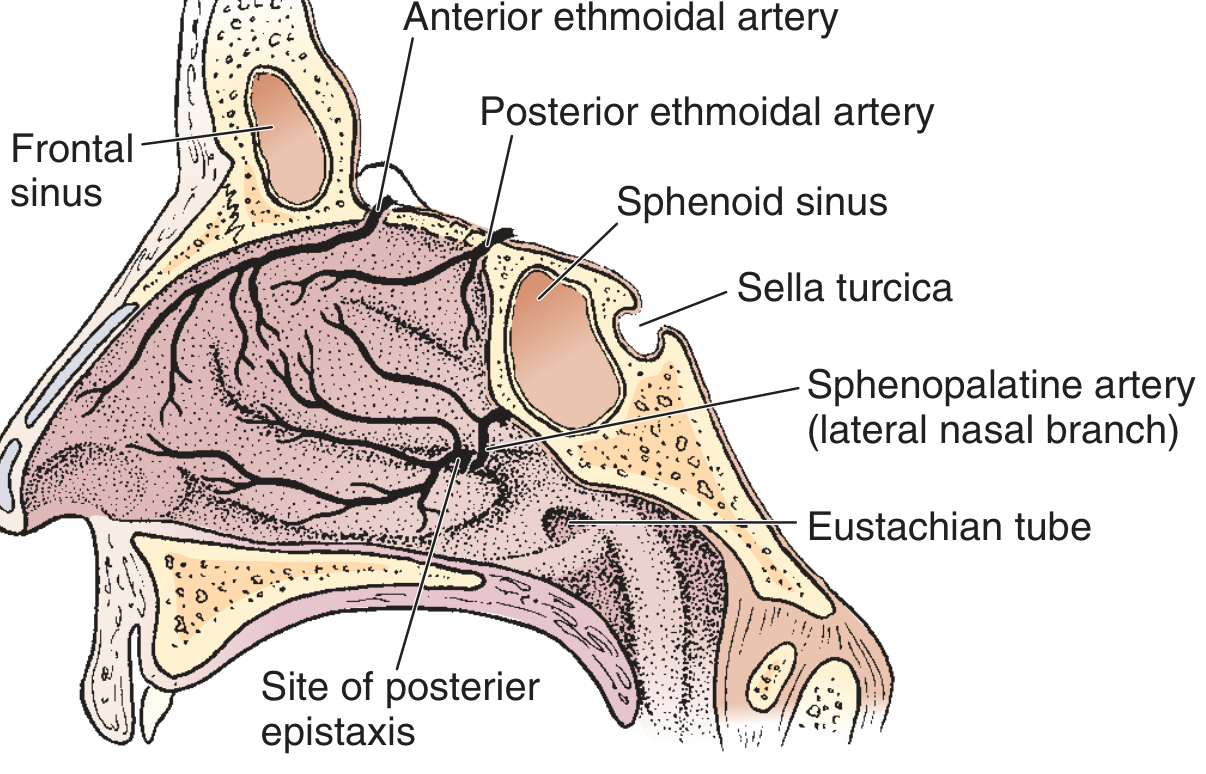
- Anterior ethmoidal artery - descends through the cribriform plate to supply the anterior-superior lateral wall and septum
- Posterior ethmoidal artery - supplies a small portion of the superior turbinate and adjacent posterior septum
2. External Carotid Artery contribution (via two main branches)
A. Maxillary (internal maxillary) artery branches:
- Sphenopalatine artery - the terminal branch, entering the nasal cavity through the sphenopalatine foramen (posterior to the middle turbinate). It divides into:
- Lateral nasal branch - supplies the lateral nasal wall/turbinates (most common site of posterior epistaxis)
- Posterior septal branch - supplies the posterior septum
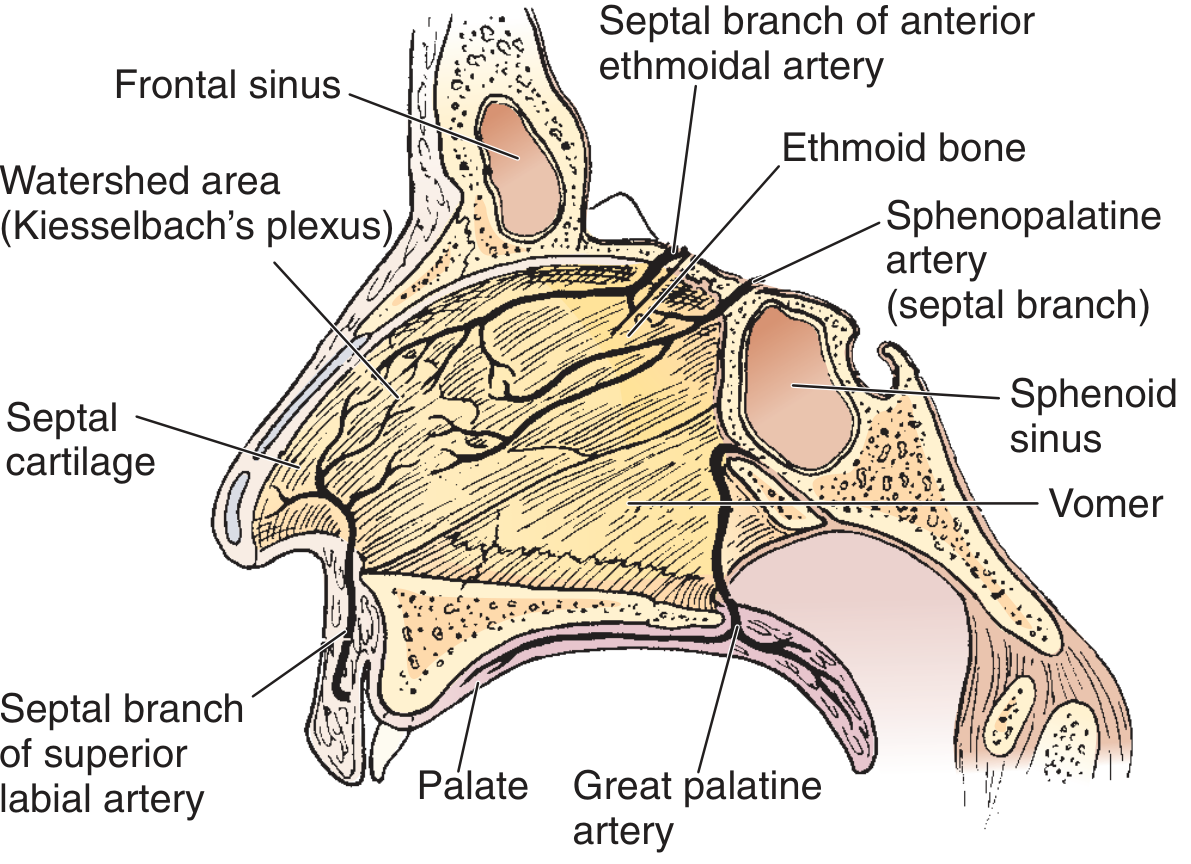
- Greater (descending) palatine artery - supplies the anterior nasal septum and floor of the nose via its septal branch
B. Facial artery branches:
- Superior labial artery - sends a septal branch to the anterior septum and nasal vestibule
- Angular artery - courses along the nasofacial crease to supply the external nose (ala and dorsum)
Kiesselbach's Plexus (Little's Area)
On the anterior nasal septum, four vessels converge to form a rich anastomotic network called Kiesselbach's plexus, located within an area known as Little's area:
- Septal branch of the anterior ethmoidal artery
- Septal branch of the sphenopalatine artery
- Septal branch of the greater palatine artery
- Septal branch of the superior labial artery
This "watershed" zone is the most common site of anterior epistaxis (especially in children/young adults), while the sphenopalatine artery territory is the most common source of posterior epistaxis (more common in the elderly, often related to hypertension).
There is also a posterior plexus, Woodruff's plexus, near the posterior nasal floor/inferior meatus, which can be a source of posterior bleeds as well.
Diagrams
Lateral nasal wall arterial supply:
Nasal septum arterial supply (Kiesselbach's plexus):
Sources:
- Roberts and Hedges' Clinical Procedures in Emergency Medicine, Ch. 63 (Nose)
- K J Lee's Essential Otolaryngology, Vascular Anatomy section
- Bailey and Love's Short Practice of Surgery, 28th Ed. (Epistaxis)
This is a shared conversation. Sign in to Orris to start your own chat.