
Classification of cholinergic
Reading File
Cholinergic drugs are classified based on their mechanism of action into two broad groups: direct-acting (acting on cholinergic receptors) and indirect-acting (inhibiting acetylcholinesterase). Let me pull the full detail from the textbooks.
Searching sources...
Finding Sources
Finding Sources
Finding Sources
Finding Sources
Reading File
Reading File
Reading File
Reading File
Reading File
Reading File
Reading File
Loading Image
I now have comprehensive information from multiple authoritative pharmacology textbooks (Lippincott, Katzung, Goodman & Gilman). Here is the full classification:
Classification of Cholinergic Drugs
Cholinergic drugs (cholinomimetics) are agents that mimic or potentiate acetylcholine (ACh) at cholinergic synapses. They are classified by mechanism of action into two major groups:
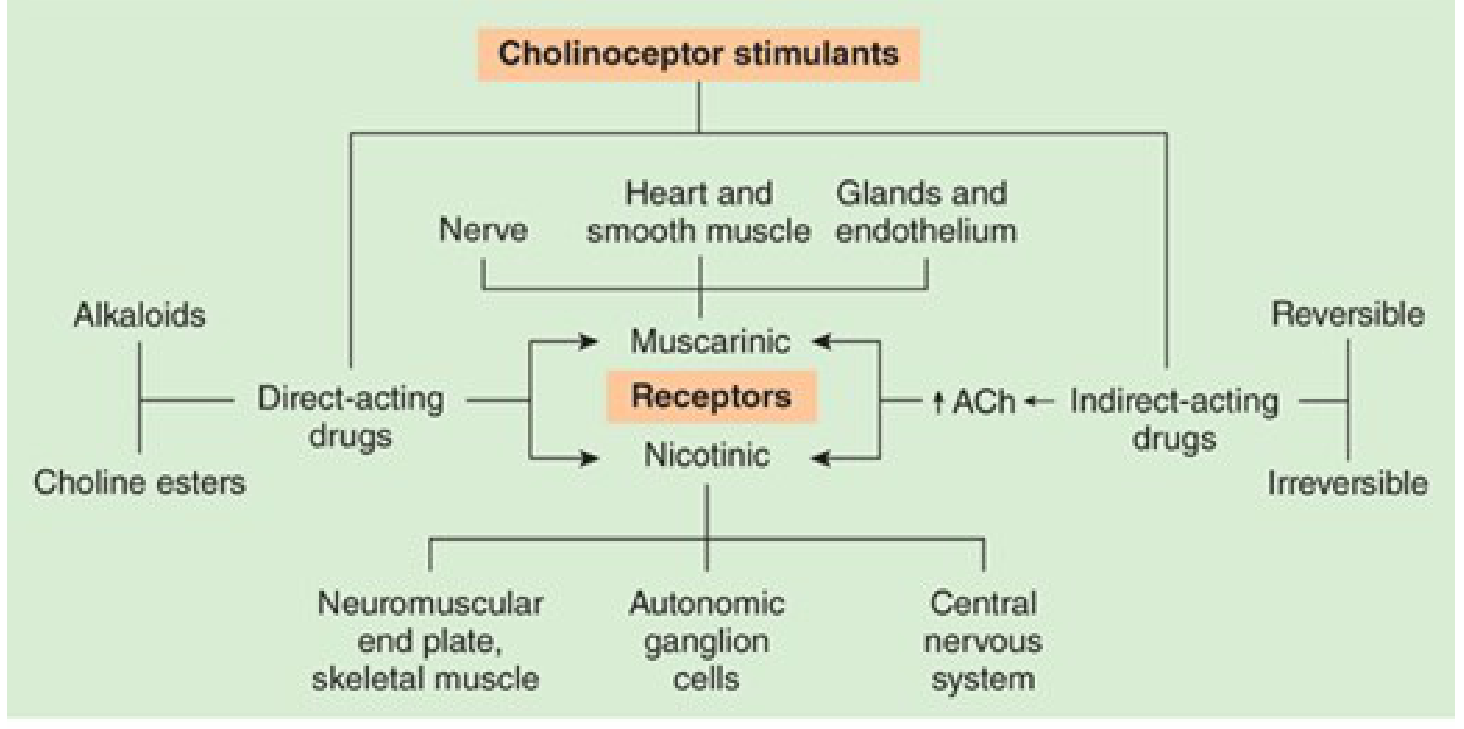
I. Direct-Acting Cholinergic Agonists
These drugs bind directly to cholinoceptors (muscarinic or nicotinic) and activate them. They are sub-classified into two chemical groups:
A. Choline Esters
Synthetic esters of choline. They are hydrophilic (quaternary nitrogen), poorly absorbed orally, and cannot penetrate the CNS.
| Drug | Muscarinic Action | Nicotinic Action | Susceptibility to Cholinesterase | Key Use |
|---|---|---|---|---|
| Acetylcholine | +++ | +++ | ++++ (very rapid) | Ophthalmic (miosis in surgery) |
| Methacholine | ++++ | None | + (resistant) | Bronchoprovocation test for asthma |
| Carbachol | ++ | +++ | Negligible | Glaucoma, miosis |
| Bethanechol | ++ | None | Negligible | Urinary retention, GI atony |
- The β-methyl group in methacholine and bethanechol reduces nicotinic activity while retaining muscarinic selectivity.
- Carbachol retains significant nicotinic action.
B. Naturally Occurring Alkaloids (and Synthetic Analogs)
These are tertiary amines - well absorbed orally and able to cross the CNS. They have longer duration of action than ACh.
| Drug | Receptor Selectivity | Key Use |
|---|---|---|
| Pilocarpine | Chiefly muscarinic | Glaucoma (reduces IOP), Sjogren syndrome (dry mouth) |
| Muscarine | Purely muscarinic | Mushroom poisoning (no therapeutic use) |
| Nicotine | Chiefly nicotinic (low dose stimulates; high dose blocks) | Smoking cessation |
| Lobeline | Chiefly nicotinic | Previously used for smoking cessation |
| Cevimeline | Muscarinic (M1, M3) | Sjogren syndrome |
II. Indirect-Acting Cholinergic Agonists (Anticholinesterases)
These drugs do not directly activate receptors. They inhibit acetylcholinesterase (AChE), the enzyme that breaks down ACh in the synapse, thereby increasing endogenous ACh concentration and prolonging its action.
"Indirect-acting agents produce their primary effects by inhibiting acetylcholinesterase, which hydrolyzes acetylcholine to choline and acetic acid." - Katzung's Basic and Clinical Pharmacology, 16th Ed.
A. Reversible Anticholinesterases
Form a reversible carbamyl-enzyme complex with AChE. Duration of action is limited.
1. Short-acting
- Edrophonium - binds electrostatically; very short duration (~10-20 min). Used in the Tensilon test to diagnose myasthenia gravis.
2. Medium-duration (carbamic acid esters)
| Drug | CNS Penetration | Key Use |
|---|---|---|
| Physostigmine | Yes (tertiary amine) | Atropine/anticholinergic poisoning overdose; glaucoma |
| Neostigmine | No (quaternary N) | Myasthenia gravis, reversal of non-depolarizing NMBAs, urinary retention |
| Pyridostigmine | No (quaternary N) | Chronic management of myasthenia gravis (longer acting than neostigmine, 3-6 hrs) |
| Rivastigmine | Yes | Alzheimer disease, Parkinson dementia |
3. CNS-targeted (Alzheimer disease)
| Drug | Notes |
|---|---|
| Donepezil | Long-acting; first line for AD |
| Galantamine | Also potentiates nicotinic receptors (allosteric modulator) |
| Rivastigmine | Inhibits both AChE and butyrylcholinesterase |
| Tacrine | First agent for AD; now obsolete due to hepatotoxicity |
B. Irreversible Anticholinesterases
Form a stable phosphonyl bond with AChE (organophosphates). AChE is permanently inactivated - recovery requires synthesis of new enzyme.
| Drug | Use |
|---|---|
| Echothiophate | Glaucoma (ophthalmic) |
| Isoflurophate (DFP) | Ophthalmic use only |
| Malathion, Parathion | Insecticides (agricultural); common source of poisoning |
| Sarin, Soman, Tabun, VX | Chemical warfare agents (nerve agents) |
Aging: When not treated promptly with pralidoxime (2-PAM), the phosphorylated AChE undergoes "aging" - the bond becomes irreversible and pralidoxime can no longer reactivate it.
Summary of Cholinergic Receptors Targeted
| Receptor Type | Location | Signal Mechanism | Drugs acting here |
|---|---|---|---|
| M1 | Nerves, gastric parietal cells | Gq → IP3/DAG → ↑Ca2+ | Pilocarpine, bethanechol |
| M2 | Heart, smooth muscle | Gi → ↓cAMP, ↑K+ conductance | ACh (bradycardia) |
| M3 | Glands, smooth muscle, endothelium | Gq → IP3/DAG | Bethanechol (bladder), pilocarpine (glands) |
| NM (Nicotinic-Muscle) | Neuromuscular junction | Ligand-gated Na+/K+ channel | Carbachol, nicotine (at NMJ) |
| NN (Nicotinic-Neuronal) | Autonomic ganglia, CNS | Ligand-gated Na+/K+ channel | Nicotine, carbachol |
Sources:
- Lippincott Illustrated Reviews: Pharmacology, Chapter 4 (Cholinergic Agonists)
- Katzung's Basic and Clinical Pharmacology, 16th Ed., Chapter 7 (Cholinoceptor-Activating & Cholinesterase-Inhibiting Drugs)
- Goodman & Gilman's The Pharmacological Basis of Therapeutics, Chapter 10-11
This is a shared conversation. Sign in to Orris to start your own chat.