
mutation ka matlab
Mutation ka matlab hai - DNA ya genetic material mein koi permanent badlav (change).
Mutation kya hai?
Jab kisi cell ka DNA copy hota hai ya kisi external factor ki wajah se DNA mein koi galti ya badlav aa jata hai, use mutation kehte hain.
Mutation ke prakar (Types)
DNA level par:
| Type | Matlab |
|---|---|
| Point Mutation | Ek single nucleotide (base) badal jata hai |
| Insertion | Extra DNA sequence add ho jaati hai |
| Deletion | DNA ka kuch hissa nikal jaata hai |
| Substitution | Ek base ki jagah doosra base aa jaata hai |
Asar ke hisaab se:
- Silent Mutation - Change hota hai lekin protein same rehta hai, koi asar nahi
- Missense Mutation - Ek alag amino acid banta hai
- Nonsense Mutation - Protein banna beech mein ruk jaata hai (stop codon banta hai)
- Frameshift Mutation - Poori reading frame shift ho jaati hai (insertion/deletion se)
Mutation kyun hoti hai?
- Spontaneous - DNA replication mein natural galti
- Mutagens - Baahri factors jaise:
- UV radiation (dhoop)
- X-rays
- Cigarette smoke
- Kuch chemicals
Mutation ke natije (Effects)
- Harmful - Cancer, genetic disorders (e.g., sickle cell anemia, cystic fibrosis)
- Neutral - Koi asar nahi
- Beneficial - Evolution mein madad karta hai (e.g., antibiotic resistance in bacteria, adaptation in species)
Ek simple example:
Normal DNA:
...CAT-GAT-TAC... → Protein sahi banta hai
Mutated DNA: ...CAT-**GAG**-TAC... → Ek alag amino acid banta hai → protein ka kaam badal sakta haiAgar aap kisi specific mutation ke baare mein jaanna chahte hain (jaise cancer mutations, genetic diseases, ya evolution), toh bataiye!
Cancer mutations kaise hoti hain, samjhaiye
Reading File
Finding Sources
Finding Sources
Reading File
Reading File
Loading Image
Reading File
Ab aapke liye poori tarah se samjhata hoon - authoritative medical textbooks se (Basic Medical Biochemistry & Campbell Walsh Urology / Sabiston Surgery).
Cancer Mutations - Poori Tarah Samjhaiye
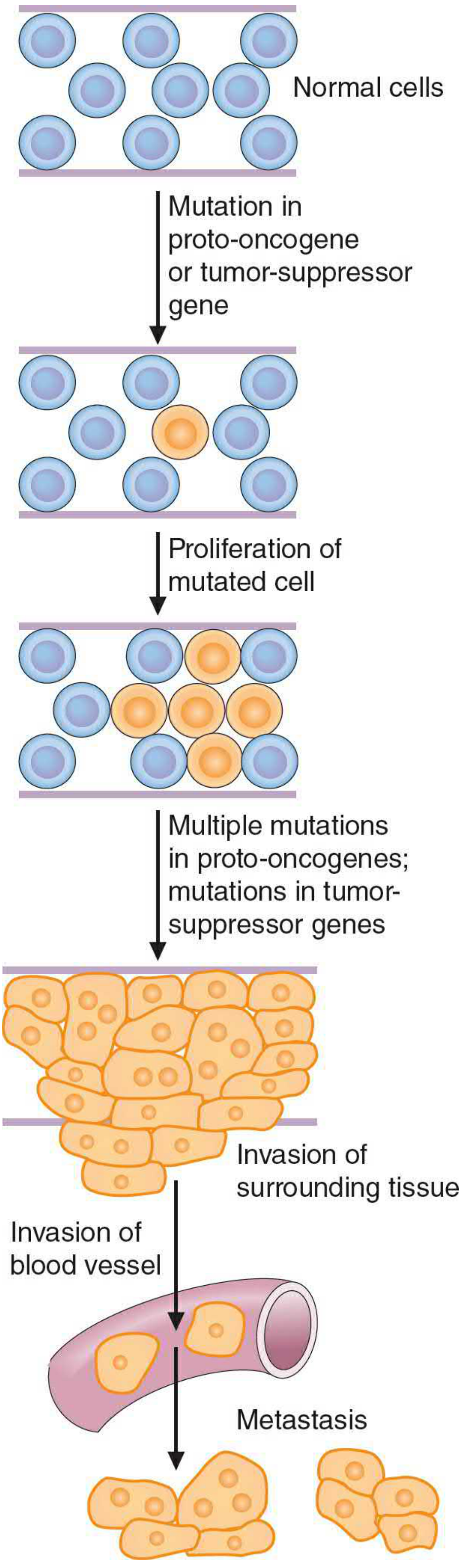
Cancer kya hoti hai?
Cancer aik group of diseases hai jisme cells abnormally badhti hain aur malignant tumor banati hain. Ye aberrant growth mutations ki wajah se hoti hai - un genes mein jo cell proliferation, differentiation, aur survival ko control karte hain.
Ek simple rule: Normal cell cancer cell tab banta hai jab 4 se 7 mutations accumulate ho jaati hain.
Cancer Mutations kaisi hoti hain - Step by Step
Step 1: DNA ko Damage
Pehle DNA ko kisi cheez se damage hona zaroori hai:
- Chemical carcinogens - cigarette, industrial chemicals, processed food mein
- UV radiation - dhoop/sunlight
- Viruses - HPV, Hepatitis B/C
- Replication errors - jab DNA copy hota hai tab galti
Step 2: Damage Repair na ho
Agar DNA damage repair nahi hua to wo permanent mutation ban jaata hai.
Step 3: Clonal Expansion
Ek mutated cell divide hota rehta hai - yahi "clonal expansion" hai. Ab ek poora group of cells hai jisme mutation hai.
Step 4: Aur mutations accumulate hoti hain
Jab cells badhte hain, har baar ek naya mutation add ho sakta hai. Jitni zyada mutations, utna zyada cancer-like behavior.
Do Main Type ke Cancer Genes
1. Proto-Oncogenes (Accelerator genes)
Ye normal genes hain jo cell growth promote karte hain. Jab inme mutation aati hai, ye Oncogenes ban jaate hain.
Proto-oncogene (normal) --[mutation]--> Oncogene (cancer-causing)
- Mechanism: "Gain of Function" - gene zyada ya hamesha active ho jaata hai
- Sirf ek allele mutate ho toh bhi cancer ho sakta hai
Examples:
| Oncogene | Cancer |
|---|---|
| RAS | Lung, colon, bladder cancer |
| MYC | Lymphoma, breast cancer |
| HER2 | Breast cancer |
| BCR-ABL | Chronic Myelogenous Leukemia (CML) |
Proto-oncogene ek car ka accelerator hai - mutation se accelerator jam jaata hai, car hamesha full speed par chalti rehti hai.
2. Tumor-Suppressor Genes (Brake genes)
Ye normal genes hain jo cell growth ko rokti hain. Cancer mein ye inactivate ho jaate hain.
- Mechanism: "Loss of Function" - gene kaam karna band kar deta hai
- Dono alleles ko inactivate hona padta hai (Two-Hit Hypothesis)
Four ways se Tumor Suppressor inactivate ho sakta hai:
- Homozygous deletion (dono copies delete)
- Ek allele lost + doosra mutated
- Dono alleles mutated
- Ek allele lost + doosra epigenetically silenced
Examples:
| Gene | Normal Function | Cancer |
|---|---|---|
| TP53 (p53) | DNA damage check, apoptosis | Almost every cancer |
| RB1 | Cell cycle control | Retinoblastoma, bladder cancer |
| BRCA1/2 | DNA repair | Breast, ovarian cancer |
| APC | Growth control | Colorectal cancer |
Tumor suppressor gene ek car ka brake hai - mutation se brake fail ho jaata hai, car rok nahi sakti.
Cell Cycle aur Checkpoints - Cancer ka Core Mechanism
Normal cell cycle mein checkpoints hote hain:
- Agar DNA damaged hai → Cell cycle ruk jaata hai → DNA repair hoti hai
- Agar repair possible nahi → Apoptosis (cell suicide)
Cancer cells mein:
- Checkpoints kaam nahi karte
- Damaged DNA ke saath bhi divide hote rehte hain
- Apoptosis nahi hoti
- Result: Genetic instability - aur mutations fast accumulate hoti hain
Key proteins involved:
- p53 - "Guardian of the genome" - DNA damage detect karta hai
- RB1 - Cell cycle ke G1 checkpoint par brake lagata hai
- CDKs (Cyclin-Dependent Kinases) - cell cycle ke accelerators
Colorectal Cancer - Ek Classic Example
Colon cancer mein mutations ka kram (sequence) pata hai:
Normal epithelium
    ↓ APC gene mutate (tumor suppressor lost)
Small polyp
    ↓ K-RAS proto-oncogene mutate (oncogene activated)
Larger polyp
    ↓ p53 mutate (guardian lost)
Malignant cancer
    ↓ Multiple additional mutations
Metastasis
Cancer Mutations ke Causes - Summary
| Cause | Example |
|---|---|
| Chemical carcinogens | Cigarette smoke, aflatoxin |
| Physical carcinogens | UV rays, X-rays |
| Viruses | HPV (cervical cancer), HBV (liver cancer) |
| Inherited mutations | BRCA1/2, APC gene |
| Random replication errors | Age ke saath badhte hain |
Key Takeaway
Cancer ek "multi-step genetic disease" hai. Ek hi mutation se cancer nahi hota - 4 se 7 mutations ka accumulation zaroori hai. Yahi wajah hai ki cancer zyatar umar ke saath hota hai - zyada time = zyada mutations ka mauka.
Sources: Basic Medical Biochemistry - A Clinical Approach 6e, p. 588-590; Campbell Walsh Wein Urology, p. 2748-2760; Sabiston Textbook of Surgery
mere father ko colon cancer hua tha, but wo cigarette, alcohol ko touch bhi nhi kiya tha. fir ye kyun ?
Pehle aapke father ke liye dua - umeed hai wo theek hain ya the.
Ye bahut important sawaal hai - aur aap akele nahi hain jo ye sochte hain. Bahut log sochte hain "cancer sirf smokers/drinkers ko hota hai" - lekin ye galat hai.
Reading File
Finding Sources
Finding Sources
Finding Sources
Finding Sources
Finding Sources
Reading File
Reading File
Ab aapke sawaal ka bilkul seedha aur honest jawab - medical textbooks se:
Cigarette/Alcohol nahi phir bhi Colon Cancer - Kyun?
Ye bahut common galfahmi hai. Sach ye hai: colon cancer ke liye cigarette ya alcohol zaroori nahi. Ye sirf kuch risk factors hain - main cause nahi.
Harrison's Principles of Internal Medicine ke mutabiq, colon cancer ke bohot saare independent causes hain:
1. Sporadic Mutations (Sabse Common - 75% cases)
75% colon cancer cases mein koi family history ya obvious risk factor nahi hota. Ye hota hai:
- Har baar jab colon ki cells divide hoti hain (aur ye daily hoti hain), DNA copy hota hai
- Billions of cell divisions lifetme mein hoti hain
- Kabhi kabhi replication mein random galti ho jaati hai - koi carcinogen ki zaroorat nahi
- Umar ke saath ye random errors accumulate hote rehte hain
- Yahi wajah hai ki colon cancer age ke saath bohot zyada badhta hai
Sochiye aise: agar aap ek paragraph 50 saal tak roz type karo, toh kabhi na kabhi ek typo zaroor aayega - chahe aap kitna bhi dhyan rakhein.
2. Diet - Sab se Bada Silent Risk Factor
Harrison's ke mutabiq, colon cancer ka etiology mostly environmental/dietary factors se hota hai:
| Cheez | Risk |
|---|---|
| Red meat / processed meat | Risk badhata hai - gut bacteria bile acids ko carcinogens mein convert karte hain |
| High fat, high calorie diet | Strong correlation |
| Kam fiber, kam vegetables | Protective effect kho jaata hai |
| Western diet (maida, fast food, oily food) | Japan mein jab Western diet aayi, colon cancer badhne laga |
Aapke father ka daily khana kaisa tha? Ghar ka khana bhi agar high in red meat, ghee, maida, processed food tha - ye ek major reason ho sakta hai.
3. Gut Microbiome (Aant ke bacteria)
Naya research bata raha hai ki gut mein kuch bacteria - jaise Fusobacterium nucleatum aur Bacteroides fragilis - colon cancer se directly linked hain. Ye bacteria bile acids ko carcinogenic compounds mein convert karte hain. Kisi bhi insan ke gut mein ye imbalance ho sakta hai.
4. Hereditary / Genetic Causes
Kya aapke family mein kisi aur ko colon cancer tha? Ye bohot important sawaal hai, kyunki:
Lynch Syndrome (HNPCC)
- Colon cancer ka sabse common hereditary cause
- MMR genes (MLH1, MSH2, MSH6, PMS2) mein mutation hoti hai
- Ye genes DNA repair karte hain - jab ye kaam nahi karte, mutations 1000x zyada tezi se accumulate hoti hain
- Autosomal dominant - sirf ek parent se mila hua gene kaafi hai
- Is syndrome mein colon cancer ke saath ovarian, endometrial, stomach cancer ka bhi risk
FAP (Familial Adenomatous Polyposis)
- APC gene mein mutation
- Colon mein hundreds of polyps ban jaate hain, jo cancer ban sakte hain
5. Inflammation
- IBD (Inflammatory Bowel Disease) - Crohn's disease ya ulcerative colitis
- Chronic inflammation DNA damage karta rehta hai
Ek Important Baat Aapke Liye
Kyunki aapke father ko colon cancer tha, aap khud ek higher risk category mein hain. Medical guidelines kehti hain:
Agar ek first-degree relative (father/mother/sibling) ko colon cancer hua ho, especially age 60 se pehle, toh aapko colonoscopy 40 saal ki umra par, ya unke diagnosis se 10 saal pehle shuru karni chahiye - jo bhi pehle aaye.
Yahi nahi, family history hone ki wajah se aapko Lynch Syndrome ka genetic test bhi karwana chahiye - ek simple blood test hai.
Meri suggestion: Apne gastroenterologist se miliye aur father ki family history discuss karein. Ye cancer hai toh darane wali baat hai, lekin early detection mein colon cancer bohot treatable hai.
Sources: Harrison's Principles of Internal Medicine 22E, p. 41-50; Textbook of Family Medicine 9e, p. 2183-2202
colon cancer explain karo with harrison
Finding Sources
Reading File
Reading File
Reading File
Reading File
Reading File
Reading File
Ab poori tarah Harrison's se Colon Cancer samjhata hoon:
Colorectal Cancer - Harrison's Principles of Internal Medicine 22E (2025)
Chapter 86 - Dr. David P. Ryan
Incidence (Kitna Common Hai?)
- USA mein 2024 mein 1,53,000 cases expect kiye gaye
- GI tract ka sabse common cancer
- Second most common cause of cancer death (lung cancer ke baad)
- 50+ age mein incidence gir rahi hai (colonoscopy screening ki wajah se)
- Lekin 50 se kam umra wale young adults mein cases badh rahe hain - yahi zyada chintaajanak hai
- Young men (20-49): Ab cancer death ka #1 cause
- Young women (40-49): Breast cancer ke baad #2 cause
Adenomatous Polyps - Cancer Kaise Banta Hai
Colon cancer directly nahi banta - pehle polyp banta hai, phir cancer.
Normal colon mucosa
        ↓
Adenomatous Polyp (benign)
        ↓  (sirf <5% polyps agar untreated rahe)
Adenocarcinoma (Cancer)
- 25% logon ko age 50 par polyps hote hain
- 50% logon ko age 70 par polyps hote hain
- Villous adenoma - 3x zyada dangerous (tubular se)
- Zyada bada polyp = zyada cancer risk
Molecular Pathogenesis - Andar kya hota hai
Harrison's ke mutabiq, 3 molecular pathways hain sporadic colon cancer mein:
1. CIN Pathway (Chromosomal Instability) - Sabse Common
Step by step gene mutations:
| Kram | Gene | Kya hota hai |
|---|---|---|
| 1st | APC gene lost | Tumor suppressor gone - polyp banta hai |
| 2nd | KRAS / BRAF mutate | Oncogene activate - polyp barta hai |
| 3rd | p53 lost | Final guardian gone - cancer |
2. MMR Pathway (Mismatch Repair Deficiency)
- DNA repair genes kaam karna band kar dete hain
- Result: MSI-high (Microsatellite Instability)
- Sporadic cases mein: MLH1 gene promoter methylation se hota hai
- Lynch Syndrome mein: germline (genetic) mutation se hota hai
- Bohot important: MSI-high tumors immunotherapy ke liye best respond karte hain
3. CIMP Pathway (Methylation)
- Right-sided tumors zyada
- MLH1 methylation se hota hai
Risk Factors (TABLE 86-1 Harrison's)
| Category | Risk Factor |
|---|---|
| Diet | Animal fat, obesity, high calories |
| Hereditary | FAP, Lynch Syndrome, MYH polyposis |
| Inflammation | IBD (Ulcerative Colitis, Crohn's) |
| Infections | Streptococcus bovis bacteremia |
| Other | Tobacco (35+ saal baad), alcohol |
| Metabolic | Diabetes, insulin resistance, Vitamin D deficiency |
Important - Tobacco aur Alcohol:
- Tobacco linked hai adenomas se, lekin sirf 35+ saal ke use ke baad - short term ya occasional use se colon cancer nahi hota
- Alcohol ka effect bhi "other lifestyle factors se alag karna mushkil hai" - Harrison's khud kehti hai
Hereditary Syndromes (TABLE 86-2 Harrison's)
| Syndrome | Gene | % of CRC | Risk |
|---|---|---|---|
| FAP | APC | <1% | Virtually 100% without treatment |
| MYH-Associated Polyposis | MUTYH | <1% | High |
| Lynch Syndrome | MLH1, MSH2, MSH6, PMS2 | ~3% | Up to 17x normal risk |
~10% patients ke colon cancer mein koi inherited germline mutation hoti hai. Young adults mein ye 15% tak hota hai.
Inflammatory Bowel Disease (IBD)
- UC ya Crohn's patients ko colon cancer ka risk:
- Pehle 10 saal: relatively low
- Phir: har saal 0.5-1% increase
- Lifetime: 8-30% patients cancer develop karte hain
- Extensive, severe, aur lamba chalte IBD mein risk zyada
Symptoms - Kaise Pata Chalta Hai
Harrison's ke mutabiq symptoms location par depend karte hain:
| Location | Symptoms |
|---|---|
| Right colon (proximal) | Occult blood, iron deficiency anemia, thakan - tumor large ho sakta hai bina obstruction ke |
| Left colon (distal) | Stool mein blood, constipation/diarrhea, pencil-thin stools, obstruction |
| Rectum | Tenesmus (incomplete evacuation feel), bright red blood, pain |
General symptoms: unintentional weight loss, fatigue, abdominal pain
Staging (Duke's / TNM System)
| Stage | Matlab | Survival (5-year) |
|---|---|---|
| I | Mucosa/submucosa tak, no lymph nodes | ~95% |
| II | Wall ke bahar lekin no nodes | ~75-85% |
| III | Lymph nodes involved | ~40-70% |
| IV | Metastasis (liver, lungs) | ~10-15% |
Liver - colon cancer ka #1 metastasis site (portal circulation se directly liver jaata hai)
Treatment - Harrison's ke Mutabiq
Localized Colon Cancer (Stage I-III)
- Surgery - standard of care (laparoscopy/robotic ab common)
- Stage I - surgery se cure
- Stage II-III high risk - surgery + adjuvant chemotherapy (3-6 months)
- FOLFOX (fluoropyrimidine + oxaliplatin) - standard
- Survival 30% improve hoti hai
MSI-High Cancers (Naya 2025 Update)
- Checkpoint inhibitors (PD-1 antibodies / immunotherapy) - bahut effective
- MSI-high rectal cancer: ab surgery, radiation, chemo ki jagah sirf immunotherapy se cure possible!
Metastatic Cancer (Stage IV)
- Chemotherapy: FOLFOX ya FOLFIRI regimens
- Targeted therapy: Bevacizumab (anti-VEGF), Cetuximab/Panitumumab (anti-EGFR - sirf KRAS wild-type mein)
- Liver metastasis mein: surgical resection possible ho toh cure bhi ho sakta hai
Screening - Harrison's Recommendations (2021 Update)
| Population | Recommendation |
|---|---|
| Average risk | Colonoscopy age 45 se shuru (pehle 50 tha, 2021 mein badla) |
| First-degree relative | Age 40 par ya relative ke diagnosis se 10 saal pehle |
| Lynch Syndrome | Age 20-25 se, har 1-2 saal colonoscopy |
| FAP | Age 10-12 se annual sigmoidoscopy |
Screening Methods:
- Colonoscopy - har 10 saal (gold standard)
- FIT test (Fecal Immunochemical Test) - har saal
- Stool DNA test (Cologuard) - har 1-3 saal
- CT Colonography - har 5 saal
Follow-up After Surgery
- CEA level (blood test) - har 3 months, 5 saal tak
- Colonoscopy: 1 saal baad, phir har 3 saal
- CT scan: har 6-12 months, 3 saal tak
- 3-5% chance of second colon cancer in survivors
Prevention
- Aspirin/NSAIDs - colon adenomas reduce karte hain (prostaglandin inhibition)
- High fiber, vegetables, fruits - protective
- Vitamin D - studies mixed, supplementation proven nahi
- Estrogen replacement - women mein incidence thodi kam (mortality nahi)
Source: Harrison's Principles of Internal Medicine 22E, 2025 - Chapter 86: Colorectal Cancer, Dr. David P. Ryan, pp. 697-704
This is a shared conversation. Sign in to Orris to start your own chat.