
Popliteal fossa nerve supply
Reading File
The popliteal fossa is supplied mainly by the tibial nerve (the larger terminal branch of the sciatic nerve) and the common fibular (peroneal) nerve, along with contributions from the posterior cutaneous nerve of the thigh. Let me pull the full textbook detail now.
Searching sources...
Finding Sources
Searching the Web
popliteal fossa nerve supply anatomy tibial common peroneal
Reading File
Reading File
Reading File
Finding Sources
Reading File
Loading Image
Here is a complete account of the nerve supply of the popliteal fossa, based on Gray's Anatomy for Students and Localization in Clinical Neurology.
Nerve Supply of the Popliteal Fossa
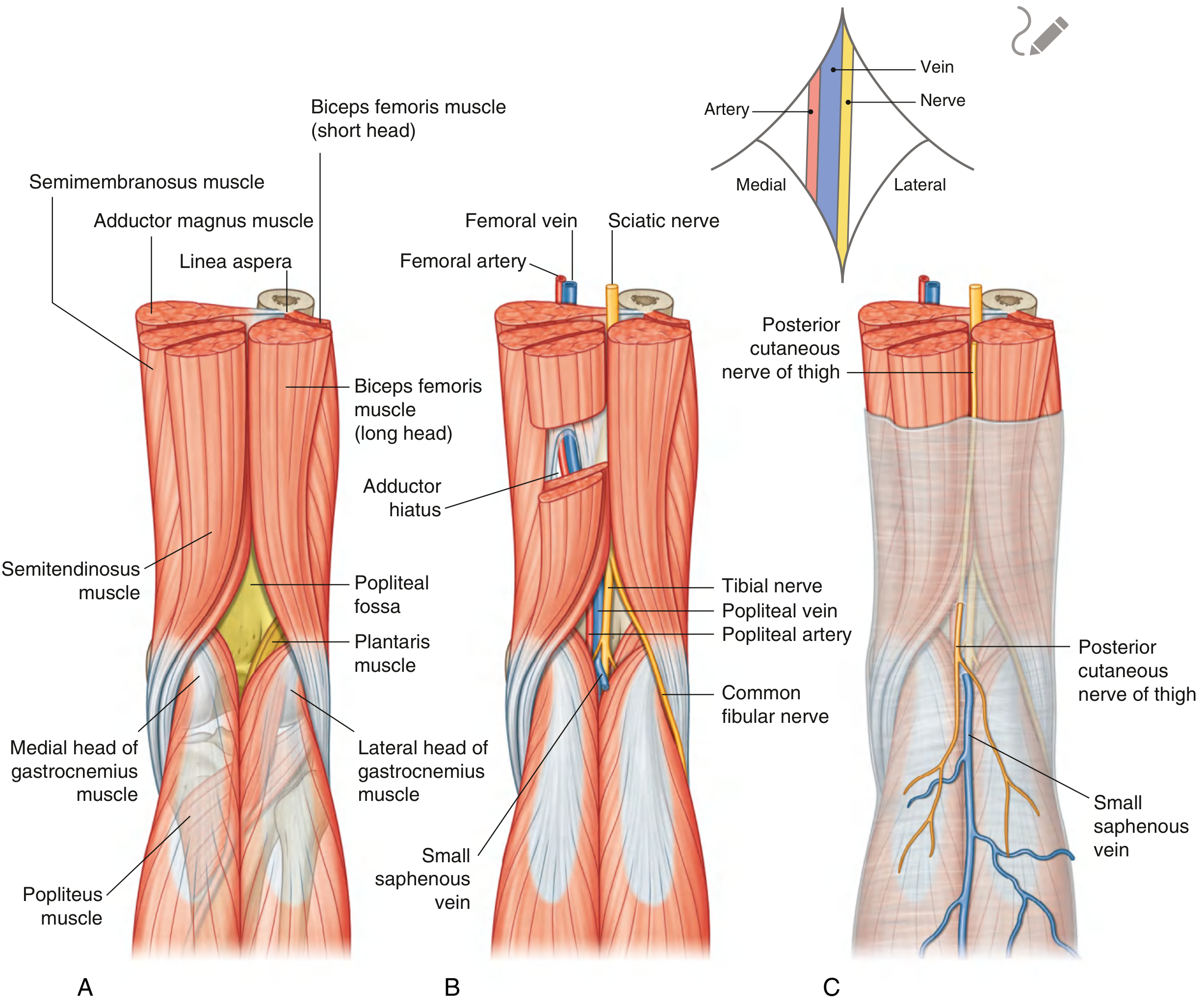
The nerves in the popliteal fossa can be divided into deep (within the fossa) and superficial (in the roof).
Deep Nerves (Contents of the Fossa)
The two major nerves are the most superficial of all the neurovascular structures in the fossa - they lie superficial to the popliteal vein, which in turn is superficial to the popliteal artery.
1. Tibial Nerve (L4, L5, S1, S2, S3)
The larger of the two terminal branches of the sciatic nerve. It enters the fossa from above, directly under the margin of the biceps femoris muscle, and descends vertically through the middle of the popliteal fossa.
Branches given off within the popliteal fossa:
- Muscular branches to:
- Gastrocnemius (both heads) - S1, S2
- Soleus - S1, S2
- Plantaris - S1, S2
- Popliteus - L4, L5, S1
- Medial sural cutaneous nerve - descends with the small saphenous vein; joins the lateral sural cutaneous nerve (from the common peroneal) at the level of the Achilles tendon to form the sural nerve, which supplies the skin of the lateral heel and lateral foot
- Articular (genicular) branches - to the knee joint capsule; articular branches pass to the superior tibiofibular joint via the nerve to popliteus
The tibial nerve then exits inferiorly, passing deep to the plantaris, and enters the posterior compartment of the leg.
2. Common Fibular (Peroneal) Nerve (L4, L5, S1, S2)
The smaller terminal branch of the sciatic nerve. It follows the biceps femoris tendon laterally, over the lower lateral margin of the popliteal fossa, and winds around the neck of the fibula to enter the lateral compartment of the leg.
Branches given off within the popliteal fossa:
- Lateral sural cutaneous nerve - supplies skin on the lateral and posterior aspects of the proximal leg
- Peroneal (fibular) anastomotic branch - joins the medial sural cutaneous nerve (tibial) to form the sural nerve
- Articular branches - to the knee joint and superior tibiofibular joint
Superficial Nerve (In the Roof / Superficial Fascia)
3. Posterior Cutaneous Nerve of the Thigh (S1, S2, S3)
Descends through the thigh superficial to the hamstrings, passes through the roof of the popliteal fossa (the deep fascia / popliteal fascia), and continues inferiorly alongside the small saphenous vein. It innervates the skin of the upper half of the back of the leg.
Relation of Nerves to Other Structures (Superficial to Deep)
From most superficial to deepest in the popliteal fossa:
- Tibial nerve (most superficial of the deep contents)
- Common fibular nerve (exits laterally)
- Popliteal vein
- Popliteal artery (deepest - adjacent to the floor)
Summary Table
| Nerve | Origin | Course | Branches in Fossa |
|---|---|---|---|
| Tibial nerve | Sciatic nerve | Descends vertically through fossa | Muscular (gastroc, soleus, plantaris, popliteus), medial sural cutaneous, articular |
| Common fibular nerve | Sciatic nerve | Follows biceps femoris tendon laterally | Lateral sural cutaneous, peroneal anastomotic, articular |
| Posterior cutaneous nerve of thigh | Sacral plexus (S1-S3) | Passes through roof (superficial fascia) | Skin of back of upper leg |
Sources: Gray's Anatomy for Students, pp. 720-722; Localization in Clinical Neurology 8e, pp. 143-144.
This is a shared conversation. Sign in to Orris to start your own chat.