
Explain eye refraction short notes
Reading File
Finding Sources
Finding Sources
Reading File
Finding Sources
Reading File
Reading File
Reading File
Loading Image
Loading Image
Reading File
I now have comprehensive content. Let me compile the short notes.
Eye Refraction — Short Notes
1. Basic Concept of Refraction
Refraction is the bending of light rays when they pass from one transparent medium into another with a different refractive index (RI).
Refractive index = velocity of light in air ÷ velocity in the substance
The degree of bending depends on:
- The ratio of refractive indices of the two media
- The angle at which light strikes the interface
2. Refracting Media of the Eye
The eye has four refractive interfaces, each between media of differing RI:
| Medium | Refractive Index |
|---|---|
| Air | 1.00 |
| Cornea | 1.38 |
| Aqueous humor | 1.33 |
| Crystalline lens (avg) | 1.40 |
| Vitreous humor | 1.34 |
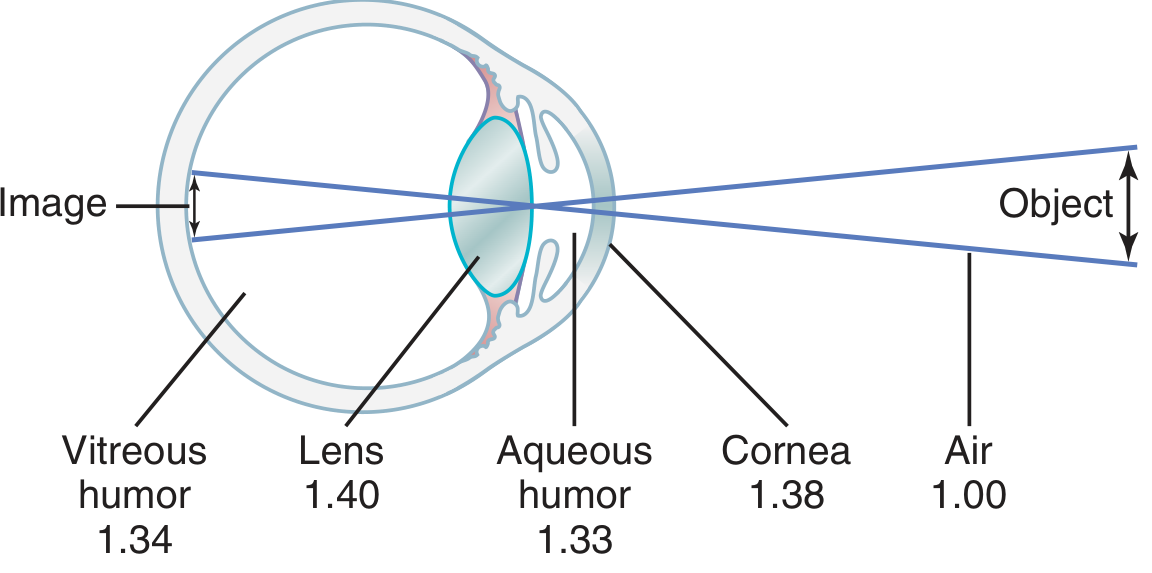
Figure: The lens system of the eye with refractive indices. — Guyton & Hall Medical Physiology
The four interfaces are:
- Air → anterior surface of cornea
- Posterior cornea → aqueous humor
- Aqueous humor → anterior lens
- Posterior lens → vitreous humor
3. Total Refractive Power
- Total refractive power of the eye = 59 diopters (for distant vision)
- ~2/3 (≈40 D) is contributed by the anterior corneal surface — because the RI difference between air and cornea is the greatest
- ~1/3 (≈20 D) is contributed by the crystalline lens — which can change its power via accommodation
The "Reduced Eye"
All refracting surfaces can be simplified into one single lens placed 17 mm in front of the retina with 59 D total power. This is called the reduced eye model.
4. Diopter (Unit of Lens Power)
A diopter is the reciprocal of the focal length in meters.
- A lens with focal length of 1 meter = +1 diopter
- Convex (converging) lenses → positive diopters
- Concave (diverging) lenses → negative diopters
5. Accommodation
The crystalline lens adjusts its curvature via ciliary muscle contraction, increasing refractive power to focus on near objects. This is called accommodation.
- For distant vision: ciliary muscle relaxed → lens flattened
- For near vision: ciliary muscle contracts → lens rounds up → refractive power increases
6. Emmetropia (Normal Refraction)
In emmetropia, parallel rays from infinity are focused exactly on the retina with the ciliary muscle relaxed. This is the ideal/normal refractive state — though enjoyed by only a minority of the population.
7. Refractive Errors (Ametropia)
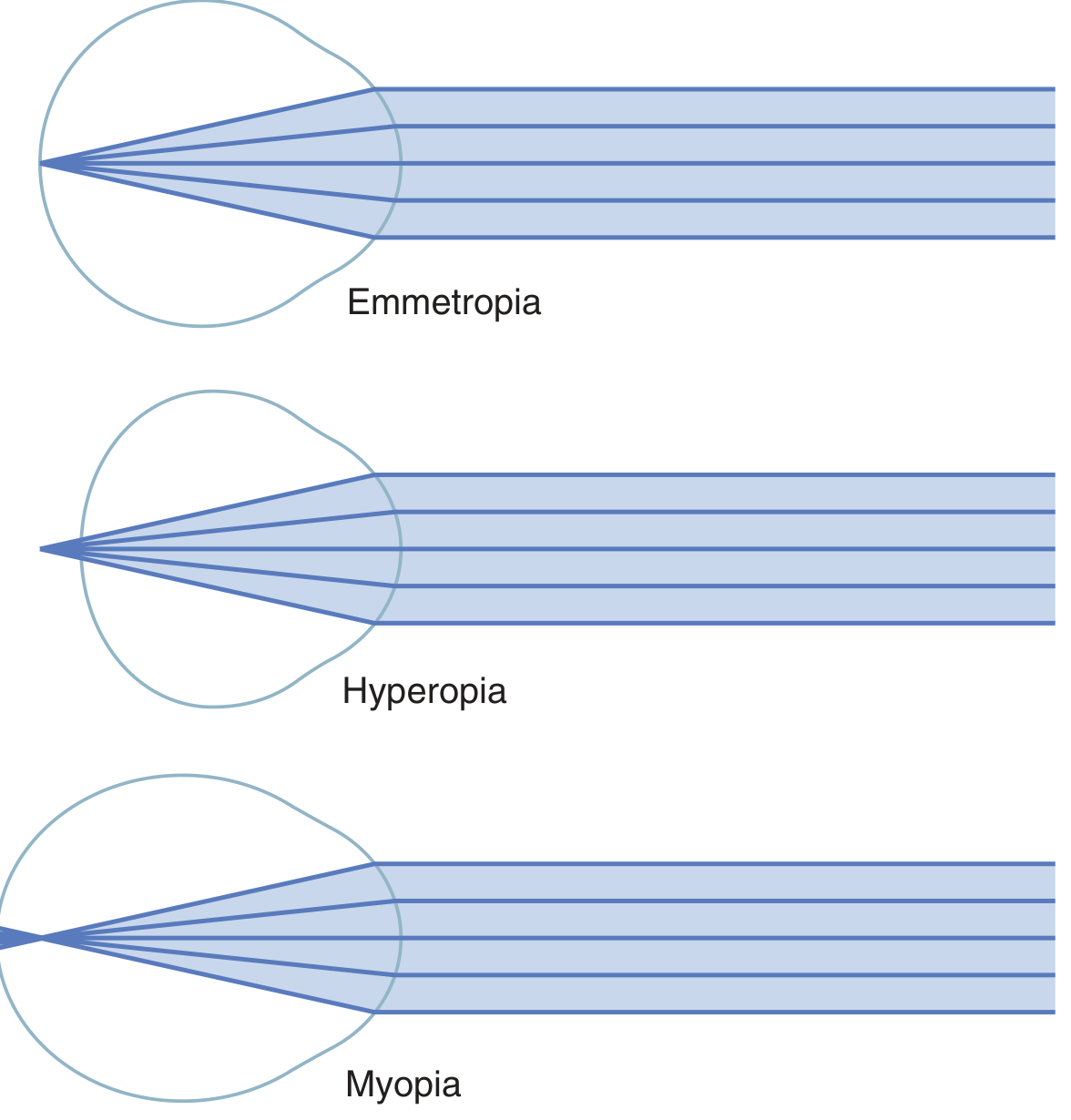
Figure: Light ray focus in emmetropia, hyperopia, and myopia. — Guyton & Hall Medical Physiology
a) Myopia (Nearsightedness)
- Eyeball is too long (or lens too powerful)
- Light focuses in front of the retina
- Distant objects blurred; near objects clear
- Correction: Concave (diverging) lens (negative diopters)
b) Hyperopia / Hypermetropia (Farsightedness)
- Eyeball is too short (or lens too weak)
- Light focuses behind the retina
- Distant objects may be seen by accommodating; near objects blurred
- Correction: Convex (converging) lens (positive diopters)
c) Astigmatism
- Cornea is not spherical — different curvature in different planes
- Light in one plane focuses at a different distance than at right angles
- Produces blurred/distorted vision in all distances
- Correction: Cylindrical lens oriented at the appropriate axis
d) Presbyopia
- Age-related loss of lens elasticity → reduced accommodative power
- Emmetropes need reading glasses; myopes may remove distance glasses to read
- Appears in middle age (typically after 40 years)
8. Clinical Testing
| Test | Use |
|---|---|
| Snellen chart (6 m / 20 ft) | Visual acuity — normal is 6/6 (20/20) |
| Pinhole test | If acuity improves through a pinhole → refractive error is the cause |
| Trial and error lens | Determine strength of corrective lens |
| Cylinder axis chart | Parallel bars at various angles to identify axis of astigmatism |
Tip: If acuity is worse than 6/240 (20/800), record as counting fingers, hand motions, or light perception.
9. Surgical Correction
When glasses/contacts are not preferred:
- LASIK (Laser in situ keratomileusis) — permanently reshapes corneal curvature
- PRK (Photorefractive keratectomy) — surface laser ablation
- Contact lenses — nullify corneal refraction by replacing the air–cornea interface with a tear film of near-equal RI to the cornea; especially useful in keratoconus
Summary Table
| Condition | Defect | Focal Point | Correction |
|---|---|---|---|
| Emmetropia | None | On retina | None |
| Myopia | Long eyeball / strong lens | In front of retina | Concave lens |
| Hyperopia | Short eyeball / weak lens | Behind retina | Convex lens |
| Astigmatism | Asymmetric corneal curvature | Different planes | Cylindrical lens |
| Presbyopia | Reduced lens elasticity | Variable | Reading glasses |
Sources: Guyton & Hall Textbook of Medical Physiology, pp. 619–626; Harrison's Principles of Internal Medicine 22E, p. 264
This is a shared conversation. Sign in to Orris to start your own chat.