
I now have all the key images and content needed. Let me compile the comprehensive MD exam answer. --- # ACID-BASE BALANCE - Comprehensive MD Exam Answer (10 Marks) --- ## 1. NORMAL ACID-BASE HOMEOSTASIS Systemic arterial pH is maintained between **7.35 and 7.45** by three integrated mechanisms: - Extracellular and intracellular **chemical buffers** (immediate, seconds) - **Respiratory regulation** of PaCO2 (minutes to hours) - **Renal regulation** of plasma HCO3- (hours to days) The relationship between these components is expressed by the **Henderson-Hasselbalch equation**: > pH = pK' + log [HCO3-] / (0.03 x PaCO2) Where pK' = 6.1, and 0.03 is the solubility coefficient of CO2. At steady state, pH = 7.4 when [HCO3-] = 24 mEq/L and PaCO2 = 40 mmHg. Normal daily acid production: ~50-70 mEq of fixed (non-volatile) acid from metabolism. --- ## 2. BUFFER SYSTEMS ### A. Bicarbonate Buffer (most important extracellular buffer) CO2 + H2O ⇌ H2CO3 ⇌ H+ + HCO3- - pKa = 6.1 (far from physiological pH, yet most effective because CO2 is an open system - lungs continuously regulate CO2) - Buffers ~50% of acid load ### B. Proteins (Hemoglobin - most important intracellular buffer) - Hb is the major intracellular buffer in blood - Deoxyhemoglobin is a better buffer than oxyhemoglobin (Haldane effect) ### C. Phosphate Buffer - HPO4²- / H2PO4- system (pKa = 6.8) - Important in urine acidification and intracellular buffering ### D. Bone Buffer - In chronic acidosis, bone carbonate and phosphate are mobilized - contributes to osteomalacia/osteoporosis --- ## 3. RESPIRATORY REGULATION The respiratory system controls PaCO2 by adjusting alveolar ventilation: - **Acidosis** → stimulates peripheral (carotid body) and central chemoreceptors → hyperventilation → decreased PaCO2 → pH rises - **Alkalosis** → decreased chemoreceptor drive → hypoventilation → increased PaCO2 → pH falls Respiratory compensation is **rapid** (minutes to hours) but **incomplete** - it returns pH toward, but not to, normal. --- ## 4. RENAL REGULATION The kidney regulates pH by: 1. **Reabsorption of filtered HCO3-** (proximal tubule: 80-85%; TAL and distal: remainder) 2. **Titratable acid excretion** (mainly as H2PO4- in distal tubule) 3. **Ammonium (NH4+) excretion** - most important for net acid excretion - Proximal tubule generates NH4+ from glutamine - NH4+ excreted in urine carries H+ out of the body Renal compensation is **slow** (days) but **complete** (fully restores pH in isolated respiratory disorders). --- ## 5. CLASSIFICATION OF ACID-BASE DISORDERS | Disorder | pH | Primary Change | Compensation | |----------|-----|---------------|--------------| | Metabolic acidosis | ↓ | HCO3- ↓ | PaCO2 ↓ (hyperventilation) | | Metabolic alkalosis | ↑ | HCO3- ↑ | PaCO2 ↑ (hypoventilation) | | Respiratory acidosis | ↓ | PaCO2 ↑ | HCO3- ↑ (renal) | | Respiratory alkalosis | ↑ | PaCO2 ↓ | HCO3- ↓ (renal) | --- ## 6. COMPENSATION FORMULAS (Critical for MD Exams) | Disorder | Expected Compensation | |----------|----------------------| | **Metabolic acidosis** | PaCO2 = 1.5 x [HCO3-] + 8 ± 2 (Winter's formula) | | **Metabolic alkalosis** | PaCO2 increases by 0.7 mmHg per 1 mEq/L rise in HCO3- | | **Acute resp. acidosis** | HCO3- increases by 1 mEq/L per 10 mmHg rise in PaCO2 | | **Chronic resp. acidosis** | HCO3- increases by 3.5 mEq/L per 10 mmHg rise in PaCO2 | | **Acute resp. alkalosis** | HCO3- falls by 2 mEq/L per 10 mmHg fall in PaCO2 | | **Chronic resp. alkalosis** | HCO3- falls by 5 mEq/L per 10 mmHg fall in PaCO2 (only disorder where pH fully normalizes) | - Harrison's Principles of Internal Medicine 22E, p. 411 --- ## 7. ACID-BASE NOMOGRAM The Davenport/acid-base nomogram plots pH vs. HCO3- with PCO2 isobars, showing 95% confidence bands for each simple disorder: 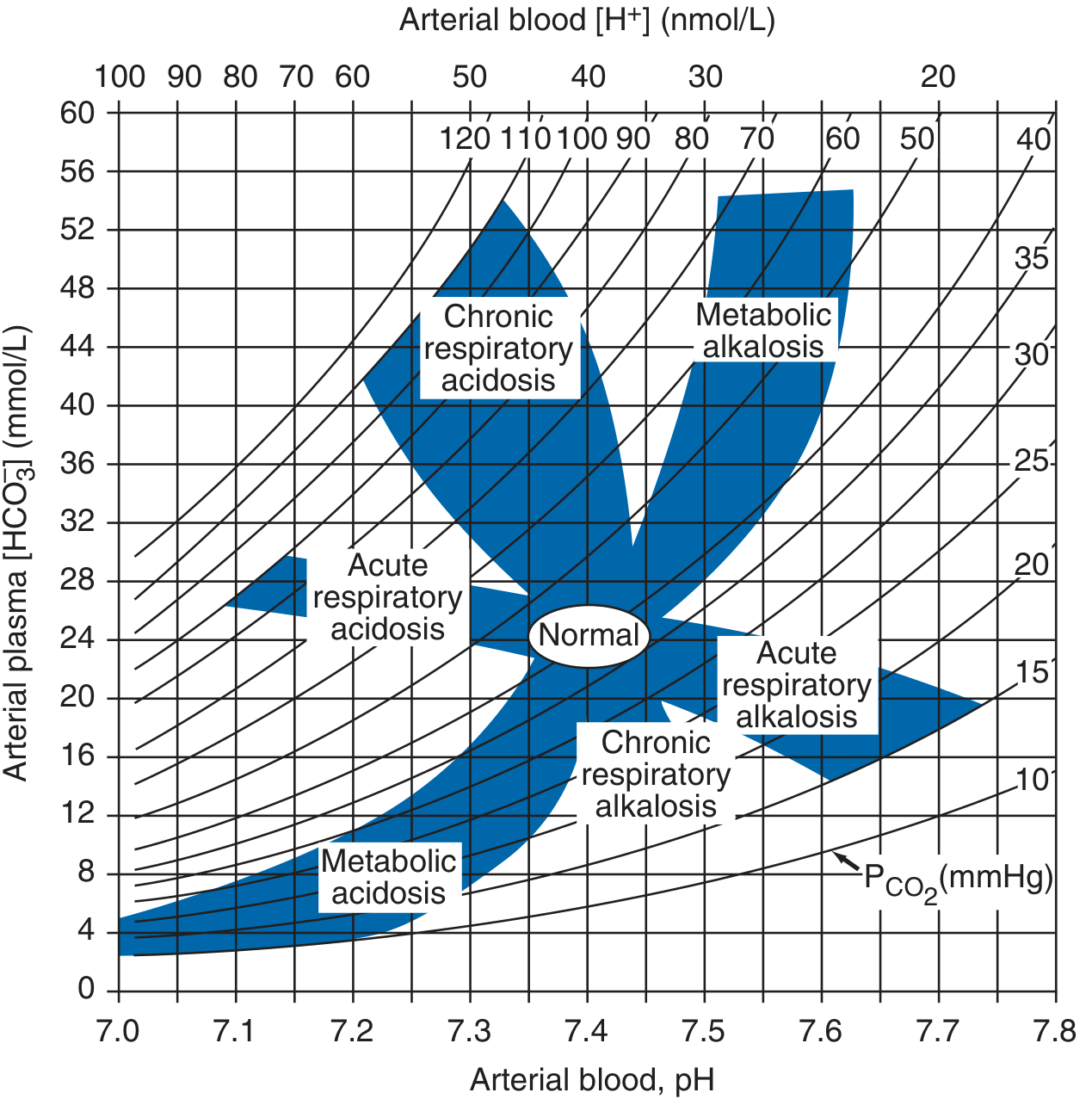 *Acid-base nomogram (Harrison's Principles of Internal Medicine 22E) - shaded zones represent 95% confidence limits for simple disorders* --- ## 8. METABOLIC ACIDOSIS ### Definition Primary fall in plasma HCO3- (< 22 mEq/L), with compensatory fall in PaCO2. ### Causes - classified by Anion Gap **Anion Gap (AG) = Na+ - (Cl- + HCO3-)** - Normal AG = 6-12 mEq/L (average ~10 mEq/L) - Corrected AG: add 2.5 mEq/L per 1 g/dL fall in serum albumin below 4.5 g/dL **High Anion Gap (HAGMA)** - mnemonic **MUDPILES**: - **M** - Methanol - **U** - Uraemia (renal failure) - **D** - DKA (diabetic ketoacidosis) - **P** - Propylene glycol / Paraldehyde - **I** - Isoniazid / Iron - **L** - Lactic acidosis (type A: tissue hypoxia; type B: metformin, liver failure) - **E** - Ethylene glycol - **S** - Salicylates **Normal Anion Gap (hyperchloraemic) acidosis** - mnemonic **HARD-UP**: - Diarrhoea (most common - loss of HCO3-) - Renal tubular acidosis (types 1, 2, 4) - Ureterosigmoidostomy - Addison's disease - Post-hypocapnia - Carbonic anhydrase inhibitors (acetazolamide) **Delta Ratio** (for HAGMA) = (AG - 12) / (24 - HCO3-) - <0.4: pure normal AG acidosis - 0.4-0.8: mixed HAGMA + normal AG acidosis - 1-2: pure HAGMA - >2: HAGMA + concurrent metabolic alkalosis ### Clinical Features - Kussmaul breathing (deep, rapid - compensatory hyperventilation in severe metabolic acidosis) - Decreased cardiac contractility, hypotension - Decreased insulin sensitivity, hyperkalaemia - Confusion, lethargy, coma ### Treatment - Treat underlying cause - NaHCO3 rarely needed; use if pH < 7.1 or severe acidaemia with haemodynamic compromise --- ## 9. METABOLIC ALKALOSIS ### Definition Primary rise in plasma HCO3- (>26 mEq/L), with compensatory hypoventilation (PaCO2 rises). ### Causes **Chloride-responsive (urine Cl- <10 mEq/L):** - Vomiting/nasogastric suction (loss of HCl) - Diuretics (thiazides, loop) - Post-hypercapnia - Villous adenoma **Chloride-resistant (urine Cl- >20 mEq/L):** - Hyperaldosteronism (primary/secondary) - Cushing's syndrome - Bartter's/Gitelman's syndrome - Severe hypokalaemia ### Maintenance factors - Volume depletion → increased aldosterone → renal HCO3- retention - Hypokalaemia → increased renal H+ secretion ### Treatment - Chloride-responsive: IV saline (0.9%) + KCl; correct the underlying cause - Chloride-resistant: treat underlying mineralocorticoid excess --- ## 10. RESPIRATORY ACIDOSIS ### Definition Primary rise in PaCO2 (>45 mmHg) with compensatory rise in HCO3-. ### Causes (hypoventilation) | CNS depression | Opiates, sedatives, anaesthesia, brainstem lesion | |----------------|--------------------------------------------------| | Neuromuscular | Myasthenia gravis, GBS, poliomyelitis, MND | | Airway obstruction | COPD, severe asthma, foreign body | | Chest wall | Kyphoscoliosis, obesity hypoventilation | | Parenchymal | End-stage pulmonary fibrosis | ### Acute vs Chronic - **Acute**: HCO3- rises by 1 mEq/L per 10 mmHg rise in PaCO2; pH falls markedly - **Chronic**: HCO3- rises by 3.5 mEq/L per 10 mmHg rise in PaCO2; pH nearly normal ### Treatment - Treat the cause - Mechanical ventilation if severe - Oxygen cautiously in COPD (avoid eliminating hypoxic drive) --- ## 11. RESPIRATORY ALKALOSIS ### Definition Primary fall in PaCO2 (<35 mmHg) with compensatory fall in HCO3-. ### Causes (hyperventilation) - Anxiety, psychogenic - Hypoxaemia (pneumonia, PE, high altitude, severe anaemia) - Sepsis (early) - most common cause of resp. alkalosis in ICU - CNS stimulation (salicylates, fever, head injury) - Pregnancy (progesterone effect) - Liver failure (hepatic encephalopathy) - Iatrogenic (mechanical ventilation) ### Compensation - Acute: HCO3- falls 2 mEq/L per 10 mmHg fall in PaCO2 - Chronic: HCO3- falls 5 mEq/L per 10 mmHg fall - only disorder where full pH compensation can occur ### Clinical Features - Paraesthesias (perioral, fingertips), carpopedal spasm - Lightheadedness, syncope - Decreased ionised calcium (alkalosis increases protein binding of Ca2+) --- ## 12. MIXED ACID-BASE DISORDERS Defined as independently coexisting disorders (not just compensation). Common in critically ill patients. 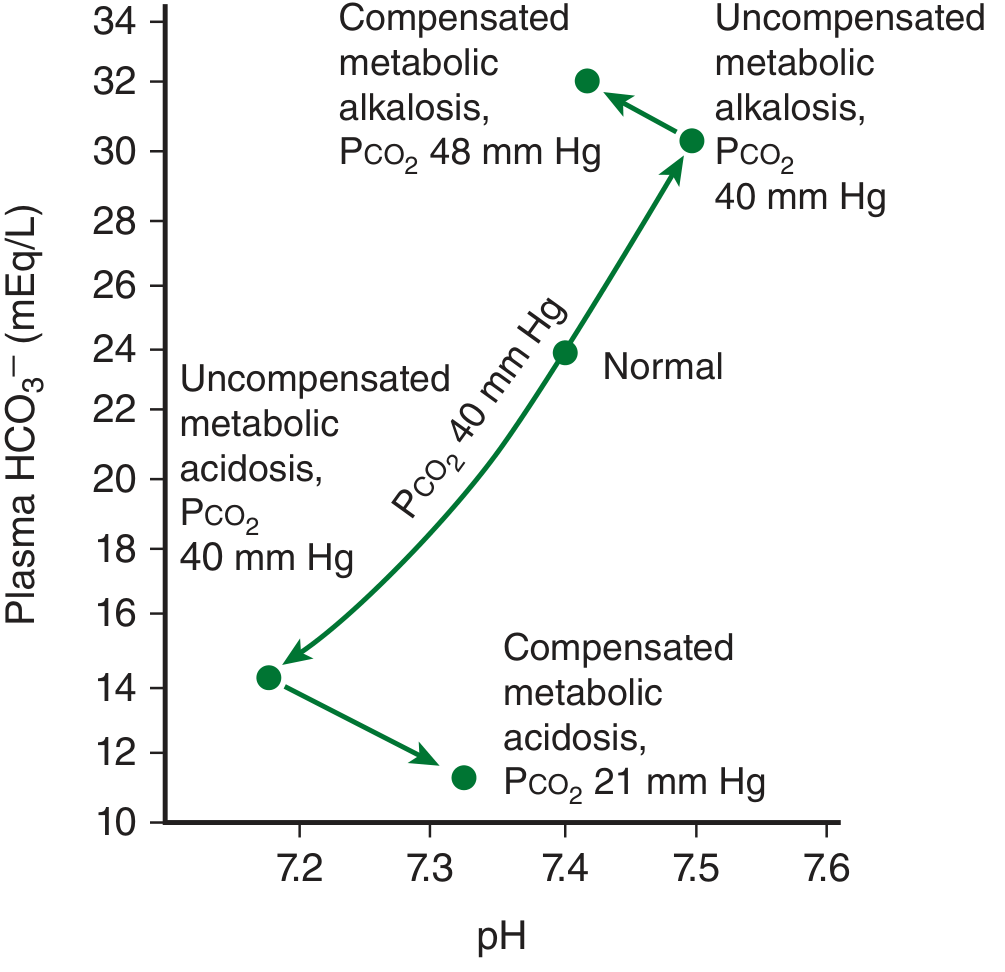 *Acid-base paths during metabolic acidosis and alkalosis (Ganong's Review of Medical Physiology, 26th Ed.)* | Mixed Disorder | pH change | Example | |---------------|-----------|---------| | Met. acidosis + Resp. acidosis | Severe ↓↓ | Cardiac arrest, severe COPD + DKA | | Met. acidosis + Resp. alkalosis | May be near normal | Sepsis + shock, salicylate poisoning | | Met. alkalosis + Resp. acidosis | May be near normal | COPD + diuretics/vomiting | | Met. acidosis + Met. alkalosis | pH variable | DKA + vomiting | **Key:** If PaCO2 deviates from the predicted compensation (using Winter's formula or compensation table), a mixed disorder is present. --- ## 13. SYSTEMATIC APPROACH TO ABG INTERPRETATION (Step-by-Step) 1. **Check pH** - acidaemia (<7.35) or alkalaemia (>7.45)? 2. **Check PaCO2** - elevated, normal, or low? 3. **Check HCO3-** - elevated, normal, or low? 4. **Identify the primary disorder** - which change (CO2 or HCO3-) explains the pH direction? 5. **Calculate expected compensation** - using formulas above 6. **Compare actual vs. expected compensation** - deviation = mixed disorder 7. **Calculate Anion Gap** - if metabolic acidosis present 8. **Calculate Delta Ratio** - if HAGMA present 9. **Correlate with clinical context** --- ## 14. KEY NORMAL VALUES (Reference) | Parameter | Normal Range | |-----------|-------------| | Arterial pH | 7.35-7.45 | | PaCO2 | 35-45 mmHg | | HCO3- | 22-26 mEq/L | | PaO2 | 80-100 mmHg | | Base excess | -2 to +2 mEq/L | | Anion Gap | 6-12 mEq/L | --- ## 15. SPECIAL TOPICS FOR MD EXAMS ### Renal Tubular Acidosis (RTA) - Normal AG acidosis | Type | Defect | Urine pH | K+ | Cause | |------|--------|----------|----|-------| | Type 1 (Distal) | Failure to acidify urine | >5.5 | Low | SLE, Sjogren's, amphotericin | | Type 2 (Proximal) | Failure to reabsorb HCO3- | <5.5 | Low | Multiple myeloma, Wilson's | | Type 4 | Aldosterone deficiency/resistance | <5.5 | **High** | DM nephropathy, Addison's | ### Lactic Acidosis - **Type A**: Tissue hypoperfusion - shock, cardiac arrest, severe anaemia, CO poisoning - **Type B**: No obvious hypoperfusion - metformin toxicity, liver failure, thiamine deficiency, malignancy ### Salicylate Poisoning - Classic Mixed Disorder - Early: Respiratory alkalosis (direct CNS stimulation) - Late: Metabolic acidosis (HAGMA) + Respiratory alkalosis simultaneously - Classic exam scenario --- **Sources:** Harrison's Principles of Internal Medicine 22E (2025), Ganong's Review of Medical Physiology 26th Ed., Medical Physiology (Boron & Boulpaep)