
Abnormal head sweating
Reading File
Finding Sources
Finding Sources
Searching PubMed
craniofacial hyperhidrosis
Searching the Web
abnormal head sweating causes gustatory sweating craniofacial hyperhidrosis
Reading File
Reading File
Reading File
Reading File
Abnormal Head Sweating (Craniofacial Hyperhidrosis)
Excessive or unusual sweating localized to the head, face, or scalp is called craniofacial hyperhidrosis. It can be a primary (essential) condition or a symptom of an underlying disease. Below is a structured overview of causes, key patterns to recognize, and management.
1. Primary (Essential) Craniofacial Hyperhidrosis
- Idiopathic, focal, bilaterally symmetric sweating of the face/scalp, usually starting before age 25.
- Triggered by heat, emotion, or exercise; absent during sleep.
- Thought to result from overactive sympathetic cholinergic innervation of facial sweat glands, sometimes with a positive family history (~25% of cases) - Bradley and Daroff's Neurology in Clinical Practice, p. 2718-2731.
2. Gustatory Sweating (Frey Syndrome) - a key differential
Facial/scalp sweating specifically triggered by eating, most classically:
- Physiologic: mild sweating on the lips, forehead, nose when eating hot/spicy food (trigeminovascular reflex).
- Pathologic (Frey syndrome): asymmetric, intense sweating and flushing in the auriculotemporal nerve distribution, occurring after parotid gland surgery/trauma (parotidectomy), due to aberrant regeneration of parasympathetic secretomotor fibers that get rerouted to cutaneous sweat glands instead of salivary tissue. Also reported after birth trauma (forceps delivery in infants), cervical sympathectomy, facial zoster, chorda tympani injury, cluster headache, and diabetic autonomic neuropathy - Fitzpatrick's Dermatology, p. 2933-2939; Bailey and Love's Short Practice of Surgery, p. 2921-2926.
- Diagnosed with the Minor starch-iodine test, which turns dark blue/black over sweating skin.
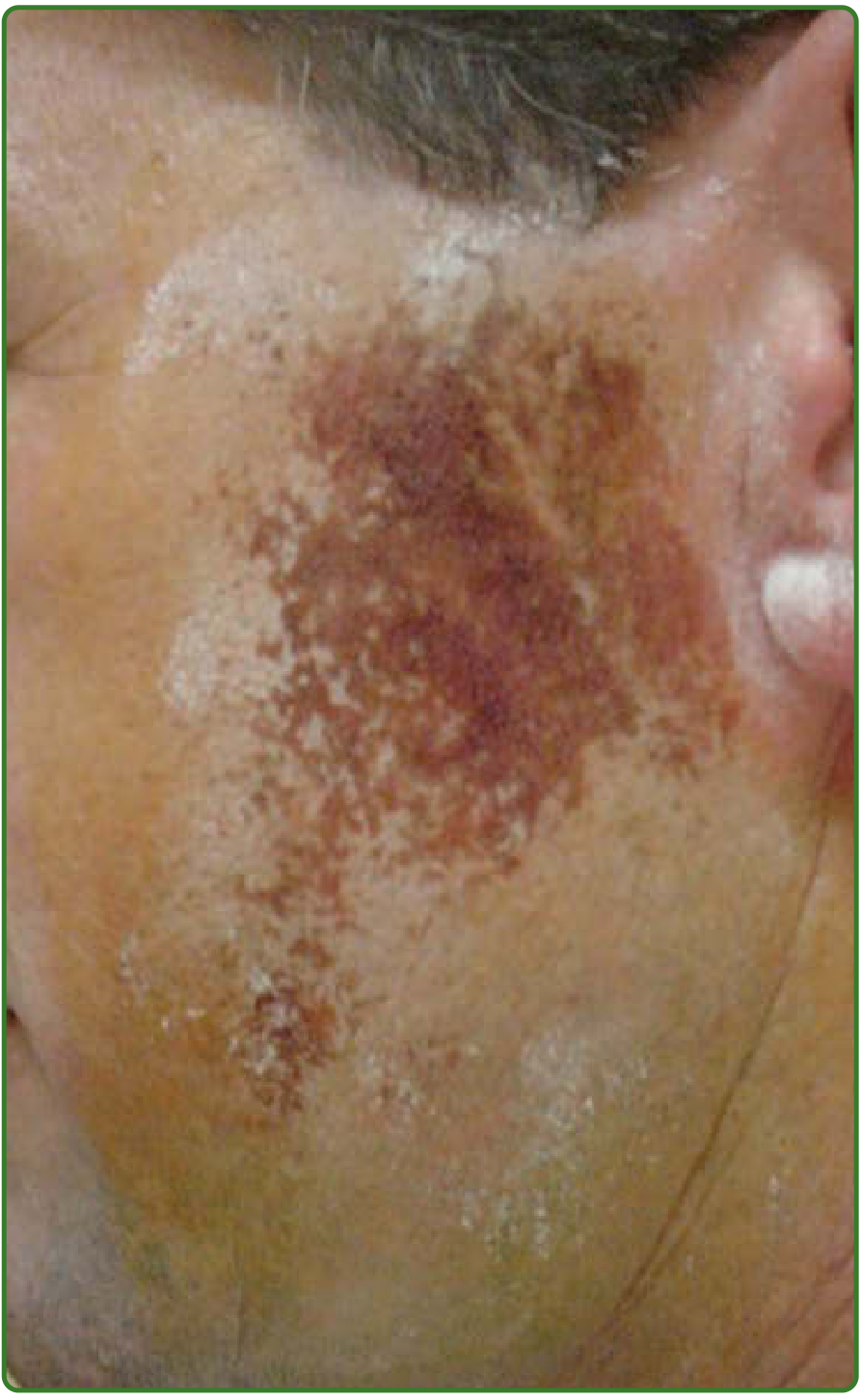
3. Secondary Causes to Rule Out
Because new-onset abnormal head sweating in an adult should prompt evaluation for an underlying cause, consider:
| Category | Examples |
|---|---|
| Endocrine | Hyperthyroidism, diabetes mellitus (autonomic neuropathy), pheochromocytoma, carcinoid syndrome, acromegaly, menopause |
| Neurologic | Autonomic dysfunction/dysautonomia, stroke (post-cerebral infarct causing loss of contralateral sweating inhibition), Parkinson's disease, spinal cord injury, complex regional pain syndrome, cluster headache (with ipsilateral facial sweating as part of autonomic features), Raeder/Horner-associated syndromes |
| Post-surgical/traumatic | Frey syndrome after parotidectomy, cervical/thoracic sympathectomy (compensatory sweating - loss of sweating in one region can cause hyperhidrosis elsewhere, sometimes affecting the head/face) |
| Infectious/inflammatory | Fever states, tumor-related cytokine release |
| Toxic/withdrawal | Delirium tremens, sympathomimetic excess |
| Medication/hormonal | Certain drugs (e.g., nifedipine, sublingual captopril triggering autonomic dysreflexia in susceptible patients) |
| Paroxysmal localized hyperhidrosis | A distinct daytime, episodic sweating of head/neck/upper trunk seen mainly in postmenopausal women, unrelated to hot flashes and unresponsive to hormone therapy - Fitzpatrick's Dermatology, p. 2951-2954 |
Source: Bradley and Daroff's Neurology in Clinical Practice (Table 107.1, p. 2718-2733); Localization in Clinical Neurology, p. 4261-4277.
4. Clinical Evaluation
- History: onset age, symmetry, triggers (food vs. heat vs. emotion), timing (daytime vs. nocturnal/sleep - secondary causes often persist during sleep, primary hyperhidrosis typically does not), associated flushing, weight loss, palpitations, menopausal status, prior parotid/neck surgery.
- Exam/tests: starch-iodine test to map affected areas; targeted labs if secondary cause suspected (TSH, fasting glucose/HbA1c, catecholamines/metanephrines if pheochromocytoma suspected).
5. Treatment Options
- Topical: glycopyrrolate (anticholinergic) or aluminum chloride antiperspirants.
- Botulinum toxin A injections: effective for both essential craniofacial hyperhidrosis and Frey syndrome; effects last roughly 4-12 months.
- Oral agents: systemic anticholinergics (e.g., oral glycopyrrolate), clonidine for paroxysmal localized hyperhidrosis.
- Surgical: rarely, tympanic neurectomy or endoscopic thoracic sympathectomy for refractory cases (sympathectomy carries a risk of causing compensatory hyperhidrosis elsewhere).
- Treat the underlying secondary cause when identified (e.g., thyroid disease, diabetes management).
Recent Evidence Note
A 2020 review ("Current treatment options for craniofacial hyperhidrosis," PMID: 34211510) confirms botulinum toxin and topical/oral anticholinergics as mainstays, and separately classifies gustatory (Frey) sweating from primary craniofacial hyperhidrosis and compensatory sweating after sympathectomy - consistent with the textbook material above, no contradictions found. Case reports (PMID: 29238998, 22571572) also support postmenopausal craniofacial hyperhidrosis as a distinct, likely hormonally-mediated secondary pattern.
If you're asking about this for yourself or a patient, it would help to know: is the sweating triggered by eating (suggests gustatory sweating/Frey syndrome, especially with any prior neck/parotid surgery), does it happen during sleep (suggests a secondary cause), or is it a lifelong pattern with heat/emotion triggers (suggests primary essential hyperhidrosis)? Let me know if you want me to narrow this down to a specific scenario.
For frontal region alone
Finding Sources
Finding Sources
Searching the Web
forehead sweating only causes unilateral frontal hyperhidrosis differential diagnosis
Reading File
Sweating Confined to the Frontal Region (Forehead) Alone
Isolated forehead sweating is a recognized, more specific pattern within craniofacial hyperhidrosis. It can be physiologic, primary/idiopathic, or a localizing clue to autonomic/neurologic pathology - especially when unilateral.
1. Physiologic Forehead Sweating
- Normal thermoregulatory sweating actually begins on the forehead first before spreading to other body sites, because forehead eccrine glands have a low threshold for thermal activation - Histology: A Text and Atlas, p. 2656-2663.
- Emotional sweating is typically confined to palms, soles, axillae, and forehead - so stress-induced forehead sweating alone is common and benign - Fitzpatrick's Dermatology, p. 3455.
- Physiologic gustatory sweating: mild forehead/upper-lip sweating a few minutes after spicy or hot food/drink, via a trigeminal-taste-to-medullary reflex; bilateral, brief, no other symptoms - Dermatology 2-Volume Set, p. 924-926.
2. Bilateral Pathologic Forehead Sweating
- Primary craniofacial hyperhidrosis: excessive, symmetric forehead/scalp sweating from a young age, triggered by heat/emotion, absent during sleep, sometimes familial.
- Frontal hyperhidrosis as a distinct treatment target has been specifically described and successfully treated with botulinum toxin A - Fitzpatrick's Dermatology references, p. 3097-3108; case reports confirm forehead/scalp response to Botox (PMID: 18086602).
- Paroxysmal localized hyperhidrosis: episodic daytime forehead/neck/upper-trunk sweating in postmenopausal women, distinct from hot flashes and unresponsive to hormone therapy.
3. Unilateral Forehead Sweating - Think Neurologic/Autonomic
This is the pattern that most often signals an underlying lesion rather than a benign disorder:
| Condition | Mechanism | Key associated features |
|---|---|---|
| Cluster headache / trigeminal autonomic cephalalgia | Sympathetic deficit impairs normal thermoregulatory sweating on the affected forehead side; misdirected parasympathetic fibers (normally to lacrimal glands) cause paradoxical ipsilateral hyperhidrosis and flushing during attacks | Ipsilateral lacrimation, conjunctival injection, ptosis/miosis, nasal congestion, severe periorbital pain |
| Raeder (paratrigeminal) syndrome | Horner syndrome (ptosis, miosis +/- anhidrosis) plus unilateral temporofrontal headache; excessive supraorbital "lacrimal sweating" can occur | Facial pain in ophthalmic (V1) distribution, otherwise intact facial sweating |
| Harlequin/compensatory sweating | Horner's syndrome causes anhidrosis on one side of the face; the contralateral side (including forehead) compensates with hyperhidrosis | Exam must compare both sides - the sweaty side is often the "normal" compensating side, not the lesioned one |
| Idiopathic unilateral focal hyperhidrosis | Isolated patch of profuse sweating, most often forehead or one wrist, without an identifiable neurologic lesion | Normal neuro exam; skin biopsy may show eccrine nevus-like changes |
| Auriculotemporal (Frey) or chorda tympani syndrome variants | Aberrant parasympathetic regeneration after parotid/facial nerve injury; usually cheek/temple but can extend to lower forehead | Triggered specifically by eating/salivation, history of parotid surgery or trauma |
| Cervical sympathetic trunk injury/lesion (e.g., neck trauma, tumor, syringomyelia) | Disruption of sympathetic supply to face causes ipsilateral anhidrosis, contralateral compensatory forehead hyperhidrosis | Look for accompanying Horner's triad |
Any asymmetric sweating pattern should prompt a neurological cause to be actively excluded, and the contralateral (often anhidrotic) side should always be examined for a Horner's-type deficit - Bradley and Daroff's Neurology in Clinical Practice, p. 2718-2733; supported by current clinical reviews on hyperhidrosis.
4. Practical Approach
- Bilateral, longstanding, worse with heat/stress, sleep-sparing -> favor primary/essential craniofacial hyperhidrosis or emotional sweating.
- Bilateral, food-triggered, brief -> physiologic gustatory sweating.
- Unilateral -> examine for Horner's signs, headache pattern (cluster/TACs), prior parotid or neck surgery/trauma, and consider imaging or neurology referral if no clear precipitant.
- New-onset in an adult, especially with systemic symptoms (weight loss, palpitations, flushing) -> screen for secondary causes (thyroid function, glucose/HbA1c, consider pheochromocytoma if paroxysmal and severe).
Treatment (frontal-specific considerations)
- Topical glycopyrrolate or aluminum chloride for mild cases.
- Botulinum toxin A injections work well for isolated frontal hyperhidrosis, but injectors must be cautious of diffusion causing forehead muscle asymmetry (brow ptosis) as a described side effect.
- Treat the underlying trigger if a secondary/neurologic cause (e.g., cluster headache prophylaxis, addressing the Horner's lesion) is identified rather than treating the sweating in isolation.
No recent systematic reviews or meta-analyses (last 2 years) were found that contradict this - the pubmed search on craniofacial/frontal hyperhidrosis returned only reviews and case reports consistent with the textbook material above.
This is a shared conversation. Sign in to Orris to start your own chat.