
Someone with a stroke, 54 years male, and family history of high cholesterol and blood pressure. Differential diagnosis for this patient.
"ischemic stroke" AND "differential diagnosis"
Differential Diagnosis: 54-Year-Old Male Presenting with Stroke + FHx Hypertension & Hypercholesterolemia
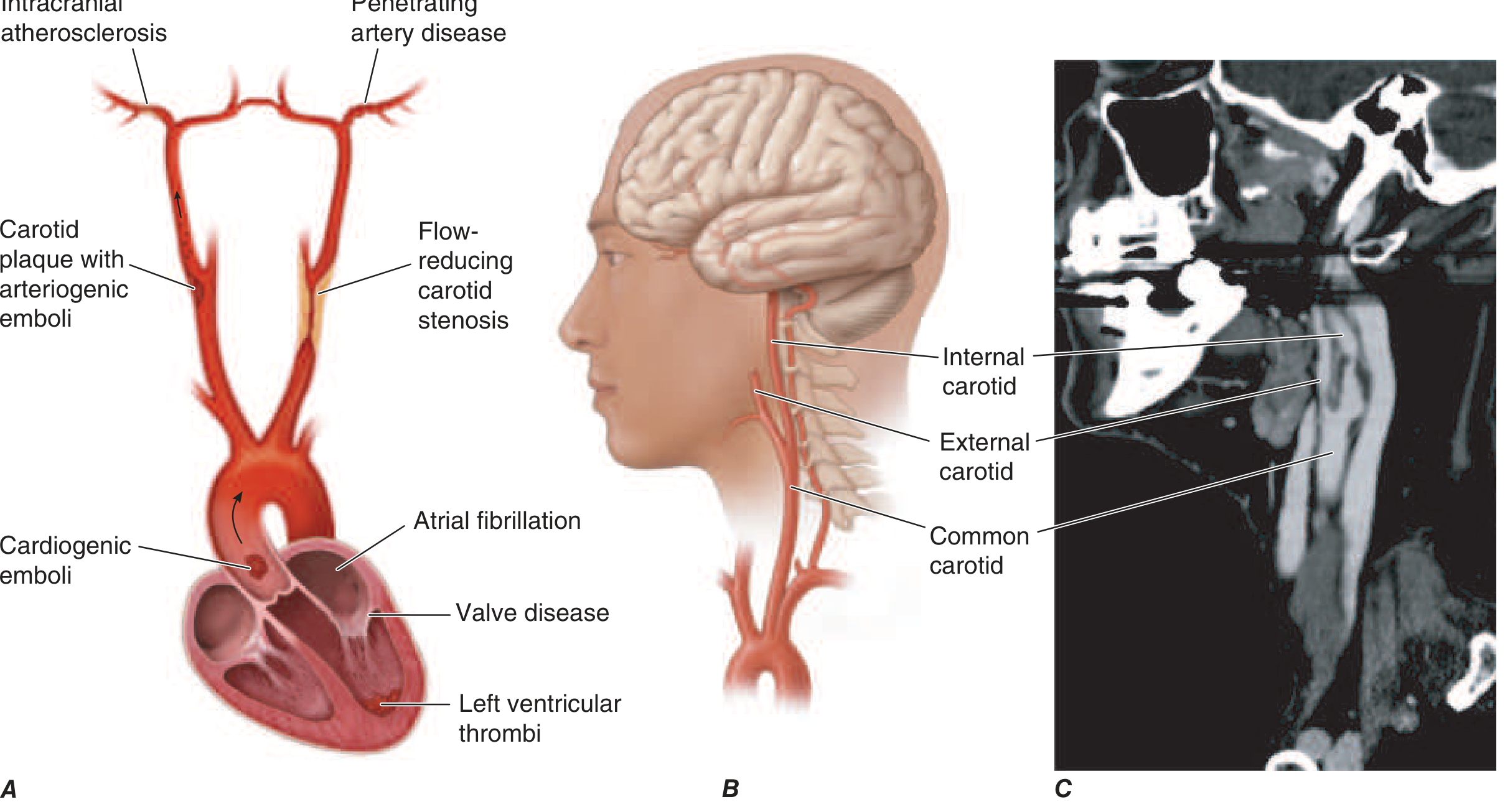
Part 1 — Stroke Subtypes (What Type of Stroke?)
A. Ischemic Stroke (~85% of all strokes)
| Subtype | Mechanism | Relevance to This Patient |
|---|---|---|
| Large-artery atherosclerosis | Carotid/vertebral stenosis → artery-to-artery embolism or flow reduction | Most likely — hypertension + hypercholesterolemia = classic atherosclerotic risk profile |
| Lacunar (small vessel) | Lipohyalinosis of penetrating arteries from chronic hypertension | Highly relevant — family Hx of HTN; presents as pure motor, pure sensory, or ataxic hemiparesis |
| Cardioembolic | Atrial fibrillation (most common), LV thrombus, valvular disease, cardiomyopathy | Must be excluded — AF accounts for ~20% of ischemic strokes; ECG mandatory |
| Other determined etiology | Hypercoagulable states (antiphospholipid syndrome, protein C/S deficiency), vasculitis, dissection | Less likely at 54 but should be considered if no clear atheroembolic cause |
| Cryptogenic (undetermined) | ~30% of strokes remain unexplained despite workup | Diagnosis of exclusion |
"Focus should be on atrial fibrillation and carotid atherosclerosis, because these etiologies have proven secondary prevention strategies." — Harrison's Principles of Internal Medicine 22E, p. 3487
B. Hemorrhagic Stroke (~15% of all strokes)
| Subtype | Key Features |
|---|---|
| Intracerebral hemorrhage (ICH) | Hypertension is the #1 cause; rupture of Charcot-Bouchard microaneurysms in basal ganglia, thalamus, pons, cerebellum |
| Subarachnoid hemorrhage (SAH) | Sudden onset "thunderclap" worst-of-life headache; rupture of saccular aneurysm |
| Subdural/Epidural hematoma | Trauma history; anticoagulant use; may mimic stroke |
Part 2 — Stroke Mimics (Rule Out First)
| Mimic | Distinguishing Feature |
|---|---|
| Hypoglycemia | Bedside glucose — must be excluded immediately before any intervention |
| Hypertensive encephalopathy (PRES) | Gradual onset, global dysfunction, headache, elevated BP, diffuse edema on imaging |
| Todd's paralysis (post-ictal) | Transient hemiparesis after seizure; seizures can themselves be caused by stroke |
| Complicated migraine | History of migraines, preceding aura — but new onset at 54 is a red flag |
| Brain tumor/abscess | Focal findings, may have subacute onset; detected on CT/MRI |
| Subdural hematoma | Trauma or anticoagulation history; crescentic hyperdensity on CT |
| Meningitis/encephalitis | Fever, neck stiffness, CSF analysis confirms |
| Demyelinating disease (MS) | Uncommon at 54 as new presentation; MRI white matter lesions |
| Wernicke's encephalopathy | Triad of ataxia, ophthalmoplegia, confusion; alcoholism/malnutrition hx |
| Conversion disorder | Non-anatomic deficits, normal imaging |
| Labyrinthitis / Ménière's | Predominantly vestibular; no other focal neurologic signs (can mimic cerebellar stroke) |
Part 3 — Risk Factor-Driven Priorities for This Patient
| Risk Factor | Most Likely Diagnosis It Points To |
|---|---|
| Family Hx Hypertension | Lacunar infarct, ICH (hypertensive), carotid atherosclerosis |
| Family Hx Hypercholesterolemia | Large-artery atherosclerosis (carotid stenosis, intracranial atherosclerosis) |
| 54-year-old male | Atherosclerosis peaks in this demographic; atrial fibrillation also common |
Immediate Workup to Narrow the Differential
- Non-contrast CT head — first step: differentiates hemorrhagic from ischemic; rules out mass lesion
- Blood glucose (stat) — excludes hypoglycemia mimic
- ECG + cardiac telemetry — identifies AF as cardioembolic source
- MRI brain with DWI — most sensitive for acute ischemia; identifies lacunar vs. cortical patterns
- CT/MRI angiography — carotid and intracranial vessels; identifies stenosis or dissection
- Lipid panel, HbA1c, CBC, ESR, coagulation studies
- Echocardiogram — left atrial thrombus, patent foramen ovale, valvular disease
- Holter monitor / extended cardiac monitoring — paroxysmal AF
Summary Ranking for This Patient
- Atherothrombotic large-artery disease (carotid atherosclerosis) — most likely given HTN + hypercholesterolemia FHx
- Lacunar infarct (small vessel disease from chronic hypertension)
- Cardioembolic stroke (atrial fibrillation — must actively exclude)
- Hypertensive intracerebral hemorrhage — possible; excludes with CT
- Cryptogenic stroke — diagnosis of exclusion
- Stroke mimic — hypoglycemia, hypertensive encephalopathy — rule out immediately
Create a diagnostic flowchart for ischemic vs hemorrhagic vs mimic stroke
A detailed clinical diagnostic flowchart for differentiating stroke types: Ischemic Stroke vs Hemorrhagic Stroke vs Stroke Mimics. The flowchart starts at the top with "Acute Neurological Deficit" as the entry point, then flows down through these decision nodes: Step 1: "Immediate Assessment" box with: ABCs, Vital signs, Blood glucose (fingerstick), Time of onset, GCS score Step 2: Diamond decision node "Blood Glucose < 3.5 mmol/L?" → YES branch goes RIGHT to green box "HYPOGLYCEMIA MIMIC → Give Dextrose IV → Reassess" Step 3 (NO path continues down): Diamond "NIHSS Score & Clinical Features" → Two branches: - LEFT: "Thunderclap headache? Meningism? LOC at onset?" → YES → Orange box "Suspect SAH → Urgent CT → LP if CT negative" - RIGHT: "Seizure activity? Fever? Gradual onset? Drug history?" → YES → Yellow box "STROKE MIMICS → Todd's paralysis, Encephalitis, Hypertensive encephalopathy, Brain tumor, Conversion disorder" Step 4 (main path): Large box "URGENT NON-CONTRAST CT HEAD" Step 5: Three-way split diamond "CT Result?": - LEFT branch (RED): "Hyperdense lesion / Blood visible" → "HEMORRHAGIC STROKE" red box → Two sub-boxes: "Intracerebral Hemorrhage (ICH): Hypertensive, Amyloid angiopathy, AVM" and "Subarachnoid Hemorrhage (SAH): Aneurysm rupture" - CENTER branch (BLUE): "No blood / Early ischemic changes / Normal" → "ISCHEMIC STROKE" blue box → Four sub-boxes: "1. Large Artery Atherosclerosis (carotid/intracranial stenosis)", "2. Cardioembolic (AF, LV thrombus, valvular)", "3. Lacunar/Small Vessel (hypertension)", "4. Cryptogenic (~30%)" - RIGHT branch (YELLOW): "Atypical findings / Mass lesion" → "FURTHER IMAGING: MRI Brain, Contrast CT" → leads to Stroke Mimics box Below the ISCHEMIC box: "Further workup: MRI DWI, CT/MR Angiography, ECG, Echo, Lipid panel, Holter monitor" Below HEMORRHAGIC box: "Further workup: CT Angiography (CTA), Neurosurgery consult, BP control, Reverse anticoagulation" At the bottom: Management boxes for each pathway in respective colors. Use clean medical/clinical design with white background, clear arrow connections, color-coded boxes (red for hemorrhagic, blue for ischemic, yellow for mimics, green for resolved mimics, gray for assessment steps). Professional sans-serif font. Clear hierarchy and spacing. Title at top: "Diagnostic Flowchart: Acute Stroke Differentiation"
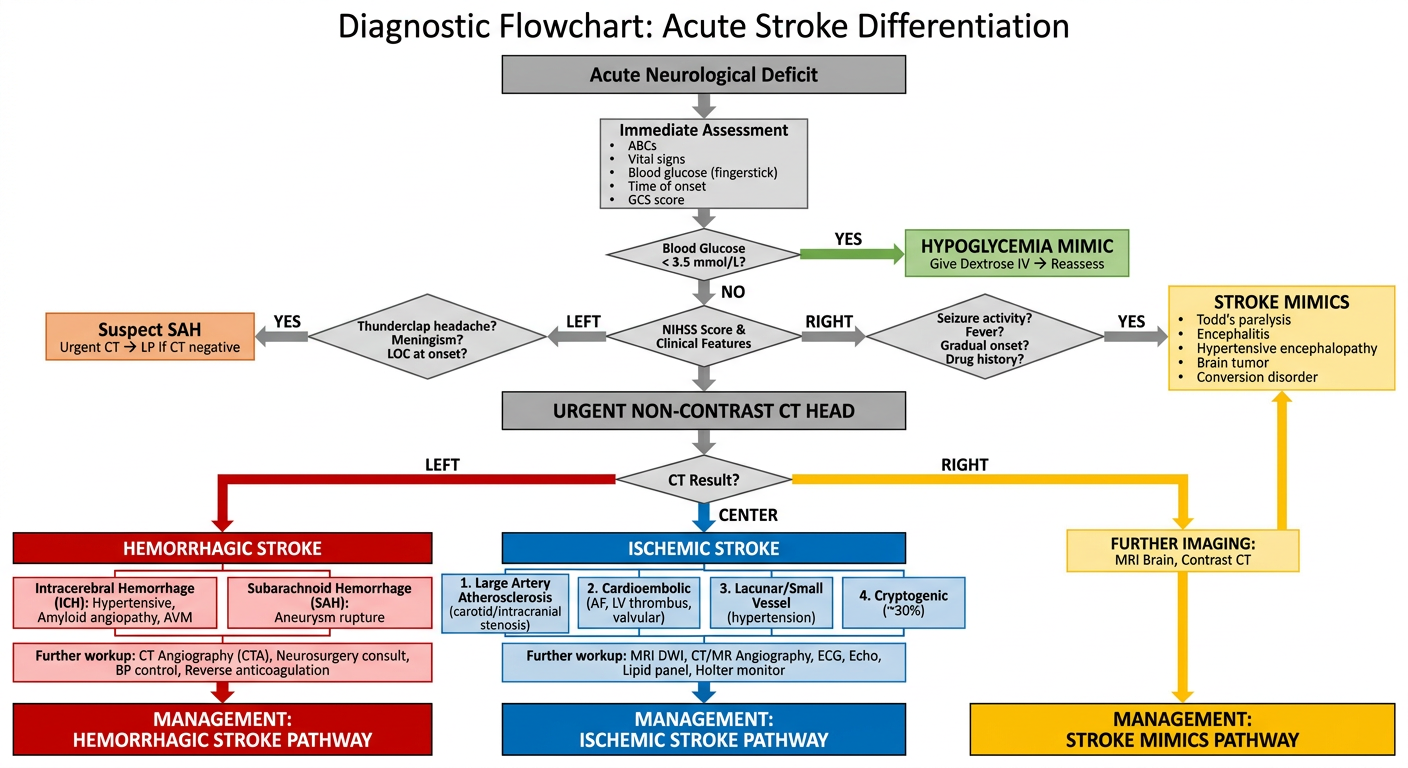
- Hypoglycemia is eliminated first with a glucose check (fastest, cheapest mimic to reverse).
- Clinical red flags (thunderclap headache, seizure, fever, gradual onset) redirect toward SAH or other mimics before imaging.
| CT Finding | Diagnosis |
|---|---|
| Hyperdense blood (red) | Hemorrhagic stroke → ICH or SAH |
| No blood / early ischemic change (blue) | Ischemic stroke → further TOAST subtyping |
| Mass lesion / atypical (yellow) | Mimic → MRI ± contrast for tumor, abscess, MS |
Hey
What is your name?