
Housemaid knee
Reading File
Housemaid's knee is prepatellar bursitis - inflammation of the bursa lying in front of the patella. It typically affects people who kneel for prolonged periods (housemaids, carpet layers, plumbers). The bursa becomes swollen and tender, with a fluctuant swelling over the kneecap but preserved range of motion.
Searching sources...
Finding Sources
Finding Sources
Searching PubMed
prepatellar bursitis treatment
Reading File
Reading File
Reading File
Reading File
Reading File
Loading Image
Loading Image
Housemaid's Knee (Prepatellar Bursitis)
Definition & Anatomy
Housemaid's knee is inflammation of the prepatellar bursa - a small fluid-filled sac lying directly anterior to the patella and between the skin and the bone. It is also called nun's knee or carpet-layer's knee, reflecting the occupational pattern.
The anatomy of the knee bursae is shown below - note the prepatellar bursa sitting anterior to the patella:
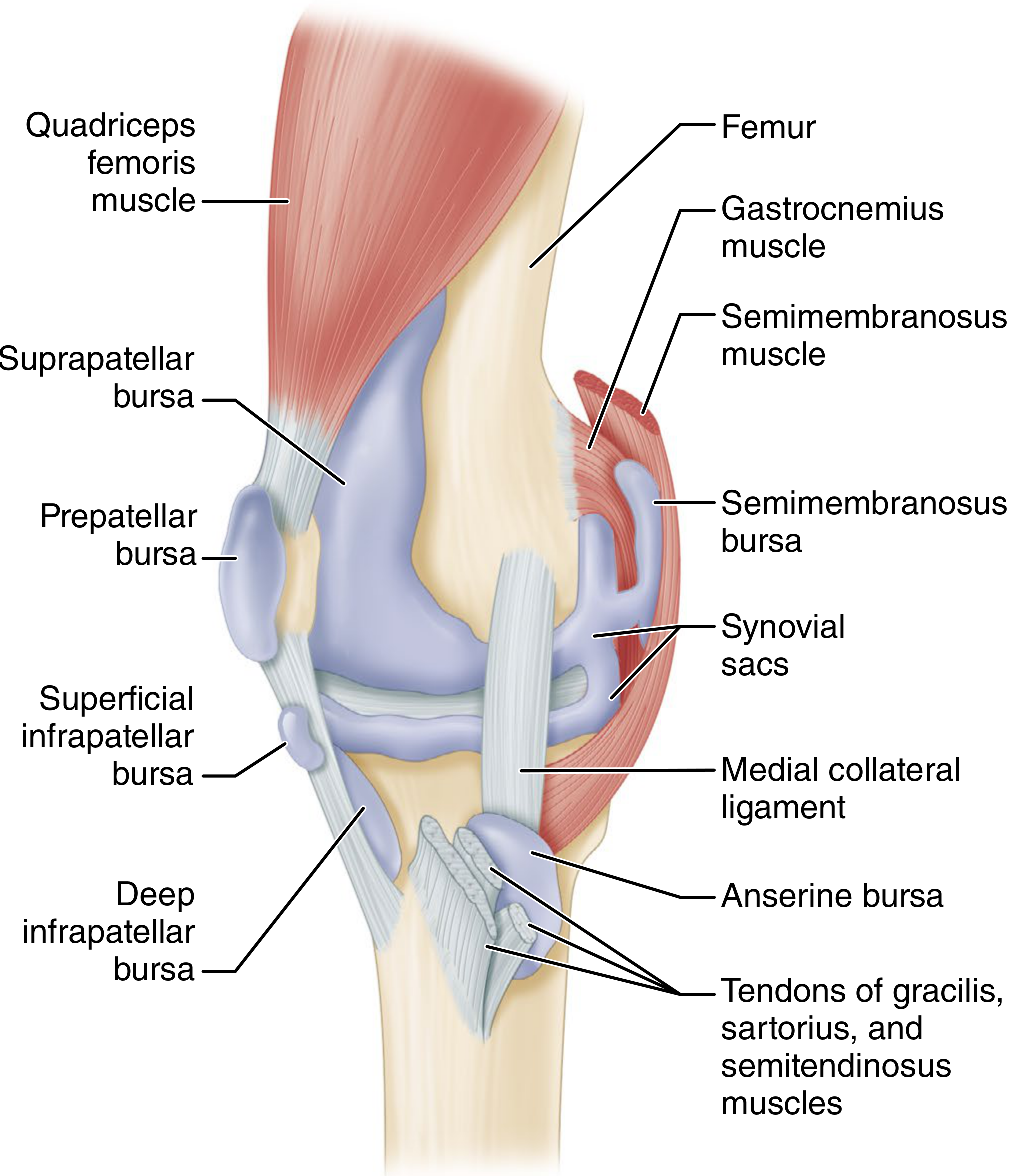
(Campbell's Operative Orthopaedics, Fig. 10.6 - Multiple bursae around the knee)
Cause
- Friction between the skin and patella from repetitive kneeling on hard surfaces (housemaids cleaning floors, carpet layers, plumbers, wrestlers)
- Can also result from an acute direct blow (fall onto patella)
- The resulting swelling covers the lower half of the patella and the upper half of the ligamentum patellae
Clinical Features
| Feature | Finding |
|---|---|
| Location | Fluctuant swelling anterior to patella |
| Pain | Frequently mild in nonseptic form |
| Range of motion | Usually preserved; only end-range flexion may cause discomfort (as the inflamed bursa is compressed) |
| Skin | May be thickened/calloused in chronic cases; does NOT communicate with the joint space |
| Bursal margins | Often palpable |
Clinical photo of prepatellar bursitis (left knee swollen, right knee normal for comparison):
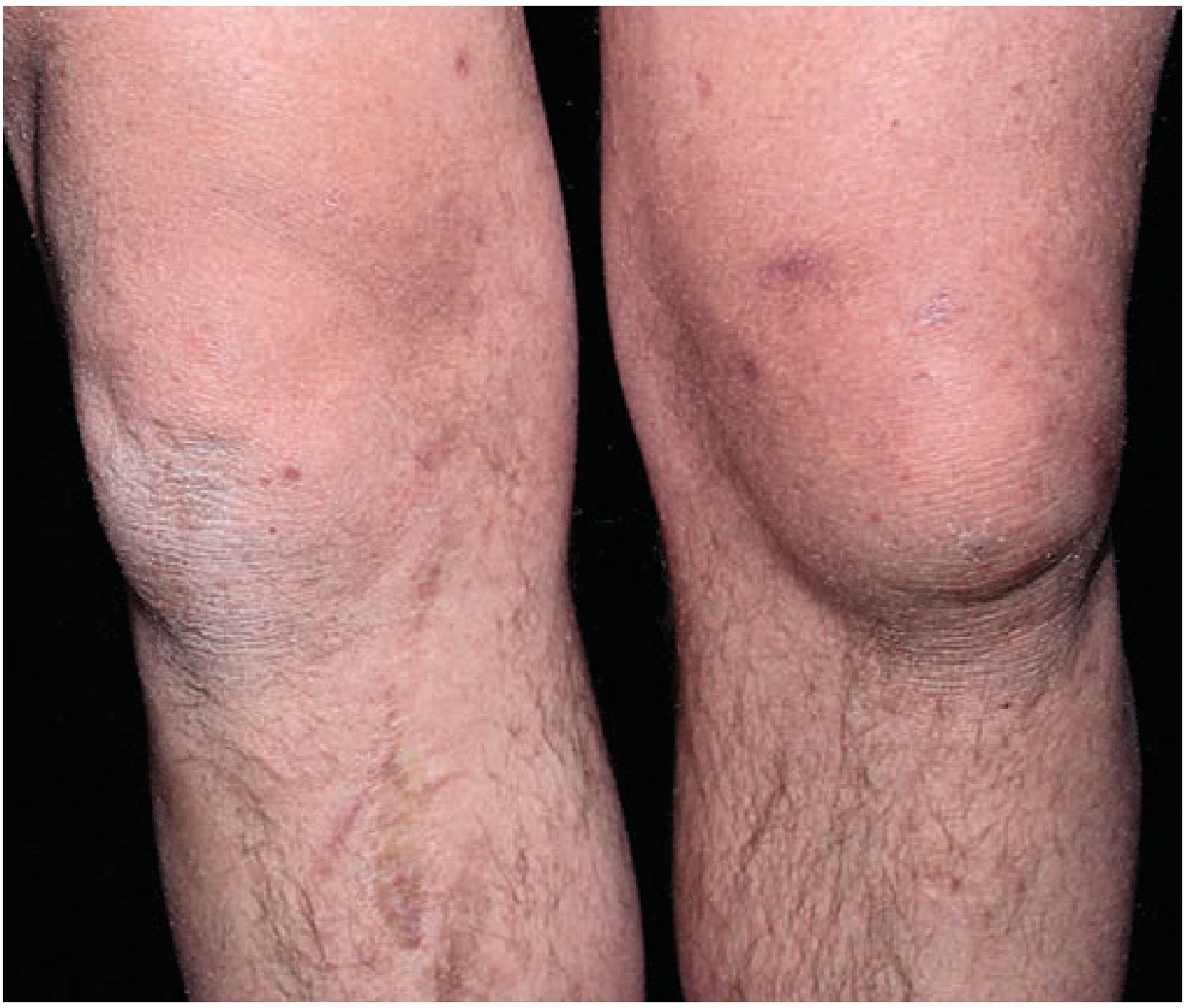
(Tintinalli's Emergency Medicine, Fig. 281-9)
Key distinguishing point: Because the prepatellar bursa does NOT communicate with the joint space, the swelling is anterior and fluctuant, and passive/active ROM is largely preserved - unlike a true intra-articular effusion.
Differential Diagnosis
- Infrapatellar bursitis (Clergyman's knee) - also from kneeling, but the bursa lies on the lower half of the ligamentum patellae
- Septic arthritis of the knee - distinguished by joint-wide effusion, significant ROM restriction, and constitutional features
- Joint effusion - swelling fills the suprapatellar pouch and parapatellar gutters rather than being confined anteriorly
- Gout / pseudogout / rheumatoid arthritis (which can also cause bursitis)
Types
1. Traumatic (Nonseptic) Bursitis
- Chronic or progressive enlargement
- No tenderness, no erythema
- Skin over bursa may be thickened
- No limitation of joint movement or pain on movement
- Associated with repetitive trauma
2. Septic Bursitis
- The prepatellar bursa is the most common site for septic bursitis (50-53% of cases)
- Especially common in children
- Caused by bacterial spread from skin flora (not hematogenous)
- Presents with acute pain, tenderness, erythema, and warmth
- Fever present in 20-77% of cases
- Most common organism: Staphylococcus aureus
Bursal Fluid Analysis
| Feature | Septic | Traumatic/Idiopathic | Crystal-Induced |
|---|---|---|---|
| Appearance | Purulent/serosanguineous | Straw-colored or bloody | Straw-colored to bloody |
| WBC/mm³ | Mean ~54,000; >3000 diagnostic | Mean ~2475 | Mean ~2900 |
| Differential | >50% PMNs diagnostic | Predominantly mononuclear | Highly variable |
| Bursal:serum glucose | <50% in 90% of septic cases | >50% in 98% | Unknown |
| Gram stain | Positive in 70% | Negative | Negative |
| Culture | Positive | Negative | Negative |
(Tintinalli's Emergency Medicine, Table 204)
Treatment
Nonseptic Bursitis
- NSAIDs and activity modification (eliminating the precipitating kneeling activity)
- Aspiration is controversial - fluid often reaccumulates
- If fibrosis or painful nodules fail conservative treatment: surgical excision of the bursa (open or endoscopic)
Septic Bursitis
- Aspiration - once or twice daily
- Antibiotics - covering skin flora (anti-staphylococcal)
- Immobilization
- If no significant improvement in 36-48 hours: proceed to incision and drainage
Related Conditions
- Clergyman's knee (infrapatellar bursitis) - infrapatellar bursa, lying on the lower half of the ligamentum patellae, also from repetitive kneeling
- Student's elbow (olecranon bursitis) - analogous condition at the elbow
Sources: Campbell's Operative Orthopaedics 15th Ed 2026, p. 593; Tintinalli's Emergency Medicine; Rosen's Emergency Medicine; S Das Manual on Clinical Surgery 13th Ed
This is a shared conversation. Sign in to Orris to start your own chat.