
Glass ionomer cements (GICs) are widely used in restorative dentistry due to their fluoride release and chemical adhesion to dental tissues [1]. GICs offer advantages, such as sustained fluoride release, biocompatibility, esthetic tooth-like appearance, and thermal compatibility with tooth structure [1, 2]. However, their application is limited by low mechanical strength, moisture sensitivity during setting, and poor wear resistance, restricting their use to low-stress clinical areas [2, 3]. To address these shortcomings, several materials have been incorporated into GICs to improve their physical performance [4, 5]. Resin-modified GICs (RMGICs), developed through the addition of resin monomers, show enhanced diametral tensile, flexural, and compressive strength and allow light-curing, providing improved handling and control during placement [6, 7]. The inclusion of resin shortens the setting duration, decreases sensitivity to moisture, provides longer working time, and improves both translucency and overall esthetics [7, 8]. In restorative dentistry, preventing bacterial colonization after caries removal is critical for restoration longevity. Incorporating antibacterial agents into restorative materials helps inhibit bacterial growth and penetration, thereby reducing the risk of recurrent caries [9, 10]. Although, GICs exhibit antibacterial effects attributed to fluoride release and low initial pH, they may not provide sufficient long-term protection against cariogenic bacteria, potentially leading to secondary caries and restoration failure [11]. Consequently, enhancing the antibacterial properties of GICs remains a focus of ongoing research to improve their clinical performance and durability. Zinc oxide (ZnO), known for its antimicrobial properties, is commonly used in dental materials [10, 12]. It is affordable, stable, and biocompatible [10]. Recently, ZnO nanoparticles (ZnO NPs) have gained popularity due to their enhanced antibacterial efficacy [10]. Due to their small size, NPs penetrate dentinal tubules more effectively than larger particles [10]. ZnO NPs show significant antibacterial activity against S. mutans and Lactobacillus, inhibiting biofilm formation when added to dental materials [13]. Moreover, they improve bond strength in enamel and dentin without compromising it during pretreatment [14]. Mesoporous materials, with pore sizes ranging from 2 to 50 nm, have gained significant interest in both medicine and dentistry [15]. These materials are valued for their adjustable pore sizes, biocompatibility, high surface area, and lack of toxicity [16]. Their pore structure can be easily modified, and various synthesis methods enable the optimization of their composition, structure, and porosity [16]. Mesoporous ZnO NPs, characterized by their large surface area, porosity, crystallinity, and antimicrobial properties, show promising potential for a wide range of therapeutic applications [15, 16]. Nanosized materials, particularly mesoporous ZnO NPs, demonstrate significantly enhanced antibacterial properties compared to their bulk counterparts, owing to their increased surface area-to-volume ratio, making them promising candidates as nanofillers for RMGICs [16]. Incorporating nanofillers, such as mesoporous ZnO NPs may enhance antibacterial activity and mechanical performance; however, preserving adequate bond strength is critical and must be thoroughly evaluated. Although, these materials show potential, their influence on the bond strength of resin-modified glass ionomer cement (RMGIC) to enamel and dentin in permanent teeth remains unclear. Therefore, the present study aimed to evaluate and compare the microshear bond strength (µSBS) of RMGIC to enamel and dentin of permanent teeth restored with RMGIC, with and without the incorporation of mesoporous ZnO NPs and ZnO NPs. The null hypothesis proposed that there would be no significant difference in the bond strength of RMGIC to enamel and dentin regardless of the addition of mesoporous ZnO NPs or ZnO NPs.
What would you like me to do with this introduction?
ZnO nanoparticles glass ionomer cement bond strength
mesoporous ZnO nanoparticles antibacterial dental
resin modified glass ionomer cement mechanical properties nanoparticles
PMID: 40995531
PMID: 40490048
PMID: 34760064
PMID: 40364893
Scientific Review and Critique: Introduction on Mesoporous ZnO NPs in RMGIC
Overall Assessment
Paragraph-by-Paragraph Analysis
Paragraph 1 - GIC Background
- The phrase "thermal compatibility with tooth structure" is imprecise. The correct term is coefficient of thermal expansion that is similar to that of tooth structure. Using "thermal compatibility" is a colloquial shorthand that could be made more precise.
- The limitation list omits aesthetic inferiority compared to composite resin, which is a clinically relevant disadvantage for conventional GICs and contextualizes why RMGICs were developed. Mention of this would strengthen the transition into paragraph 2.
Paragraph 2 - RMGIC Background
- "The inclusion of resin shortens the setting duration" is partially inaccurate. RMGICs undergo a dual-cure mechanism (acid-base + light-cure). The light-curing component gives command set on demand, which is different from simply shortening the setting time of the acid-base reaction itself. This distinction matters scientifically. The resin component extends working time while allowing the clinician to control when initial set occurs - it does not universally "shorten" the setting reaction.
- The statement that RMGICs show "enhanced diametral tensile, flexural, and compressive strength" is broadly correct, but it is worth noting that some literature shows only modest mechanical improvements over conventional GICs, and that RMGICs still fall far below composite resin. Framing these as uniformly "enhanced" without qualification may overstate the evidence. A citation to a comparative study would strengthen this.
- "Longer working time" is well-documented and correctly stated.
Paragraph 3 - Antibacterial Context and GIC Limitations
- "GICs exhibit antibacterial effects attributed to fluoride release and low initial pH" - this is correct, but the low pH is a transient effect during setting and is not a sustained antimicrobial mechanism. The long-term antibacterial effect of GICs is primarily fluoride-mediated. This nuance should be explicitly stated, as otherwise the sentence implies that low pH contributes to ongoing antimicrobial activity, which is misleading.
- The claim that GICs "may not provide sufficient long-term protection" is plausible but stated without direct citation of clinical or microbiological evidence. A reference here would strengthen the claim and is expected in a peer-reviewed introduction.
- This paragraph could benefit from one sentence that names specific organisms beyond S. mutans (e.g., Lactobacillus acidophilus, Actinomyces) to reflect the polymicrobial nature of caries, foreshadowing the broader antibacterial relevance of ZnO NPs.
Paragraph 4 - ZnO and ZnO NPs
- "ZnO NPs show significant antibacterial activity against S. mutans and Lactobacillus, inhibiting biofilm formation when added to dental materials [13]" - this is a strong claim attributed to a single reference. This would benefit from corroboration by additional citations. The 2025 systematic review by Danelon et al. (PMID 40490048) directly supports this and is a higher-quality source (meta-analysis) that should have been cited here.
- "They improve bond strength in enamel and dentin without compromising it during pretreatment [14]" is ambiguous. The sentence contradicts itself: does ZnO NP incorporation improve bond strength, or merely not compromise it? These are different claims. The statement needs to be reworded for clarity. If the reference [14] refers to ZnO NP use as a pretreatment agent (not incorporation into cement), that context needs to be explicit.
- The mechanisms of ZnO NP antibacterial activity (reactive oxygen species generation, Zn²⁺ ion release, membrane disruption) are not mentioned at all. Even a brief description of the proposed mechanism would add scientific depth and is standard in introductions of this type.
Paragraph 5 - Mesoporous Materials
- "Lack of toxicity" is a strong absolute claim. More accurate phrasing would be "low cytotoxicity" or "acceptable biocompatibility profile" since cytotoxicity is concentration- and cell-type-dependent. This is particularly important given that the paper's own methodology involves evaluating bond strength, and while cytotoxicity is not the primary endpoint, overstating biocompatibility without nuance could be challenged by reviewers.
- "Various synthesis methods enable the optimization of their composition, structure, and porosity" - this sentence is vague and does not add information specific to ZnO. Consider replacing with a brief mention of synthesis routes relevant to mesoporous ZnO NPs (e.g., sol-gel, hydrothermal, template-assisted methods) to add specificity.
Paragraph 6 - Study Rationale and Aim
- "Nanosized materials, particularly mesoporous ZnO NPs, demonstrate significantly enhanced antibacterial properties compared to their bulk counterparts, owing to their increased surface area-to-volume ratio" - this repeats content introduced in paragraph 5. This is redundant in a short introduction and suggests the paragraphs 5 and 6 could potentially be merged or consolidated.
- "Making them promising candidates as nanofillers for RMGICs" - the leap from "enhanced antibacterial surface area" to "promising as a nanofiller" skips over the question of how the mesoporous structure specifically affects the filler-matrix interface and bond strength. The reader is left wondering: does more surface area help or hinder adhesion? This is the central question of the study, and the introduction should better set up why either outcome is plausible, making the study question more compelling.
- The phrase "remains unclear" is used to justify the study, but the authors' own group published a paper on ZnO NP incorporation in RMGIC (Malekhoseini et al., 2021, PMID 34760064) that actually found decreased µSBS at 1 month with 2% ZnO NPs. This finding is not discussed or acknowledged in the introduction, yet it is directly relevant to the knowledge gap and the choice of mesoporous NPs as an improvement strategy. Omitting it could be seen as selectively ignoring a prior conflicting result.
- The null hypothesis is appropriate and clearly stated.
Cross-Cutting Issues
1. Self-Citation Cluster Without Disclosure of the Research Program
- Antimicrobial properties of mesoporous ZnO NPs vs. S. mutans (PMID 40364893)
- Surface microhardness and roughness (PMID 41059355)
- Diametral tensile and flexural strength (PMID 42146274)
- Bond strength to primary molars with ZnO NPs + bacterial cellulose nanocrystals (PMID 40968739)
2. Missing Discussion of Nanofiller Concentration Effects in the Introduction
3. No Discussion of Potential Mechanisms Linking Mesoporous Structure to Bond Strength
4. Language
- Avoid "although" at the start of a sentence mid-paragraph ("Although, GICs exhibit antibacterial effects..." and "Although, these materials show potential..."). The comma after "although" when it begins a clause is grammatically non-standard in academic English. Rephrase as "Although GICs exhibit..." (no comma) or restructure the sentence.
- "Gaining popularity" (paragraph 4) is informal. Consider "increasing in research interest" or simply cite recent uptake in publications.
- "Lack of toxicity" (paragraph 5) - see comment above.
Summary Table
| Section | Strength | Issue |
|---|---|---|
| P1 - GIC background | Accurate, well-cited | "Thermal compatibility" imprecise; aesthetic limitation missing |
| P2 - RMGIC | Logical flow | "Shortens setting" mechanistically oversimplified |
| P3 - Antibacterial rationale | Clear clinical need | Low pH presented as ongoing mechanism; no citation for long-term failure claim |
| P4 - ZnO NPs | Correct organism specificity | Mechanism of action absent; bond strength claim ambiguous; Danelon SR not cited |
| P5 - Mesoporous materials | Correct IUPAC definition | "Lack of toxicity" overstated; synthesis methods vague |
| P6 - Rationale and aim | Clear research question | Malekhoseini 2021 conflicting result not cited; no concentration justification; redundant text with P5 |
| Overall | Logical funnel structure | Companion papers by same group largely uncited; no mechanism for mesoporous-bond relationship |
make a slide image regarding the explanation of the introduction with related images
A professional scientific presentation slide titled "Mesoporous ZnO Nanoparticles in Resin-Modified Glass Ionomer Cement (RMGIC)" with a dark navy blue background and clean white text. The slide is divided into sections with labeled panels and scientific illustrations: TOP SECTION: Large bold white title. Subtitle: "Enhancing Bond Strength & Antibacterial Performance" LEFT COLUMN - "GIC Limitations": A tooth cross-section diagram showing enamel and dentin layers with annotations: low mechanical strength, moisture sensitivity, poor wear resistance. Small red warning icons next to each limitation. CENTER COLUMN - "Why ZnO Nanoparticles?": A detailed molecular/nanoparticle illustration showing mesoporous spherical ZnO nanoparticles (grey-white porous spheres with visible internal pore channels, 2-50nm pore size labeled). Below it, green checkmarks listing: fluoride synergy, antibacterial vs S. mutans, improved adhesion, biocompatible. A small SEM-style microscopy image texture of nanoparticles. RIGHT COLUMN - "RMGIC + Mesoporous ZnO NPs": A diagram of cement matrix with embedded nanoparticles bonding to tooth structure (enamel and dentin shown in cross-section). Arrows showing chemical adhesion bond. Labels: 3%, 5%, 7% concentration tested. Highlight box: "5 wt% optimal concentration". BOTTOM BANNER: A horizontal flowchart with icons: [Caries removal] → [RMGIC placement] → [ZnO NP antibacterial action] → [Reduced secondary caries]. Soft teal and gold accent colors for icons and arrows. Footer text: "µSBS = Microshear Bond Strength | In Vitro Study | Jowkar et al., 2025" Overall style: scientific poster aesthetic, high information density, clean sans-serif fonts, color-coded sections with subtle dividers.
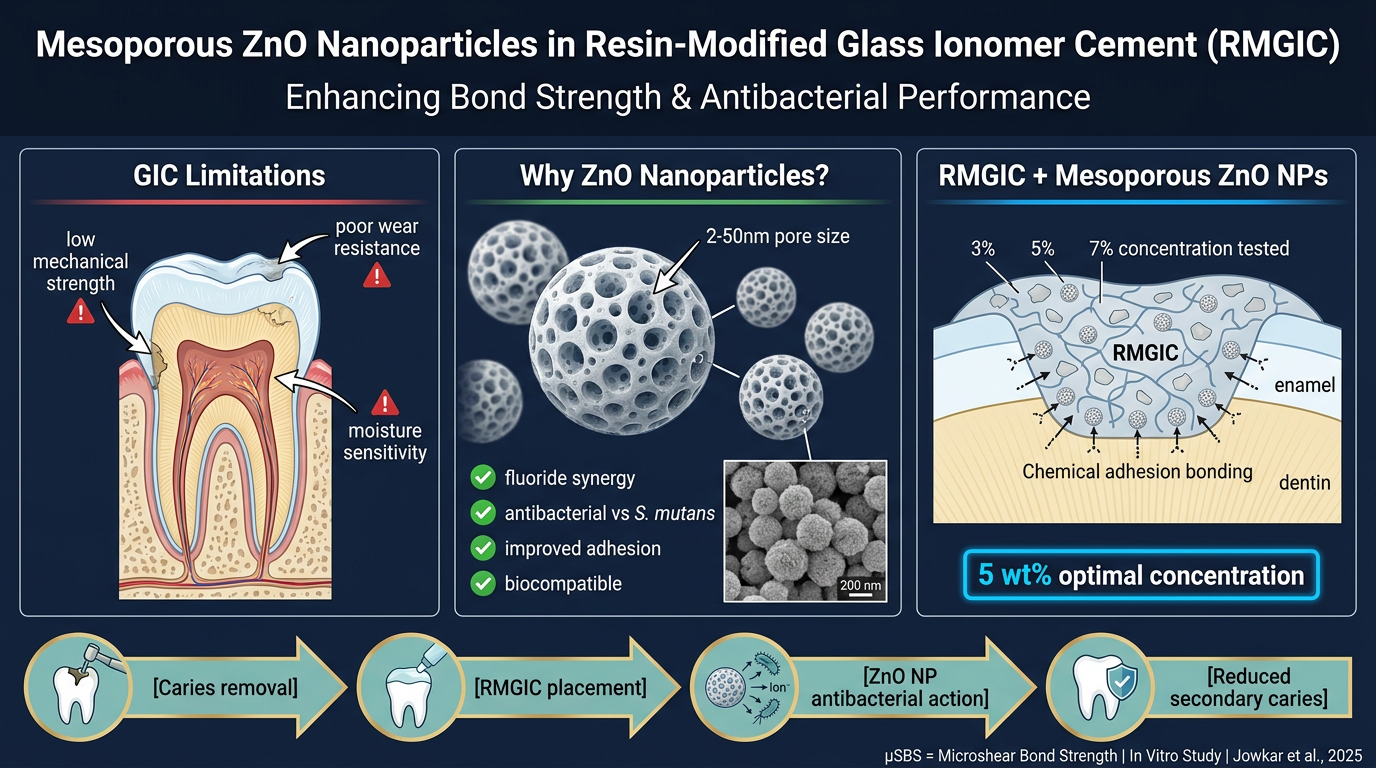
- Left panel - GIC limitations (mechanical weakness, moisture sensitivity, wear)
- Center panel - Why mesoporous ZnO NPs: their porous architecture, antibacterial action against S. mutans, and biocompatibility
- Right panel - RMGIC + NP integration showing the bond to enamel/dentin and the 5 wt% optimal concentration finding
- Bottom flowchart - The clinical logic from caries removal through to reduced secondary caries risk