
Cbt for various psychiatry disorders
CBT cognitive behavioral therapy psychiatric disorders evidence-based indications techniques 2024
Cognitive Behavioral Therapy (CBT) in Psychiatry
Core Principles of CBT
| Technique | Description |
|---|---|
| Cognitive restructuring | Identifying and challenging irrational/distorted thoughts (cognitive distortions) |
| Behavioral activation | Scheduling rewarding activities to counteract avoidance/withdrawal |
| Exposure | Gradual, systematic confrontation of feared stimuli to extinguish fear responses |
| Self-monitoring | Recording thoughts, behaviors, and emotions to identify patterns |
| Psychoeducation | Teaching the patient about their disorder and the CBT model |
| Homework assignments | Between-session practice to reinforce skills |
| Relaxation training | Diaphragmatic breathing, progressive muscle relaxation to reduce arousal |
| Relapse prevention | Anticipating future stressors and preparing adaptive coping responses |
1. Depressive Disorders
- Behavioral activation (countering withdrawal and anhedonia)
- Activity scheduling with pleasant event monitoring
- Cognitive restructuring targeting hopelessness and worthlessness
- Problem-solving therapy for situational triggers
- Meta-analyses show CBT has clear benefits over waitlist/no-treatment; effect sizes are medium to large
- CBT + pharmacotherapy is superior to either alone
- CBT works well in older adults, adolescents, patients with comorbidities, and low-income minority women
- For adolescents, CBT (12-16 sessions) is superior to nondirective supportive therapy and systemic behavior family therapy (65% remission vs. 39%/38%)
- Computerized CBT (e.g., SPARX game) shows comparable results to treatment-as-usual for adolescent depression
2. Anxiety Disorders
- Exposure therapy (in vivo, imaginal, interoceptive) - the core behavioral component
- Cognitive restructuring of catastrophic misappraisals
- Relaxation and breathing retraining
- Systematic desensitization (graduated exposure)
- Effect sizes for CBT across anxiety disorders are consistently medium to large - among the strongest in psychiatry
- Long-term outcomes are maintained well post-treatment
- CBT is as effective as or more effective than benzodiazepines, with lower relapse risk
- Important: Benzodiazepines should be avoided during CBT - they interfere with the extinction learning required for exposure therapy
- Panic disorder: Interoceptive exposure (confronting feared bodily sensations), psychoeducation about panic physiology, breathing retraining
- Social anxiety disorder: Social skills training, behavioral experiments, cognitive restructuring of feared social evaluation
- Specific phobia: Graded in vivo exposure (most effective standalone treatment)
- GAD: Worry postponement, cognitive challenging of "what if" thinking, uncertainty tolerance training
3. OCD (Obsessive-Compulsive Disorder)
- Patient is exposed to feared stimuli (obsession trigger) while refraining from the compulsive ritual
- Repeated exposure leads to habituation and extinction
- Typically 12-20 sessions; often combined with SSRIs
- ERP + SSRI is the first-line treatment for OCD in both adults and children/adolescents
- CBT with ERP is superior to relaxation alone and pharmacotherapy alone for many patients
- NICE guidelines recommend CBT/ERP as first-line, with medications for moderate-severe cases
4. PTSD (Post-Traumatic Stress Disorder)
| Modality | Core Focus |
|---|---|
| Prolonged Exposure (PE) | Repeated imaginal + in vivo exposure to trauma memories and avoided situations |
| Cognitive Processing Therapy (CPT) | Identifies and restructures "stuck points" - distorted trauma-related beliefs (e.g., self-blame, permanence of loss) |
| EMDR | Eye movement desensitization; considered a CBT variant |
| Narrative Exposure Therapy | For complex/multiple traumas; constructs a coherent life narrative |
5. Schizophrenia / Psychotic Disorders
- Reality testing and collaborative empiricism around delusional beliefs
- Normalizing psychotic experiences (placing them on a continuum)
- Coping strategy enhancement for distressing voices
- Relapse prevention by identifying prodromal warning signs
- Social skills training and cognitive remediation
- CBT has small to medium effect sizes for schizophrenia
- CBTp is most valuable as an adjunct to antipsychotic medication - not as a standalone treatment
- Integrated psychological interventions including CBT are more effective than standard treatment in delaying onset of psychosis in at-risk (prodromal) individuals over 2-year follow-up
- CBTp reduces hospitalization rates and improves quality of life even in treatment-resistant cases
6. Bipolar Disorder
- Psychoeducation about the illness, early warning signs, and medication adherence
- Sleep and routine regulation (disruption of circadian rhythms can trigger episodes)
- Cognitive restructuring during depressive phases
- Activity monitoring to detect hypomania escalation
- Small to medium effects for bipolar disorder with CBT as adjunct
- Most beneficial for the depressive phase and relapse prevention
- Reduces relapse rates and improves functioning when combined with medications
7. Eating Disorders
Bulimia Nervosa
- CBT is the treatment of choice for bulimia nervosa
- 30-50% of patients achieve full symptom abstinence; higher % achieve significant reduction
- CBT phases: (1) Psychoeducation + meal regularity, (2) Self-monitoring + behavioral interventions for binge/purge, (3) Cognitive restructuring of body image distortions and dietary rules, (4) Relapse prevention
- CBT self-help formats (guided or pure) are also effective
- IPT is effective but slower; at treatment end CBT is superior (45% abstinence vs. 8% for IPT); groups converge at 1 year
Anorexia Nervosa
- CBT is used but evidence is less robust than in bulimia
- Enhanced CBT (CBT-E) addresses perfectionism, low self-esteem, and interpersonal difficulties
- Weight restoration must precede substantial psychological work
8. Substance Use Disorders
- Functional analysis (identifying triggers for use)
- Coping skills training (refusal skills, urge surfing)
- Relapse prevention (Marlatt's model) - identifying high-risk situations and planning coping responses
- Motivational enhancement (often combined with CBT)
- Small to medium effects overall
- Best evidence for cannabis and nicotine dependence
- Contingency management combined with CBT produces better outcomes in adolescent smokers
- Useful adjunct for alcohol and opioid use disorders
9. Insomnia (CBT-I)
- Sleep restriction therapy - consolidating time in bed to actual sleep time
- Stimulus control - associating bed only with sleep/sex, not waking activities
- Sleep hygiene education
- Cognitive restructuring of dysfunctional beliefs about sleep ("I must get 8 hours or I can't function")
- Relaxation training
10. ADHD
- Behavioral modification (reward/contingency management)
- Organization and planning skills training
- Time management strategies
- For adults: cognitive restructuring of negative self-schemas
- Behavioral therapy combined with medication outperforms medication alone
- Parent management training and classroom contingency management are core components for children
- CBT provides the most benefit in adults with ADHD for comorbid emotional dysregulation and procrastination
11. Personality Disorders
Borderline Personality Disorder (BPD) - DBT
- Dialectical Behavior Therapy (DBT) is the gold-standard CBT variant for BPD
- Developed by Marsha Linehan; proposes emotion dysregulation as the core deficit
- Four skill modules: Mindfulness, distress tolerance, emotion regulation, interpersonal effectiveness
- Format: Individual therapy + group skills training + phone coaching
- Strongly reduces non-suicidal self-injury, suicidal ideation, hospitalizations, and BPD symptoms in both adults and adolescents
Other PDs
- Schema therapy (a CBT variant) is used for avoidant, dependent, and narcissistic PDs
- CBT has moderate evidence for paranoid and avoidant PDs
Third-Wave CBT Variants (Summary)
| Modality | Key Concept | Best Evidence In |
|---|---|---|
| DBT (Dialectical Behavior Therapy) | Emotion regulation skills; radical acceptance | BPD, self-harm, suicidality, substance use, eating disorders |
| ACT (Acceptance & Commitment Therapy) | Cognitive defusion; psychological flexibility; values-based action | Depression, OCD, chronic pain, PTSD, substance use |
| MBCT (Mindfulness-Based Cognitive Therapy) | Mindfulness + CBT to prevent depressive relapse | Recurrent depression (3+ episodes), anxiety, insomnia |
| Schema Therapy | Identifying and healing early maladaptive schemas | Personality disorders, chronic depression |
Evidence Summary by Disorder
| Disorder | CBT Role | Effect Size | Notes |
|---|---|---|---|
| Major Depression | First-line | Medium-Large | Equal to pharmacotherapy; combination best |
| Anxiety Disorders | First-line | Medium-Large | Exposure is key; avoid BZDs |
| Panic Disorder | First-line | Large | Interoceptive exposure highly effective |
| OCD | First-line (ERP) | Large | With or without SSRIs |
| PTSD | First-line (TF-CBT) | Large | PE, CPT most studied |
| Bulimia Nervosa | First-line | Large | 30-50% full remission |
| Insomnia | First-line (CBT-I) | Large | Preferred over medications |
| Schizophrenia | Adjunct | Small-Medium | Never monotherapy |
| Bipolar Disorder | Adjunct | Small-Medium | Pharmacotherapy primary |
| ADHD | Adjunct | Moderate | Combined with medication |
| BPD | First-line (DBT) | Large | DBT is the evidence-based variant |
| Substance Use | Adjunct/standalone | Small-Medium | Best for cannabis, nicotine |
Defence mechanisms in ocd
defense mechanisms OCD obsessive compulsive disorder psychodynamic isolation undoing reaction formation
Defense Mechanisms in OCD
The Psychodynamic Framework
- Control vs. surrender (holding on vs. letting go)
- Ambivalence - simultaneous love and hate toward the same object (the hallmark of obsessional dynamics)
- Aggression - rage that is unacceptable to the superego
Primary (Hallmark) Defense Mechanisms in OCD
1. Isolation of Affect
- The thought or memory is retained in consciousness, but the emotion attached to it is cut off and repressed
- The patient can describe distressing content in a cold, detached, precise manner - without experiencing the accompanying feeling
- Example: A patient describes in clinical detail a violent intrusive thought about harming a loved one, but feels no emotional distress while describing it - the affect has been isolated from the idea
- This is why obsessional patients answer questions about feelings with thoughts instead - they have split the cognitive from the emotional
"Isolation of affect allows obsessive patients to split thought from feeling. They can describe situations with great precision but seem emotionally distant."
2. Undoing
- An action or thought is symbolically performed to magically cancel out or reverse a previous unacceptable thought, impulse, or action
- It is rooted in magical thinking - the idea that one act can neutralize another
- The compulsion IS the undoing: washing undoes contamination, checking undoes the feared harm, counting/repeating undoes a forbidden thought
- Example: A person has an intrusive thought of harming someone (aggressive impulse) → performs a counting ritual to "undo" the thought and prevent the feared consequence
- Freud described it as a "negative magic" - a two-act behavior where the second act negates the first
3. Reaction Formation
- The ego transforms an unacceptable impulse into its exact opposite in conscious behavior and attitude
- Unconscious aggression → exaggerated gentleness, concern, and compassion
- Unconscious sexual/dirty impulses → extreme cleanliness, morality, disgust
- Unconscious greed or possessiveness → ostentatious generosity
- Example: Intense unconscious rage toward a parent is transformed into excessive worrying and overprotective behavior toward that parent
- This explains the moralistic, overly conscientious, scrupulous character of many OCD patients
4. Rationalization
- The patient constructs logical, socially acceptable reasons for behaviors that are actually driven by unconscious impulses
- "I wash my hands 30 times because germs are dangerous" - a rational explanation that conceals the deeper anxiety
- Often seamlessly blends with intellectualization
5. Intellectualization
- Related to isolation of affect; abstract, intellectual discussion replaces direct emotional engagement
- The patient analyses their obsessions philosophically or theoretically, keeping emotional experience at bay
- Obsessional rumination itself can be a form of intellectualization - endless thinking substitutes for feeling
Secondary Defense Mechanisms
6. Displacement
- Anxiety or unacceptable feelings are shifted from their original object to a substitute that is symbolically related but less threatening
- Example: Intolerable rage toward a family member is displaced onto an obsession about leaving the stove on and burning the house down
- The displaced object (stove) captures the symbolic meaning (danger, destruction) while disguising the original target (the family member)
- This explains why OCD symptoms often have symbolic valence when interpreted psychodynamically
7. Magical Thinking
- Closely tied to undoing; involves the belief that thoughts can directly cause events (thought-action fusion)
- "If I think about my mother dying, she will die"
- Represents a regression to primary process (pre-logical) thinking from the anal-sadistic phase
- Explains the patient's inflated sense of responsibility - they feel their thoughts are as powerful as actions
8. Ambivalence (not strictly a defense, but a core dynamic)
- OCD patients experience simultaneous love and hate toward significant objects
- This ambivalence is unbearable, so defenses are deployed to manage it
- Explains the oscillating nature of obsessions - an obsession about harming a loved one reflects the hatred pole of ambivalence; the compulsion/undoing reflects the love pole trying to counteract it
Summary Table
| Defense Mechanism | Core Function | How It Manifests in OCD |
|---|---|---|
| Isolation of affect | Severs emotion from thought | Patient describes obsessions without emotional reaction; intellectualizes |
| Undoing | Magically negates unacceptable thought/impulse | Compulsive rituals (washing, checking, counting) |
| Reaction formation | Converts impulse into its opposite | Obsessive cleanliness (vs. unconscious dirtiness); excessive concern (vs. unconscious rage) |
| Rationalization | Provides logical cover for irrational behavior | "I'm just being careful/responsible" |
| Intellectualization | Substitutes thinking for feeling | Endless rumination; philosophical analysis of obsessions |
| Displacement | Shifts anxiety to a symbolic substitute | Fear of contamination from doorknobs instead of fear of emotional contact |
| Magical thinking | Treats thoughts as causally potent | Thought-action fusion; "If I think it, it will happen" |
In OCPD vs. OCD
"The defense mechanisms they use are rationalization, isolation, intellectualization, reaction formation, and undoing." - Kaplan & Sadock's Synopsis of Psychiatry, p. 1696 (discussing OCPD)
Psychodynamic Therapy Implication
- First identify displacement (what is the symptom symbolically about?)
- Then interpret isolation of affect (what feeling is being kept at bay?)
- Then interpret undoing (what impulse is the ritual trying to neutralize?)
- Finally address the underlying ambivalence and the conflicted feeling toward the key object
Qeeg
qEEG quantitative EEG psychiatry clinical applications brain mapping 2024
https://pmc.ncbi.nlm.nih.gov/articles/PMC7175442
https://axoneegsolutions.com/wp-content/uploads/2022/03/Usin…
quantitative EEG psychiatric disorders biomarker
Quantitative EEG (qEEG) in Psychiatry
What is qEEG?
- Compared against normative reference databases of age-matched healthy controls
- Displayed as topographic color maps of the scalp showing areas of dysregulation
- Analyzed for frequency band power, coherence, phase, and network connectivity
EEG Frequency Bands - The Building Blocks
| Band | Frequency | Associated States |
|---|---|---|
| Delta (δ) | 0.5-4 Hz | Deep sleep; pathological when excess in waking state (encephalopathy, TBI) |
| Theta (θ) | 4-8 Hz | Drowsiness, creativity, memory processing; excess in waking = cortical underarousal |
| Alpha (α) | 8-12 Hz | Relaxed wakefulness, idle state; dominant over occipital regions; reduced = hyperarousal |
| Beta (β) | 12-30 Hz | Active thinking, focused attention, arousal; excess = anxiety, hyperarousal |
| Gamma (γ) | >30 Hz | Higher cognitive processing, sensory binding |
| High Beta | 20-30 Hz | Worry, rumination, hypervigilance |
Key qEEG Metrics
- Absolute Power - total amplitude of a frequency band at a given electrode
- Relative Power - percentage of total power occupied by a given band
- Theta/Beta Ratio (TBR) - elevated in cortical underarousal (ADHD)
- Coherence - degree of synchrony between two electrode sites; reflects connectivity between brain regions
- Phase - timing relationships between brain regions
- Asymmetry - difference in power between homologous left vs. right hemisphere sites
- Frontal Alpha Asymmetry (FAA) - key marker for mood and emotional disorders
- Source localization (LORETA) - 3D reconstruction of the generators of EEG activity in deeper brain structures
Clinical Applications in Psychiatry
1. ADHD
- Increased theta and delta power (especially at Cz - vertex)
- Decreased beta power in adolescents
- Elevated theta/beta ratio (TBR) - the most replicated finding
- Sensitivity: 86-90% | Specificity: 94-98% (Bresnahan & Barry meta-analysis)
- Reflects cortical underarousal / hypoactivation of frontal attention networks
- Supports diagnosis when clinical picture is unclear
- Monitors treatment response to stimulant medications (which normalize TBR)
- Guides neurofeedback protocols (theta suppression / beta enhancement)
- The American Academy of Neurology (AAN) recommends qEEG as Class II-III investigation for learning/attention disorders
2. Major Depressive Disorder (MDD)
- Standard qEEG detects structural and functional brain abnormalities in 20-40% of depression patients
- Sensitivity: 72-93% | Specificity: 75-88% (American Association of Neuropsychiatry)
- Frontal Alpha Asymmetry (FAA): Reduced left frontal alpha (= greater left frontal activation) in healthy states; in depression, there is relatively greater right frontal activation (reduced left alpha relative to right alpha at F3 vs. F4)
- Increased theta and delta in frontal regions
- Reduced alpha activity in posterior regions
- ALPHA asymmetry as a biomarker: FAA has been proposed as a treatment predictor - some studies show that patients with greater left hemisphere hypoactivation respond better to antidepressants vs. psychotherapy
- LORETA imaging identifies hypofrontality (reduced PFC activity), mirroring PET/SPECT findings
- Can differentiate depression from dementia, schizophrenia, and alcoholism
- Predicting antidepressant response: The BRITE (Biomarkers for Rapid Identification of Treatment Effectiveness) study showed pre-treatment frontal theta cordance predicts SSRI response within 1 week
3. Anxiety Disorders
- Increased high-frequency beta and high beta (hyperarousal)
- Reduced alpha (reflecting inability to relax)
- Frontal alpha asymmetry:
- Anxious arousal (panic, somatic anxiety) → right frontal alpha asymmetry
- Anxious apprehension (GAD-type worry, rumination) → left frontal alpha asymmetry
- This distinction between anxiety subtypes with different FAA patterns has clinical implications for neurofeedback targeting
4. OCD (Obsessive-Compulsive Disorder)
- Associated with multiple frequency anomalies across studies
- Increased beta (reflecting hyperarousal/hyperactivation of frontal-striatal loops)
- Elevated gamma activity in some studies (reflecting obsessional processing)
- Abnormalities in frontal midline theta (cortico-striatal dysregulation)
- Coherence abnormalities between frontal and parietal regions (reflecting disrupted cortico-striatal-thalamo-cortical circuits)
5. PTSD
- Increased beta (especially high beta, 20-30 Hz) in frontal regions - reflects hypervigilance, intrusive re-experiencing
- Reduced alpha - inability to down-regulate arousal
- Increased right hemisphere activation (threat-detection bias)
- Diminished coherence between frontal and temporal regions
- Alpha asymmetry abnormalities reflecting emotional dysregulation
6. Schizophrenia
- Reduced alpha power
- Increased delta and theta (reflecting frontal lobe dysfunction)
- Reduced gamma coherence (particularly in the 40 Hz range) - reflects disrupted thalamo-cortical synchronization underlying cognitive fragmentation
- Reduced P300 amplitude (event-related potential) - marker of cognitive processing deficits
- Mismatch Negativity (MMN) reduction - auditory prediction error signal, a reliable biomarker
- Coherence abnormalities (reduced long-range connectivity, especially frontoparietal)
7. Bipolar Disorder
- Increased theta during manic and depressive phases
- Frontal alpha asymmetry changes that differ between phases
- Interhemispheric asymmetry in beta and alpha bands
- Can help differentiate bipolar depression from unipolar depression in some studies
8. Autism Spectrum Disorder (ASD)
- Elevated delta and theta power
- Reduced gamma coherence (impaired long-range connectivity)
- Abnormal mirror neuron mu-rhythm suppression during social observation
- Auditory evoked potential (P300, MMN) abnormalities
- A 2021 systematic review (PMID 35185452) confirmed EEG/qEEG as a valuable early screening tool for ASD
9. Dementia / Cognitive Impairment
- Generalized slowing - decrease in alpha, increase in theta and delta
- Theta/alpha ratio increases with cognitive decline severity
- Reduced coherence (especially parietal-occipital)
- Can differentiate:
- Alzheimer's disease: diffuse slowing
- Lewy body dementia: prominent occipital theta/delta
- Frontotemporal dementia: frontal predominant changes
- Useful for severity staging of dementia and encephalopathy
10. Substance Use Disorders / Addiction
- Increased theta (craving state)
- Reduced P300 amplitude (impaired inhibitory control)
- Elevated beta in alcohol dependence (withdrawal/anxiety)
- qEEG can track neurological recovery during abstinence
qEEG and Neurofeedback
| Disorder | Neurofeedback Protocol (derived from qEEG) |
|---|---|
| ADHD | Theta suppression + beta enhancement at Cz/Fz |
| Depression | Left frontal alpha enhancement (to increase left hemisphere activation) |
| Anxiety | Alpha/theta training to reduce high-beta; increase alpha |
| PTSD | High-beta reduction; alpha coherence training |
| Peak performance | Alpha/theta depth training |
AAN/ACNS Endorsed Applications
- Screening for epileptic peaks/seizures
- ICU monitoring for subclinical seizures
- Pre-surgical assessment in drug-resistant epilepsy
- Cerebrovascular disease evaluation
- Severity assessment of dementia and encephalopathies
- Intraoperative monitoring
- Learning disorders (Class II-III)
- ADHD, depression, schizophrenia, TBI, TBI-related psychiatric symptoms, alcoholism, tinnitus, and monitoring psychotropic drug response
Limitations and Important Caveats
| Limitation | Detail |
|---|---|
| Not diagnostic alone | qEEG provides supportive data; cannot replace clinical diagnosis. The role is to "provide additional insight in conjunction with clinical assessment" |
| Normative database variability | Results vary depending on which normative database is used; age-matching and recording conditions must be standardized |
| Artifact sensitivity | Muscle artifacts, eye movements, and drowsiness can contaminate data |
| Overlap between disorders | Many qEEG patterns (e.g., elevated theta) are not specific to a single diagnosis |
| TBR criticism | The FDA previously cleared a TBR-based device (Neuropsychiatric EEG-Based Assessment Aid - NEBA) for ADHD, but subsequent reviews questioned clinical utility as a standalone tool |
| Limited standardization | Recording protocols, analysis methods, and normative databases are not uniformly standardized across centers |
| Not FDA-cleared for most psychiatric diagnoses | Regulatory approval is limited |
Summary: qEEG Patterns by Disorder
| Disorder | Dominant Finding | Key Metric |
|---|---|---|
| ADHD | Theta↑, Beta↓ | TBR elevated |
| Depression | Right frontal alpha↑, Left frontal alpha↓ | Frontal Alpha Asymmetry |
| Anxiety | High-beta↑, Alpha↓ | Frontal asymmetry varies by subtype |
| OCD | Beta↑, Frontal theta dysregulation | Coherence abnormalities |
| PTSD | High-beta↑, Alpha↓ | Right hemisphere activation |
| Schizophrenia | Delta/theta↑, Gamma coherence↓ | MMN, P300 reduction |
| Dementia | Delta/theta↑, Alpha↓ | Generalized slowing |
| ASD | Delta/theta↑, Gamma coherence↓ | Mu-rhythm abnormality |
Soccer moms
What would you like to know about 'soccer moms'?
Soccer moms in psychiatry
"soccer moms" psychiatry psychology mental health concept
"soccer mom" personality type psychiatry anxious overprotective parenting style
Could you be thinking of one of these?
1. A colloquial/social description used in a lecture or course
2. Substance use in this demographic
- Intensive parenting demands and identity loss
- Social isolation despite appearing socially engaged
- Anxiety and depression masked by functional performance
- Alcohol normalized socially ("mommy wine culture")
3. Parenting style and child psychiatric outcomes
- Linked to increased social anxiety and reduced emotional regulation in children
- Relevant to the concept of anxious attachment
- Discussed in child psychiatry under parental factors in childhood anxiety disorders
4. A specific term in your course material
Positive psychology
positive psychology PERMA model concepts psychiatry mental health 2024
Positive Psychology
Definition
"The new field of positive psychology calls for as much focus on strength as on weakness, as much interest in building the best things in life as in repairing the worst, and as much concern with making the lives of normal people fulfilling as with healing pathology."
- Kaplan & Sadock's Comprehensive Textbook of Psychiatry
Historical Roots
| Era | Contributor | Contribution |
|---|---|---|
| Ancient Greece | Aristotle | Concept of eudaimonia (flourishing through virtuous living) |
| Early 20th century | William James | "Healthy-minded" religion; positive emotions as adaptive |
| 1940s-50s | Abraham Maslow | Hierarchy of needs; peak experiences; self-actualization |
| 1940s-60s | Carl Rogers | Person-centered therapy; unconditional positive regard |
| 1948 | WHO Constitution | Health = "complete physical, mental, and social well-being, not merely absence of disease" |
| 1958 | Marie Jahoda | Criteria for positive mental health |
| 1989 | Carol Ryff | Psychological well-being model (6 dimensions) |
| 1998 | Martin Seligman | Formal founding of positive psychology as a discipline |
| 2002 | Seligman | Authentic Happiness - happiness = positive emotions + engagement + meaning |
| 2011 | Seligman | Flourish - expanded PERMA model |
Core Theoretical Models
1. Seligman's PERMA Model (2011)
| Element | Description |
|---|---|
| P - Positive Emotions | Joy, gratitude, hope, love, awe, interest, serenity - not just happiness |
| E - Engagement | Deep absorption/flow in activities; using signature strengths |
| R - Relationships | Deep, positive connections with others - the single most critical contributor to happiness |
| M - Meaning | Belonging to and serving something larger than the self |
| A - Accomplishment | Pursuing and achieving goals for their own sake |
2. Ryff's Psychological Well-Being Model (6 Dimensions)
- Autonomy - self-determination and independence
- Environmental mastery - managing one's life and surroundings effectively
- Personal growth - continuous development and openness to experience
- Positive relations with others - warm, trusting interpersonal relationships
- Purpose in life - sense of direction and meaning
- Self-acceptance - positive attitude toward oneself
3. Broaden-and-Build Theory (Barbara Fredrickson)
4. Flow (Mihaly Csikszentmihalyi)
- Loss of self-consciousness
- Distorted time perception
- Intrinsic motivation
- Deep enjoyment
Empirical Findings on Happiness
- Number and quality of friendships - the strongest predictor
- Being married / in a committed relationship
- Being extroverted
- Practicing gratitude
- Religious/spiritual engagement
- Leisure activities and hobbies
- Employment (not income per se - income matters little beyond basic needs)
Comparing very happy people to moderately happy people, the one striking difference was good relationships with other people. All of the very happy individuals had close relationships - suggesting social connection may be a necessary condition for extreme happiness. - Kaplan & Sadock's Synopsis of Psychiatry
The Mental Health Quadrant Model
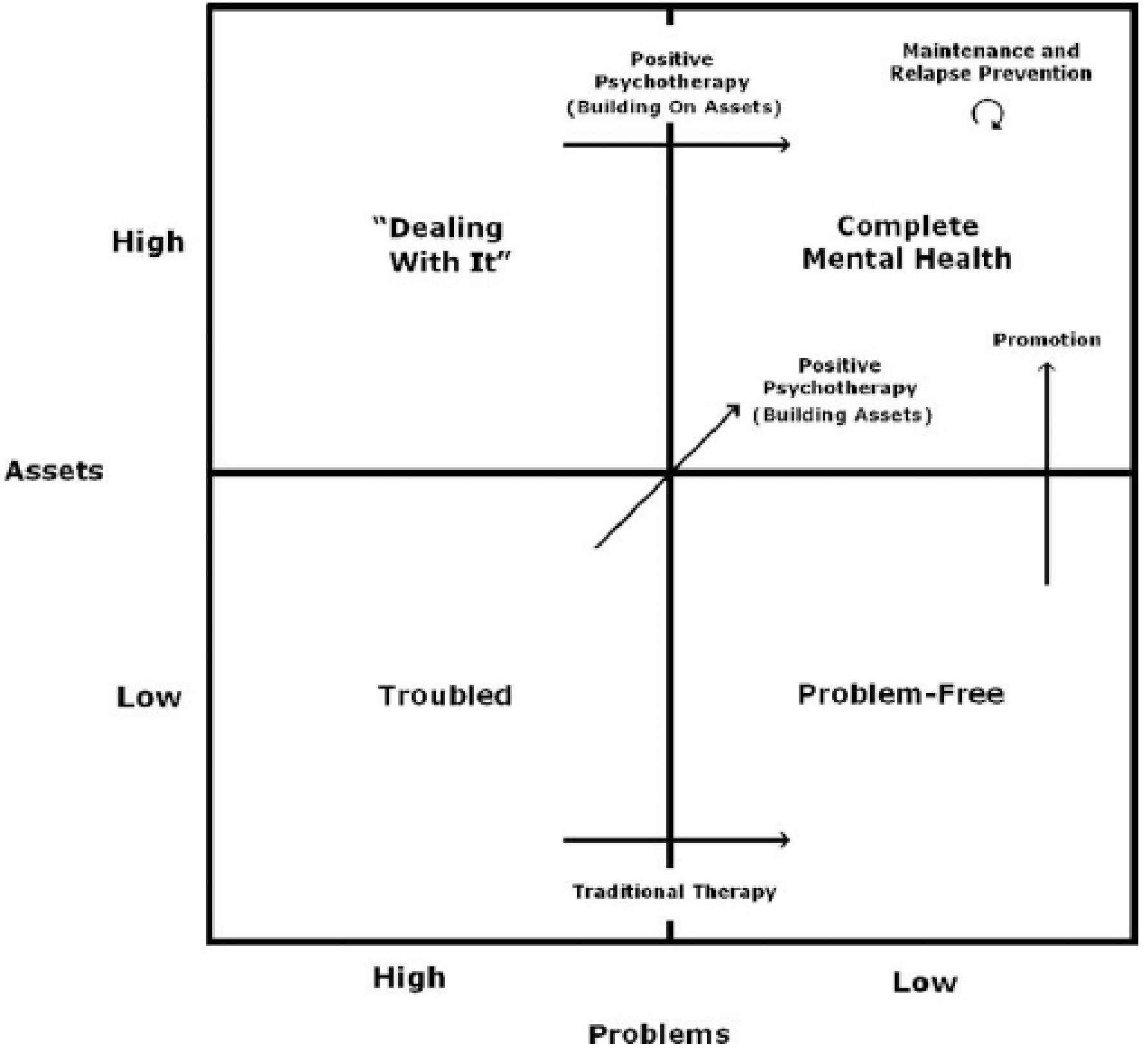
| Quadrant | Assets | Problems | Description |
|---|---|---|---|
| Q1 - "Dealing With It" | High | High | Has strengths AND psychiatric problems; can cope despite challenges |
| Q2 - "Complete Mental Health" | High | Low | Fully functioning; WHO definition of health; the ultimate goal |
| Q3 - "Troubled" | Low | High | Most studied by clinical psychiatry; psychiatric diagnoses + poor functioning |
| Q4 - "Problem-Free" | Low | Low | Neither ill nor flourishing; complacent; understudied |
Character Strengths and Values in Action (VIA)
| Virtue | Character Strengths |
|---|---|
| Wisdom | Creativity, curiosity, judgment, love of learning, perspective |
| Courage | Bravery, perseverance, honesty, zest |
| Humanity | Love, kindness, social intelligence |
| Justice | Teamwork, fairness, leadership |
| Temperance | Forgiveness, humility, prudence, self-regulation |
| Transcendence | Appreciation of beauty, gratitude, hope, humor, spirituality |
Positive Psychology Techniques (Evidence-Based Interventions)
1. Three Good Things / Counting Blessings
- Each night, write down 3 things that went well and WHY they went well
- Duration: 1 week minimum; benefits persist at 6-month follow-up
- Increases happiness, reduces depression
- Mechanism: redirects attentional bias toward positive information (depressed individuals have impaired learning of positive information - Conklin et al.)
2. Savoring
- Deliberate awareness of pleasure and attempt to extend it
- Strategies: share good events with others, build memories (photos/diaries), congratulate yourself, sharpen perceptions during enjoyment
- Habitual savers are happier, more optimistic, and less depressed
3. Strengths-Based Interventions
- Identify signature strengths via VIA Survey
- Use them in new ways each day for one week
- Produces sustained increases in happiness and decreases in depression at 6-month follow-up
4. Gratitude Letter / Visit
- Write a detailed letter of gratitude to someone who has been kind
- Deliver and read it in person (gratitude visit)
- Among the largest effect sizes of all positive psychology interventions for immediate happiness boost
5. Optimism Exercises
- Best Possible Self: Imagine your best possible future self in all domains; write about it for 20 minutes
- Increases positive affect and optimism; activates approach motivation
- Reduces depression and anxiety in clinical populations
6. Acts of Kindness
- Performing deliberate acts of kindness (especially varied, done in a single day)
- Increases well-being; may involve prosocial behavior reward circuits (dopaminergic)
7. Mindfulness-Based Positive Psychology
- Combining mindfulness (present-moment awareness) with positive emotion cultivation
- Mindfulness-Based Cognitive Therapy (MBCT) is at the intersection of third-wave CBT and positive psychology
Positive Psychology and Clinical Psychiatry
The Strength-Based Approach in Therapy
Well-Being Therapy (Fava)
- Monitors episodes of well-being (not just distress)
- Identifies and corrects interruptions to well-being
- Builds the six dimensions of psychological well-being
- Has evidence for preventing relapse in recurrent depression beyond CBT alone
Positive Psychotherapy (PPT)
- Targets positive emotion, engagement, meaning, relationships, and accomplishment (PERMA) in clinical populations
- Has evidence for depression, anxiety, and schizophrenia
- Moves the locus from deficit → strength
Criticisms of Positive Psychology
| Criticism | Response |
|---|---|
| "It ignores suffering and pathology" | Positive psychology explicitly does not replace pathology-focused work - it supplements it |
| "Toxic positivity - forced happiness" | The field recognizes that negative emotions are also genuine and adaptive |
| "Cultural bias (Western/individualistic)" | Eudaimonic components (relationships, meaning) appear cross-culturally consistent |
| "Evidence is preliminary" | Much research lacks long-term follow-up and uses motivated volunteers - generalizability is limited |
| "Self-help commercialization" | Some applications have run ahead of the evidence base |
Summary
"What is wrong with this person?" → "What is right, and how can it be amplified?"