
Apla syndrome
I'll look this up in the medical library right away.
Searching sources...
Reading File
Finding Sources
Searching PubMed
"antiphospholipid syndrome" management
Good results. Now let me read the most comprehensive sections in parallel.
Reading File
Reading File
Finding Sources
Let me also get the full kidney section and the classification criteria details.
Reading File
Finding Sources
Reading File
Reading File
I now have a comprehensive body of textbook information to write a thorough answer. Let me also fetch the APS histology image for visual clarity.
Loading Image
Here is a detailed overview of Antiphospholipid Syndrome (APS / aPL Syndrome), synthesized from multiple authoritative textbooks.
Antiphospholipid Syndrome (APS)
Definition
Antiphospholipid syndrome (APS) is a systemic autoimmune thrombophilia characterized by recurrent venous and/or arterial thrombosis, pregnancy morbidity (recurrent fetal loss, fetal growth retardation), and persistently positive antiphospholipid (aPL) antibodies. The antibodies target plasma proteins bound to anionic phospholipids, the primary cofactor being β₂-glycoprotein I (β₂GPI).
- Goldman-Cecil Medicine, p. 795
- Brenner and Rector's The Kidney, p. 1464
Historical Background
| Year | Milestone |
|---|---|
| 1906 | Wassermann described aPL based on syphilis reactivity (VDRL test origin) |
| 1941 | Pangborn identified cardiolipin from bovine heart |
| 1963 | Lupus anticoagulant (LA) shown to cause thrombosis, not bleeding |
| 1972 | Feinstein & Rappaport coined the term "lupus anticoagulant" |
| 1983 | ELISA for anticardiolipin antibodies (aCL) developed by Harris et al. |
| 1990 | β₂GPI recognized as a phospholipid-binding protein |
| 1999 | Preliminary Sapporo classification criteria published |
| 2006 | Revised Sapporo (Sydney) classification criteria |
- Tietz Textbook of Laboratory Medicine, 7th Ed., p. (block 40)
Classification
-
Primary APS: No associated autoimmune disease (30-55% of all APS patients)
-
Secondary APS: Associated with SLE (aPL antibodies found in 25-75% of SLE patients) or other connective tissue diseases
-
Catastrophic APS (CAPS): Rare, life-threatening form with multiple simultaneous vascular occlusions ("thrombotic storm"); often fatal
-
Brenner and Rector's The Kidney, p. 1464
-
Goldman-Cecil Medicine, p. 795
Antibody Profile (Diagnostic Criteria Tests)
Three types of aPL antibodies are recognized in classification criteria:
- Lupus anticoagulant (LA) - phospholipid-based clotting test (paradoxically prolongs aPTT in vitro, but is prothrombotic in vivo)
- Anticardiolipin antibodies (aCL) - IgG and/or IgM isotype
- Anti-β₂GPI antibodies - IgG and/or IgM isotype
Important notes:
-
IgG isotype is more strongly associated with thrombosis than IgM
-
LA is the strongest risk factor for thrombosis (6x higher risk of future thrombosis)
-
aCL and anti-β₂GPI IgG are more correlated with thrombosis than IgM counterparts
-
aPL antibodies found in up to 2% of normal individuals and in infections (HIV, HCV), but these are not usually associated with clinical APS
-
"Seronegative APS": clinically suspected APS, negative for all three criteria antibodies - highlights need for additional biomarkers
-
aPL may cause a false-positive VDRL test
-
Tietz Textbook of Laboratory Medicine, 7th Ed.
-
Brenner and Rector's The Kidney, p. 1464
Classification Criteria (Revised Sapporo / Sydney 2006)
A patient is classified as APS if at least one clinical criterion AND at least one laboratory criterion are present:
Clinical Criteria
- Vascular thrombosis: One or more clinical episodes of arterial, venous, or small vessel thrombosis in any tissue/organ
- Pregnancy morbidity:
- One or more unexplained fetal deaths at or beyond 10 weeks' gestation
- One or more premature births before 34 weeks due to eclampsia, severe preeclampsia, or placental insufficiency
- Three or more unexplained consecutive spontaneous abortions before 10 weeks
Laboratory Criteria
- Positive for LA, aCL (IgG/IgM, medium or high titer), or anti-β₂GPI (IgG/IgM)
- Documented on 2 or more occasions at least 12 weeks apart, and within 5 years of clinical manifestations
Pathogenesis
The exact mechanism remains unclear but is multifactorial:
- "Two-hit" hypothesis: aPL antibodies alone may be insufficient; a "second hit" (pregnancy, oral contraceptives, nephrotic syndrome, SLE, hyperlipidemia, infection) may be required to trigger thrombosis
- Procoagulant mechanisms of aPL antibodies:
- Activation of endothelial cells, monocytes, and platelets
- Interference with multiple coagulation factors: prothrombin, protein C, annexin V, factors VII and XII, tissue factor
- Impaired fibrinolysis (inhibition of tissue plasminogen activator)
- Inhibition of mTORC intracellular pathway
- Complement activation (especially relevant in obstetric APS)
- Net result: endothelial damage and intravascular coagulation
- Genetic associations: HLA-DRB1 loci in SLE-associated APS
- Brenner and Rector's The Kidney, p. 1464
Clinical Features
Thrombotic Manifestations
In a landmark series of 1000 APS patients:
| Feature | Frequency |
|---|---|
| Deep vein thrombosis | 32% |
| Thrombocytopenia | 22% |
| Livedo reticularis | 20% |
| Stroke | 13% |
| Pulmonary embolism | 9% |
| Fetal loss | 9% |
Arterial Thrombosis
- Cerebrovascular events are the most common arterial complication: stroke, TIA, multi-infarct dementia, retinal artery occlusion
- Peripheral and intra-abdominal vascular occlusion (less common)
Cardiac
- Libman-Sacks endocarditis (nonbacterial valve vegetations) in ~1/3 of patients
- Pulmonary hypertension
Obstetric
- Recurrent spontaneous pregnancy loss
- Fetal growth retardation
- Placental thrombosis (mechanism)
- Preeclampsia, HELLP syndrome
Hematologic
- Thrombocytopenia (common)
- Prolonged aPTT (laboratory finding, paradoxical)
- Hemolytic anemia (less common)
Renal (APL Nephropathy)
Occurs in up to 25% of primary APS patients and is a distinct entity:
- Thrombosis from glomerular capillaries to main renal artery and vein
- Arterial/arteriolar lesions: intimal mucoid thickening, subendothelial fibrosis, medial hyperplasia
- Glomerular: capillary thrombosis, mesangiolysis, GBM duplication (resembles TTP/HUS)
- Interstitial fibrosis and cortical atrophy from ischemia
- Found in ~40% of aPL-positive biopsied patients vs. only 4% without aPL antibodies
- Clinical features: proteinuria (sometimes nephrotic), active urinary sediment, hypertension, progressive renal dysfunction, renal infarction, renal vein thrombosis
- Important: biopsies may be misclassified as FSGS, membranous nephropathy, or MPGN
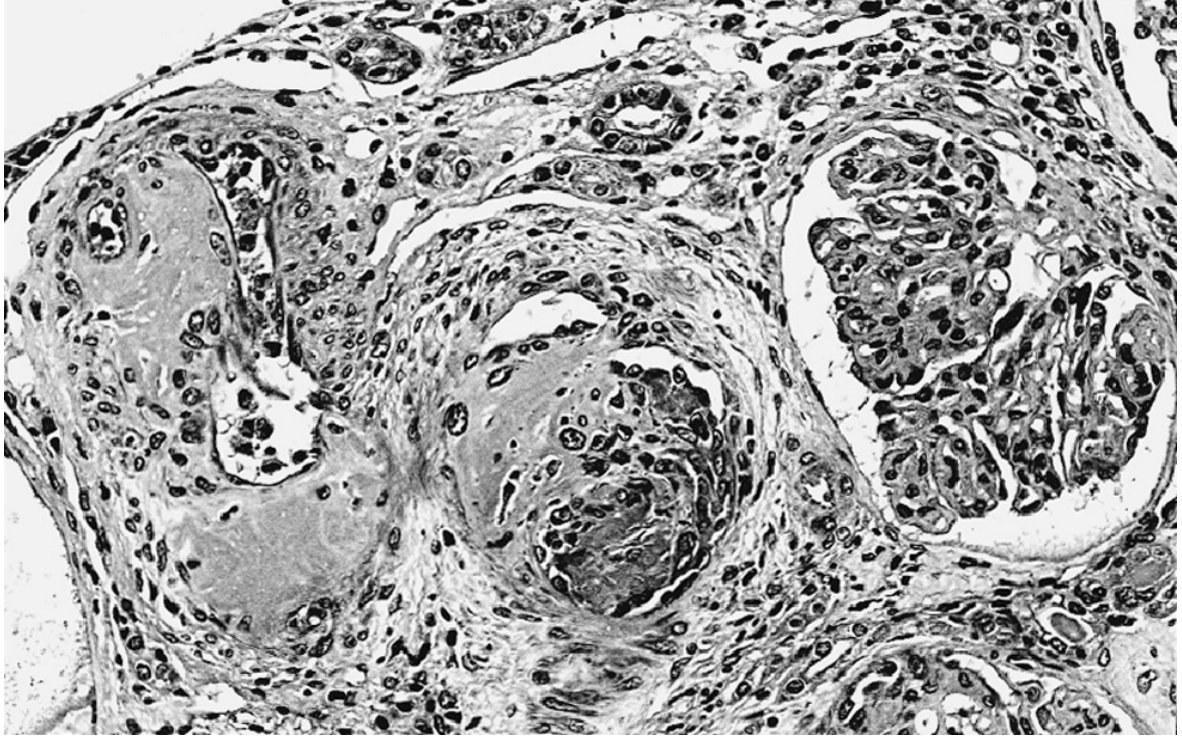
- Brenner and Rector's The Kidney, pp. 1464-1466
Laboratory Findings
- Prolonged aPTT (due to LA activity)
- Thrombocytopenia
- False-positive VDRL
- Positive aCL, anti-β₂GPI, or LA (must be confirmed on a second occasion ≥12 weeks apart)
Treatment
Acute Thrombosis
- Managed similarly to thrombosis from other causes
- LMWH preferred when LA is present (avoids aPTT monitoring difficulties, since baseline aPTT is already prolonged)
Long-Term Anticoagulation
- Warfarin is the standard of care; target INR 2.0-3.0 for most patients
- Prolonged or indefinite therapy is generally required
- Direct oral anticoagulants (DOACs) are NOT as effective as warfarin in APS - this is a critical distinction from most other thrombophilias
- For first-episode VTE with positive aPL: indefinite anticoagulation is usually recommended (though evidence is limited)
Obstetric APS
- No established treatment has been shown to definitively prevent recurrent fetal loss
- Low-dose aspirin + heparin (LMWH or UFH) is commonly used in pregnancy
Catastrophic APS (CAPS)
-
High-dose glucocorticoids
-
Therapeutic anticoagulation
-
Plasmapheresis and/or IVIG in refractory cases
-
Goldman-Cecil Medicine, pp. 795-796
Prognosis
-
Lupus anticoagulant carries the worst prognosis among aPL tests:
- 6-fold higher risk of future thrombosis
- 2-4 fold increased risk of recurrent thrombosis
- 12% increased 10-year mortality
-
SLE patients with IgG aCL have higher incidence of thrombosis and thrombocytopenia
-
In one multicenter European study of 1000 SLE patients, thrombosis occurred in 7% over 5 years
-
Goldman-Cecil Medicine, p. 795
Recent Evidence (2025)
A 2025 systematic review (Murvai et al., BMC Pregnancy Childbirth, PMID 40128683) provides a comprehensive update on APS in pregnancy, further exploring obstetric outcomes and management strategies - worth consulting for the latest evidence on pregnancy-related APS.
Sources: Brenner and Rector's The Kidney (2-Vol Set) | Goldman-Cecil Medicine | Tietz Textbook of Laboratory Medicine, 7th Ed. | Creasy & Resnik's Maternal-Fetal Medicine | Braunwald's Heart Disease
This is a shared conversation. Sign in to Orris to start your own chat.