
Learn ecg
Reading File
Before diving into sources, here's a quick orientation: an ECG (electrocardiogram) records the electrical activity of the heart. It has P waves (atrial depolarization), a QRS complex (ventricular depolarization), and T waves (ventricular repolarization). Rate, rhythm, axis, intervals, and waveform morphology are the core things you analyze. Now let me pull comprehensive content from the medical library.
Searching sources...
Finding Sources
Finding Sources
Finding Sources
Finding Sources
Finding Sources
Reading File
Finding Sources
Finding Sources
Reading File
Reading File
Finding Sources
Finding Sources
Reading File
Reading File
Reading File
Loading Image
Reading File
Finding Sources
Reading File
Reading File
Reading File
Loading Image
Reading File
Loading Image
Reading File
Reading File
I now have comprehensive content from authoritative sources (Guyton & Hall physiology, Harrison's Internal Medicine, Costanzo Physiology, Braunwald's Heart Disease, Rosen's Emergency Medicine). Here is a complete ECG guide:
Complete Guide to ECG (Electrocardiogram)
What Is an ECG?
An ECG is a graphical recording of the electrical activity generated by the heart. Metallic electrodes attached to the limbs and chest wall detect tiny voltage signals, which are amplified and printed on graph paper. It is non-invasive, inexpensive, and one of the most versatile tools in medicine - detecting arrhythmias, conduction defects, ischemia/infarction, electrolyte disturbances, and drug toxicities.
- Harrison's Principles of Internal Medicine, 22E
1. The ECG Paper
Standard ECG paper runs at 25 mm/second:
- Each small box (1 mm) = 0.04 seconds (40 ms)
- Each large box (5 small boxes) = 0.20 seconds (200 ms)
- Vertically: 1 mV = 10 mm (2 large boxes)
2. Electrical Basis - Why the Waves Exist
The heart generates electrical impulses in a specific sequence:
- SA node fires spontaneously (automaticity) → depolarization spreads through right and left atria
- Impulse reaches the AV node → delayed (allowing atria to finish contracting)
- Impulse travels down the Bundle of His → splits into right and left bundle branches → through Purkinje fibers → ventricular muscle depolarizes
- Ventricles then repolarize
Each of these steps creates a measurable wave on the ECG.
- Guyton and Hall Textbook of Medical Physiology
3. The Waveforms
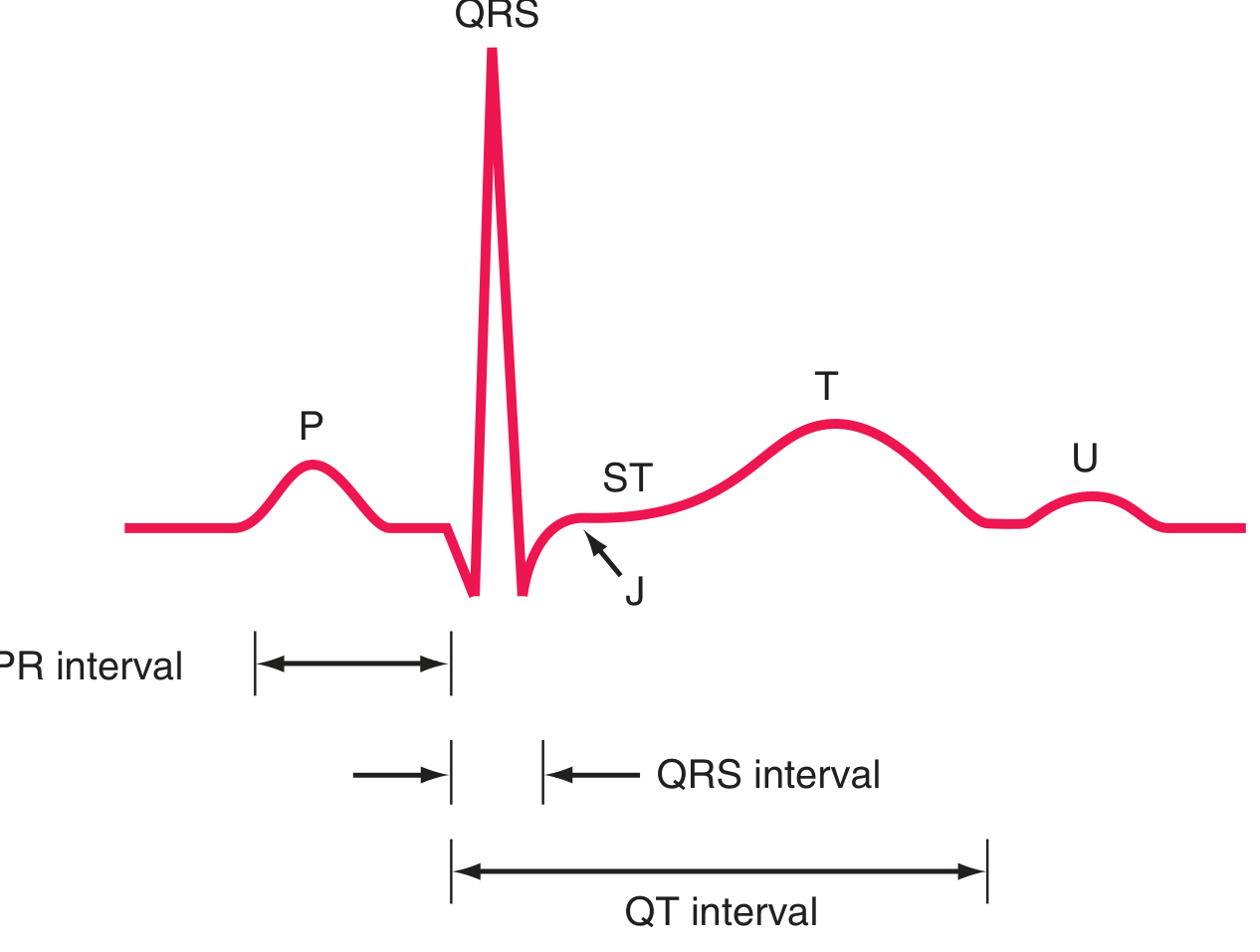
Figure from Harrison's Principles of Internal Medicine, 22E - The classic ECG waveform showing P, QRS, T, U, J point, and all key intervals.
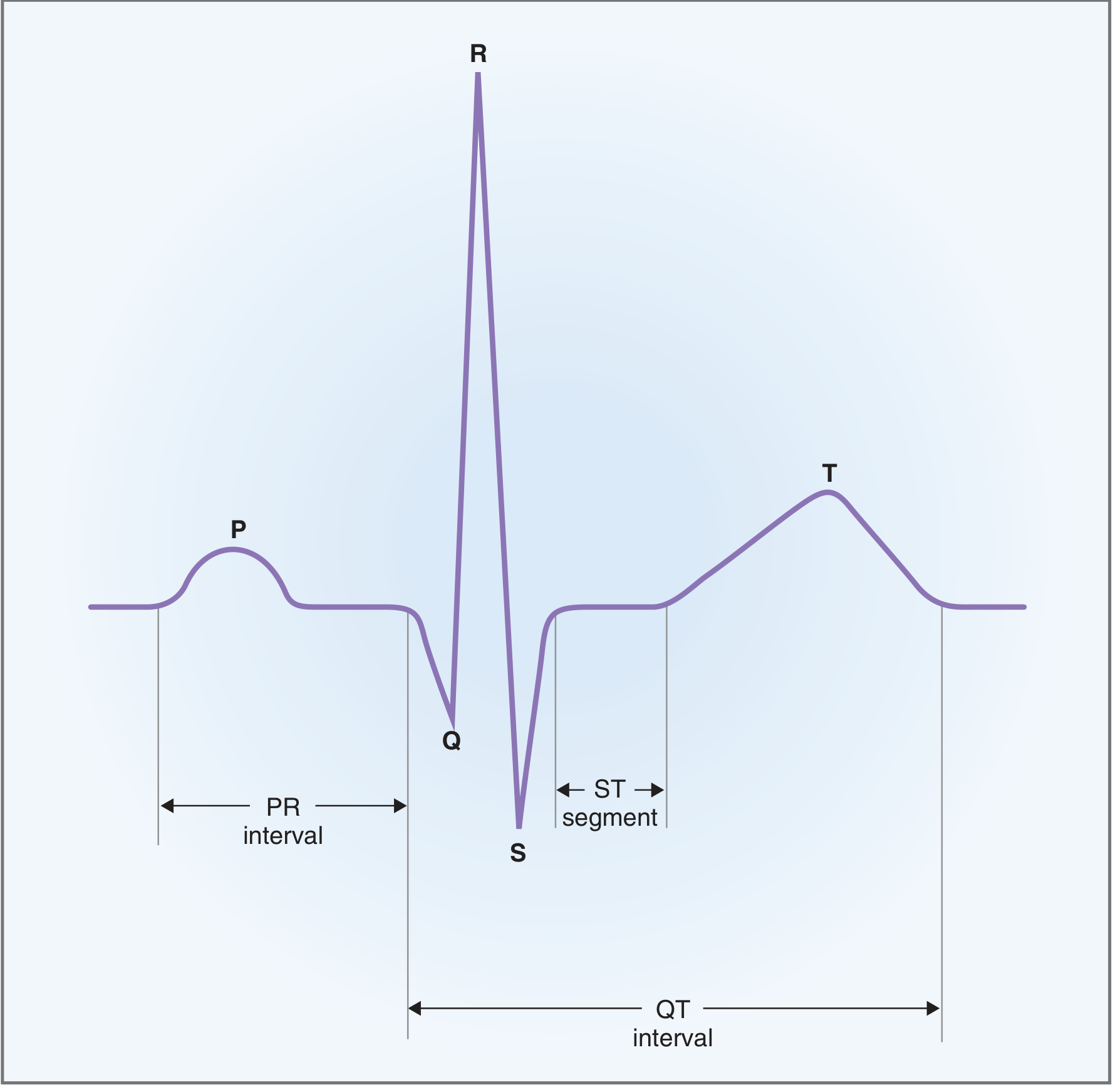
Figure from Costanzo Physiology 7th Edition - ECG measured from lead II showing labeled segments.
| Wave/Segment | What It Represents | Normal Features |
|---|---|---|
| P wave | Atrial depolarization | Upright in II, inverted in aVR; duration < 120 ms |
| PR segment | AV node conduction delay | Isoelectric (flat) |
| PR interval | Start of P wave to start of QRS | 120-200 ms (3-5 small boxes) |
| QRS complex | Ventricular depolarization | < 100-110 ms (< 2.5 small boxes) |
| ST segment | Ventricular plateau (phase 2 of action potential) | Isoelectric; corresponds to plateau of action potential |
| T wave | Ventricular repolarization | Upright in I, II, V3-V6; inverted in aVR |
| QT interval | Start of QRS to end of T wave; full ventricular depolarization + repolarization | Corrected QTc: < 460 ms (women), < 450 ms (men) |
| U wave | Possibly Purkinje repolarization | Small, same direction as T wave |
| J point | Junction between end of QRS and start of ST segment | At baseline |
Key physiology notes:
- Atrial repolarization is NOT visible on a normal ECG - it is buried within the QRS complex
- The QT interval varies inversely with heart rate; QTc corrects for this (Framingham formula: QT + 0.154 × [1000 - RR])
- Costanzo Physiology 7th Edition; Harrison's 22E
4. The 12 Leads
The 12-lead ECG gives 12 different "views" of the same electrical activity. Think of placing cameras around the heart at different angles.
Limb Leads (Frontal Plane)
Bipolar limb leads (Einthoven's triangle):
- Lead I = Left arm (+) vs Right arm (-) → 0°
- Lead II = Left leg (+) vs Right arm (-) → +60°
- Lead III = Left leg (+) vs Left arm (-) → +120°
Einthoven's Law: Lead I + Lead III = Lead II (voltages sum at any instant)
Augmented unipolar limb leads:
- aVR = Right arm → -150° (looks at heart from right shoulder)
- aVL = Left arm → -30° (looks from left shoulder)
- aVF = Left foot → +90° (looks from below)
Chest (Precordial) Leads (Horizontal Plane)
Electrodes placed on the anterior chest wall, all referenced to Wilson's central terminal:
| Lead | Position | What it "sees" |
|---|---|---|
| V1 | 4th ICS, right sternal border | Right ventricle / septum |
| V2 | 4th ICS, left sternal border | Septum |
| V3 | Between V2 and V4 | Anterior wall |
| V4 | 5th ICS, midclavicular line | Anterior wall |
| V5 | Anterior axillary line | Lateral wall |
| V6 | Midaxillary line | Lateral wall |
Normal R-wave progression: R waves grow from V1 (small) to V5 (tallest), then slightly decrease at V6. The "transition zone" where R = S is normally at V3/V4.
- Guyton and Hall; Harrison's 22E
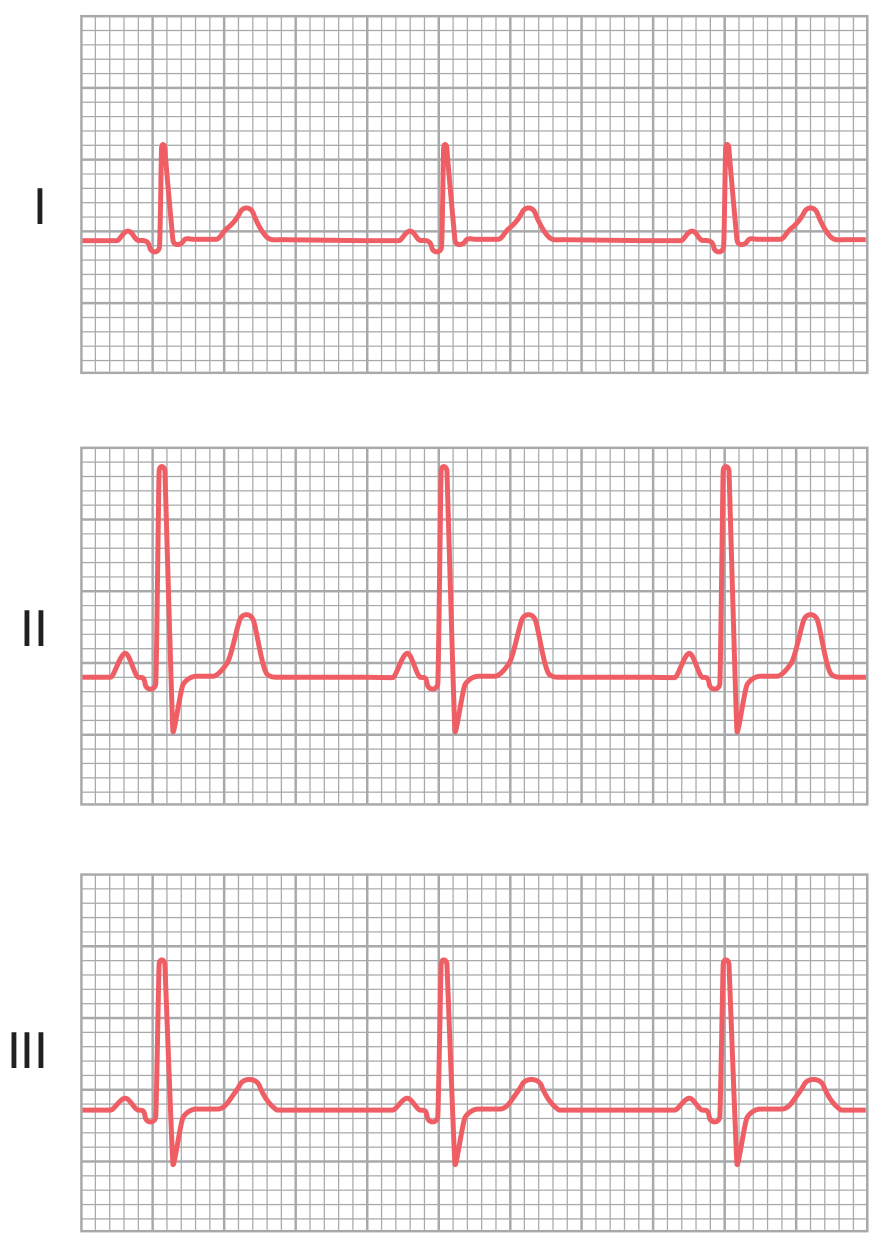
Normal ECGs recorded from the three standard bipolar limb leads (I, II, III) - Guyton and Hall Textbook of Medical Physiology
5. Systematic Approach to Reading Any ECG
Use this 8-step method every single time:
Step 1 - Rate
Count R waves:
- 300 ÷ number of large boxes between R waves = rate (quick method)
- Or: 1500 ÷ number of small boxes between R waves
- Or: Count R waves in a 10-second strip × 6
- Normal: 60-100 bpm
Step 2 - Rhythm
- Is it regular or irregular?
- Is there a P wave before every QRS? Is every P followed by a QRS?
- Normal sinus rhythm: regular rate 60-100 bpm, P wave upright in lead II, P-wave axis normal
Step 3 - P Wave
- Morphology, duration, axis
- Right atrial enlargement: tall peaked P waves (P pulmonale, > 2.5 mm in II)
- Left atrial enlargement: broad notched P waves (P mitrale, > 120 ms) or deep biphasic P in V1
Step 4 - PR Interval
- Normal: 120-200 ms
- Prolonged (> 200 ms) = first-degree AV block
- Variable PR with dropped beats = second-degree AV block
- PR < 120 ms = pre-excitation (WPW syndrome)
Step 5 - QRS Complex
- Normal: < 110 ms
- Widened QRS (> 120 ms) = bundle branch block, ventricular rhythm, hyperkalemia, drugs
- Right BBB pattern: rSR' in V1, wide S in I and V6
- Left BBB pattern: broad, notched R in I and V6, no septal Q, QS in V1
Step 6 - Axis
Using leads I and aVF:
- Lead I positive + aVF positive = Normal axis (0° to +90°)
- Lead I positive + aVF negative = Left axis deviation (more negative than -30°)
- Lead I negative + aVF positive = Right axis deviation (more positive than +90°)
Causes of LAD: LBBB, left anterior fascicular block, inferior MI, LVH
Causes of RAD: RVH, RBBB, left posterior fascicular block, lateral MI
Step 7 - ST Segment and T Wave
- ST elevation (> 1 mm in limb leads, > 2 mm in precordial leads): STEMI, pericarditis, Brugada, early repolarization, LV aneurysm
- ST depression (horizontal or downsloping): subendocardial ischemia/NSTEMI, digoxin effect, LVH strain, hypokalemia, RBBB/LBBB
- T wave changes: inversions (ischemia, PE, RVH), tall peaked T waves (hyperacute MI, hyperkalemia)
Step 8 - QT Interval
- Calculate QTc using Bazett or Framingham formula
- QTc prolonged (> 450 ms men, > 460 ms women): Torsades de Pointes risk - caused by drugs (quinolones, macrolides, antipsychotics, antiarrhythmics), hypokalemia, hypomagnesemia, hypokalemia, long QT syndrome
- QTc shortened: Hypercalcemia, digoxin, short QT syndrome
6. Key Pathological Patterns
Ischemia and MI
Ischemia creates "currents of injury" - voltage gradients between normal and ischemic tissue that cause ST displacement.
- Harrison's 22E, Chapter 247
| Pattern | Meaning | Leads Affected |
|---|---|---|
| Hyperacute tall T waves | Earliest STEMI (minutes) | Over infarct zone |
| ST elevation | Transmural injury / STEMI | Over infarct zone |
| Reciprocal ST depression | Mirror of ST elevation | Opposite leads |
| ST depression | Subendocardial ischemia / NSTEMI | Often diffuse |
| T wave inversion (symmetric, narrow) | Ischemia (chronic or Wellens) | Over ischemic zone |
| Q waves (> 40 ms, > 1/4 R height) | Completed infarct / necrosis | Over infarct zone |
Localization of MI by leads:
| Territory | Culprit Artery | Leads with Changes |
|---|---|---|
| Anterior | LAD | V1-V4 |
| Lateral | LCx | I, aVL, V5-V6 |
| Inferior | RCA (or LCx) | II, III, aVF |
| Posterior | RCA/LCx | ST depression V1-V3 (reciprocal); tall R in V1 |
| Right ventricle | RCA proximal | V1; right-sided leads V4R |
Rosen's Emergency Medicine; Harrison's 22E
Arrhythmias (Core Patterns)
| Arrhythmia | Key ECG Finding |
|---|---|
| Sinus tachycardia | Rate > 100, normal P waves, normal QRS |
| Sinus bradycardia | Rate < 60, normal morphology |
| Atrial fibrillation | No discrete P waves, irregularly irregular R-R, fibrillatory baseline |
| Atrial flutter | "Sawtooth" flutter waves at ~300/min, regular or variable block (2:1, 3:1, 4:1) |
| SVT / AVRT | Narrow complex tachycardia ~150-220/min; P waves often buried in QRS or ST segment |
| Ventricular tachycardia (VT) | Wide complex tachycardia, AV dissociation, fusion beats, capture beats; rate > 100 |
| Ventricular fibrillation | Chaotic, no organized complexes |
| 1st degree AV block | PR > 200 ms, all P waves conduct |
| 2nd degree AV block (Mobitz I / Wenckebach) | Progressive PR lengthening until dropped QRS |
| 2nd degree AV block (Mobitz II) | Fixed PR, suddenly dropped QRS - more dangerous |
| 3rd degree (complete) AV block | P and QRS completely dissociated, escape rhythm |
| WPW | Short PR (< 120 ms), delta wave (slurred QRS upstroke), wide QRS |
Hypertrophy
Left Ventricular Hypertrophy (LVH):
- Sokolow-Lyon: S in V1 + R in V5 or V6 > 35 mm
- Cornell: R in aVL > 11 mm, or R in aVL + S in V3 > 28 mm (men), > 20 mm (women)
- May also show ST depression and T wave inversion in lateral leads ("strain pattern")
Right Ventricular Hypertrophy (RVH):
- Tall R in V1 (R > S in V1), right axis deviation, T wave inversion in right precordial leads
Electrolyte Effects
| Electrolyte | ECG Changes |
|---|---|
| Hyperkalemia | Peaked narrow T waves → PR prolongation → wide QRS → sine wave → VF/asystole |
| Hypokalemia | Flattened T waves, prominent U waves, ST depression, QT prolongation |
| Hypercalcemia | Short QT interval |
| Hypocalcemia | Long QT interval (prolonged ST segment) |
Drug Effects
| Drug | ECG Change |
|---|---|
| Digoxin | "Scooped" ST depression (reverse tick), T wave changes, short QT |
| Class IA antiarrhythmics (quinidine) | Prolonged QT, wide QRS |
| Class IC (flecainide) | Wide QRS, PR prolongation |
| Beta blockers / CCBs | Bradycardia, AV block |
| Tricyclic antidepressants | Wide QRS, right axis deviation, prolonged QT |
7. Memory Aids
"Rate, Rhythm, P, PR, QRS, Axis, ST/T, QT" - 8 steps, never skip any.
Lead groupings to remember:
- Inferior = II, III, aVF
- Lateral = I, aVL, V5, V6
- Anterior/septal = V1-V4
- aVR = "looks in" from right shoulder - usually negative (inverted P, QRS, T)
Normal intervals (in order from short to long):
- QRS < 110 ms
- PR 120-200 ms
- QTc < 450-460 ms
Bundle branch block rule: Wide QRS + look at V1:
- rSR' in V1 (rabbit ears) = RBBB
- QS or wide R in V1 = LBBB
8. Clinical Significance of Each Lead
Each lead "looks" at a specific wall of the heart. When you see ST changes, look for reciprocal changes in anatomically opposite leads - this dramatically increases the specificity for MI. For example:
- Inferior STEMI (II, III, aVF elevation) → reciprocal ST depression in aVL (150° away)
- Anterior STEMI (V1-V4) → may show reciprocal depression in inferior leads
Summary Table - Quick Reference
| Finding | Think of |
|---|---|
| Short PR | WPW, LGL, AV junctional rhythm |
| Long PR | 1st degree AV block, drugs, hypervagal |
| Wide QRS | BBB, VT, WPW, hyperkalemia, toxins |
| Long QT | Drugs, electrolytes, congenital LQTS |
| ST elevation | STEMI, pericarditis, Brugada, early repol |
| ST depression | Ischemia, NSTEMI, LVH, drugs, posterior MI |
| Peaked T | Hyperacute MI, hyperkalemia |
| Inverted T | Ischemia, PE (right heart strain), CNS events |
| U wave | Hypokalemia, bradycardia |
| Irregular rhythm | AF, MAT, frequent ectopics |
| No P waves + irregular | Atrial fibrillation |
| Sawtooth waves | Atrial flutter |
| AV dissociation | VT, complete heart block |
Sources: Guyton and Hall Textbook of Medical Physiology | Costanzo Physiology 7th Edition | Harrison's Principles of Internal Medicine 22E | Rosen's Emergency Medicine | Braunwald's Heart Disease
This is a shared conversation. Sign in to Orris to start your own chat.