

Peritonitis pathogenesis in flow chart
Peritonitis - Pathogenesis Flowchart
INITIAL CAUSE
Perforation (GIT) / Post-inflammatory / Post-operative / Trauma / Foreign body
Appendicitis / Cholecystitis / Intestinal obstruction with strangulation
Fallopian tube septicemia / Abortion / Uterine perforation
                                    |
                                    ▼
              MULTIPLICATION OF BACTERIA IN PERITONEAL CAVITY
                        (E. coli, Bacteroides, Klebsiella, etc.)
                                    |
               ┌────────────────────┴─────────────────────┐
               ▼                                           ▼
        ENDOTOXIN RELEASE                     PERITONEAL IRRITATION
     (from gram-negative bacteria)         (inflammation of peritoneum)
               |                                           |
               ▼                                           ▼
         SEPTIC SHOCK                        EXUDATE COLLECTS IN PERITONEAL CAVITY
    (vasodilation, hypotension,                  (3rd Space Fluid Loss)
     tachycardia, fever, SIRS)                         |
                                                        ▼
                                                HYPOVOLEMIC SHOCK
                                           (intravascular volume depletion)
               |                                           |
               └──────────────────┬────────────────────────┘
                                   ▼
                        MOF (Multiple Organ Failure)
                   (Renal failure, ARDS, hepatic failure,
                    DIC, cardiac failure)
                                   |
                                   ▼
                                DEATH
                    (100% mortality if untreated surgically)
Key Points to Remember
- Primary - no identifiable secondary cause (e.g. spontaneous bacterial peritonitis in cirrhosis)
- Secondary - due to bowel perforation, appendicitis, trauma
- Tertiary - post-operative, persistent peritonitis after treatment
- Generalized - whole peritoneum involved; 100% mortality without surgery
| Pathway | Mechanism | Result |
|---|---|---|
| Endotoxin pathway | Gram-negative bacteria release LPS endotoxin -> SIRS | Septic shock |
| Peritoneal irritation pathway | Inflammation -> massive exudate -> 3rd space loss | Hypovolemic shock |
Detail flow chart
A detailed medical flowchart titled "Peritonitis - Detailed Pathogenesis" on a clean white background with professional medical diagram styling. The flowchart flows top to bottom with color-coded boxes and arrows. TOP BOX (red, wide): "INITIAL INSULT / CAUSES" listing: Perforation (GIT, bowel) | Post-inflammatory (appendicitis, cholecystitis) | Post-operative / Trauma / Foreign body | Fallopian tube septicemia | Uterine perforation / Abortion Arrow down to: YELLOW BOX: "BREACH OF PERITONEAL BARRIER" - Loss of sterility of peritoneal cavity Arrow down to: ORANGE BOX: "MULTIPLICATION OF BACTERIA IN PERITONEAL CAVITY" - E. coli (MCC), Bacteroides fragilis, Klebsiella, Enterococcus - Gram-negative bacilli predominate Arrow splits into TWO PARALLEL PATHWAYS with a dividing line: LEFT PATHWAY (blue boxes): Box 1: "ENDOTOXIN (LPS) RELEASE" - From gram-negative bacterial cell walls Arrow down: Box 2: "ACTIVATION OF MACROPHAGES & COMPLEMENT" - Release of IL-1, IL-6, TNF-alpha Arrow down: Box 3: "SYSTEMIC INFLAMMATORY RESPONSE SYNDROME (SIRS)" - Fever, tachycardia, tachypnea, leukocytosis Arrow down: Box 4: "VASODILATION + INCREASED CAPILLARY PERMEABILITY" - Decreased SVR, maldistribution of blood flow Arrow down: Box 5 (dark blue): "SEPTIC SHOCK" - Hypotension unresponsive to fluids RIGHT PATHWAY (green boxes): Box 1: "PERITONEAL IRRITATION" - Chemical + bacterial inflammation of peritoneum Arrow down: Box 2: "MASSIVE EXUDATE FORMATION" - Protein-rich fluid pours into peritoneal cavity Arrow down: Box 3: "3rd SPACE FLUID LOSS" - Fluid sequestration in peritoneal cavity (litres lost) Arrow down: Box 4: "PARALYTIC ILEUS" - Bowel distension, vomiting, reduced oral intake Arrow down: Box 5 (dark green): "HYPOVOLEMIC SHOCK" - Reduced preload, low cardiac output BOTH ARROWS CONVERGE to: PURPLE BOX: "MULTI-ORGAN FAILURE (MOF)" listing: Acute Kidney Injury (AKI) | ARDS (lung) | Hepatic failure | DIC (coagulopathy) | Myocardial depression | Encephalopathy Arrow down to: RED BOX: "DEATH" - 100% mortality if not treated surgically Small side note box: "Generalized peritonitis = whole peritoneum involved = surgical emergency" Use clear bold text, color-coded arrows matching box colors, professional clean medical diagram look.
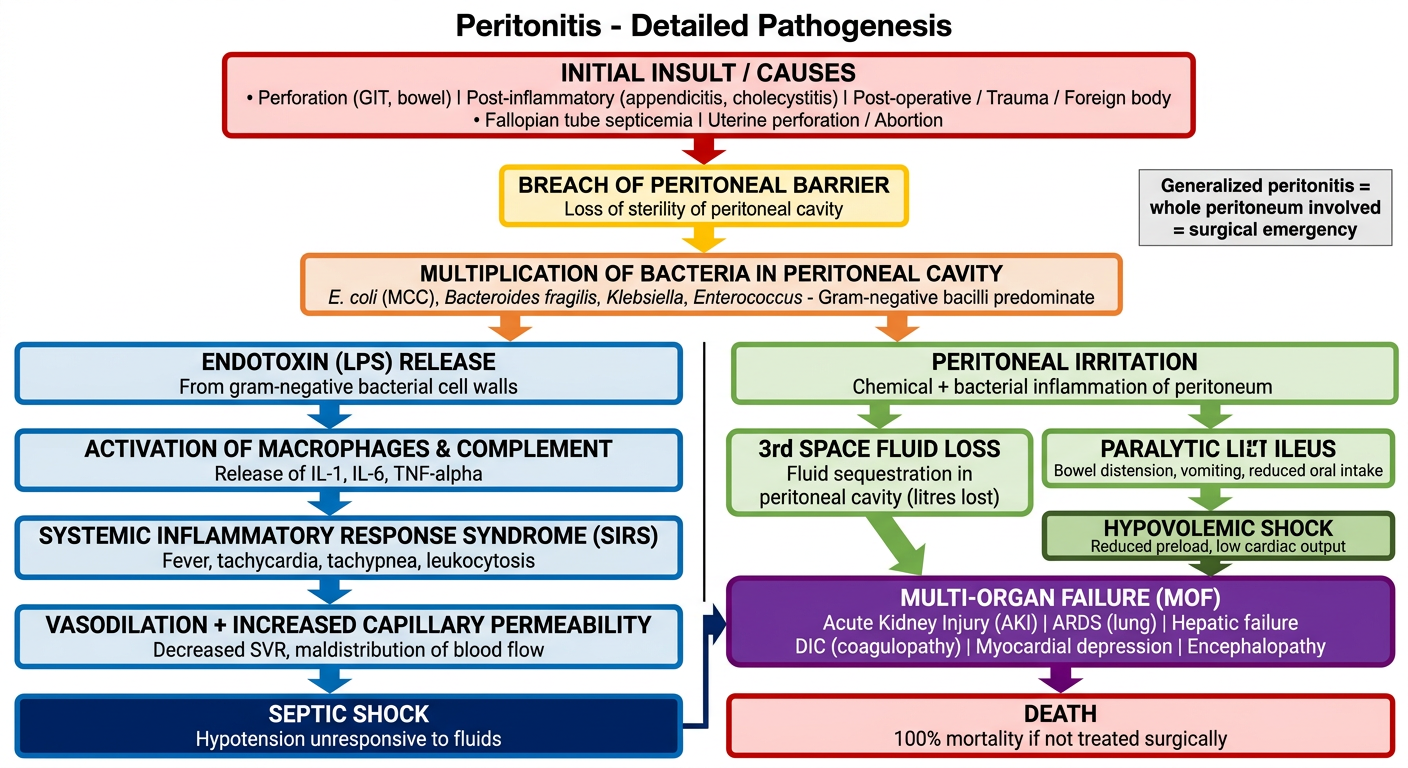
Peritonitis - Detailed Pathogenesis
STEP 1 - Initial Insult
| Category | Examples |
|---|---|
| Perforation | Bowel, peptic ulcer, GIT trauma |
| Post-inflammatory | Appendicitis, cholecystitis, diverticulitis |
| Pelvic/Gynecological | Fallopian tube septicemia, uterine perforation, abortion |
| Iatrogenic | Post-operative, drain, foreign body |
STEP 2 - Breach of Peritoneal Barrier
- Loss of sterility of peritoneal cavity
- Normally sterile environment is contaminated
STEP 3 - Bacterial Multiplication in Peritoneal Cavity
- E. coli (MCC), Bacteroides fragilis, Klebsiella, Enterococcus
- Gram-negative bacilli predominate
LEFT PATHWAY - Endotoxin Route → Septic Shock
Endotoxin (LPS) Release from gram-negative bacteria
            ↓
Macrophage activation → IL-1, IL-6, TNF-alpha release
            ↓
SIRS (fever, tachycardia, tachypnea, leukocytosis)
            ↓
Vasodilation + ↑ Capillary permeability
            ↓
Maldistribution of blood flow
            ↓
        SEPTIC SHOCK
RIGHT PATHWAY - Peritoneal Irritation Route → Hypovolemic Shock
Peritoneal Irritation (chemical + bacterial)
            ↓
Massive Exudate Formation (protein-rich fluid)
            ↓
3rd Space Fluid Loss (litres sequestered in peritoneal cavity)
            ↓
Paralytic Ileus → vomiting, reduced oral intake
            ↓
       HYPOVOLEMIC SHOCK
CONVERGENCE
Septic Shock  +  Hypovolemic Shock
                ↓
    MULTI-ORGAN FAILURE (MOF)
    - AKI (Acute Kidney Injury)
    - ARDS (lung failure)
    - Hepatic failure
    - DIC (coagulopathy)
    - Myocardial depression
    - Encephalopathy
                ↓
             DEATH
    (100% if not surgically treated)
Make a quick reference PDF on peritonitis diagnosis, lab findings, and imaging
Create a comparison poster: primary vs secondary vs tertiary peritonitis