
A number of enzymes are secreted as zymogens why? From Lippincott
Reading File
Zymogens (inactive enzyme precursors) are secreted in that form to protect the cells that produce them from self-digestion. For example, pancreatic proteases like trypsin would destroy the pancreas itself if secreted in active form.
Searching sources...
Finding Sources
Finding Sources
I found the Lippincott Biochemistry reference. Let me read the relevant sections directly.
Reading File
Finding Sources
Now let me also read the proteolytic cleavage section from Lippincott (Basic Medical Biochemistry) for the more direct "why zymogens" explanation:
Reading File
Reading File
I now have the full Lippincott content. Let me also fetch the diagram referenced:
Loading Image
Here is the full answer directly from Lippincott Illustrated Reviews: Biochemistry (8th ed.) and Lippincott's Basic Medical Biochemistry (6th ed.):
Why Enzymes Are Secreted as Zymogens
What Is a Zymogen?
A zymogen (also called a proenzyme) is an inactive precursor form of an enzyme. The inactive state is conferred by extra amino acids in the sequence that prevent the enzyme from adopting its catalytically active conformation. Removal of these peptides - by specific proteolytic cleavage - permits the proper folding required for an active enzyme.
"In general, zymogens contain extra amino acids in their sequences that prevent them from being catalytically active. Removal of these amino acids permits the proper folding required for an active enzyme."
- Biochemistry, 8th ed. Lippincott Illustrated Reviews, p. 691
The Core Reason: To Prevent Premature Activation
The synthesis of zymogens as inactive precursors prevents them from cleaving proteins prematurely at their sites of synthesis or secretion. If these proteases were secreted in active form, they would digest the very cells that produce them - a process called autodigestion.
"The synthesis of zymogens as inactive precursors prevents them from cleaving proteins prematurely at their sites of synthesis or secretion."
- Basic Medical Biochemistry, 6th ed. (Lippincott), p. 289
Key Examples from Lippincott
1. Pepsinogen (Stomach)
- Secreted by chief cells of the stomach as the inactive zymogen pepsinogen.
- In the presence of HCl (gastric acid), pepsinogen undergoes a conformational change allowing it to cleave itself (autocatalysis) into the active form pepsin.
- Pepsin then cleaves dietary proteins into polypeptides.
2. Pancreatic Proteases (Most Important Group)
The pancreas secretes multiple zymogens:
| Zymogen | Active Enzyme |
|---|---|
| Trypsinogen | Trypsin |
| Chymotrypsinogen | Chymotrypsin |
| Proelastase | Elastase |
| Procarboxypeptidase | Carboxypeptidase |
All are activated in the intestinal lumen, not inside the pancreas. The key trigger is:
- Enteropeptidase (formerly enterokinase), secreted by the brush border cells of the small intestine, cleaves trypsinogen → trypsin.
- Trypsin then activates all the other pancreatic zymogens (cascade activation).
"Because the active forms of these enzymes can digest each other, it is important for their zymogen forms all to be activated within a short span of time."
- Basic Medical Biochemistry, 6th ed. (Lippincott)
3. Blood Clotting Proteases (Another Classic Example)
Most proteases involved in blood clotting - such as fibrinogen and prothrombin - circulate in the blood as zymogens. They are only cleaved to their active forms (fibrin and thrombin) at the site of vessel injury, ensuring clots form locally and not randomly throughout the circulation.
Digestion of Dietary Protein - Summary Diagram
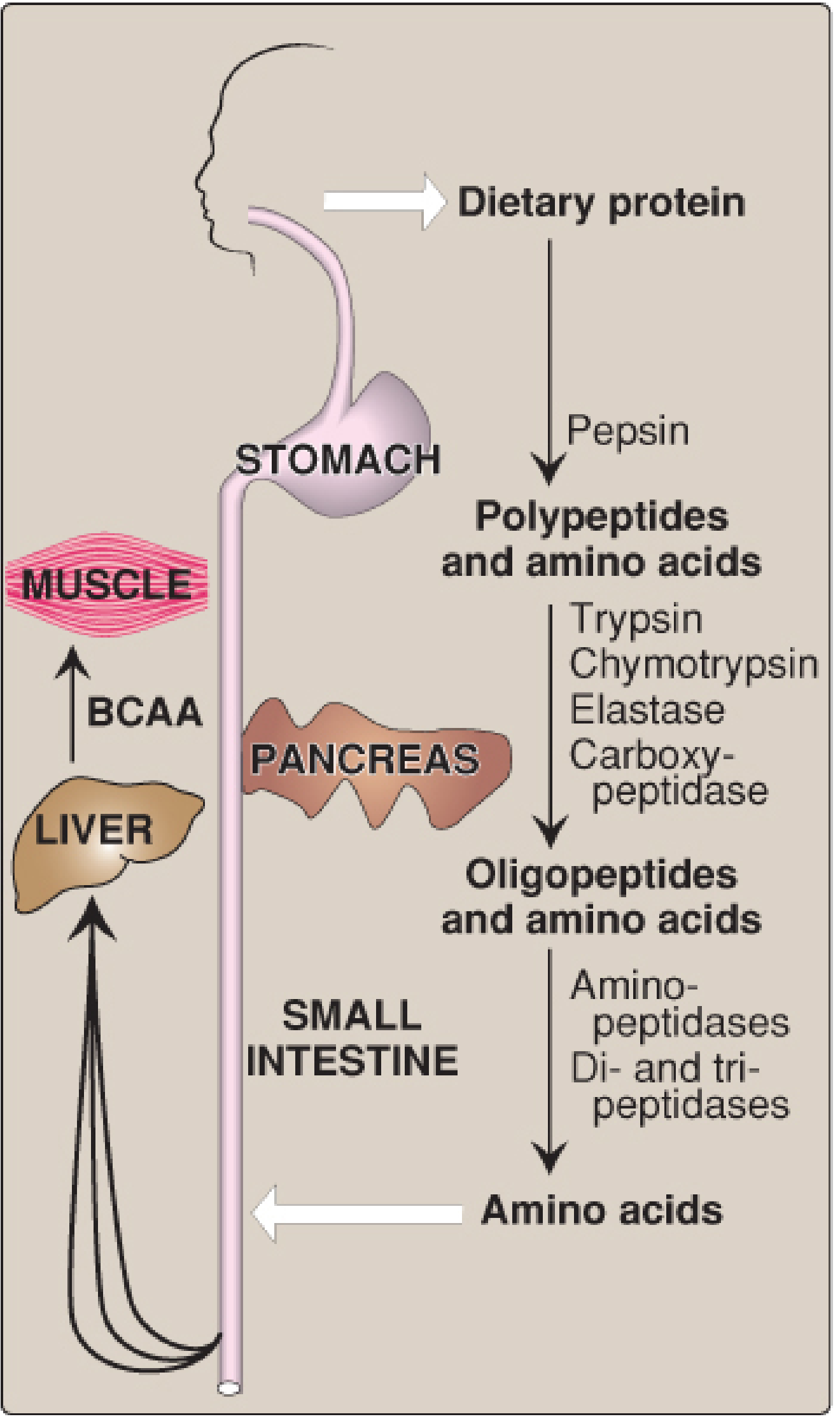
Figure 19.4 from Lippincott Biochemistry 8th ed. - Digestion of dietary proteins along the GI tract.
Summary
Enzymes are secreted as zymogens for one overarching reason: to protect the producing cells and tissues from destruction by premature enzymatic activity. Activation is then triggered in a controlled location (e.g., the intestinal lumen) and often in a cascade (trypsin activating all other pancreatic zymogens), ensuring the right enzyme is active at the right place and time.
- Biochemistry, 8th ed. Lippincott Illustrated Reviews, pp. 691-694
- Basic Medical Biochemistry: A Clinical Approach, 6th ed. (Lippincott), p. 289, 1294
Coenzyme can be considered as cosubstarate.Give reason.from lippincot
Coenzymes act like cosubstrates because they bind to the enzyme, get chemically altered during the reaction, and then dissociate - just like a substrate does. They are not permanently bound and must be regenerated to be reused.
Searching sources...
Finding Sources
Finding Sources
Found the exact Lippincott reference. Let me read those sections in full.
Reading File
Finding Sources
Now let me find the main chapter text where Lippincott defines and explains coenzyme-cosubstrates in detail:
Finding Sources
Finding Sources
Finding Sources
Found the exact section. Let me read it in full:
Reading File
I now have everything needed for a complete answer directly from Lippincott. Let me also look for the NAD+ specific example text and the study question answer already found:
Finding Sources
I have all the key Lippincott content needed. Here is the full answer:
Why a Coenzyme Can Be Considered a Cosubstrate
The Core Definition (from Lippincott)
Lippincott Illustrated Reviews: Biochemistry (8th ed.) defines and distinguishes coenzymes as follows:
"If it is a small organic molecule, it is termed a coenzyme. Coenzymes or cosubstrates only transiently associate with the enzyme and dissociate from the enzyme in an altered state (for example, NAD+). If the coenzyme is permanently associated with the enzyme and returned to its original form, it is called a prosthetic group (for example, FAD)."
- Biochemistry, 8th ed. Lippincott Illustrated Reviews, p. 172, Section D
The Reason: Coenzymes Behave Like Substrates
A substrate is a molecule that:
- Binds to the enzyme transiently (not permanently)
- Is chemically changed during the reaction
- Dissociates from the enzyme after the reaction
A coenzyme-cosubstrate does exactly the same three things:
| Property | Substrate | Coenzyme-Cosubstrate |
|---|---|---|
| Binding to enzyme | Transient | Transient |
| Chemical alteration | Yes - converted to product | Yes - leaves enzyme in altered form |
| Dissociates after reaction | Yes | Yes |
| Must be regenerated | N/A | Yes - by another reaction |
This is precisely why Lippincott explicitly uses the term "coenzyme-cosubstrate" - the coenzyme acts as a second substrate in the reaction.
The Classic Example: NAD+
Lippincott's study question illustrates this perfectly with alcohol dehydrogenase (ADH):
"Alcohol dehydrogenase (ADH) requires NAD+ for catalytic activity. In the reaction catalyzed by ADH, an alcohol is oxidized to an aldehyde as NAD+ is reduced to NADH and dissociates from the enzyme. The NAD+ is functioning as a coenzyme-cosubstrate."
"Correct answer = B. Coenzyme-cosubstrates are small organic molecules that associate transiently with an enzyme and leave the enzyme in a changed form."
- Biochemistry, 8th ed. Lippincott Illustrated Reviews, p. 209
So in this reaction:
- Alcohol = substrate 1 (oxidized to aldehyde)
- NAD+ = cosubstrate (reduced to NADH and released)
NAD+ enters the reaction, gets chemically reduced to NADH, and dissociates - just like a true substrate. It must then be regenerated back to NAD+ (e.g., by the electron transport chain) before it can participate in another reaction.
Contrast: Coenzyme-Prosthetic Group (Not a Cosubstrate)
To clarify the distinction Lippincott makes:
| Type | Example | Association | Leaves altered? |
|---|---|---|---|
| Coenzyme-cosubstrate | NAD+, CoA | Transient | Yes - must be regenerated elsewhere |
| Coenzyme-prosthetic group | FAD, heme | Permanent | No - regenerated on the enzyme itself |
FAD, for instance, is also a small organic molecule, but it stays bound to the enzyme and is returned to its oxidized form while still attached - so it is NOT a cosubstrate.
Summary
A coenzyme is considered a cosubstrate because it transiently binds to the enzyme, undergoes a chemical change during the reaction (just like a substrate does), and then dissociates in its altered form - requiring regeneration by a separate reaction before it can be reused. This transient, altered-state departure is the defining feature that makes it behave as a second substrate rather than a permanent structural component of the enzyme.
- Biochemistry, 8th ed. Lippincott Illustrated Reviews, p. 172 (Section 5.D) and p. 209 (Study Question 5.2)
Discuss the mechanism of action of enzymes
Enzymes lower activation energy, form enzyme-substrate complexes at the active site, and use chemical strategies like acid-base catalysis, covalent intermediates, and metal ion coordination to accelerate reactions. The active site provides a precise 3D environment that stabilizes the transition state.
Searching sources...
Finding Sources
Finding Sources
Reading File
Reading File
Now let me also look for the active site specificity (lock-and-key / induced fit) section which is core to mechanism of action:
Finding Sources
Finding Sources
Finding Sources
Finding Sources
Reading File
Now let me fetch the key diagrams to include in the answer:
Loading Image
Loading Image
I have all the content needed. Here is the full, structured answer directly from Lippincott Illustrated Reviews: Biochemistry (8th ed.):
Mechanism of Action of Enzymes
Lippincott Illustrated Reviews: Biochemistry, 8th ed.
The mechanism of enzyme action can be viewed from two perspectives:
- Energy changes that occur during the reaction
- Active site chemistry that facilitates catalysis
I. The Active Site
Enzyme molecules contain a special pocket or cleft called the active site, formed by the 3D folding of the protein chain. The active site contains amino acid residues whose side chains participate in substrate binding and catalysis.
"The substrate first binds the enzyme, forming an enzyme-substrate (ES) complex. Binding is thought to cause a conformational change in the enzyme (induced fit model) that allows rapid conversion of the ES to enzyme-product (EP) complex, which subsequently dissociates to free enzyme and product."
- Lippincott Biochemistry 8th ed., p. 170
Induced Fit Model
Unlike the older "lock-and-key" idea (rigid complementarity), the induced fit model states that:
- The enzyme is flexible
- Substrate binding causes a conformational change in the enzyme
- This change brings catalytic residues into precise alignment around the substrate
- The result is a tighter, more reactive ES complex
II. Energy Changes During the Reaction
1. Activation Energy (Ea)
All chemical reactions have an energy barrier called the activation energy (Ea) - the energy difference between the reactants and the high-energy transition state (T*), the short-lived intermediate formed during conversion of substrate to product.
"Because of the high Ea, the rates of uncatalyzed chemical reactions are often slow."
2. How Enzymes Speed Up Reactions
"An enzyme allows a reaction to proceed rapidly under conditions prevailing in the cell by providing an alternate reaction pathway with a lower Ea."
The enzyme does NOT:
- Change the free energy (ΔG) of the reactants or products
- Change the equilibrium of the reaction
The enzyme DOES:
- Accelerate the rate at which equilibrium is reached
- Lower the energy barrier so more molecules can cross it
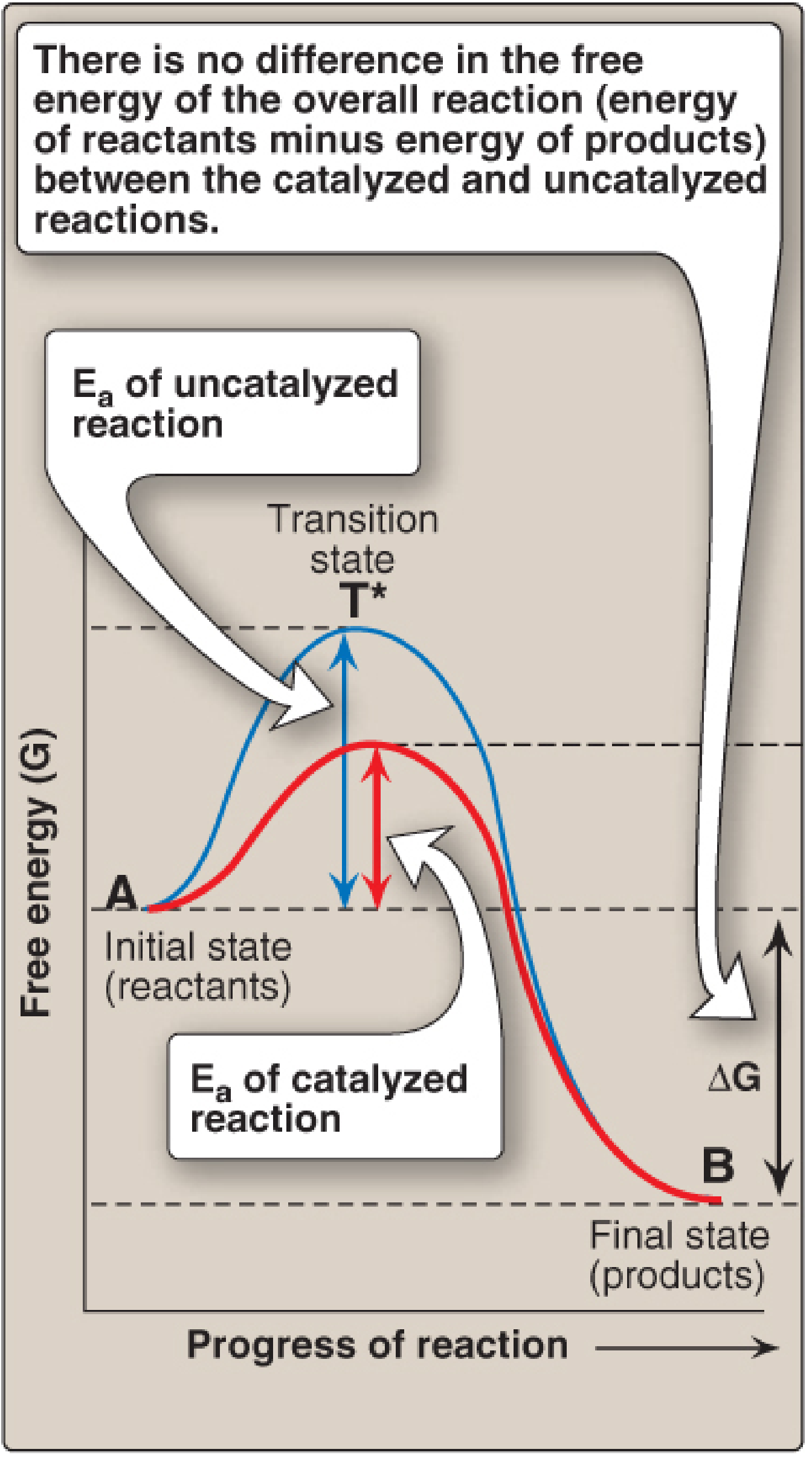
Fig. 5.4 - Lippincott Biochemistry 8th ed. p. 174: The enzyme lowers Ea but does not change ΔG.
III. Active Site Chemistry - How the Active Site Catalyzes the Reaction
The active site is not a passive binding pocket - it is an active molecular machine that uses multiple chemical strategies:
1. Transition-State Stabilization
"The active site often acts as a flexible molecular template that binds the substrate and initiates its conversion to the transition state... By stabilizing the transition state, the enzyme greatly increases the concentration of the reactive intermediate that can be converted to product and, thus, accelerates the reaction."
The enzyme binds the transition state more tightly than the substrate itself, lowering the energy required to reach it.
2. General Acid-Base Catalysis
Amino acid residues at the active site can donate or accept protons to facilitate bond breaking and formation.
- Example: Histidine at the active site of chymotrypsin has a pKa close to physiologic pH, allowing it to both gain (general base) and lose (general acid) protons during catalysis.
3. Covalent Catalysis
The active site can form a transient covalent bond with the substrate, creating a reactive intermediate that then breaks down to release product and regenerate the free enzyme.
- Example: Serine at the active site of chymotrypsin forms a transient covalent bond with the peptide substrate.
"The mechanism of action of chymotrypsin includes general base, general acid, and covalent catalysis. A histidine at the active site gains (general base) and loses (general acid) protons... Serine at the active site forms a transient covalent bond with the substrate."
- Lippincott Biochemistry 8th ed., p. 176-177
Summary of Catalytic Strategies
| Mechanism | Description | Example |
|---|---|---|
| Transition-state stabilization | Active site molds around and stabilizes T* | Most enzymes |
| General acid-base catalysis | Amino acids donate/accept protons | Chymotrypsin (His) |
| Covalent catalysis | Transient ES covalent bond | Chymotrypsin (Ser) |
| Metal ion catalysis | Metal cofactors stabilize charges or orient substrates | Carbonic anhydrase (Zn²+) |
IV. Efficiency and Specificity
| Property | Detail |
|---|---|
| Speed | Enzymes catalyze reactions 10³ to 10⁸ times faster than uncatalyzed reactions |
| Turnover number (kcat) | Typically 10² to 10⁴ substrate molecules converted per enzyme per second |
| Specificity | Each enzyme interacts with one or very few substrates and catalyzes only one type of reaction |
"The number of substrate molecules converted to product per enzyme molecule per second is called the turnover number, or kcat, and typically is 10² to 10⁴ second⁻¹."
- Lippincott Biochemistry 8th ed., p. 171
V. The Complete Sequence of Events
S + E → ES → EP → E + P
- Substrate (S) binds to the active site of free enzyme (E)
- Conformational change occurs (induced fit) - forming the ES complex
- Active site chemistry (acid-base, covalent catalysis, transition-state stabilization) converts substrate to product
- EP complex dissociates
- Product (P) is released; enzyme (E) is regenerated unchanged and ready for the next cycle
The small dip in the energy curve at the ES stage (slightly lower than free S) reflects the stabilization energy gained on substrate binding, before the climb to the transition state.
Source: Biochemistry, 8th ed. Lippincott Illustrated Reviews, Chapter 5 (Enzymes), pp. 170-178
This is a shared conversation. Sign in to Orris to start your own chat.