
Is ptca and reconstructive surgery in leprosy are tertiary level of prevention or not explain it
Both PTCA (Physiotherapy, Corrective exercises, and Assistive devices) and reconstructive surgery in leprosy fall under tertiary prevention - they aim to reduce disability and restore function in patients who already have established deformities from leprosy.
Searching sources...
Reading File
Finding Sources
Finding Sources
Reading File
Finding Sources
Reading File
Finding Sources
Finding Sources
Reading File
Now let me fetch the referral system flowchart image and search for the specific PTCA content at primary/secondary levels:
Finding Sources
Finding Sources
Finding Sources
Searching the Web
PTCA leprosy prevention level tertiary secondary reconstructive surgery Leavell Clark
I now have all the information needed for a thorough answer. Let me also fetch the referral system image:
Loading Image
Excellent! I now have all the information needed. Here is the complete, detailed answer:
PTCA and Reconstructive Surgery in Leprosy: Are They Tertiary Level of Prevention?
YES - both PTCA and reconstructive surgery in leprosy constitute tertiary prevention. Here is the full explanation.
Understanding the Levels of Prevention (Leavell & Clark)
The three levels of prevention are based on the natural history of disease:
| Level | Stage of Disease | Goal |
|---|---|---|
| Primary | Pre-pathogenesis (no disease) | Prevent disease from occurring |
| Secondary | Early pathogenesis (early disease) | Early detection + prompt treatment to halt progression |
| Tertiary | Advanced disease / established disability | Limit disability + restore function |
Tertiary prevention has two components:
- Disability limitation - preventing further/worsening disability in advanced disease
- Rehabilitation - restoring function and quality of life after disability is established
What is PTCA in Leprosy?
PTCA stands for Physiotherapy, Training (in self-care), Corrective exercises, and Assistive devices (sometimes also expanded as Prevention of impairment, Treatment of reactions, Corrective surgery, and Appliances/aids). In the leprosy context, it refers to a package of non-surgical interventions for patients who already have nerve damage and deformity:
- Physiotherapy - exercises to maintain range of motion in clawed hands/feet, prevent contractures
- Self-care training - teaching patients to protect insensitive hands/feet to prevent secondary ulcers
- Corrective exercises - strengthening muscles to compensate for paralysis (e.g. wrist drop, foot drop)
- Assistive devices - MCR (Micro-Cellular Rubber) footwear, splints, orthoses to protect insensitive limbs
Why PTCA is Tertiary Prevention
PTCA is applied after disability has already occurred - the patient has established nerve damage (Grade 1 or Grade 2 disability). The goals are:
- Prevent the disability from worsening (disability limitation)
- Help the patient cope and maintain function despite existing disability (rehabilitation)
This fits squarely into the rehabilitation and disability limitation arms of tertiary prevention.
Why Reconstructive Surgery is Tertiary Prevention
Reconstructive surgery (RCS) in leprosy is performed on patients with established deformities such as:
- Claw hand (ulnar/median nerve palsy)
- Foot drop (common peroneal nerve palsy)
- Lagophthalmos (facial nerve palsy causing inability to close eye)
- Wrist drop
- Plantar ulcers requiring flap repair or amputation
The goals of RCS are:
- Correct visible deformity (cosmetic + functional restoration)
- Prevent secondary complications (e.g. eye damage from lagophthalmos, ulceration from claw foot)
- Restore social/occupational function
This is classic rehabilitation - the fifth element of Leavell & Clark's model - and therefore tertiary prevention.
Three-Tier DPMR System in NLEP
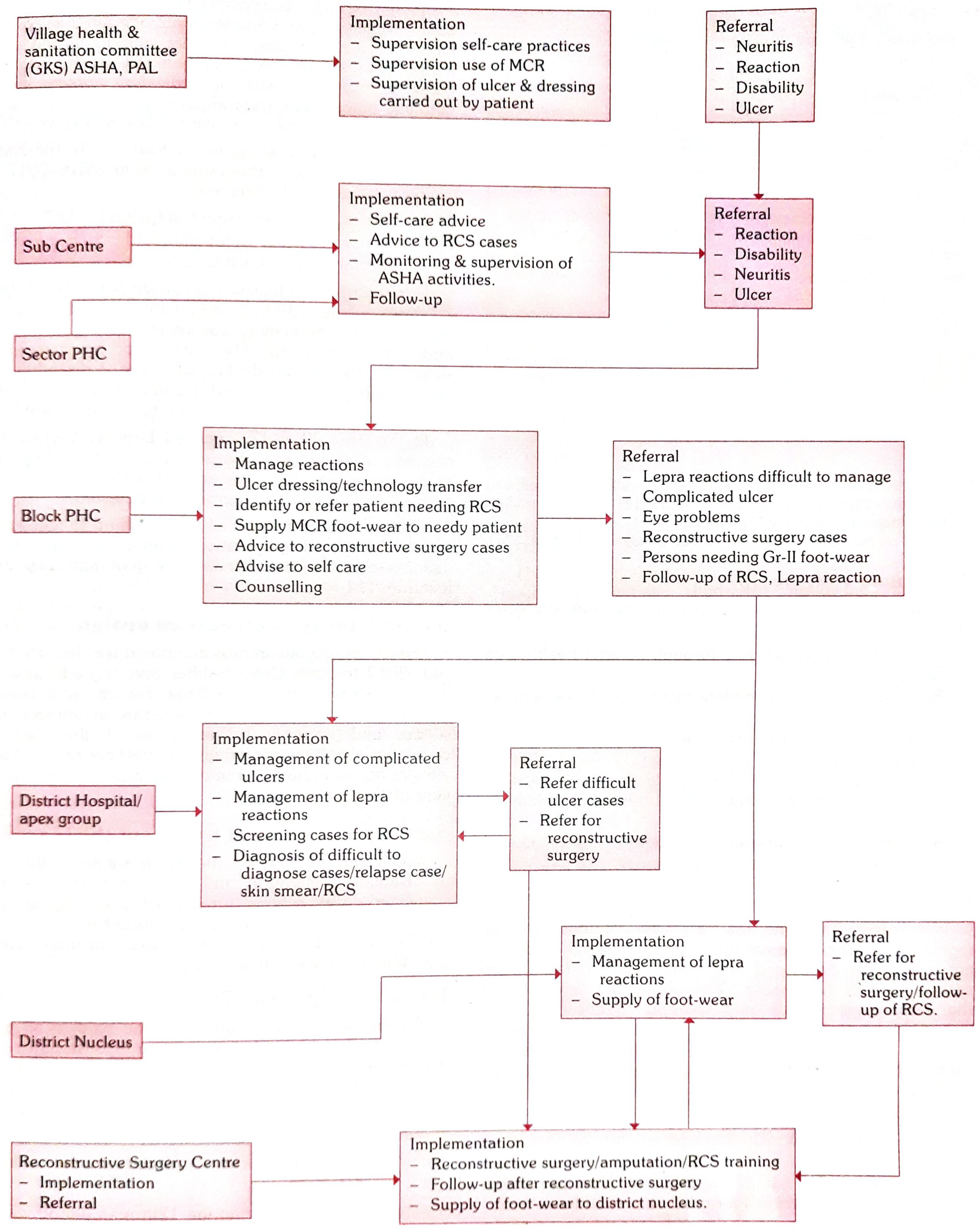
According to Park's Textbook of Preventive and Social Medicine, the National Leprosy Eradication Programme (NLEP) implements Disability Prevention and Medical Rehabilitation (DPMR) services in a three-tier referral system:
| Tier | Institutions | Activities |
|---|---|---|
| Primary (1st level) | PHCs, CHCs, Urban leprosy centres | Self-care advice, ulcer dressing, MCR footwear supply, surveillance |
| Secondary (2nd level) | District HQ Hospitals, District Nucleus | Management of reactions, complicated ulcers, screening for RCS, management of lepra reactions |
| Tertiary (3rd level) | CLTRI (Chingalpettu), RLTRI (Aska/Gauripur/Raipur), ICMR-JALMA (Agra), ILEP hospitals, PMR departments of medical colleges | Reconstructive surgery, physiotherapy, full rehabilitation programmes |
The referral flowchart from the NLEP clearly shows reconstructive surgery is handled at the Reconstructive Surgery Centre - the apex of this three-tier system:
Important Distinction: Two Meanings of "Tertiary"
Note that the word "tertiary" is used in two different senses in leprosy:
-
Tertiary level of PREVENTION (Leavell & Clark framework) - PTCA and RCS are tertiary prevention because they rehabilitate people with established disability. This is a conceptual/public health classification.
-
Tertiary level of CARE (NLEP's 3-tier delivery system) - Reconstructive surgery is also delivered at tertiary care institutions (CLTRI, medical college PMR departments). This is an administrative/service delivery classification.
Both answers are correct in their respective contexts, but the question is asking about prevention levels, so the answer is: YES, both PTCA and reconstructive surgery are tertiary prevention because they address patients with established leprosy-related disability.
Summary Table
| Intervention | Applied When | Tertiary Prevention Arm | Level of Care Delivery |
|---|---|---|---|
| PTCA (physiotherapy, corrective exercises, MCR footwear) | Established nerve damage (Grade 1/2 disability) | Disability limitation + Rehabilitation | Primary/Secondary level |
| Reconstructive surgery | Established deformity (claw hand, lagophthalmos, foot drop) | Rehabilitation | Tertiary level institutions |
- Park's Textbook of Preventive and Social Medicine, DPMR section, NLEP chapter (pp. 475-480)
This is a shared conversation. Sign in to Orris to start your own chat.