
Dangerous area of face
Reading File
Finding Sources
Finding Sources
Searching Images
danger triangle of the face cavernous sinus venous drainage diagram
Finding Sources
Reading File
Danger Area of the Face
The "danger area" (or danger triangle) of the face is the region extending from the corners of the mouth to the bridge of the nose, encompassing the upper lip, nose, and inner canthi of the eyes. It is considered dangerous because infections here (boils, carbuncles, folliculitis, or a squeezed pimple) can spread intracranially and cause cavernous sinus thrombosis, a life-threatening complication.
Why this area is dangerous - the venous anatomy
The facial veins in this region lack valves, so blood (and infection) can flow in either direction, including retrograde toward the brain. Two main pathways exist:
- Angular vein route: The angular vein (formed by union of the supraorbital and supratrochlear veins near the medial canthus) communicates directly with the superior ophthalmic vein, which drains into the cavernous sinus - Scott-Brown's Otorhinolaryngology, Vol 1, p. 6414-6424.
- Deep facial vein route: The deep facial vein connects with the pterygoid venous plexus, which passes through the foramen ovale and foramen lacerum to also communicate with the cavernous sinus - S. Das, A Manual on Clinical Surgery, 13th ed., p. 458-464.
Because these veins are valveless, increased pressure from manipulating an infected lesion (squeezing a pimple, incising a boil) can push infected thrombus backward into the cavernous sinus - Textbook of Family Medicine, 9e, p. 1770-1776.
Clinical consequence: cavernous sinus thrombosis
Signs that suggest this complication has occurred:
- Severe systemic illness (fever, toxicity)
- Proptosis (bulging eye)
- Chemosis (conjunctival swelling)
- Squint/ophthalmoplegia - especially lateral rectus palsy, since the abducens (VI) nerve runs directly within the sinus and is affected early, unlike CN III, IV, and V1/V2 which run in the lateral wall and are relatively more protected
- Can progress to blindness, meningitis, or death if untreated
Clinical teaching point
This is the anatomical basis for the classic warning: never squeeze, incise, or traumatize a boil/pimple in the nose, upper lip, or medial eye region - drain surgically only when clearly indicated, and treat with systemic antibiotics rather than manipulation.
Here is a diagram showing the venous drainage pathways relevant to this danger area:
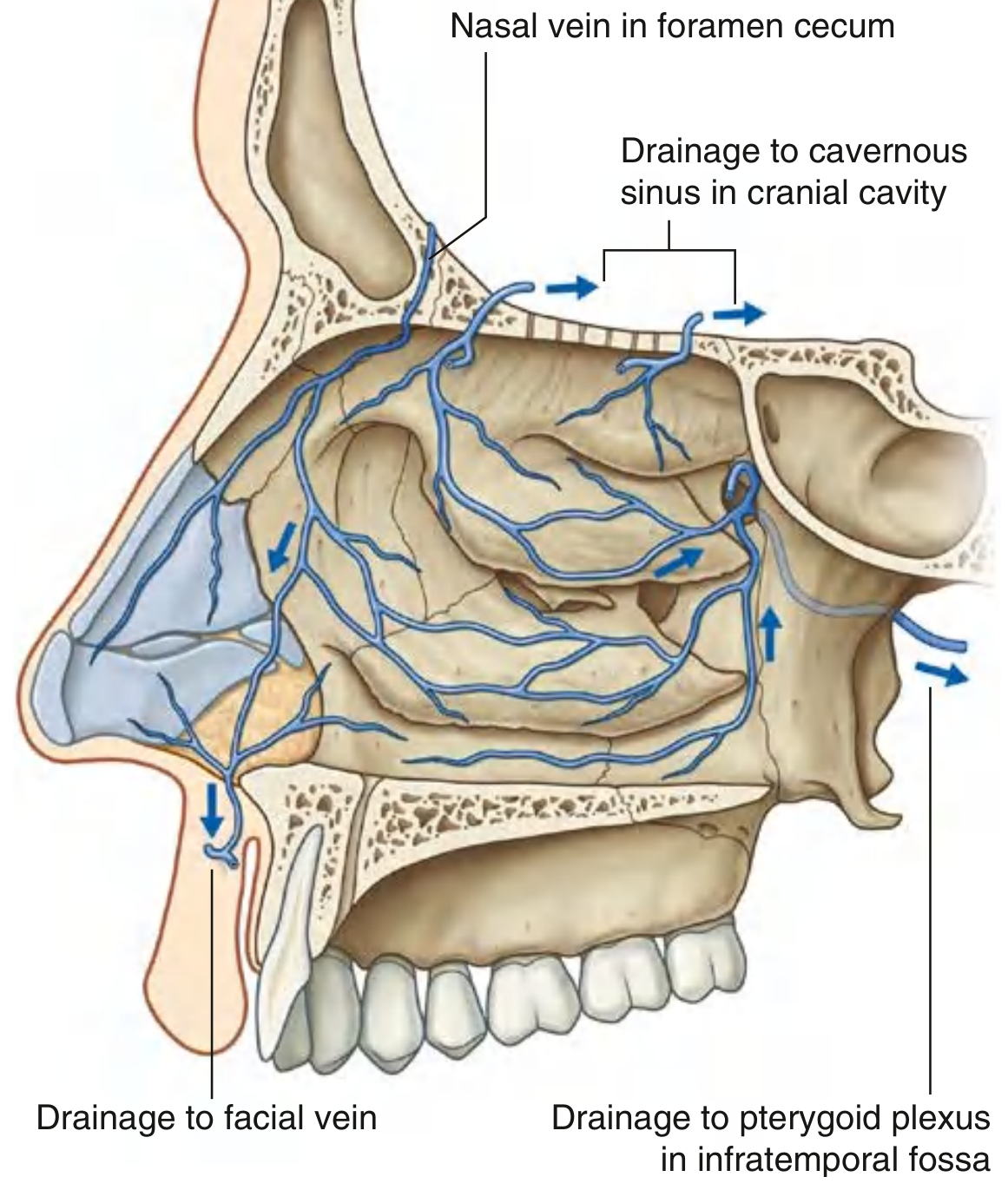
Fig: Venous drainage of the nasal cavities, illustrating pathways to the cavernous sinus - Gray's Anatomy for Students, p. 5799-5810.
This is a shared conversation. Sign in to Orris to start your own chat.