
Please translate the file attached into English .Make a colorful handbook pdf.
~/
professional handbook PDF design accessibility color contrast guidance
~/attachments/7206f03d-1342-49c8-b9b3-7ed059b8f6a8
mkdir -p "/tmp/workspace/handbook_translation/output" "/tmp/workspace/handbook_translation/src" "/tmp/workspace/handbook_translation/assets" && python - <<'PY' import fitz, os p='/tmp/workspace/attachments/7206f03d-1342-49c8-b9b3-7ed059b8f6a8/DOC-20260922-WA0013 (1).pdf' doc=fitz.open(p) print('pages',len(doc)) for i,page in enumerate(doc): print('\n--- PAGE',i+1,'---') print(page.get_text('text')[:12000]) pix=page.get_pixmap(matrix=fitz.Matrix(1.5,1.5), alpha=False) pix.save(f'/tmp/workspace/handbook_translation/assets/source_page_{i+1}.png') PY
python - <<'PY' from pypdf import PdfReader p='/tmp/workspace/attachments/7206f03d-1342-49c8-b9b3-7ed059b8f6a8/DOC-20260922-WA0013 (1).pdf' r=PdfReader(p) print('pages',len(r.pages)) for i,page in enumerate(r.pages): print('\n--- PAGE',i+1,'---') print((page.extract_text() or '')[:15000]) PY
"otitis media"[MeSH Terms]
~/handbook_translation
~/handbook_translation/src/create_handbook.py
from reportlab.lib.pagesizes import A4
from reportlab.lib import colors
from reportlab.lib.styles import getSampleStyleSheet, ParagraphStyle
from reportlab.lib.enums import TA_LEFT, TA_CENTER
from reportlab.lib.units import mm
from reportlab.platypus import SimpleDocTemplate, Paragraph, Spacer, Table, TableStyle, PageBreak, KeepTogether
from reportlab.pdfbase.ttfonts import TTFont
from reportlab.pdfbase import pdfmetrics
from reportlab.pdfgen import canvas
from reportlab.lib.colors import HexColor
from reportlab.platypus.flowables import Flowable
import os

OUT='/tmp/workspace/handbook_translation/output/Otitis_Media_English_Handbook.pdf'
os.makedirs(os.path.dirname(OUT), exist_ok=True)

# Palette
NAVY=HexColor('#173B5C'); TEAL=HexColor('#007C83'); AQUA=HexColor('#DDF5F3')
SKY=HexColor('#EAF5FF'); CORAL=HexColor('#E85C52'); PEACH=HexColor('#FFF0E9')
GOLD=HexColor('#F5B942'); CREAM=HexColor('#FFF9EE'); INK=HexColor('#173042')
MINT=HexColor('#EAF8ED'); PURPLE=HexColor('#6D4AA2'); LIGHTGREY=HexColor('#F3F6F8')

class EarDiagram(Flowable):
    def __init__(self, width=150*mm, height=65*mm):
        Flowable.__init__(self); self.width=width; self.height=height
    def draw(self):
        c=self.canv; w,h=self.width,self.height
        # outer ear / canal
        c.setFillColor(HexColor('#FFD3B1')); c.setStrokeColor(NAVY); c.setLineWidth(1.4)
        c.roundRect(5*mm, 16*mm, 32*mm, 34*mm, 10*mm, fill=1, stroke=1)
        c.setFillColor(HexColor('#F6B58A')); c.roundRect(31*mm, 26*mm, 26*mm, 12*mm, 5*mm, fill=1, stroke=0)
        # membrane
        c.setStrokeColor(CORAL); c.setLineWidth(3); c.line(59*mm, 20*mm, 59*mm, 44*mm)
        # middle ear
        c.setFillColor(SKY); c.setStrokeColor(TEAL); c.roundRect(61*mm,13*mm,43*mm,39*mm,8*mm,fill=1,stroke=1)
        # ossicles
        c.setFillColor(GOLD); c.setStrokeColor(NAVY); c.circle(69*mm,35*mm,3*mm,fill=1,stroke=1); c.line(71*mm,34*mm,79*mm,31*mm); c.circle(81*mm,30*mm,3*mm,fill=1,stroke=1); c.line(84*mm,30*mm,91*mm,35*mm); c.circle(94*mm,36*mm,3*mm,fill=1,stroke=1)
        # inner ear
        c.setFillColor(HexColor('#D9C6F2')); c.setStrokeColor(PURPLE); c.circle(116*mm,33*mm,15*mm,fill=1,stroke=1)
        c.setFillColor(colors.white); c.circle(116*mm,33*mm,10*mm,fill=1,stroke=1); c.circle(116*mm,33*mm,5*mm,fill=1,stroke=1)
        # eustachian
        c.setStrokeColor(TEAL); c.setLineWidth(6); c.line(83*mm,18*mm,111*mm,2*mm)
        # labels
        c.setFillColor(INK); c.setFont('Helvetica-Bold',8)
        labels=[('Outer ear',18,57),('Ear canal',38,10),('Tympanic\nmembrane',51,57),('Middle ear',73,57),('Ossicles',74,7),('Inner ear',109,57),('Eustachian tube',108,10)]
        for text,x,y in labels:
            for i,line in enumerate(text.split('\n')): c.drawCentredString(x*mm,(y-i*3.2)*mm,line)

class Callout(Flowable):
    def __init__(self, text, color=TEAL, width=170*mm):
        Flowable.__init__(self); self.text=text; self.color=color; self.width=width; self.height=19*mm
    def draw(self):
        c=self.canv; c.setFillColor(self.color); c.roundRect(0,0,self.width,self.height,4*mm,fill=1,stroke=0)
        c.setFillColor(colors.white); c.setFont('Helvetica-Bold',9); tx=c.beginText(5*mm,11*mm); tx.setLeading(11)
        for line in self.text.split('\n'): tx.textLine(line)
        c.drawText(tx)

def p(text, style='body'):
    return Paragraph(text, styles[style])
def bullets(items):
    return [p('• '+x,'bullet') for x in items]

def header_footer(canv, doc):
    canv.saveState(); w,h=A4
    canv.setFillColor(NAVY); canv.rect(0,h-12*mm,w,12*mm,fill=1,stroke=0)
    canv.setFillColor(colors.white); canv.setFont('Helvetica-Bold',8)
    canv.drawString(17*mm,h-8*mm,'OTITIS MEDIA  |  ENGLISH STUDY HANDBOOK')
    canv.setStrokeColor(TEAL); canv.setLineWidth(1); canv.line(17*mm,12*mm,w-17*mm,12*mm)
    canv.setFillColor(NAVY); canv.setFont('Helvetica',8); canv.drawString(17*mm,7*mm,'Translated and redesigned from the supplied Russian study notes')
    canv.drawRightString(w-17*mm,7*mm,str(doc.page))
    canv.restoreState()

styles=getSampleStyleSheet()
styles.add(ParagraphStyle(name='coverTitle',parent=styles['Title'],fontName='Helvetica-Bold',fontSize=30,leading=34,textColor=colors.white,alignment=TA_LEFT,spaceAfter=8))
styles.add(ParagraphStyle(name='coverSub',parent=styles['Normal'],fontName='Helvetica',fontSize=13,leading=18,textColor=colors.white))
styles.add(ParagraphStyle(name='h1',parent=styles['Heading1'],fontName='Helvetica-Bold',fontSize=20,leading=24,textColor=NAVY,spaceBefore=3,spaceAfter=9))
styles.add(ParagraphStyle(name='h2',parent=styles['Heading2'],fontName='Helvetica-Bold',fontSize=13,leading=16,textColor=TEAL,spaceBefore=7,spaceAfter=5))
styles.add(ParagraphStyle(name='body',parent=styles['BodyText'],fontName='Helvetica',fontSize=9.5,leading=14,textColor=INK,spaceAfter=6))
styles.add(ParagraphStyle(name='bullet',parent=styles['BodyText'],fontName='Helvetica',fontSize=9.5,leading=13,textColor=INK,leftIndent=5*mm,firstLineIndent=-3.5*mm,spaceAfter=4))
styles.add(ParagraphStyle(name='small',parent=styles['BodyText'],fontName='Helvetica',fontSize=8,leading=10,textColor=INK,spaceAfter=4))
styles.add(ParagraphStyle(name='table',parent=styles['BodyText'],fontName='Helvetica',fontSize=8.4,leading=11,textColor=INK))

story=[]
# Cover
story.append(Spacer(1,24*mm))
story.append(Callout('TRANSLATED FROM RUSSIAN  •  STUDY NOTES ON MIDDLE-EAR DISEASE', NAVY))
story.append(Spacer(1,9*mm))
story.append(p('Otitis Media', 'h1'))
story.append(p('An English handbook for reviewing the supplied lecture notes', 'h2'))
story.append(Spacer(1,5*mm)); story.append(EarDiagram())
story.append(Spacer(1,8*mm))
story.append(p('<b>What is inside</b><br/>Middle-ear anatomy • Eustachian-tube function • otoscopic landmarks • distinguishing non-purulent and bacterial inflammation • danger signs and source-note translation', 'body'))
story.append(Spacer(1,9*mm))
story.append(Callout('Educational translation only. It is not a diagnostic or treatment guide.\nThe supplied notes contain classroom statements that may differ from current local clinical guidance.', CORAL))
story.append(PageBreak())

# Source note / contents
story += [p('How to use this handbook','h1'), p('This is a faithful English rendering and organized summary of the supplied Russian notes. Repeated lecture-style content has been grouped under clear headings; no patient-specific advice or drug doses are supplied.', 'body')]
story.append(p('Important editorial note','h2'))
story.append(Callout('The original notes use broad statements about antibiotics and adenoids.\nClinical decisions for ear disease should be made using current local guidance and ENT/clinician assessment.', CORAL))
story += [Spacer(1,5*mm),p('Contents','h2')]
contents=[['1','Core concept and categories'],['2','Anatomy and Eustachian-tube function'],['3','Otoscopic examination and normal landmarks'],['4','What pressure and fluid can change'],['5','Children, adenoids, and effusion'],['6','Inflammation, complications, and red flags'],['7','Source-note translation: treatment and history'],['8','Quick review glossary']]
t=Table([[p('<b>Section</b>','table'),p('<b>Topic</b>','table')]]+[[p(a,'table'),p(b,'table')] for a,b in contents],colWidths=[25*mm,140*mm])
t.setStyle(TableStyle([('BACKGROUND',(0,0),(-1,0),TEAL),('TEXTCOLOR',(0,0),(-1,0),colors.white),('GRID',(0,0),(-1,-1),0.35,HexColor('#B9D9DC')),('ROWBACKGROUNDS',(0,1),(-1,-1),[colors.white,AQUA]),('VALIGN',(0,0),(-1,-1),'MIDDLE'),('LEFTPADDING',(0,0),(-1,-1),5),('RIGHTPADDING',(0,0),(-1,-1),5),('TOPPADDING',(0,0),(-1,-1),5),('BOTTOMPADDING',(0,0),(-1,-1),5)]))
story.append(t); story.append(PageBreak())

# 1
story += [p('1. Core concept and categories','h1'),p('The notes describe <b>otitis media</b> as disease of the middle ear. They distinguish a non-purulent or “catarrhal” group from bacterial inflammatory disease, and emphasize the need to differentiate these patterns clinically. Chronic otitis is described as requiring specialist ENT management rather than routine primary-care management.', 'body')]
story += [p('Patterns described in the source notes','h2')]
data=[[p('<b>Pattern</b>','table'),p('<b>Source-note description</b>','table')],[p('Catarrhal / non-purulent','table'),p('Presented as non-bacterial. It may involve Eustachian-tube dysfunction, pressure change, or fluid without systemic inflammatory features.', 'table')],[p('Bacterial inflammatory otitis','table'),p('Presented as a condition with local and systemic signs of inflammation and a greater concern for complications.', 'table')],[p('Otitis media with effusion','table'),p('Fluid in the middle ear. The notes describe reduced hearing as a key change once fluid is present.', 'table')]]
t=Table(data,colWidths=[48*mm,117*mm]); t.setStyle(TableStyle([('BACKGROUND',(0,0),(-1,0),NAVY),('TEXTCOLOR',(0,0),(-1,0),colors.white),('GRID',(0,0),(-1,-1),0.4,HexColor('#CBD7DE')),('ROWBACKGROUNDS',(0,1),(-1,-1),[SKY,colors.white]),('VALIGN',(0,0),(-1,-1),'TOP'),('PADDING',(0,0),(-1,-1),6)])); story.append(t)
story += [p('The five classical signs of inflammation','h2')] + bullets(['<b>Tumor:</b> swelling from fluid accumulation.','<b>Rubor:</b> redness from increased blood flow.','<b>Calor:</b> warmth from increased blood flow.','<b>Dolor:</b> pain from nerve pressure and chemical irritation.','<b>Functio laesa:</b> loss of function caused by pain and swelling.'])
story.append(PageBreak())

#2
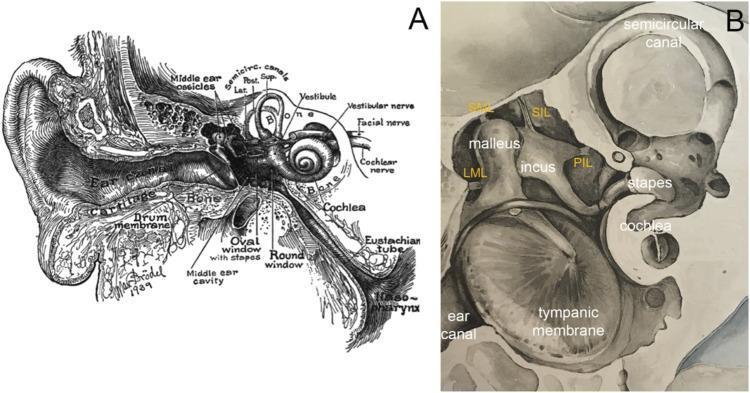
story += [p('2. Anatomy and pressure regulation','h1'),p('The tympanic membrane (eardrum) separates the external ear from the middle ear. The middle ear includes the tympanic cavity, auditory ossicles, and the Eustachian (auditory) tube. The tube opens toward the nasopharynx and helps equalize pressure between the middle-ear space and the outside atmosphere.', 'body'), EarDiagram(), p('Why this matters','h2')]
story += bullets(['During upper respiratory illness, mucosal swelling can involve the nose, pharynx, and Eustachian tube.','When tube ventilation is reduced, middle-ear pressure may fall relative to atmospheric pressure.','A rapid pressure change, such as during air travel, can alter the appearance and position of the eardrum.','The supplied notes repeatedly link otoscopic landmarks to Eustachian-tube function and middle-ear pressure.'])
story.append(Callout('Study anchor: normal external and middle-ear pressure are balanced.\nTube dysfunction can change the eardrum’s position, light reflex, and visibility of landmarks.', TEAL))
story.append(PageBreak())

#3
story += [p('3. Otoscopy: normal landmarks','h1'),p('The notes ask the learner to examine both ears and recognize the normal tympanic membrane. They emphasize comparing findings with the opposite ear.', 'body'),p('Normal features listed in the supplied notes','h2')]
normal=[['Feature','What the notes say'],['Colour','A normal membrane is described as greyish-white to pale yellow.'],['Mobility','With pneumatic otoscopy, it should move slightly when air pressure is applied.'],['Light reflex','A clear cone-shaped reflection is normally visible. Its direction and position depend on the eardrum’s orientation.'],['Anatomical landmarks','The handle of the malleus, short process of the malleus, and anterior and posterior folds should be identifiable.']]
t=Table([[p('<b>'+x+'</b>','table') for x in normal[0]]]+[[p(a,'table'),p(b,'table')] for a,b in normal[1:]],colWidths=[45*mm,120*mm]);t.setStyle(TableStyle([('BACKGROUND',(0,0),(-1,0),GOLD),('TEXTCOLOR',(0,0),(-1,0),NAVY),('GRID',(0,0),(-1,-1),.35,HexColor('#D9C798')),('ROWBACKGROUNDS',(0,1),(-1,-1),[CREAM,colors.white]),('VALIGN',(0,0),(-1,-1),'TOP'),('PADDING',(0,0),(-1,-1),6)]));story.append(t)
story += [p('Examination reminders from the notes','h2')] + bullets(['Inspect the external auditory canal walls as the otoscope is introduced.','The anterior canal wall is close to the temporomandibular joint; dental or joint problems can cause referred ear pain.','The tympanic membrane lies obliquely.','For young children, the notes advise considering middle-ear disease when a child aged roughly 1-3 years has ear pain.'])
story.append(PageBreak())

#4
story += [p('4. Interpreting changes in the eardrum','h1'),p('The notes caution that colour change alone does not establish bacterial inflammation. Pressure, tube function, and middle-ear fluid can all change the eardrum’s appearance.', 'body')]
rows=[['Situation described','Possible otoscopic change in the notes'],['Low middle-ear pressure','The eardrum may retract. Malleus contours can appear sharper or more prominent compared with the other ear.'],['High pressure / fluid in middle ear','The eardrum may bulge toward the ear canal. The light reflex may shift or be distorted; malleus contours may become less distinct.'],['Effusion with blood elements','The membrane can appear bluish because of a hemorrhagic effusion.'],['Oedematous, infiltrated membrane','Malleus landmarks may no longer be visible.'],['Light reflex absent or altered','The notes treat a missing, diffuse, or deformed light reflex as a sign of middle-ear pathology rather than a diagnosis by itself.']]
t=Table([[p('<b>'+x+'</b>','table') for x in rows[0]]]+[[p(a,'table'),p(b,'table')] for a,b in rows[1:]],colWidths=[60*mm,105*mm]);t.setStyle(TableStyle([('BACKGROUND',(0,0),(-1,0),PURPLE),('TEXTCOLOR',(0,0),(-1,0),colors.white),('GRID',(0,0),(-1,-1),.35,HexColor('#D7C9E7')),('ROWBACKGROUNDS',(0,1),(-1,-1),[HexColor('#F6F0FC'),colors.white]),('VALIGN',(0,0),(-1,-1),'TOP'),('PADDING',(0,0),(-1,-1),6)]));story.append(t)
story.append(Callout('Clinical observation in the notes: compare the two ears.\nA unilateral difference is often more informative than an isolated feature.', PURPLE))
story.append(PageBreak())

#5
story += [p('5. Children, adenoids, and effusion','h1'),p('The source notes focus on children with enlarged adenoids near the pharyngeal opening of the Eustachian tube. They explain this as a potential cause of impaired ventilation and negative middle-ear pressure.', 'body')]
story += [p('Points translated from the source','h2')] + bullets(['Adenoid tissue is located in the nasopharynx, near the pharyngeal opening of the Eustachian tube.','The notes describe enlarged adenoids as contributing to reduced tube ventilation and a pinkish eardrum from injected vessels.','A pinkish membrane alone is not presented as proof of bacterial inflammation. The notes frame it as a functional/pressure-related vascular change in this context.','A child may describe ear fullness while hearing remains normal. If fluid then accumulates, reduced hearing is emphasized as a key symptom.','The notes label Eustachian-tube dysfunction as “tubo-otitis” and describe otitis media with effusion as a non-purulent/catarrhal pattern.'])
story += [p('Learning distinction','h2')]
story.append(Callout('“My ear feels blocked, but I hear well” → the notes suggest tube dysfunction without fluid.\n“Yesterday it was blocked; today I hear poorly” → the notes suggest possible effusion.', TEAL))
story += [Spacer(1,5*mm),p('The notes state that management of persistent adenoid-associated problems may require specialist assessment. Treatment decisions, including surgery, require current clinician evaluation.', 'small')]
story.append(PageBreak())

#6
story += [p('6. Inflammation, complications, and red flags','h1'),p('The notes explain that the ear is anatomically close to the middle and posterior cranial fossae. They therefore emphasize the risk of serious complications from severe otogenic infection.', 'body')]
story += [p('Complications named in the source notes','h2')] + bullets(['Otogenic purulent meningitis','Meningoencephalitis','Sigmoid sinus thrombosis','Sepsis'])
story += [p('Urgent pattern described in the source case','h2'),p('A person who has recently been treated for an ear problem develops fever, severe headache, vomiting or nausea, worsening general condition, and a difference between the two eardrums on otoscopy. The notes state that this raises concern for a complication and calls for assessment of meningeal signs.', 'body')]
story.append(Callout('Seek urgent medical assessment for severe headache, fever, vomiting, neck stiffness, altered consciousness, or rapid deterioration with an ear infection.', CORAL))
story += [p('Meningeal features named in the notes','h2')] + bullets(['Neck stiffness','Kernig sign','Brudzinski sign','In infants: the Lesage suspension sign and a tense/bulging fontanelle may be considered in clinical assessment.'])
story.append(PageBreak())

#7
story += [p('7. Treatment and clinical history: translated notes','h1'),p('The original notes make several treatment statements. They are reproduced here as study content, with an editorial safety note because real-world treatment depends on age, diagnostic certainty, severity, allergies, recurrence, local resistance patterns, and current guidelines.', 'body')]
story += [p('What the notes say','h2')] + bullets(['Catarrhal otitis does not require antibacterial treatment.','The notes characterize bacterial inflammation as requiring antibacterial therapy.','They discuss short-course nasal decongestants after antibiotics to reduce nasopharyngeal swelling and improve Eustachian-tube patency.','They stress restoring tube function and drainage/ventilation of the middle ear.','They advise using history, symptoms, otoscopy, and, where uncertainty remains, a complete blood count to distinguish patterns.'])
story.append(Callout('Do not use this page to self-start antibiotics or decongestants.\nThese are translation notes, not a current prescribing protocol.', CORAL))
story += [p('Questions the notes use for differentiation','h2')] + bullets(['How is your hearing?','Does your ear hurt?','Do you have a fever?','What has changed since symptoms began?','Are there systemic symptoms such as headache, weakness, nausea, or vomiting?'])
story.append(PageBreak())

#8
story += [p('8. Quick review glossary','h1')]
gloss=[['Term','Plain-English meaning'],['Otitis media','Inflammation or disease of the middle ear.'],['Tympanic membrane','The eardrum, separating the external ear from the middle ear.'],['Eustachian tube','A passage linking the middle ear and nasopharynx; helps with pressure equalization and ventilation.'],['Ossicles','The small middle-ear bones: malleus, incus, and stapes.'],['Malleus','The “hammer” bone; its handle and short process can be seen through a normal eardrum.'],['Effusion / exudate','Fluid in the middle-ear space. “Exudate” usually indicates inflammatory fluid.'],['Transudate','Fluid associated with pressure/fluid-balance changes rather than inflammation.'],['Retraction','Inward drawing of the eardrum, often discussed in relation to negative middle-ear pressure.'],['Bulging','Outward displacement of the eardrum, described in the notes with raised pressure or fluid.'],['Adenoids','Lymphoid tissue in the nasopharynx, near the Eustachian-tube opening.'],['Pneumatic otoscopy','Otoscopy that uses a small pressure change to assess eardrum mobility.']]
t=Table([[p('<b>'+x+'</b>','table') for x in gloss[0]]]+[[p(a,'table'),p(b,'table')] for a,b in gloss[1:]],colWidths=[50*mm,115*mm]);t.setStyle(TableStyle([('BACKGROUND',(0,0),(-1,0),TEAL),('TEXTCOLOR',(0,0),(-1,0),colors.white),('GRID',(0,0),(-1,-1),.3,HexColor('#B7D8D5')),('ROWBACKGROUNDS',(0,1),(-1,-1),[MINT,colors.white]),('VALIGN',(0,0),(-1,-1),'TOP'),('PADDING',(0,0),(-1,-1),5)]));story.append(t)
story += [Spacer(1,4*mm),p('Source and scope','h2'),p('Source document: “DOC-20260922-WA0013 (1).pdf”, supplied by the user. This handbook translates and restructures the document’s Russian content into English. It does not replace a clinician, examination, or current local clinical guidance.', 'small')]

doc=SimpleDocTemplate(OUT,pagesize=A4,rightMargin=17*mm,leftMargin=17*mm,topMargin=19*mm,bottomMargin=18*mm,title='Otitis Media: English Study Handbook',author='Orris')
doc.build(story,onFirstPage=header_footer,onLaterPages=header_footer)
print(OUT)
python "/tmp/workspace/handbook_translation/src/create_handbook.py" && python - <<'PY' from pypdf import PdfReader p='/tmp/workspace/handbook_translation/output/Otitis_Media_English_Handbook.pdf' r=PdfReader(p) print('pages:',len(r.pages)) for i,page in enumerate(r.pages): t=page.extract_text() or '' print(i+1, len(t), t[:75].replace('\n',' | ')) PY
~/handbook_translation/src/create_handbook.py
Successfully replaced 1 instance(s) of the string in '/tmp/workspace/handbook_translation/src/create_handbook.py'
~/handbook_translation/src/create_handbook.py
Successfully replaced 10 instance(s) of the string in '/tmp/workspace/handbook_translation/src/create_handbook.py'
~/handbook_translation/src/create_handbook.py
Successfully replaced 16 instance(s) of the string in '/tmp/workspace/handbook_translation/src/create_handbook.py'
python "/tmp/workspace/handbook_translation/src/create_handbook.py" && python - <<'PY' from pypdf import PdfReader p='/tmp/workspace/handbook_translation/output/Otitis_Media_English_Handbook.pdf' r=PdfReader(p) print('pages:',len(r.pages)) for i,page in enumerate(r.pages): t=page.extract_text() or '' print(i+1, len(t), t[:90].replace('\n',' | ')) PY
~/handbook_translation/output
python - <<'PY' from pypdf import PdfReader p='/tmp/workspace/handbook_translation/output/Otitis_Media_English_Handbook.pdf' r=PdfReader(p) assert len(r.pages)==10 assert all((page.extract_text() or '').strip() for page in r.pages) print('Verified: PDF opens, has 10 pages, and each page contains extractable text.') PY
Otitis Media English Handbook
PDF Document · PDF