
I need to know the tributeries of great saphenous vein that should be ligated during trendlenberg procedure
Reading File
The Trendelenburg procedure involves ligating the great saphenous vein (GSV) at the saphenofemoral junction (SFJ) along with all its tributaries to prevent recurrence of varicose veins.
Searching sources...
Finding Sources
Finding Sources
Reading File
Finding Sources
Reading File
Finding Sources
Loading Image
Reading File
I now have comprehensive information from Bailey & Love's Surgery (28th edition) and the Imaging Anatomy Atlas. Here is the complete answer:
Tributaries of the Great Saphenous Vein Ligated During the Trendelenburg Procedure
The Trendelenburg procedure (saphenofemoral ligation) involves making an oblique groin incision, dissecting the GSV to the saphenofemoral junction (SFJ), and ligating all tributaries at that junction before performing a flush SFJ ligation. The anatomy is often variable, but six tributaries are classically encountered close to the SFJ and must be ligated distal to their divisions:
Lateral Tributaries
- Superficial inferior epigastric vein - runs superiorly toward the anterior abdominal wall
- Superficial circumflex iliac vein - runs laterally toward the iliac crest
Medial Tributaries
- Superficial external pudendal vein - runs medially to the external genitalia
- Deep external pudendal vein - also medial, draining the deeper genital structures
Distal Tributaries
- Anterior accessory great saphenous vein (AA-GSV) - runs along the anterior thigh
- Posteromedial thigh vein (Posterior accessory GSV / Leonardo's vein) - runs along the posteromedial thigh
Key Surgical Points
- These tributaries are ligated distal to their divisions (i.e., each one is tied off before it enters the main GSV trunk).
- After all tributaries are secured, a flush SFJ ligation is performed - the GSV is divided right at its junction with the femoral vein to leave no stump, which is the hallmark of the Trendelenburg operation.
- The GSV is then retrogradely stripped to around the knee.
- Closure of the cribriform fascia over the ligated SFJ does not reduce groin recurrence.
Why Complete Ligation Matters
Leaving any tributary unligated is the most common cause of recurrent varicose veins after surgery. If a tributary is missed, it can develop collateral reflux back into the leg, negating the procedure.
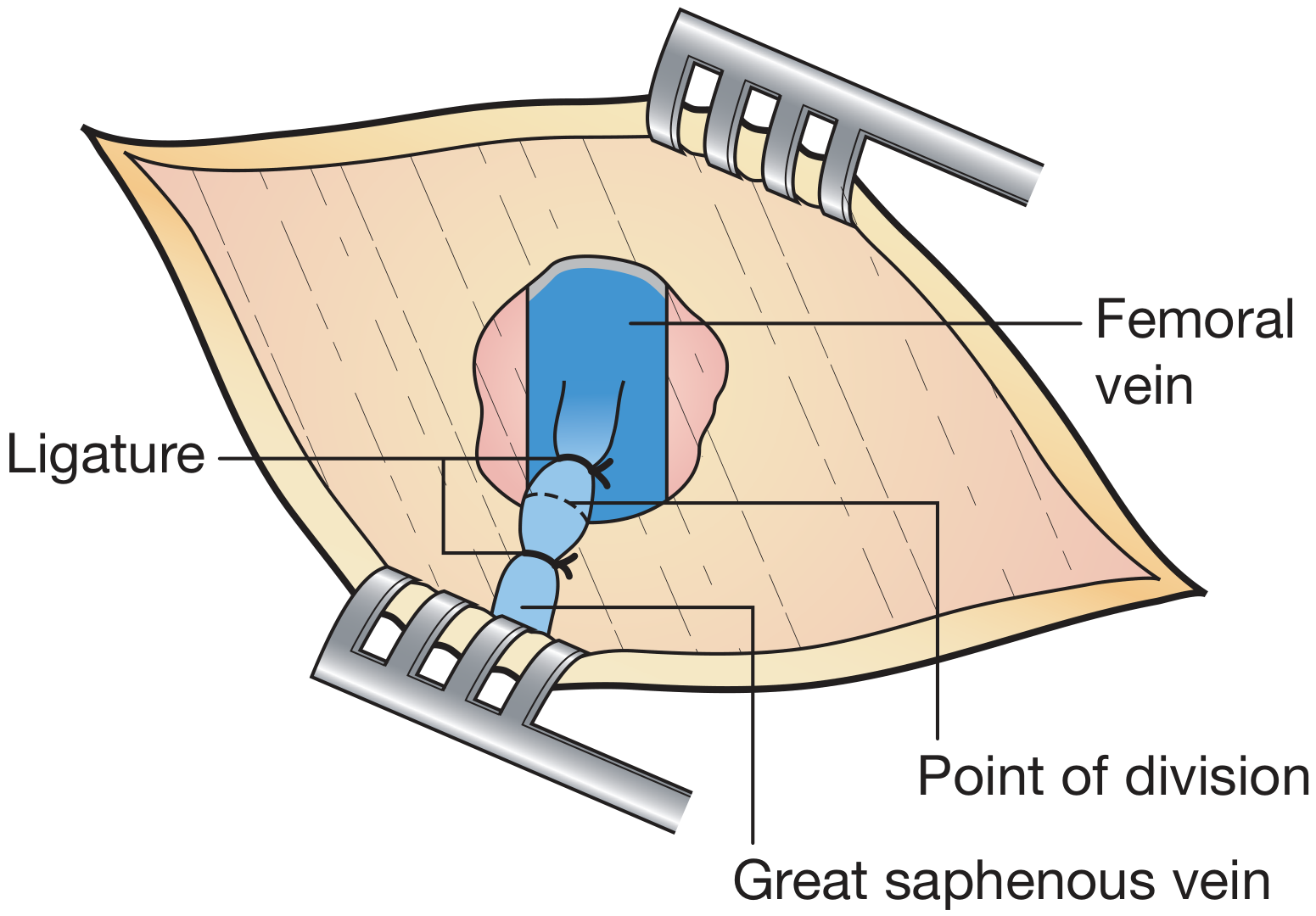
Diagram showing flush SFJ ligation - note the ligature placed at the junction with the femoral vein and the point of division of the GSV.
Source: Bailey and Love's Short Practice of Surgery, 28th Edition, p. 1058-1059
This is a shared conversation. Sign in to Orris to start your own chat.