
Explain creb cycle in simple
The Krebs cycle (also called the citric acid cycle or TCA cycle) runs in the mitochondrial matrix and is the cell's central hub for extracting energy from acetyl-CoA. Here's a simple breakdown before I pull in the textbook detail.
Quick summary: Acetyl-CoA (2 carbons) joins a 4-carbon molecule (oxaloacetate) to make a 6-carbon compound (citrate). Through 8 steps, the cycle spins twice per glucose, releasing CO2, producing electron carriers (NADH, FADH2), and regenerating the 4-carbon starter.
Searching sources...
Reading File
Finding Sources
Searching the Web
Krebs cycle steps simple explanation biochemistry
Reading File
Reading File
Now let me grab the detailed steps and the diagram images.
Reading File
Loading Image
Loading Image
I now have everything needed for a clear, well-illustrated explanation. Here is the full answer:
The Krebs Cycle (Citric Acid / TCA Cycle) - Simply Explained
What is it and where does it happen?
The Krebs cycle is a series of 8 chemical reactions that take place in the matrix of the mitochondria. Its job is to extract energy (in the form of electron carriers) from a molecule called acetyl-CoA, which is produced when carbohydrates, fats, or proteins are broken down. The cycle was named after Hans Krebs, who discovered it.
The Big Picture - Think of it like a machine
Imagine a spinning wheel that never stops. Each time it spins:
- It takes in a 2-carbon fuel (acetyl-CoA)
- It spits out CO₂ (the waste you breathe out)
- It captures energy in the form of NADH and FADH₂ (like rechargeable batteries)
- It resets itself back to the starting molecule (oxaloacetate) - ready for the next turn
Step-by-Step Walkthrough
Here is the classic diagram from Guyton & Hall's Medical Physiology:
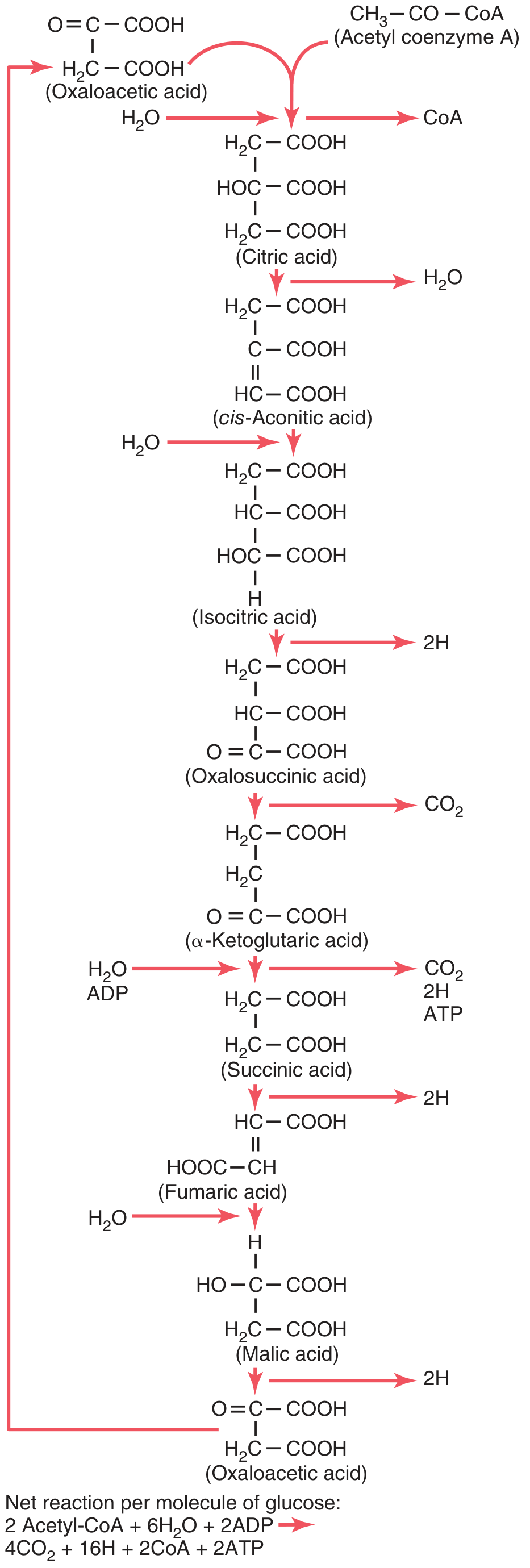
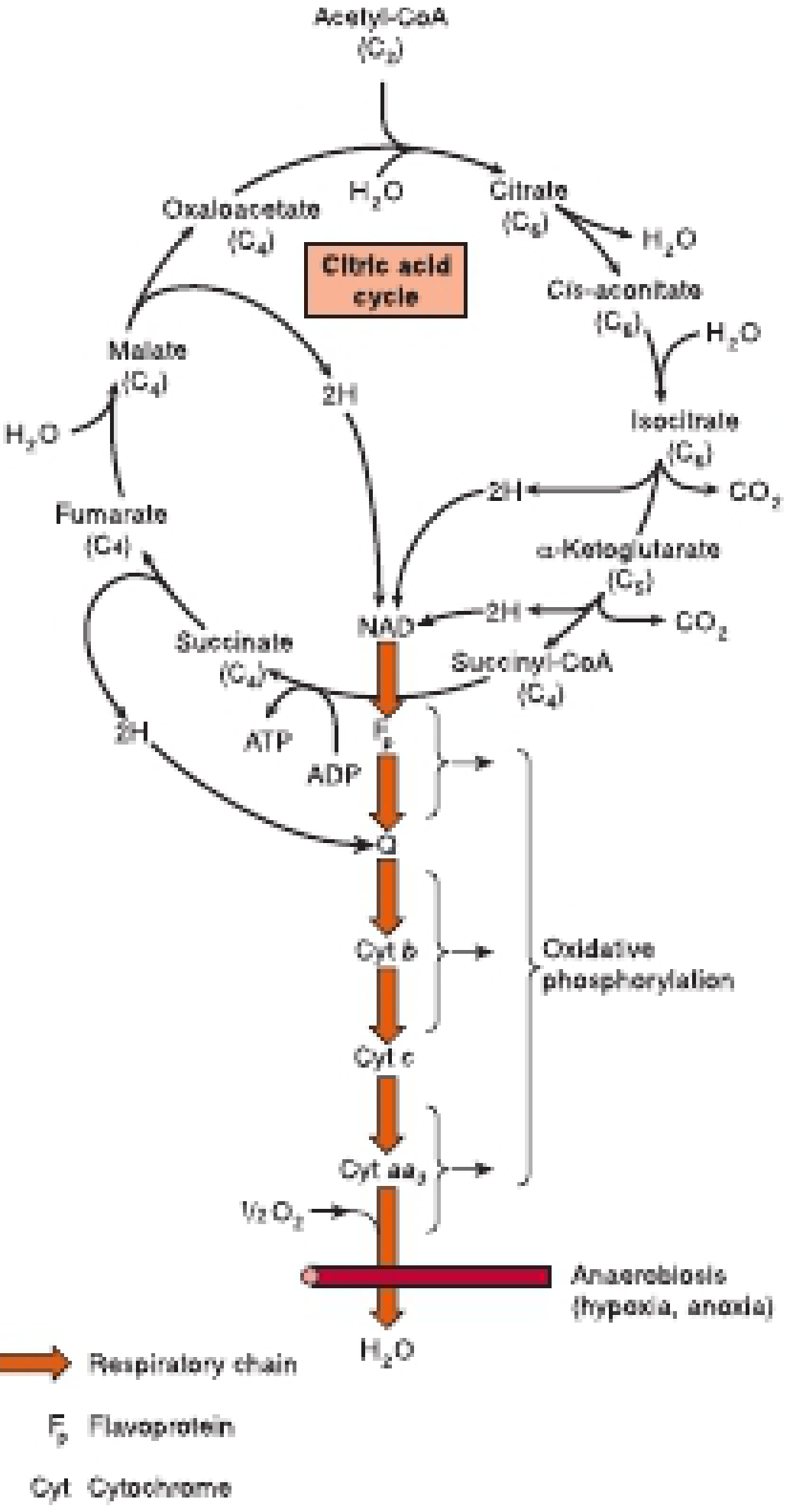
And Harper's Biochemistry diagram showing the link to the respiratory chain (where ATP is actually made):
The 8 Steps (simplified)
| Step | What Happens | What's Made |
|---|---|---|
| 1 | Acetyl-CoA (2C) + Oxaloacetate (4C) → Citrate (6C) | Citrate synthase combines them |
| 2 | Citrate → Isocitrate (rearrangement) | Just a structural reshuffling |
| 3 | Isocitrate → α-Ketoglutarate (5C) | 1 CO₂ released, 1 NADH made |
| 4 | α-Ketoglutarate → Succinyl-CoA (4C) | 1 CO₂ released, 1 NADH made |
| 5 | Succinyl-CoA → Succinate | 1 GTP (= ATP) made - the only direct energy step |
| 6 | Succinate → Fumarate | 1 FADH₂ made |
| 7 | Fumarate + water → Malate | Water added |
| 8 | Malate → Oxaloacetate | 1 NADH made - cycle resets! |
What does ONE turn of the cycle produce?
Per 1 molecule of acetyl-CoA:
- 3 NADH (steps 3, 4, 8)
- 1 FADH₂ (step 6)
- 1 GTP/ATP (step 5)
- 2 CO₂ (steps 3, 4 - exhaled as breath)
Since 1 glucose gives 2 acetyl-CoA, the cycle runs twice per glucose, doubling all these numbers.
Why do NADH and FADH₂ matter?
They are not ATP yet - they are energy carriers (like charged batteries). They carry electrons to the respiratory chain (electron transport chain) on the inner mitochondrial membrane, where the real ATP-making happens via oxidative phosphorylation. Each NADH eventually yields ~2.5 ATP; each FADH₂ yields ~1.5 ATP. This is where most of the 30-32 ATP per glucose comes from.
Simple Analogy
Think of it like a recycling plant:
- Fuel (acetyl-CoA) arrives and gets burned
- Smoke (CO₂) goes out
- Energy tokens (NADH, FADH₂) are collected and taken to the power plant (respiratory chain) to make ATP
- The machinery (oxaloacetate) is recycled and ready for the next load
Key Points to Remember
| Feature | Detail |
|---|---|
| Location | Mitochondrial matrix |
| Fuel in | Acetyl-CoA (from carbs, fats, proteins) |
| Waste out | CO₂ |
| Energy carriers out | 3 NADH + 1 FADH₂ per turn |
| Direct ATP | 1 GTP per turn |
| Turns per glucose | 2 |
| Key enzyme | Citrate synthase (step 1), plus isocitrate dehydrogenase and α-ketoglutarate dehydrogenase |
| Overall role | Central hub of cellular energy metabolism |
Sources: Guyton and Hall Textbook of Medical Physiology, p. 68.6 chapter; Harper's Illustrated Biochemistry 32nd Ed., Chapter 16 (Citric Acid Cycle)
This is a shared conversation. Sign in to Orris to start your own chat.