
how after meiosis 1 haploid chromosomes are formed
Reading File
Finding Sources
Finding Sources
Reading File
Reading File
Reading File
Loading Image
Reading File
Here is a clear explanation of how haploid cells are formed after Meiosis I, drawn from multiple authoritative medical textbooks.
How Haploid Chromosomes Are Formed After Meiosis I
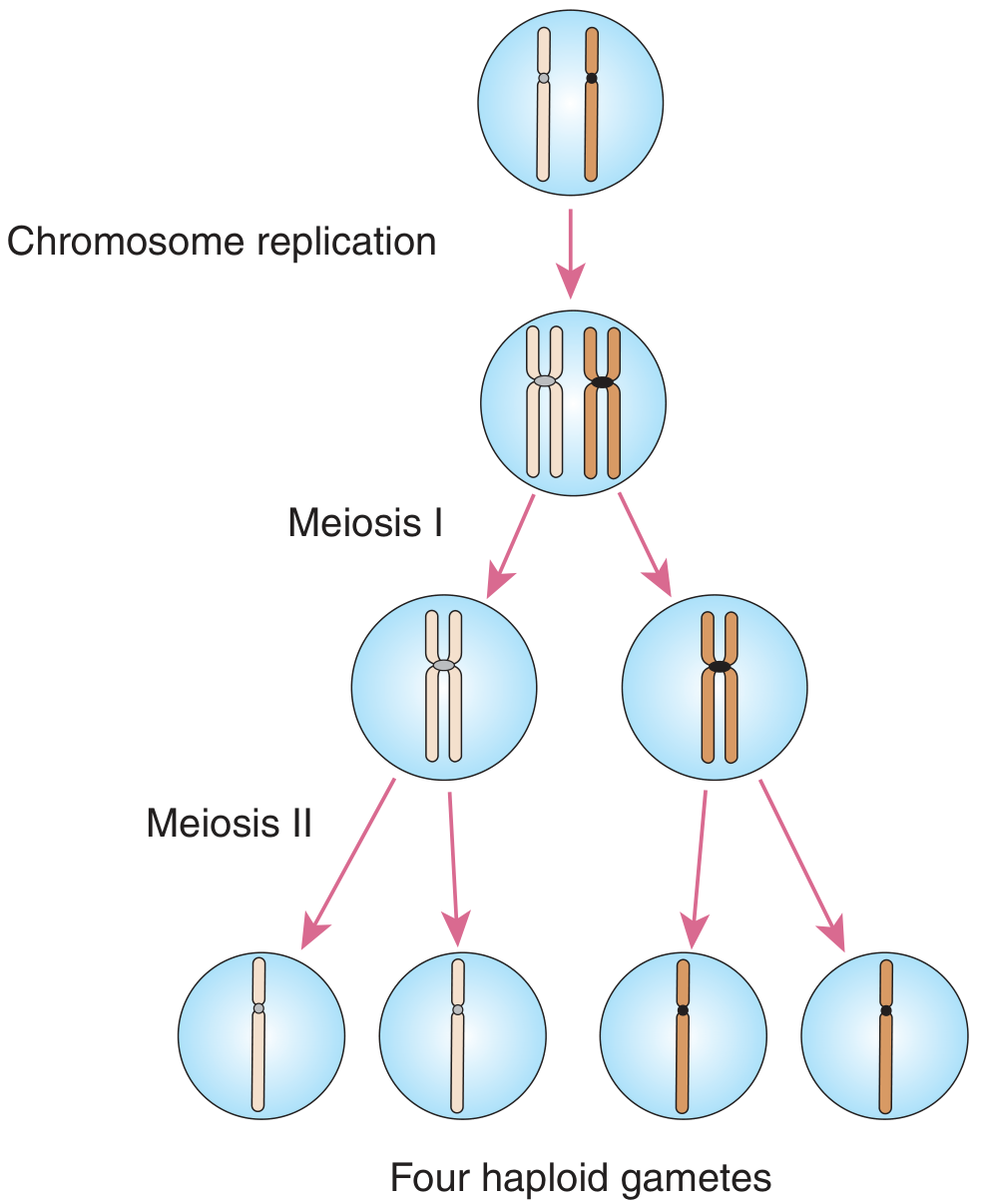
Starting Point: The Diploid Cell (2n)
Before meiosis begins, during S phase (interphase), DNA is replicated. Each of the 46 chromosomes (23 pairs of homologs) is duplicated, producing sister chromatids joined at the centromere. At this point:
- Chromosome number = 2n (diploid, 46 chromosomes)
- DNA content = 4d (each chromosome is a double-chromatid structure)
Meiosis I — The Reduction Division
Meiosis I is called the reductional division because it is the step that actually halves the chromosome number. Here is what happens at each stage:
| Stage | Key Event |
|---|---|
| Prophase I | Homologous chromosomes pair up (synapsis), forming bivalents held together by the synaptonemal complex. Crossing over (recombination) exchanges segments between non-sister chromatids. |
| Metaphase I | Bivalents (homolog pairs) align at the cell equator with each homolog's centromere oriented toward opposite poles. |
| Anaphase I | The two homologous chromosomes (not sister chromatids) are pulled to opposite poles. Each homolog still has two chromatids joined at its centromere. |
| Telophase I / Cytokinesis | Two daughter cells form, each with 23 chromosomes (haploid number). |
Critical distinction: In mitosis, sister chromatids separate at anaphase. In Meiosis I, it is the homologous chromosomes that separate — sister chromatids remain joined. This is what achieves the reduction from 2n → 1n.
The Result After Meiosis I
Each of the two daughter cells now has:
- 23 chromosomes → haploid (1n) chromosome number ✓
- But each chromosome is still a double-chromatid structure (two sisters still joined)
- DNA content = 2d (halved, but each chromosome still has 2 chromatids)
So the cells are haploid in chromosome number but still contain double-chromatid chromosomes — they are not yet fully reduced in DNA content.
Why Meiosis II Is Still Needed
Meiosis II follows without DNA replication (no S phase). It is an equatorial division — essentially a mitosis-like split:
- Sister chromatids separate at Anaphase II
- Each chromatid becomes a single-stranded chromosome
- Result: 4 haploid cells (1n, 1d) — the final gametes
In males: 4 identical spermatids (each becomes a sperm)
In females: 1 ovum + 3 polar bodies (unequal cytoplasm distribution)
Summary
| Stage | Chromosome # | DNA content |
|---|---|---|
| Before meiosis (after S phase) | 2n (46) | 4d |
| After Meiosis I | 1n (23) | 2d |
| After Meiosis II | 1n (23) | 1d |
The key mechanism making Meiosis I the reduction division is homologous chromosome pairing (synapsis) in Prophase I and their separation to opposite poles in Anaphase I — one homolog from each pair goes to each daughter cell. This is the physical basis of Mendel's Law of Segregation.
Sources: The Developing Human: Clinically Oriented Embryology; Thompson & Thompson Genetics and Genomics in Medicine, 9th ed.; Histology: A Text and Atlas, 9th ed.
This is a shared conversation. Sign in to Orris to start your own chat.