
Make me notes on adh and diabetes insipidous
Reading File
Now let me search the medical library for ADH and diabetes insipidus content in parallel.
Finding Sources
Finding Sources
Reading File
Reading File
Reading File
Reading File
Finding Sources
Finding Sources
Reading File
Reading File
Reading File
Reading File
Reading File
Reading File
Loading Image
Loading Image
I now have comprehensive information from multiple authoritative textbooks. Let me compile these into well-organized notes.
ADH (Vasopressin) & Diabetes Insipidus - Study Notes
1. ADH (Antidiuretic Hormone / Vasopressin) - Overview
What it is: A nonapeptide hormone (9 amino acids) with a 6-amino acid ring and a 3-amino acid side chain. In humans, position 8 contains arginine (hence "arginine vasopressin," AVP). It is synthesized in the hypothalamus and released from the posterior pituitary.
- Guyton and Hall Textbook of Medical Physiology
- Katzung's Basic and Clinical Pharmacology, 16th Edition
2. Regulation of ADH Secretion
Primary stimulus: Plasma osmolality
- Osmoreceptors in the supraoptic and paraventricular nuclei of the hypothalamus (possibly also the AV3V region) sense changes in ECF tonicity.
- When ECF is too concentrated → osmoreceptors shrink → ADH secretion increases.
- When ECF is too dilute → osmoreceptors swell → ADH secretion decreases.
- ADH levels can change up to 20x normal within minutes.
Secondary stimulus: Blood volume & pressure
- Decreased blood volume (15-25% or more) → ADH rises up to 50x normal.
- Stretch receptors in the atria inhibit ADH when overfilled; when underfilled they stimulate ADH.
- Baroreceptors in the carotid/aortic/pulmonary regions also feed into this pathway.
- At high concentrations, ADH constricts arterioles → hence the name vasopressin.
Other stimuli for ADH release:
- Nausea, pain, stress, angiotensin II
- Certain drugs (opioids, nicotine)
3. ADH Mechanism of Action
ADH acts on two G protein-coupled receptor subtypes:
| Receptor | Location | Effect | Signalling |
|---|---|---|---|
| V1 | Vascular smooth muscle | Vasoconstriction | Gq → Phospholipase C |
| V2 | Renal collecting duct principal cells | Water reabsorption (antidiuresis) | Gs → Adenylyl cyclase → cAMP → AQP2 insertion |
-
V2 activation triggers insertion of aquaporin-2 (AQP2) water channels into the luminal membrane of collecting duct cells, increasing water permeability.
-
Extrarenal V2-like receptors also regulate release of factor VIII and von Willebrand factor, increasing platelet aggregation.
-
Katzung's Basic and Clinical Pharmacology, 16th Edition
-
Goldman-Cecil Medicine, International Edition
4. Diabetes Insipidus (DI) - Definition & Epidemiology
Definition: Excretion of a large volume of hypotonic (tasteless/insipid) urine, manifesting as polyuria and polydipsia. Urine volume typically exceeds 50-60 mL/kg/day (can reach up to 20 L/day in severe cases).
Prevalence: Rare - approximately 1:25,000.
Key distinction from diabetes mellitus: No hyperglycemia and no glycosuria in DI.
5. Types of Diabetes Insipidus
A. Central (Neurogenic/Hypothalamic) DI
Mechanism: Failure of the hypothalamus-posterior pituitary axis to synthesize/secrete ADH in response to rising osmolality.
Causes:
- Tumors (e.g., craniopharyngioma, pituitary adenoma resection)
- Head trauma / basal skull fracture
- Neurosurgical procedures
- Infiltrative disease: neurosarcoidosis, histiocytosis, tuberculous meningitis
- Multiple sclerosis
- Congenital/genetic: autosomal dominant - mutations in the neurophysin portion of the pre-prohormone; presents later in childhood as neuronal cell death accumulates
- Idiopathic (some cases)
- Brain death
Pathophysiology:
- As few as 10-15% of normal vasopressinergic neurons is sufficient to maintain asymptomatic urine volumes; loss of even a few more neurons rapidly escalates polyuria.
- Collecting duct cannot concentrate the dilute filtrate → large volume of hypotonic urine → rising serum osmolality → thirst → secondary polydipsia.
- Plasma AVP levels are low or unmeasurable relative to plasma osmolality.
Clinical features:
- Polyuria (often >3-4 L/day before patient notices), polydipsia
- Preference for cold liquids
- Nocturia impairs sleep
- Serum sodium tends high-normal; urine sodium is usually low
- If thirst mechanism is also impaired: hypernatremia, dehydration, risk of brain damage
B. Osmoreceptor Dysfunction (Variant of Central DI)
- Neurohypophysis is intact; osmoreceptive cells in the anterior hypothalamus are damaged.
- No osmotically stimulated vasopressin secretion AND no thirst sensation.
- Baroreceptor-mediated ADH release (via hypovolemia) is preserved.
- Patients are chronically dehydrated with high serum sodium (hypovolemic hypernatremia).
- Also called adipsic/hypodipsic DI or "essential hypernatremia."
- Unique cause: anterior communicating artery aneurysm clipping.
C. Nephrogenic DI
Mechanism: The kidney fails to respond to ADH despite normal (or elevated) plasma ADH levels.
Causes:
| Type | Details |
|---|---|
| X-linked (>90% of congenital cases) | Mutations in AVPR2 gene (V2 receptor); affects males; prevalence ~4-8 per 1 million male births |
| Autosomal (AQP2 mutations, <10%) | Mutations in AQP2 water channel gene (chromosome 12); can be dominant or recessive |
| Acquired (more common than congenital) | Lithium (most common drug cause), demeclocycline, severe hypokalemia, hypercalcemia, ureteric obstruction |
Note on lithium: Interferes with AQP2 insertion into the luminal membrane → downregulation of AQP2. Persistent lithium-induced NDI treated with hydrochlorothiazide + amiloride (watch for lithium toxicity).
Clinical features:
- Congenital: vomiting, constipation, failure to thrive, fever in neonates; hypernatremia with hypotonic urine.
- Adults: polyuria and polydipsia but usually normal sodium (adequate thirst response).
- Plasma AVP levels are high or appropriate for plasma osmolality (unlike central DI).
D. Gestational DI
- Elevated activity of placental vasopressinase (cysteine aminopeptidase/oxytocinase) rapidly degrades circulating ADH.
- Occurs during pregnancy; usually resolves after delivery.
- Can unmask pre-existing partial central or compensated nephrogenic DI.
- Plasma vasopressin often unmeasurable due to circulating vasopressinase.
E. Primary Polydipsia (Dipsogenic / Psychogenic)
- Disorder of excess fluid intake, not of ADH secretion or action.
- Psychogenic: associated with schizophrenia, mania, OCD (prevalence up to 40% in psychiatric hospitals).
- Dipsogenic: excess thirst from hypothalamic lesions or idiopathic (no psychiatric illness).
- Excessive intake suppresses ADH → dilute urine mimics DI.
- Prolonged intake causes medullary "washout" → even after stopping, urine concentrating ability is slow to recover.
- Serum sodium tends low-normal or below normal; uric acid levels typically lower than other DI types.
6. Diagnosis
Step 1 - Confirm polyuria: 24-hour urine volume >50 mL/kg/day (or >3 L/day).
Step 2 - Measure urine osmolality:
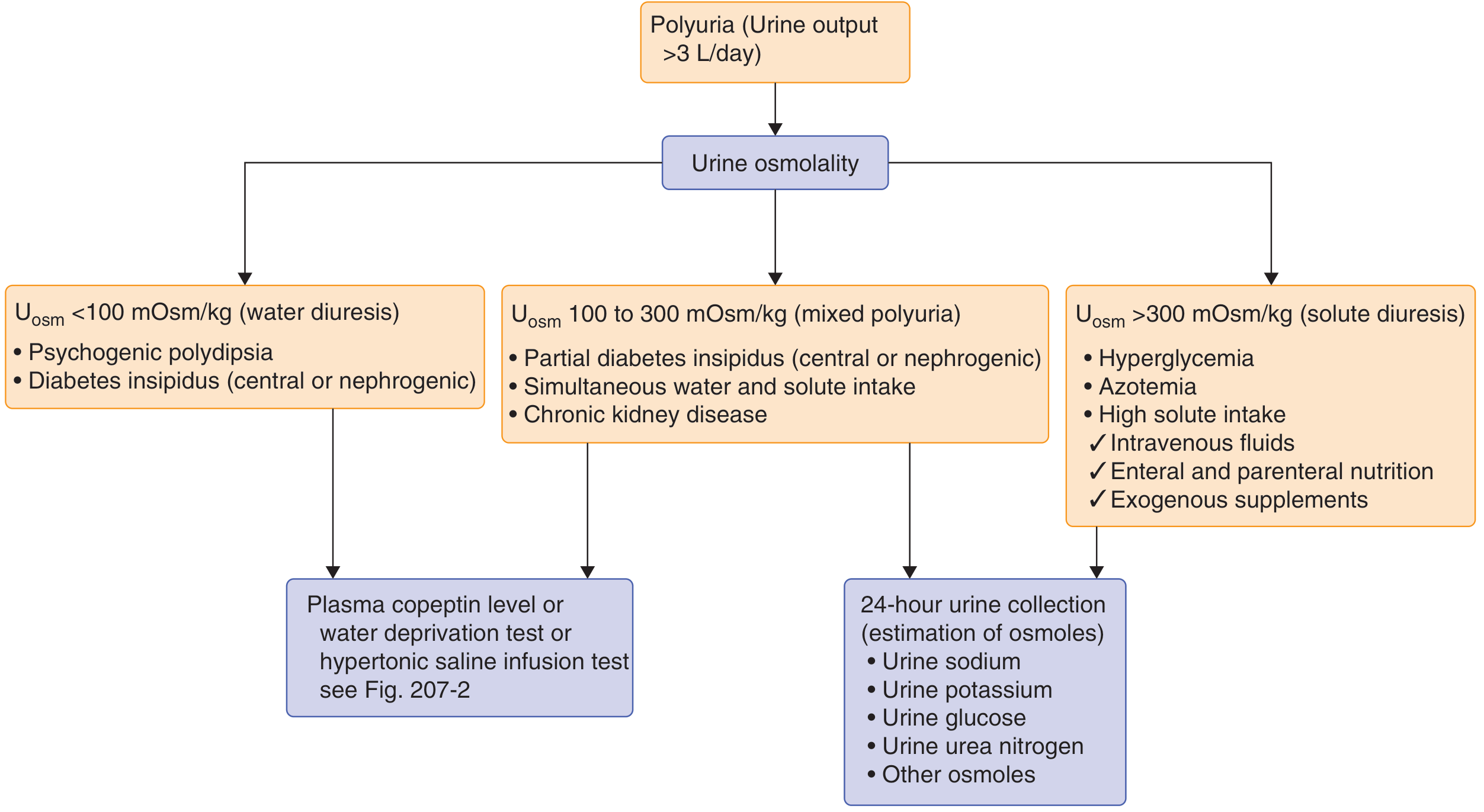
| Urine Osm | Interpretation |
|---|---|
| <100 mOsm/kg | Pure water diuresis - DI or psychogenic polydipsia |
| 100-300 mOsm/kg | Mixed - partial DI, CKD, combined intake |
| >300 mOsm/kg | Solute diuresis - hyperglycemia, azotemia |
Step 3 - Measure serum sodium:
- Low (<135 mmol/L) → suggests primary polydipsia (patients drink themselves into hyponatremia).
- High (>147 mmol/L) → suggests central or nephrogenic DI - proceed to desmopressin (DDAVP) test.
- Normal (136-146 mmol/L) → proceed to further testing.
Step 4 - Further differentiation:
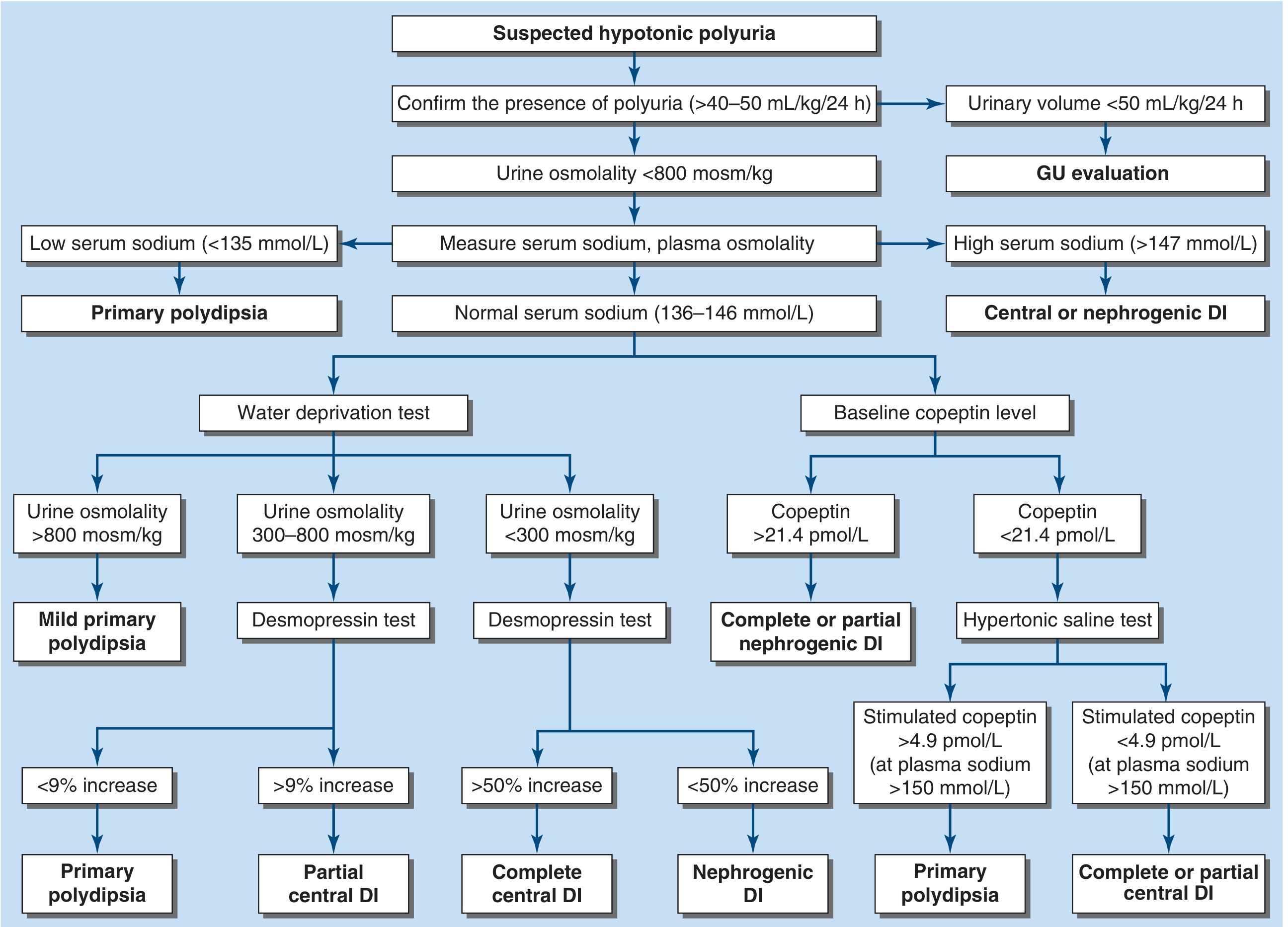
Water deprivation test (classic):
- After water deprivation, measure urine osmolality, then give desmopressin.
- Urine Osm >800 mOsm/kg after deprivation → mild primary polydipsia.
- Urine Osm 300-800, then >9% rise with DDAVP → partial central DI.
- Urine Osm <300, then >50% rise with DDAVP → complete central DI.
- Urine Osm <300, then <50% rise with DDAVP → nephrogenic DI.
- Diagnostic accuracy only ~70% overall (41% for primary polydipsia).
Copeptin-based testing (modern, preferred):
- Copeptin is the C-terminal fragment of pre-pro-AVP; it is a stable, easily measured surrogate for AVP.
- Baseline copeptin ≥21.4 pmol/L (without prior water deprivation) → complete/partial nephrogenic DI.
- Copeptin <21.4 pmol/L → hypertonic saline infusion test: stimulated copeptin >4.9 pmol/L at sodium ≥150 mmol/L → primary polydipsia; <4.9 pmol/L → central DI (97% diagnostic accuracy).
MRI findings in central DI:
-
Loss of the posterior pituitary bright spot on T1-weighted MRI (normally present as hyperintense signal representing neurosecretory vesicles containing AVP). Absence is suggestive but not diagnostic.
-
Goldman-Cecil Medicine, International Edition
-
Harrison's Principles of Internal Medicine, 22nd Edition (2025)
7. Treatment
Central DI
- Desmopressin (DDAVP) - synthetic analogue of ADH with:
- Selective V2 activity (minimal V1/pressor activity)
- Antidiuretic-to-pressor ratio 4,000x that of vasopressin
- Half-life 1.5-2.5 hours (vs. 15 min for vasopressin)
- Routes: IV/SC, intranasal (10-40 mcg/day in 2-3 doses; bioavailability 3-4%), oral (0.1-0.2 mg 2-3x/day; bioavailability <1%)
- Oral absorption reduced 50% with food; dose on empty stomach
- Key complication: hyponatremia - mild (131-134 mmol/L) in ~25% of patients; severe (<130 mmol/L) in ~15%. Use "desmopressin escape" (allow periodic brief aquaresis) to reduce risk.
Nephrogenic DI
- Desmopressin generally ineffective (V2 receptor absent/non-functional).
- Thiazide diuretics (e.g., hydrochlorothiazide) + amiloride + low-sodium diet ± NSAIDs - reduces polyuria by causing mild volume contraction → increased proximal tubular reabsorption.
- Caution: thiazide + lithium → decreased lithium excretion → risk of lithium toxicity.
- Discontinue causative drugs where possible.
Primary Polydipsia
-
Gradual reduction of fluid intake; treat underlying psychiatric illness.
-
Ice chips/hard candy to reduce mouth dryness.
-
GLP-1 analogues have shown promise in reducing fluid intake and thirst.
-
Katzung's Basic and Clinical Pharmacology, 16th Edition
-
Harrison's Principles of Internal Medicine, 22nd Edition (2025)
-
Goldman-Cecil Medicine, International Edition
8. Quick Comparison Table
| Feature | Central DI | Nephrogenic DI | Primary Polydipsia |
|---|---|---|---|
| AVP levels | Low/undetectable | High/normal | Low (appropriate to low Posm) |
| Serum Na | High-normal or high | Normal (adults); high (infants) | Low-normal or low |
| Urine Osm | Low | Low | Low |
| Response to DDAVP | Yes (>50% rise) | No (<50% rise) | No (but may concentrate after deprivation) |
| Cause | Hypothalamic/pituitary damage | V2/AQP2 mutation; drugs | Psychiatric illness; habits; dipsogenic |
| Treatment | DDAVP | Thiazide + amiloride | Reduce intake |
Sources: Goldman-Cecil Medicine (International Edition) | Harrison's Principles of Internal Medicine 22e (2025) | Katzung's Basic and Clinical Pharmacology 16e | Guyton & Hall Textbook of Medical Physiology | Tietz Textbook of Laboratory Medicine 7e | Brenner & Rector's The Kidney
This is a shared conversation. Sign in to Orris to start your own chat.