
from Guyton and Hall textbook of medical physiology, 4th South Asia edition, write a 5-mark short note on Classification of Nerve Fibre
Reading File
Finding Sources
Finding Sources
Finding Sources
Finding Sources
Finding Sources
Finding Sources
Reading File
Reading File
Loading Image
Reading File
I now have all the content needed. Let me compose the 5-mark short note.
Classification of Nerve Fibres
(From Guyton and Hall Textbook of Medical Physiology, 4th South Asia Edition - Chapter 47)
Nerve fibres range from 0.5 to 20 micrometres in diameter, and their conduction velocity ranges from 0.5 to 120 m/sec - larger diameter fibres conduct faster. Two classification systems are in use: the General classification and the Sensory (Sensory Physiologists') classification.
I. General Classification
Fibres are divided into Type A and Type C.
Type A fibres are the typical large and medium-sized myelinated fibres of spinal nerves. They are subdivided into four subtypes:
| Subtype | Diameter (µm) | Conduction Velocity (m/sec) | Functions |
|---|---|---|---|
| Aα | 12–20 | 70–120 | Skeletal muscle efferents, proprioception (muscle spindle primary endings, Golgi tendon organs) |
| Aβ | 5–12 | 30–70 | Touch, pressure, vibration (Meissner corpuscles, Pacinian corpuscles, hair receptors) |
| Aγ | 3–6 | 15–30 | Muscle spindle (intrafusal) efferents |
| Aδ | 2–5 | 5–30 | Pricking pain, temperature (cold), crude touch |
Type C fibres are small, unmyelinated fibres with the slowest conduction velocity (0.5–2 m/sec). They constitute more than half of the sensory fibres in most peripheral nerves and include all postganglionic autonomic fibres. They carry aching pain, warmth, tickle, crude touch, and itch sensations, and subserve sympathetic motor function.
II. Sensory (Alternative) Classification
Used by sensory physiologists when certain recording techniques can separate Aα into subgroups but cannot distinguish Aβ from Aγ easily:
| Group | Equivalent (General) | Diameter (µm) | Function |
|---|---|---|---|
| Ia | Aα | ~17 | Annulospiral (primary) endings of muscle spindles |
| Ib | Aα | ~16 | Golgi tendon organs |
| II | Aβ, Aγ | ~8 | Discrete cutaneous tactile receptors; flower-spray (secondary) muscle spindle endings |
| III | Aδ | ~3 | Temperature, crude touch, pricking pain |
| IV | C (unmyelinated) | 0.5–2 | Pain, itch, temperature, crude touch |
Figure 47.6 - Physiological Classification and Functions of Nerve Fibres
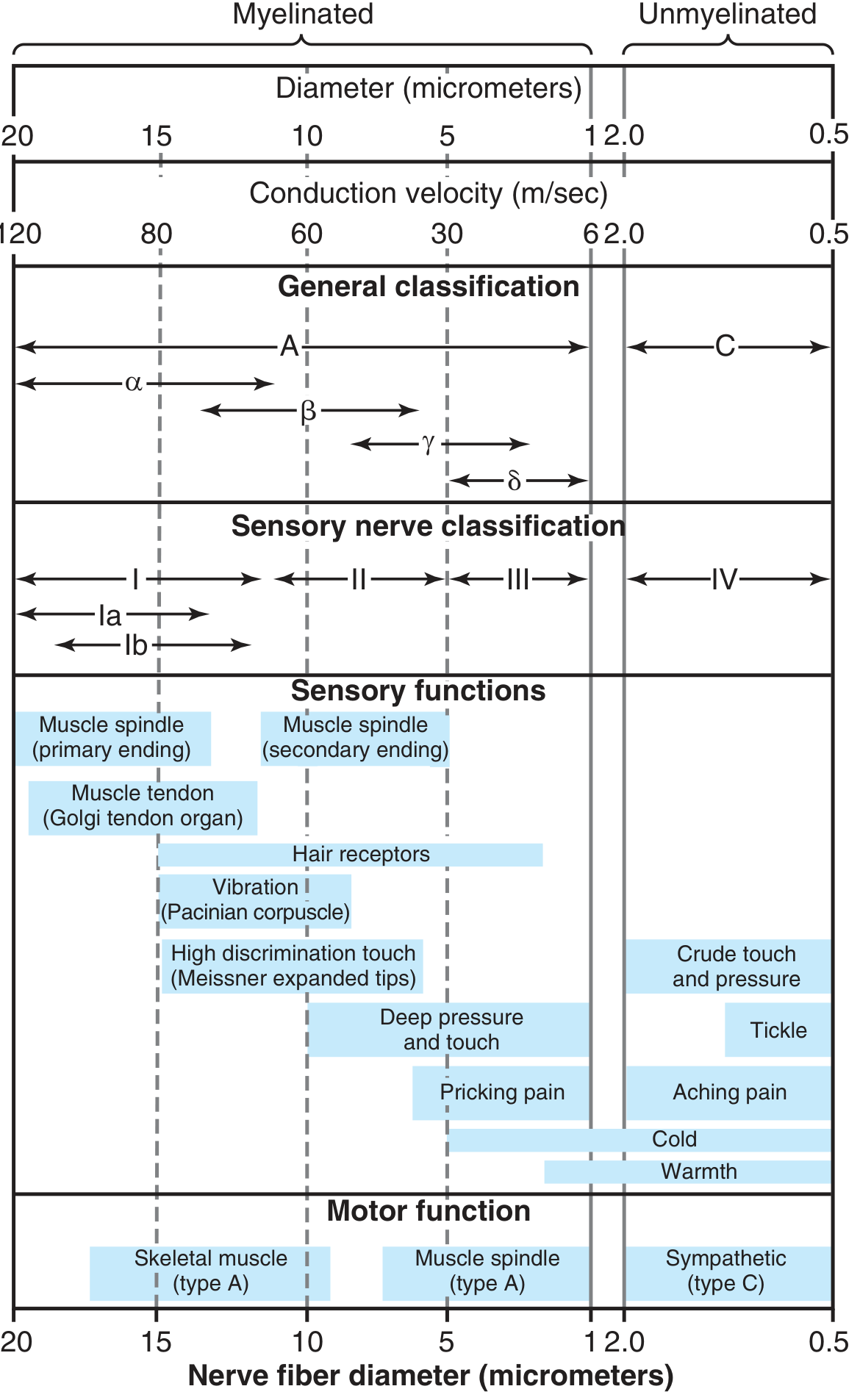
Figure 47.6: Physiological classifications and functions of nerve fibres. Note the two classification schemes (general above, sensory below) plotted against fibre diameter and conduction velocity, with sensory and motor functions mapped to each type.
Key Points to Remember
- Myelination determines speed: All Type A fibres are myelinated; Type C fibres are unmyelinated. Myelin dramatically increases conduction velocity by saltatory conduction.
- Size = speed: The larger the fibre diameter, the greater the conduction velocity.
- Type C fibres are the most abundant: They make up more than half the sensory fibres in peripheral nerves.
- The two classification systems overlap: Group I + II = Aα/Aβ/Aγ; Group III = Aδ; Group IV = C.
- Fast pain (pricking, sharp) is carried by Aδ (Group III) fibres; slow, aching pain by Type C (Group IV) fibres.
Source: Guyton and Hall Textbook of Medical Physiology, Chapter 47 - "General Principles of Sensory Physiology," pp. 586-587
This is a shared conversation. Sign in to Orris to start your own chat.