
Principles of vaporizers
Reading File
A vaporizer is an anesthetic device that converts liquid volatile anesthetic into vapor for inhalation. The key principle is controlling vapor concentration delivered to the patient. Let me search the medical library for detailed coverage.
Searching sources...
Finding Sources
Finding Sources
Good results. Now let me read the key sections from Barash and Miller's in parallel.
Reading File
Reading File
Excellent content. Let me now read more from Barash (factors influencing output, temperature compensation, desflurane vaporizer) and the Miller's desflurane section in parallel.
Reading File
Reading File
Excellent. Now let me get the desflurane vaporizer section and altitude/carrier gas effects:
Reading File
Reading File
I now have comprehensive content. Let me also fetch the SVP vs temperature graph and the vaporizer schematic images to include visually:
Loading Image
Loading Image
I now have all the content needed for a comprehensive answer. Here is the full detailed response:
Principles of Vaporizers
Overview
A vaporizer is a device that converts a liquid volatile anesthetic agent into a controlled, clinically useful vapor concentration for inhalation. The fundamental challenge is that the saturated vapor pressure (SVP) of anesthetic agents far exceeds their clinical concentrations - for example, sevoflurane has an SVP of 160 mmHg (21% at sea level) at 20°C, yet clinical use requires only 1-3%. Vaporizers must therefore dilute this saturated vapor precisely and safely.
1. Underlying Physical Principles
Saturated Vapor Pressure (SVP)
When a volatile liquid sits in a closed container, molecules escape into the vapor phase until equilibrium is reached - this equilibrium pressure is the SVP. SVP increases with temperature and is independent of atmospheric pressure.
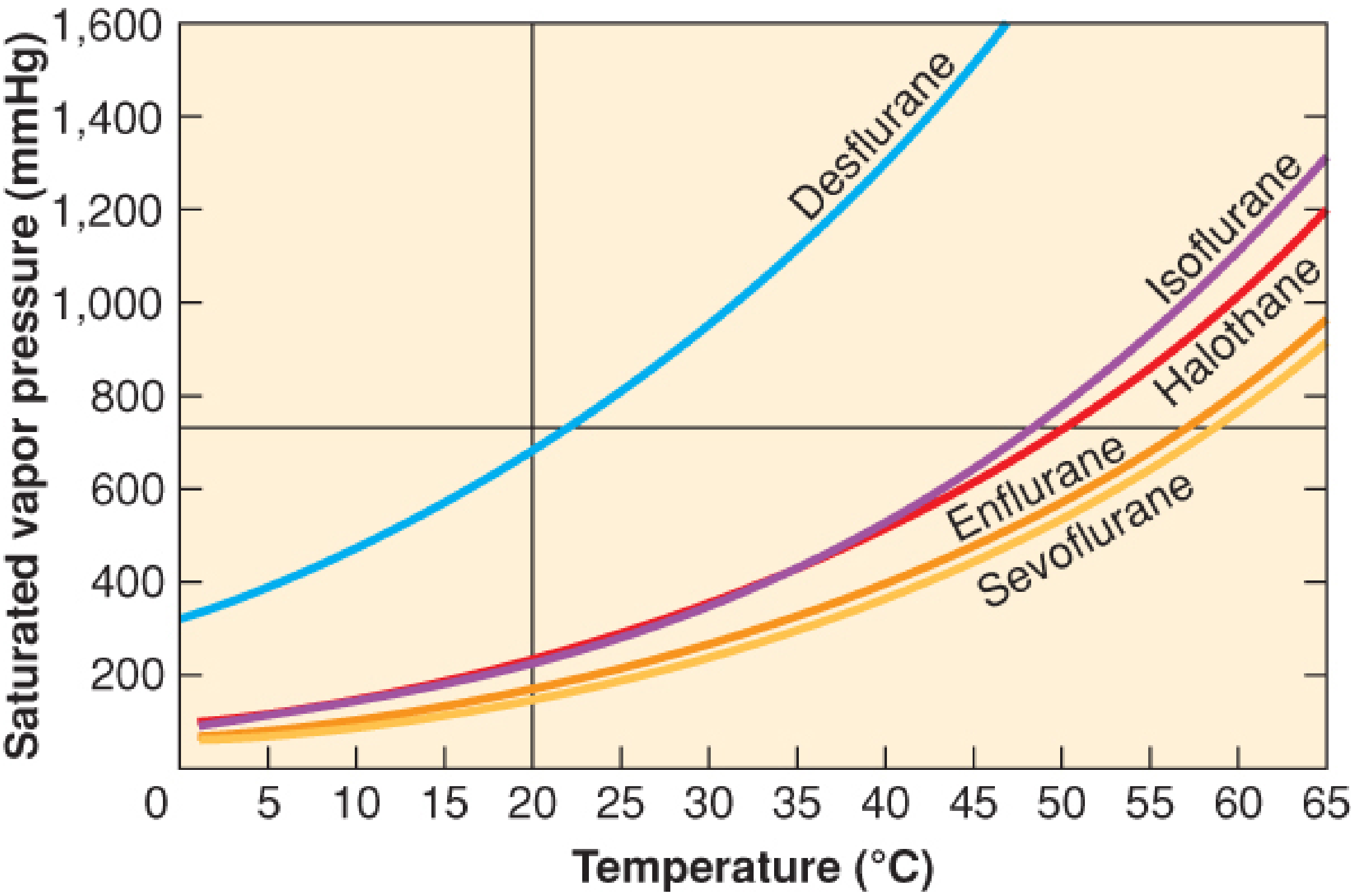
SVP vs. temperature for volatile anesthetics. Desflurane's curve is steeper and shifted markedly upward - at 20°C its SVP is 669 mmHg (87% saturation), compared to ~160-243 mmHg for other agents. At 22.8°C, desflurane boils at sea level. - Barash Clinical Anesthesia, 9e, p.1969
Key SVP values at 20°C:
| Agent | SVP (mmHg) | Saturated conc. (%) | MAC (%) |
|---|---|---|---|
| Desflurane | 669 | 87 | 6-7 |
| Halothane | 243 | 32 | 0.75 |
| Isoflurane | 238 | 31 | 1.15 |
| Enflurane | 175 | 23 | 1.68 |
| Sevoflurane | 160 | 21 | 2.05 |
Latent Heat of Vaporization
Converting liquid to vapor consumes energy (heat). Without an external heat source, the liquid anesthetic cools during vaporization, reducing its SVP and therefore vaporizer output. This is why vaporizers are made of thermally conductive metals (copper, bronze) with high specific heat capacity - to buffer against temperature drops. - Barash Clinical Anesthesia, 9e, p.1969-70
Specific Heat and Thermal Conductivity
- Specific heat determines how much energy is needed to keep the liquid at a stable temperature during vaporization. Higher specific heat = more thermally stable.
- Thermal conductivity determines how fast heat flows through vaporizer materials. High conductivity materials (metals) conduct heat quickly from the surroundings into the liquid to replace heat lost during evaporation.
2. Classification of Vaporizers
By Position Relative to Breathing Circuit
| Type | Location | Examples |
|---|---|---|
| Out-of-circuit | Upstream of breathing circuit; controlled output added to fresh gas flow | All modern plenum vaporizers (Tec 5, Tec 7, Vapor 2000) |
| In-circuit | Placed within the breathing circuit itself | Draw-over vaporizers (Oxford Miniature Vaporizer); used in resource-limited settings and some ICU sedation setups |
By Operating Mechanism
- Variable bypass vaporizer (most common)
- Dual-circuit vaporizer (Tec 6, D-Vapor - for desflurane)
- Cassette vaporizer (GE Aladin)
- Injection vaporizer (newer systems)
3. Variable Bypass Vaporizer (Plenum Vaporizer)
This is the standard design for isoflurane, sevoflurane, halothane, and enflurane.
Basic Components
- Fresh gas inlet - receives fresh gas flow from flowmeters
- Concentration control dial - determines the splitting ratio
- Bypass chamber - carries the majority of fresh gas directly to the outlet
- Vaporizing chamber - contains the liquid agent; wicks and baffles maximize liquid-gas contact surface area
- Temperature-compensating mechanism - bimetallic strip (GE Tec) or expansion element (Dräger Vapor)
- Vaporizer outlet port and filling assembly
Mechanism (Splitting Ratio)
Fresh gas entering the vaporizer is split into two streams by the concentration control dial:
- Bypass stream - flows directly to the outlet without contacting liquid agent
- Vaporizing stream - passes through the vaporizing chamber, becomes saturated (or near-saturated) with anesthetic vapor via wicks and baffles
The two streams reunite at the outlet, producing the desired concentration. The splitting ratio is the ratio of bypass flow to vaporizing chamber flow - each agent requires a different ratio because their SVPs differ.
Approximate splitting ratios at 20°C, 1% dial setting:
- Halothane: ~43:1 (bypass:vaporizing)
- Isoflurane: ~45:1
- Sevoflurane: ~13:1
Because ratios are agent-specific, variable bypass vaporizers are agent-specific and must not be cross-filled.
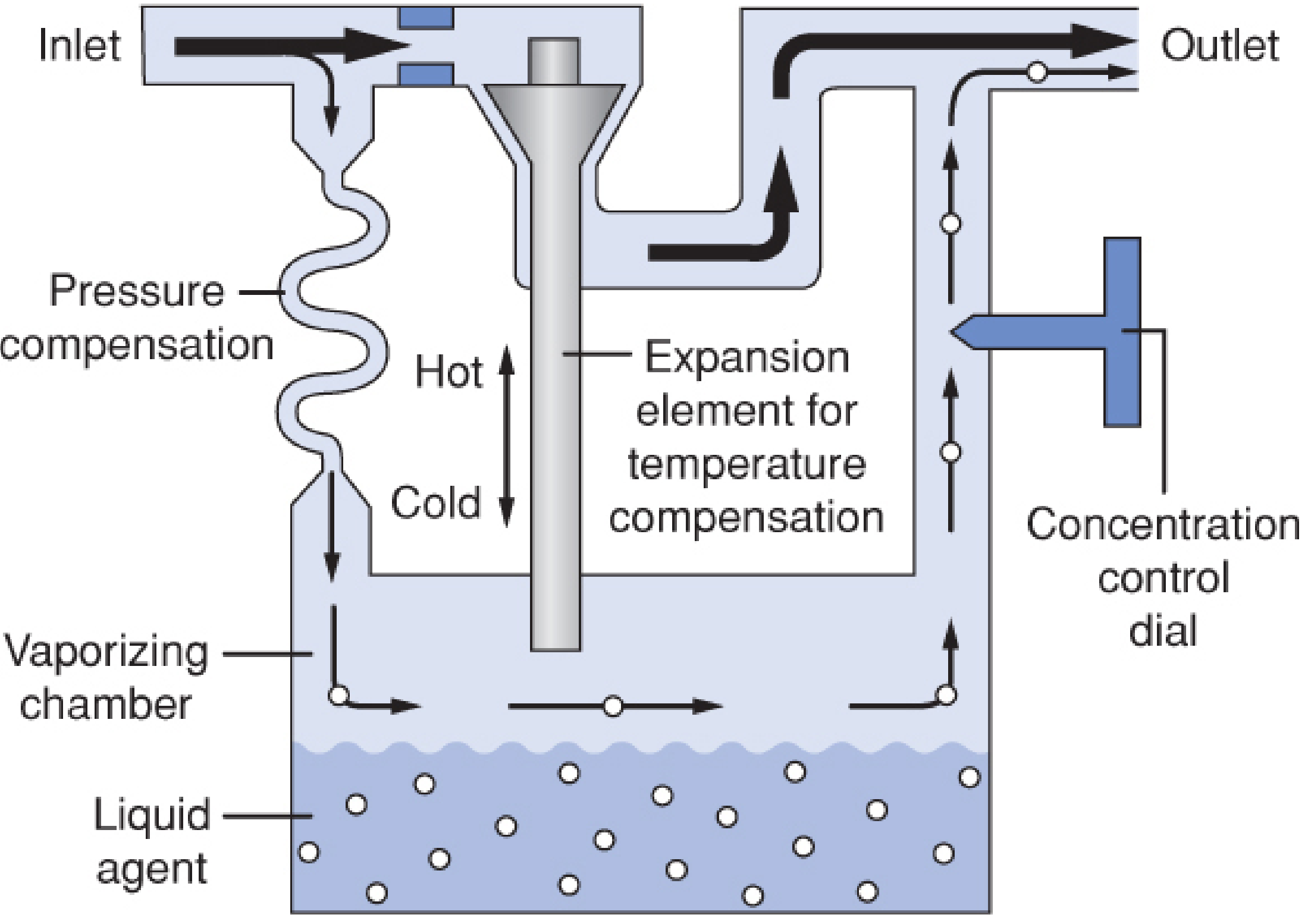
Schematic of a Dräger-type variable bypass vaporizer showing the expansion element for temperature compensation, vaporizing chamber with liquid agent, and concentration control dial. - Barash Clinical Anesthesia, 9e, p.1975
Temperature Compensation
As temperature falls during vaporization, SVP drops - the vaporizing chamber produces less agent. The temperature-compensating mechanism corrects this automatically:
- Bimetallic strip (GE Tec series): Two metals with different thermal expansion coefficients are bonded together. As temperature drops, the strip bends to divert more gas through the vaporizing chamber (increases vaporizing fraction), compensating for reduced SVP.
- Expansion element (Dräger Vapor 2000, 19.1): A liquid-filled bellows/thermostat that expands with heat - works on the same principle.
The net effect is a nearly linear, constant output over a wide temperature range (typically 15°C-35°C). - Barash Clinical Anesthesia, 9e, p.1975-76
4. Factors That Influence Vaporizer Output
Fresh Gas Flow (FGF) Rate
- At very low flows (<250 mL/min): Output is less than dialed - dense anesthetic vapors don't rise efficiently without turbulence.
- At very high flows (>15 L/min): Output may again fall - insufficient contact time to saturate the carrier gas; altered resistance characteristics between bypass and vaporizing chambers.
- Optimal accurate output is in the intermediate flow range. - Barash Clinical Anesthesia, 9e, p.1976
Intermittent Back Pressure ("Pumping Effect")
Positive-pressure ventilation or oxygen flush valve use creates intermittent back pressure transmitted to the vaporizer. This compresses gas in the vaporizing chamber and forces anesthetic-laden vapor retrograde into the bypass chamber, increasing output above the dialed setting. Modern vaporizers incorporate:
- A long, spiral inlet tube in the bypass chamber (acts as a buffer)
- A one-way check valve at the vaporizer outlet
Altitude (Ambient Pressure)
Vapor pressure is independent of atmospheric pressure, but concentration (vol%) depends on it. In modern variable bypass vaporizers (Tec 5, 7; Vapor 2000), flow proportioning occurs at the exit of the vaporizing chamber:
- At altitude (lower atmospheric pressure), the SVP of isoflurane is still 238 mmHg, but that represents a higher vol% (238/500 = 47.6% at 500 mmHg vs. 238/760 = 31.3% at sea level)
- The diluent bypass flow is also reduced proportionally
- Result: the partial pressure delivered remains nearly constant - these vaporizers are essentially ambient pressure compensated
In contrast, the Tec 6 desflurane vaporizer (a gas blender) delivers a constant vol%, so its partial pressure output decreases at altitude and the dial setting must be increased. - Barash Clinical Anesthesia, 9e, p.1988-89
Carrier Gas Composition
Nitrous oxide is more soluble in the liquid anesthetic than oxygen or nitrogen. When N₂O replaces O₂ as the carrier gas, transiently more N₂O dissolves into the liquid, reducing the volume of gas exiting the vaporizing chamber and causing a brief decrease in output followed by a return toward normal once equilibrium is reached.
5. The Desflurane Vaporizer (Tec 6 / D-Vapor)
Desflurane cannot be used in a variable bypass vaporizer for two reasons:
- SVP of 669 mmHg at 20°C - at 22.8°C it boils at sea level. Output would be uncontrolled and dangerous.
- High MAC (6-7%) means large volumes of liquid must be vaporized - the resulting cooling would be extreme and impossible to compensate without external heating.
Operating Principle: Dual Gas Blender
The Tec 6 operates as a gas blender, not a conventional vaporizer:
- The desflurane sump is electrically heated and thermostatically maintained at 39°C, creating a reservoir of vapor at ~1500 mmHg (2 atm absolute)
- There are two parallel circuits: a fresh gas circuit and a vapor circuit
- The fresh gas passes through a fixed restrictor (R1) before reaching the outlet; the resistance of R1 creates a pressure differential
- Pressurized desflurane vapor is injected into the fresh gas stream through a variable restrictor (R2) controlled by the concentration dial and a pressure-sensing differential valve
- The differential valve ensures the pressure in the vapor circuit matches the pressure in the fresh gas circuit, maintaining a constant vapor-to-gas ratio regardless of FGF changes
- Because output is in fixed vol%, not fixed partial pressure, dial adjustment is needed at altitude (unlike conventional vaporizers)
The Tec 6 has a display that warns if the liquid level is low, if it is not heated to operating temperature, or if it is tilted. - Barash Clinical Anesthesia, 9e, p.1983-87
6. Cassette Vaporizers (GE Aladin System)
In the Aladin system (used on the GE Aisys, Avance, and Carestation machines), a cassette containing liquid agent sits outside the fresh gas circuit. A gas module on the machine measures flow rates, temperature, and pressure via sensors, and a computer calculates how much gas to divert through the cassette. The cassette is color-coded and agent-specific but does not contain agent-specific internal mechanical components - the machine software handles the calculations. - Miller's Anesthesia, 10e
7. Misfilling
If a variable bypass vaporizer is accidentally filled with the wrong agent:
- A lower volatility agent in a higher-volatility calibrated vaporizer (e.g., sevoflurane in an isoflurane vaporizer): output concentration will be lower than expected
- A higher volatility agent (e.g., isoflurane in a sevoflurane vaporizer): output will be higher than expected, potentially dangerous
- Keyed filling systems (Quik-Fil, Selectatec) on modern vaporizers prevent misfilling in most clinical settings
Summary Table
| Feature | Variable Bypass | Tec 6 (Desflurane) | Cassette (Aladin) |
|---|---|---|---|
| Mechanism | Gas splitting | Dual gas blending | Computer-controlled injection |
| Heated | No (passive thermal compensation) | Yes (39°C sump) | No |
| Pressurized | No | Yes (~2 atm) | No |
| Altitude effect | Partial pressure nearly constant | vol% constant, PP decreases | Compensated electronically |
| Agent specific | Yes | Desflurane only | Yes (color-coded cassette) |
Sources: Barash, Cullen, and Stoelting's Clinical Anesthesia, 9e, pp. 1967-1990; Miller's Anesthesia, 10e, Chapter 20/29
This is a shared conversation. Sign in to Orris to start your own chat.