
Explain emergency management for hepatic coma
I'll read the medical library skill first, then search for hepatic coma management.
Reading File
Now I'll run parallel searches across the library and PubMed simultaneously.
Finding Sources
Finding Sources
Searching PubMed
"hepatic encephalopathy"[MeSH Terms] AND management
Excellent results. Now I'll read the most relevant sections in parallel - Pye's Surgical Handicraft (treatment of hepatic coma), Rosen's Emergency Medicine, and Plum & Posner.
Reading File
Reading File
Reading File
Good. Now let me get deeper content from more authoritative sources - Adams & Victor's Neurology and the Washington Manual, plus a broader search for grading/staging of hepatic encephalopathy.
Reading File
Finding Sources
Finding Sources
Excellent. Now let me read the comprehensive management sections from Tintinalli's Emergency Medicine, Washington Manual, and the grading/cerebral edema section from Current Surgical Therapy.
Reading File
Reading File
Reading File
Excellent data gathered. Let me also read the Tintinalli section on grade III/IV encephalopathy and cerebral edema management, plus fetch the pathophysiology diagram.
Reading File
Reading File
Loading Image
I now have comprehensive, multi-source information to write a thorough answer. Let me compile everything.
Emergency Management of Hepatic Coma (Hepatic Encephalopathy)
Hepatic coma - more precisely termed hepatic encephalopathy (HE) - is a neuropsychiatric syndrome of altered cerebral function secondary to hepatic dysfunction and/or portal-systemic shunting. It ranges from subtle personality change to deep coma, and should always be regarded as a grave condition with a grim prognosis, though it can be reversed if precipitating factors are corrected.
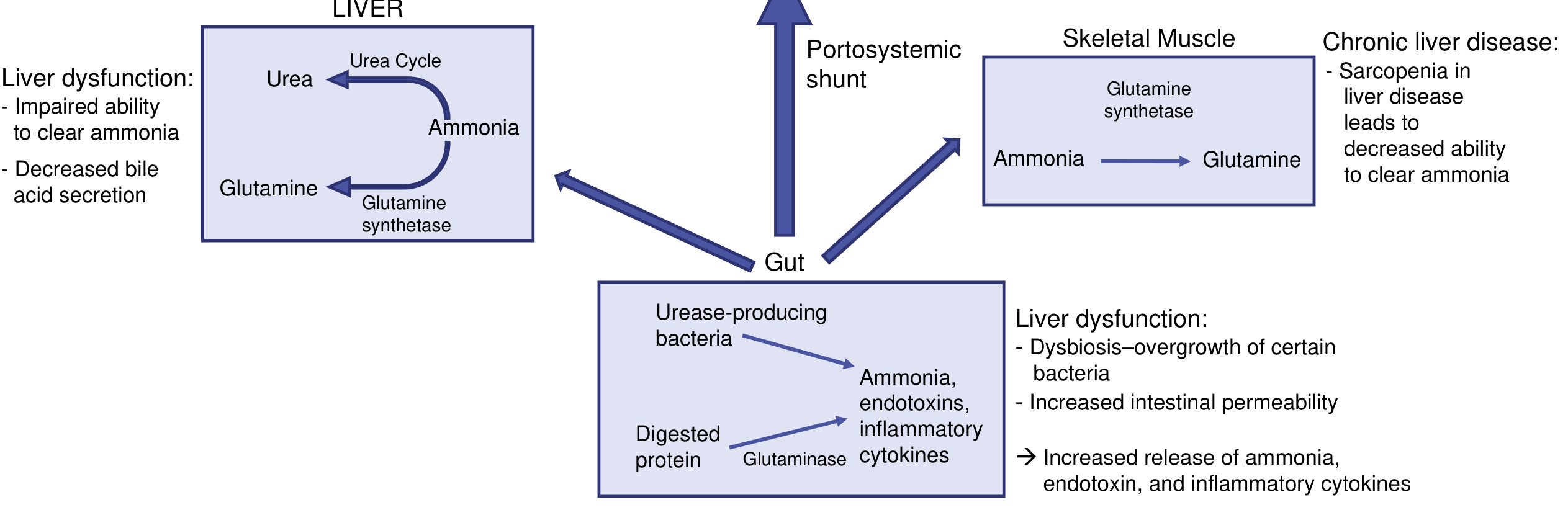
Pathophysiology (Brief)
The core mechanism is hyperammonemia from multiple sources:
-
Gut urease-producing bacteria generate ammonia from protein and blood
-
Liver dysfunction impairs the urea cycle (cannot convert NH3 to urea)
-
Portosystemic shunting bypasses hepatic clearance entirely
-
Sarcopenia in chronic liver disease further reduces glutamine synthetase-based ammonia buffering in skeletal muscle
-
Ammonia crosses the blood-brain barrier, causes astrocyte swelling, increased glutamine production, cerebral edema, and neuron dysfunction
-
Current Surgical Therapy 14e, p. 490
Grading of Hepatic Encephalopathy (West Haven Criteria)
| Grade | Category | Clinical Features |
|---|---|---|
| Minimal | Covert | Abnormal neuropsychometric tests only; no clinical signs |
| Grade 1 | Covert | Trivial lack of awareness, euphoria or anxiety, shortened attention span, altered sleep rhythm |
| Grade 2 | Overt | Lethargy/apathy, disorientation to time, inappropriate behavior, asterixis |
| Grade 3 | Overt | Somnolence, gross confusion, gross disorientation |
| Grade 4 | Overt | Coma (hepatic coma proper) |
- Current Surgical Therapy 14e, p. 490
Grade I-II patients who are otherwise stable may be considered for outpatient management with gastroenterology follow-up. Grade III-IV requires immediate hospital admission and emergency management.
- Tintinalli's Emergency Medicine
Precipitating Factors - Identify and Treat
Before treating the coma itself, identify and correct the trigger:
| Precipitant | Mechanism |
|---|---|
| GI hemorrhage | Blood protein broken down by intestinal bacteria produces ammonia load |
| Infection / sepsis | Increased protein catabolism, hypoxia |
| Hypokalemia / alkalosis | Promotes NH3 (uncharged form) entry into CNS |
| Diuretic overuse / dehydration | Electrolyte disturbance, reduced renal NH3 excretion |
| Constipation | Increases colonic ammonia production |
| Sedatives, opiates, benzodiazepines | Decreased hepatic clearance prolongs CNS depression |
| Excessive protein intake | Nitrogen load to gut |
| Portosystemic shunt surgery | Bypasses hepatic detoxification |
| Alcoholic binge | Acute hepatocellular toxicity on chronic disease |
- Adams and Victor's Principles of Neurology 12e, p. 1146
- 22nd Edition Pye's Surgical Handicraft
Emergency Management - Step by Step
1. Airway, Breathing, Circulation (ABC)
-
Intubation is required for Grade III-IV encephalopathy, respiratory failure from ascites/effusions, or risk of aspiration. BPAP is generally not suitable in somnolent patients.
-
Circulatory failure is common due to third-spacing, hemorrhage, and malnutrition. Treat with a judicious normal saline bolus.
-
Vasopressors: norepinephrine is first choice for volume-refractory hypotension. Add vasopressin if escalating doses are needed. Use vasopressin with caution in severe encephalopathy (may worsen cerebral vasodilation and intracranial hypertension).
-
Hydrocortisone may be added for refractory hypotension (AASLD recommendation).
-
Check and treat hypoglycemia urgently - the failing liver has impaired gluconeogenesis and glycogen stores.
-
Tintinalli's Emergency Medicine
2. Nutrition - Restrict and Substitute
-
Nil protein in acute coma: calories are provided by glucose. In the pre-comatose state, glucose drinks; if in frank coma, 20% glucose via intracaval (central) drip.
-
After recovery begins, protein is reintroduced cautiously - only 25-50 g/day, at the limit of tolerance.
-
Full parenteral vitamin supplements, especially vitamins B and K. Vitamin K addresses coagulopathy from hepatic synthetic failure.
-
Branched-chain amino acids (BCAA) have shown benefit without increased mortality and may be added to lactulose + rifaximin.
-
22nd Edition Pye's Surgical Handicraft; Rosen's Emergency Medicine
3. Bowel Decontamination and Ammonia Reduction
This is the central pharmacological strategy.
Lactulose (First-Line)
-
A synthetic, non-absorbed disaccharide. It acidifies the colon, trapping ammonia as NH4+ (non-diffusible form) and increasing nitrogen excretion in stool.
-
Also inhibits glutamine-dependent ammonia production in the gut wall.
-
Oral: Initial 20-30 g every hour until defecation occurs, then reduce to 20-30 g every 4-6 hours. Maintenance: 15-45 mL (20 g) PO bid-qid, titrated to 2-3 soft stools per day.
-
If the patient cannot swallow: lactulose enema - 300 mL lactulose in 700 mL water/normal saline, retained for 30 minutes, repeated every 4-6 hours.
-
Blood ammonia can fall by up to 50% with lactulose therapy.
-
Do NOT give if ileus or bowel obstruction suspected.
-
Washington Manual of Medical Therapeutics; Tintinalli's Emergency Medicine; Current Surgical Therapy 14e
Rifaximin (Add-on / Second-Line)
-
Oral, non-systemic broad-spectrum antibiotic. Suppresses intestinal flora and reduces bacterial ammonia/endotoxin production.
-
Dose: 550 mg PO twice daily (or 400 mg PO every 8 hours per some sources).
-
Recommended in combination with lactulose for overt HE and for prevention of recurrence (Grade IA recommendation, AASLD/EASL).
-
Better tolerated than neomycin; no renal or ototoxic effects.
-
Current Surgical Therapy 14e; Washington Manual; Rosen's Emergency Medicine
Neomycin (Alternative)
-
6 g daily in divided doses, reduces ammonia-forming colonic bacteria.
-
Limited by nephrotoxicity and ototoxicity with prolonged use; reserved for short-term or when rifaximin is unavailable.
-
22nd Edition Pye's Surgical Handicraft; Tintinalli's Emergency Medicine
Purges and Enemas
-
Magnesium sulfate cathartic and colonic enemas are important to clear protein load from the bowel, especially when GI hemorrhage is the precipitant.
-
22nd Edition Pye's Surgical Handicraft
Polyethylene Glycol (PEG) - Alternative
-
PEG-based electrolyte solution: 4 L over 4 hours or 2 L every 12 hours. Emerging evidence it may be more effective than lactulose; further studies needed.
-
Current Surgical Therapy 14e
4. Fluid and Electrolyte Management
-
Maintain strict fluid balance chart; daily serum electrolytes and acid-base estimations.
-
Correct hypokalemia and metabolic alkalosis - both worsen ammonia entry into the CNS.
-
Correct hypo- or hypernatremia (cirrhotic patients on diuretics are at risk for both).
-
Maintain adequate renal perfusion to support ammonia excretion.
-
22nd Edition Pye's Surgical Handicraft; Adams and Victor's 12e
5. Blood Transfusion / Coagulopathy
-
Maintain hemoglobin above 10 g/dL to ensure adequate oxygen delivery to the failing liver.
-
Coagulopathy: Vitamin K 10 mg IV/PO; fresh-frozen plasma for bleeding or pre-procedure; cryoprecipitate (1 unit/10 kg) preferred over FFP for active bleeding.
-
Platelet count should be >50,000/mm3 before invasive procedures.
-
22nd Edition Pye's Surgical Handicraft; Rosen's Emergency Medicine
6. Cerebral Edema Management (Grade III-IV / Fulminant Failure)
Cerebral edema occurs in ~80% of Grade IV HE from fulminant hepatic failure. This is the leading cause of death.
Risk factors for cerebral edema: Grade III-IV HE + renal failure + critically elevated ammonia (>150 µmol/L) + hypotension.
-
Prophylactic hypertonic saline - goal sodium 145-155 mEq/L in high-risk patients.
-
Mannitol 0.5-1 g/kg IV for confirmed raised intracranial pressure.
-
Maintain head elevation at 30 degrees; avoid hyperventilation.
-
Consider ICP monitoring in fulminant hepatic failure with Grade III-IV HE.
-
If intracranial hemorrhage is identified, treat coagulopathy urgently and consult neurosurgery.
-
Tintinalli's Emergency Medicine; Plum and Posner's Diagnosis and Treatment of Stupor and Coma; Current Surgical Therapy 14e
7. Infection Control
-
Sepsis is a major precipitant AND complication of hepatic coma. Screen for and treat infection aggressively.
-
Rule out spontaneous bacterial peritonitis (SBP) in all patients with ascites (diagnostic paracentesis; ascitic granulocytes >250 cells/mm3 is diagnostic; treat with cefotaxime 2 g IV every 8 hours for 5 days).
-
Consider blood cultures and empiric antibiotics for systemic sepsis.
-
Rosen's Emergency Medicine
8. Corticosteroids (Selected Cases)
-
Corticosteroids may be used in acute hepatic coma associated with viral hepatitis.
-
22nd Edition Pye's Surgical Handicraft
9. Liver Transplant Evaluation
-
For fulminant hepatic failure or cirrhosis with refractory encephalopathy, urgent evaluation for liver transplantation is required. This is the only definitive treatment for end-stage disease.
-
Approximately 50% of cirrhotic patients die within 1 year of demonstrating encephalopathy, making early transplant referral important.
-
Surviving transplant recipients may have persistent cognitive dysfunction in severe cases.
-
Plum and Posner's Diagnosis and Treatment of Stupor and Coma; Current Surgical Therapy 14e
Drugs to AVOID
The following are contraindicated or should be avoided:
| Drug | Reason |
|---|---|
| Thiazide diuretics | Worsen hypokalemia, precipitate encephalopathy |
| Paracentesis (large-volume without albumin replacement) | Causes circulatory dysfunction and HE |
| Morphine and opioids | Decreased hepatic clearance → prolonged CNS depression |
| Barbiturates and benzodiazepines | Same as opioids - sedation is dramatically prolonged |
| ACE inhibitors / ARBs | Worsened renal clearance in decompensated cirrhosis |
- 22nd Edition Pye's Surgical Handicraft; Rosen's Emergency Medicine
Summary Flowchart
Hepatic Coma (Grade III-IV)
        ↓
ABCs → Intubate if needed → Correct hypoglycemia
        ↓
Identify & treat precipitant (GI bleed, sepsis, electrolytes, drugs)
        ↓
Bowel decontamination:
  → Lactulose (oral/rectal) + Rifaximin
  → Purgation with Mg sulfate + enemas
        ↓
Nutrition: Zero protein → 20% IV glucose → parenteral vitamins
        ↓
Fluids/Electrolytes: Correct K+, Na+, acid-base
        ↓
Blood: Maintain Hb >10, treat coagulopathy
        ↓
Grade III-IV? → Screen for cerebral edema
  → Hypertonic saline (Na 145-155)
  → Mannitol 0.5-1 g/kg for raised ICP
        ↓
Transplant evaluation if fulminant or refractory
Prognosis Note
-
Patients with chronic cirrhosis or portacaval shunting have better recovery than those with fulminant hepatic failure.
-
Among all nontraumatic coma types, hepatic encephalopathy has the best chance for recovery (33%).
-
Cerebral edema with raised ICP (mostly fulminant failure) carries >50% mortality.
-
~50% of cirrhotic patients die within 1 year after first episode of overt encephalopathy.
-
Plum and Posner's Diagnosis and Treatment of Stupor and Coma, p. 686; Adams and Victor's Principles of Neurology 12e
This is a shared conversation. Sign in to Orris to start your own chat.