
piezogenic papules
Piezogenic papules are soft, skin-colored herniations of fat through the dermis that appear on the heels (and sometimes wrists) when weight is applied, and disappear when pressure is removed. They are usually asymptomatic and incidental but can be painful in some people, especially those with connective tissue disorders like Ehlers-Danlos syndrome.
Searching sources...
Reading File
Searching the Web
piezogenic papules clinical features treatment 2024
Finding Sources
Searching PubMed
piezogenic papules
Reading File
Reading File
Now let me read the main section from the Dermatology 5e textbook more completely, and also fetch the clinical image:
Reading File
Loading Image
Here is a complete overview of piezogenic papules:
Piezogenic Papules (Piezogenic Pedal Papules)
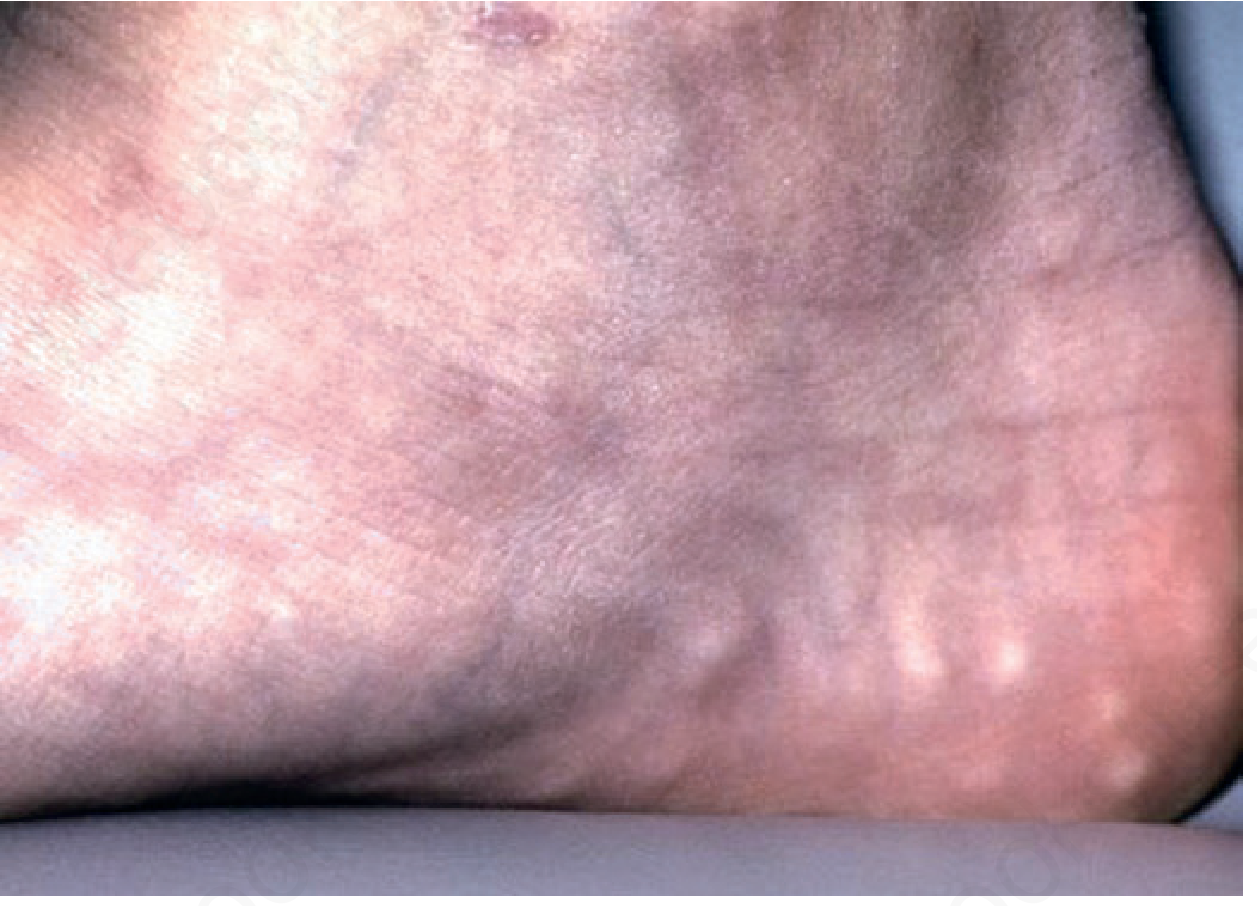
Soft skin-colored to yellowish papules on the heel representing herniation of subcutaneous fat through the plantar fascia. (Andrews' Diseases of the Skin, Fig. 3.38)
Definition and Etymology
Piezogenic pedal papules were first described by Shelley and Rawnsley in 1968. The name is technically a misnomer: "piezogenic" means "producing pressure," but the lesions are actually produced by pressure - not the other way around. The correct mechanism is pressure-induced herniation of subcutaneous fat through connective tissue defects in the dermis of the heels. - Dermatology 2-Volume Set 5e, p. 2080
Pathogenesis
- Pressure (weight-bearing) forces fat lobules to herniate through focal weaknesses in the dermis/fascial layers of the heel fat pad.
- The underlying mechanism reflects a structural insufficiency of connective tissue that normally retains the fat cushion in place.
- This is why the papules appear only on standing and resolve when pressure is removed.
Clinical Features
| Feature | Details |
|---|---|
| Morphology | Soft, skin-colored to yellowish papules/nodules, compressible |
| Location | Bilateral medial and lateral borders of heels (most common); also described on wrists |
| Triggering | Appear with weight-bearing; disappear when leg is elevated |
| Symptoms | Usually asymptomatic and noticed incidentally; painful variant exists |
| Demographics | All ages, sexes, ethnicities; common enough to be considered normal in the general population |
Associated Conditions
Piezogenic papules are more frequent and/or more symptomatic in people with:
- Ehlers-Danlos syndrome (EDS) - the most well-known association, reflecting generalized connective tissue laxity
- Prader-Willi syndrome - associated with hypotonia and obesity (increased mechanical load)
- GATA2 deficiency
- Flat feet (pes planus)
- Obesity and excessive weight-bearing exercise (e.g., long-distance running)
Painful Variant
A subgroup of patients experiences pain during weight-bearing. Andrews' Diseases of the Skin describes this as "painful fat herniation" - a rare cause of painful feet where fat herniates through thin fascial layers of the weight-bearing heel (Fig. 3.38). These patients warrant active management.
Infantile Variant
A distinct infantile form called precalcaneal congenital fibrolipomatous hamartoma (formerly "pedal papules of infancy") presents as larger nodules on the medial heel in infants, present without weight-bearing. When unilateral, it must be distinguished from juvenile aponeurotic fibroma, which can calcify. - Dermatology 2-Volume Set 5e, p. 2080
Diagnosis
Clinical diagnosis based on:
- Soft, compressible papules on the heels
- Appear with weight-bearing, disappear with elevation
- Bilateral presentation is typical
- No further workup needed in straightforward cases
Ultrasound has been used in reported cases (PMID: 38909367, 2024) and can demonstrate the fat herniation dynamically.
Treatment
Asymptomatic cases: No treatment required.
Symptomatic (painful) cases:
| Option | Notes |
|---|---|
| Orthopedic/supportive footwear | First-line for pain relief; reduces shear forces on the heel |
| Compression stockings | Reduce venous stasis and pressure load |
| Activity modification | Reduce high-impact weight-bearing activities |
| Surgical excision | Reserved for refractory painful cases; outcomes depend on location and healing capacity; the heel is a challenging surgical site |
Key Points to Remember
- Benign, common, and usually asymptomatic
- Pressure-dependent appearance is the diagnostic hallmark
- Strong association with EDS - always consider connective tissue disorders when papules are prominent or painful
- The term "piezogenic" is often used loosely to include wrist papules, which share the same mechanism
- No malignant potential; no treatment needed in most cases
Sources: Dermatology 2-Volume Set 5e (Bolognio et al.), p. 2079-2080; Andrews' Diseases of the Skin, p. 54; DermNet NZ; Cleveland Clinic
This is a shared conversation. Sign in to Orris to start your own chat.