


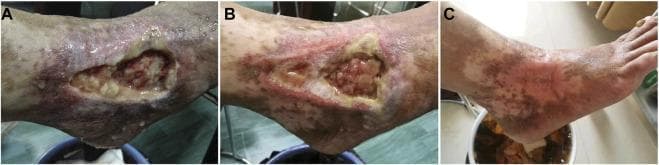
Compare the two wounds 3 days apart
wound healing assessment granulation tissue slough maceration progress
Bailey and Love's Short Practice of Surgery 28th Edition
Page 124
leg wound healing stages granulation tissue slough
Hugging Face pmc clinical VQA raw
Page 0
Wound Comparison: Day 1 vs. Day 4 (3 Days Apart)
Side-by-Side Assessment
| Feature | Image 1 (Earlier) | Image 2 (3 Days Later) |
|---|---|---|
| Wound size/shape | Larger, more open; elliptical with wider margins | Slightly narrower overall; wound edges appear more approximated |
| Wound bed tissue | Mix of bright red granulation tissue and significant yellow slough/fibrin centrally and distally | Granulation tissue still present but the wound bed appears more organized; slough remains but distributed differently |
| Periwound skin | Marked maceration (whitish, waterlogged skin) around edges — leg is soaking in water in a basin | Less maceration visible; periwound appears drier and skin edges are more defined |
| Wound edges | Edges appear raised and undermined at the superior pole; moderate peri-wound erythema/bruising | Edges are still raised; superior pole bruising/ecchymosis appears less extensive |
| Exudate | Yellow serous/sero-purulent exudate visible, particularly at the inferior tip | Some yellow exudate persists, but the wound appears somewhat drier overall |
| Inflammation signs | Significant periwound erythema and bruising at the upper margin | Upper margin bruising has faded slightly; less surrounding erythema |
| Epithelialization | Minimal inward migration of epithelium visible | Wound margins show slight inward contraction — early epithelial advancement |
| Granulation quality | ~40–50% granulation tissue; bright red beefy tissue present | ~50–60% granulation coverage; tissue appears healthy red but slough still intermixed |
Interpretation
- The periwound ecchymosis/bruising at the superior margin has begun to resolve
- The wound margins appear slightly more contracted — consistent with early wound contraction
- Less maceration in the second image (no water soaking)
- Granulation tissue proportion appears to have increased modestly
- Yellow slough/fibrin persists throughout the wound bed — this indicates the wound is still in the inflammatory/proliferative transition phase and has not yet achieved a clean granulating base
- The wound remains open with no sign of bridging epithelium across the defect
- Exudate is still present, suggesting ongoing inflammation
Clinical Takeaway
Based on wound healing principles from Bailey & Love's Short Practice of Surgery, 28th Ed., p. 124, and standard wound bed preparation guidelines.
⚠️ Note: This is an educational assessment only. For proper wound management, please consult a healthcare professional or wound care specialist.
approach to newly diagnosed diabetic p
newly diagnosed diabetes mellitus initial approach evaluation management
Eye Care Of The Patient With Diabetes Mellitus
Page 23
type 2 diabetes initial workup investigations HbA1c treatment targets lifestyle
Diabetic Retinopathy
Page 59
diabetes diagnosis criteria fasting glucose oral glucose tolerance test type 1 vs type 2 classification
diabetes complications screening nephropathy retinopathy neuropathy cardiovascular baseline assessment
Image processing blocked due to content policy violation.
We encountered an error while processing your request. Please try again or reach out to us for help.
approach to newly diagnosed diabetic p
Image processing blocked due to content policy violation.
We encountered an error while processing your request. Please try again or reach out to us for help.
approach to newly diagnosed diabetic patient
Image processing blocked due to content policy violation.
We encountered an error while processing your request. Please try again or reach out to us for help.