
What is the weeks of development from 1st week to to 8 week embryology
Reading File
Finding Sources
Finding Sources
The best source is "The Developing Human: Clinically Oriented Embryology." Let me read the relevant sections.
Reading File
Finding Sources
Finding Sources
Reading File
Reading File
Now let me read the first week, and the fourth-to-eighth week highlights section:
Reading File
Reading File
I got the 4th–8th week highlights. Now let me read the first week content and the 3rd week content:
Reading File
Reading File
Now let me get the first week content and fetch the timetable image:
Finding Sources
Loading Image
Excellent! I now have comprehensive information to provide a detailed answer. Let me also get the first week content:
Reading File
Loading Image
I now have everything needed. Let me also fetch the week 1–2 timetable image:
Loading Image
I now have comprehensive information and visual timetable images. Here is a complete, well-organized summary of embryological development from weeks 1 through 8.
Human Embryology: Weeks 1–8 (The Embryonic Period)
Source: The Developing Human: Clinically Oriented Embryology
The embryonic period spans from fertilization (day 0) through the end of week 8 (day 56, Carnegie stage 23). By the end of this period, all major organ systems have been established and the embryo takes on a distinctly human appearance.
Timetable: Weeks 1–2
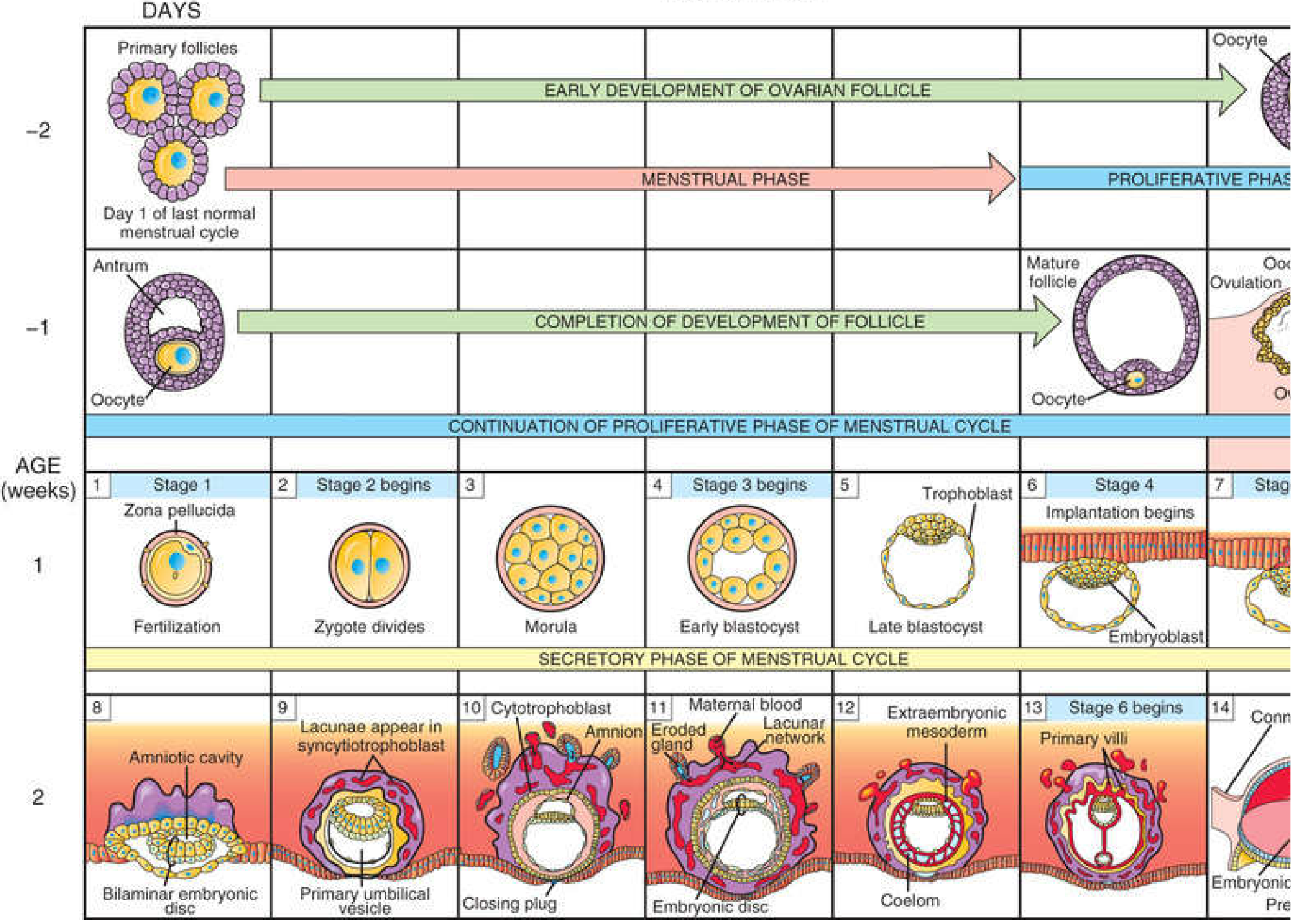
🔵 Week 1 — Fertilization, Cleavage & Blastocyst Formation
Days 1–7 | Carnegie Stages 1–4
| Event | Day(s) |
|---|---|
| Fertilization — zygote formed (Stage 1) | Day 0–1 |
| Cleavage — zygote undergoes mitotic divisions | Days 2–3 |
| Morula — 16-cell solid ball enters uterus (Stage 3) | Day 3–4 |
| Early blastocyst forms (Stage 4) | Day 4–5 |
| Late blastocyst — zona pellucida shed | Day 5–6 |
| Implantation begins (Stage 4–5) | Day 6–7 |
Key points:
- The zygote undergoes cleavage while traveling down the uterine tube
- The blastocyst consists of the embryoblast (inner cell mass → embryo) and trophoblast (outer layer → placenta)
- Implantation occurs in the posterior wall of the uterine body
🔵 Week 2 — Bilaminar Disc & Implantation Completion
Days 8–14 | Carnegie Stages 5–6
| Event | Day(s) |
|---|---|
| Amniotic cavity forms; bilaminar embryonic disc (epiblast + hypoblast) | Day 8 |
| Lacunae appear in syncytiotrophoblast; maternal blood enters | Day 9–10 |
| Cytotrophoblast and closing plug visible | Day 10 |
| Extraembryonic mesoderm forms; primary umbilical vesicle (yolk sac) | Day 11–12 |
| Extraembryonic coelom (chorionic cavity) develops | Day 12 |
| Primary chorionic villi begin forming (Stage 6) | Day 13 |
| Implantation fully complete | Day 14 |
Key points:
- "Week of twos": 2 germ layers (epiblast/hypoblast), 2 cavities (amniotic + yolk sac), 2 trophoblast layers (cyto + syncytio)
- hCG is now detectable — basis of pregnancy tests
- The prochordal plate appears at the cranial end of the embryonic disc
🔵 Week 3 — Trilaminar Disc & Gastrulation
Days 15–21 | Carnegie Stages 7–9
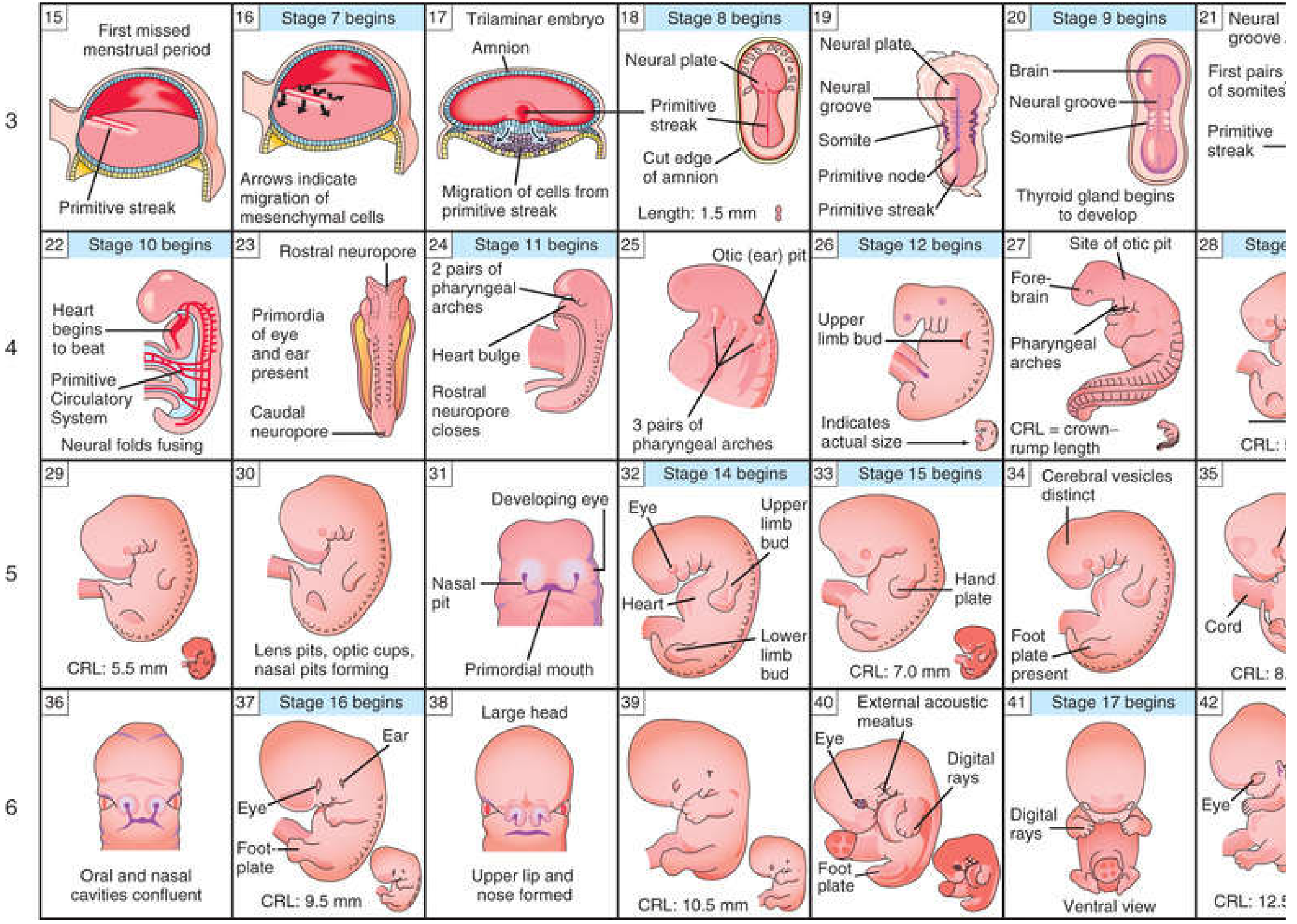
This is the week of the first missed menstrual period. Rapid morphogenesis is initiated.
| Event |
|---|
| Primitive streak appears on dorsal surface of epiblast → establishes craniocaudal axis |
| Gastrulation — epiblast cells migrate through primitive streak to form 3 germ layers: ectoderm, mesoderm, endoderm |
| Notochord develops from notochordal process → induces overlying ectoderm |
| Neurulation begins — neural plate forms |
| Neural folds and neural groove appear |
| Somites begin to develop (1st pair ~day 20) |
| Primitive cardiovascular system begins: heart tubes form; intraembryonic coelom appears |
| Secondary (definitive) yolk sac forms; allantois appears |
| Thyroid gland begins to develop (Stage 9) |
🔵 Week 4 — Embryo Folds; Organ Primordia Established
Days 22–28 | Carnegie Stages 10–13
| Event |
|---|
| Embryo folds (cranial, caudal, and lateral folds) — flat trilaminar disc becomes a cylindrical embryo |
| Heart begins to beat (~day 22–23, Stage 10) — primitive circulatory system functional |
| Neural tube closes: rostral (anterior) neuropore closes ~day 25; caudal neuropore ~day 27 |
| Pharyngeal (branchial) arches 1–2 appear |
| Otic pits (future ears) form |
| Optic vesicles (future eyes) appear |
| Upper limb buds appear by end of week |
| 3–4 pairs of somites → 28–30 somites by end of week |
| Gut tube differentiates: foregut, midgut, hindgut |
| CRL (crown-rump length): ~4–5 mm |
🔵 Week 5 — Rapid Brain Growth; Limb Development
Days 29–35 | Carnegie Stages 13–15
| Event |
|---|
| Brain grows rapidly — large head (>50% of total embryo length) |
| Upper limb buds elongate; lower limb buds appear |
| Lens placodes and optic cups form |
| Nasal pits begin forming |
| Primordial mouth visible |
| Hand plate (paddle-shaped) at end of week |
| Heart continues complex partitioning |
| CRL: ~5.5–7.0 mm |
🔵 Week 6 — Face & Limbs Develop Further
Days 36–42 | Carnegie Stages 16–17
| Event |
|---|
| Upper lip and nose formed |
| Oral and nasal cavities become confluent then re-separated |
| Retina pigmentation begins (eye visible) |
| Foot plate present; digital rays begin in hands |
| External acoustic meatus forms |
| Auricular hillocks forming (future auricle of ear) |
| CRL: ~9.5–12.5 mm |
🔵 Week 7 — Limbs Differentiate; Eyelids Begin
Days 43–49 | Carnegie Stages 18–19
| Event |
|---|
| Eyelids forming |
| Fingers indicated by grooves between digital rays |
| Head large but chin still poorly formed |
| Wrist and fingers fused with webbing |
| External ear developing further |
| Physiological umbilical herniation of gut into cord |
| CRL: ~13–16 mm |
🔵 Week 8 — End of Embryonic Period; Human Appearance Established
Days 50–56 | Carnegie Stages 20–23
| Event |
|---|
| Upper limbs longer and bent at elbows |
| Fingers distinct but webbed; toes forming |
| External genitalia beginning to differentiate (cannot yet distinguish sex) |
| Urogenital membrane, anal membrane visible |
| Large forehead; facial features more developed |
| Eye, ear, nose, wrist, knee, elbow, toes all visible externally |
| All major organ systems established |
| CRL: ~28–30 mm |
Summary Table: Weeks 1–8
| Week | Key Theme | Major Events |
|---|---|---|
| 1 | Fertilization & Cleavage | Zygote → morula → blastocyst; implantation begins |
| 2 | Bilaminar disc | Epiblast + hypoblast; amniotic cavity; yolk sac; chorionic villi start |
| 3 | Trilaminar disc | Gastrulation; primitive streak; notochord; neural plate; somites begin; heart tubes |
| 4 | Folding | Embryo folds; heart beats; neural tube closes; pharyngeal arches; optic/otic pits |
| 5 | Brain & limbs | Rapid brain growth; limb buds; lens & nasal placodes; hand plate |
| 6 | Face | Upper lip & nose formed; foot plate; digital rays; ear hillocks |
| 7 | Digits | Eyelids form; fingers visible; physiological gut herniation |
| 8 | End of embryonic period | All organ systems established; human appearance; genitalia differentiating |
Clinical Note
The embryonic period (weeks 3–8) is the most critical window for teratogen exposure. Agents such as drugs, viruses, and radiation during this time can cause major structural birth defects because all organ systems are actively differentiating. After week 8, the fetal period begins, characterized by growth and maturation rather than organ formation.
— The Developing Human: Clinically Oriented Embryology (Moore et al.)
This is a shared conversation. Sign in to Orris to start your own chat.