
Decrease liquor in obg means
Reading File
Decrease in liquor (amniotic fluid) in OBG = Oligohydramnios. It means the amniotic fluid volume is less than normal for gestational age (AFI < 5 cm or MVP < 2 cm on ultrasound).
Searching sources...
Finding Sources
Finding Sources
Reading File
Reading File
Loading Image
Finding Sources
Here is a complete explanation of Decrease in Liquor (Oligohydramnios) in Obstetrics & Gynecology:
Oligohydramnios - Decrease in Amniotic Fluid
Definition: A low volume of amniotic fluid for a given gestational age.
- AFI (Amniotic Fluid Index) < 5 cm = Significant oligohydramnios
- Normal AFI range: 8-24 cm (from 16 weeks onward)
- Alternatively diagnosed by MVP (Maximum Vertical Pocket) < 2 cm
Causes
Amniotic fluid is mainly produced by fetal urine. So any decrease in fetal urine output or fluid loss leads to oligohydramnios:
Fetal Causes (Decreased Production)
- Renal agenesis (Potter sequence) - no kidneys = no urine = severe oligohydramnios
- Obstructive uropathy (posterior urethral valves, ureterocele) - urine can't pass out
- Multicystic/dysplastic kidneys
- Intrauterine Growth Restriction (IUGR) - ~83% of oligohydramnios cases (excluding PROM) have IUGR
Maternal/Placental Causes
- Placental insufficiency (uteroplacental insufficiency) - reduced blood flow to fetus
- Post-term pregnancy (>42 weeks) - placenta ages, perfusion drops
Fluid Loss
- PROM (Premature Rupture of Membranes) - most common cause overall (~10% of pregnancies)
- Amniotic leak
Drugs
- ACE inhibitors / NSAIDs - can reduce fetal renal perfusion
Pathogenesis Diagram (from Robbins Pathology)
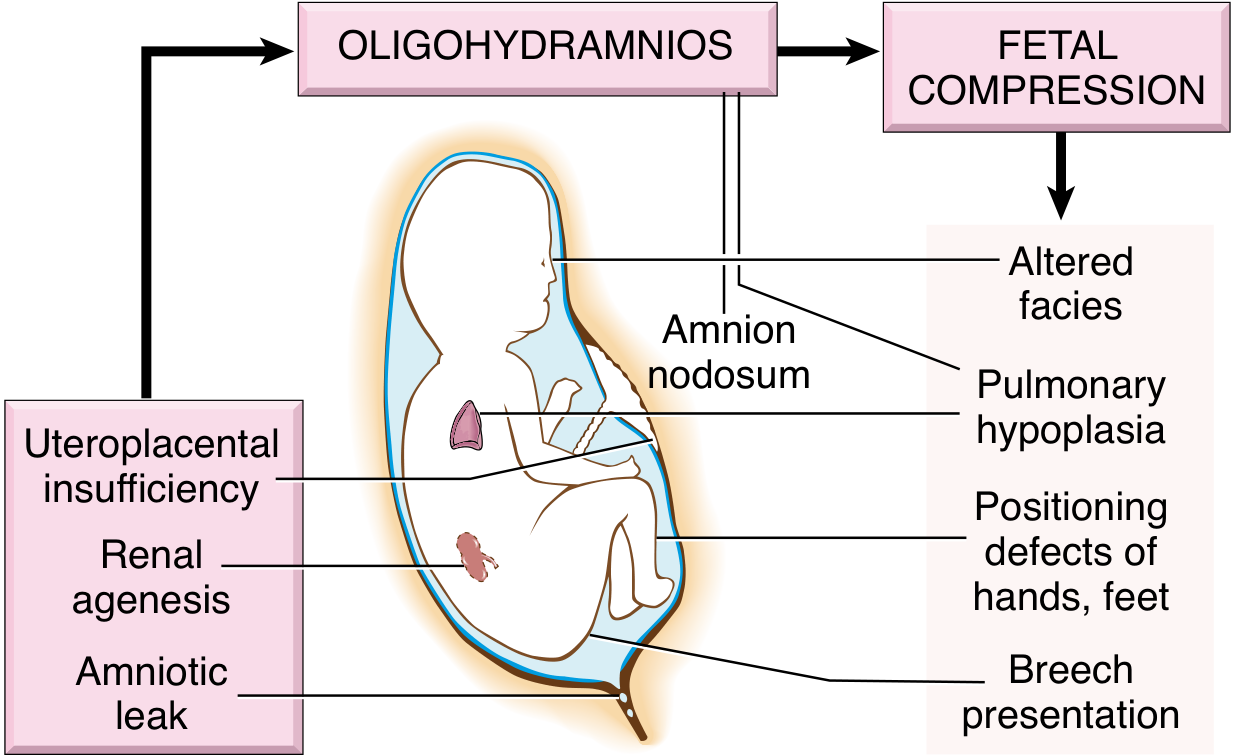
Complications (from Fetal Compression)
| Complication | Mechanism |
|---|---|
| Pulmonary hypoplasia | Restricted fetal breathing movements, especially if severe in 16-24 weeks (canalicular phase) |
| Potter facies (altered facies) | Fetal compression by uterine wall |
| Positioning defects of hands/feet (clubfoot) | Fetal compression |
| Breech presentation | Restricted space |
| Amnion nodosum | Squamous cell nodules on amnion surface |
| Umbilical cord compression | Less cushioning fluid |
| Pulmonary hypoplasia can be lethal if severe and early onset |
Potter Sequence = renal agenesis → severe oligohydramnios → fetal compression → pulmonary hypoplasia + Potter facies + limb defects (lethal)
Intrapartum Complications
- Fetal heart rate abnormalities
- Depressed Apgar scores
- Meconium passage
Diagnosis
- Ultrasound - method of choice
- AFI measurement (four-quadrant technique)
- MVP (single deepest pocket)
- Estimate fetal weight whenever oligohydramnios is found
- Detailed anomaly scan to find cause
Management
- At term: Oligohydramnios is generally an indication for delivery
- Preterm: Depends on cause and severity - serial monitoring, treat underlying cause
- Amnioinfusion (during labor) - saline infused into amniotic cavity to reduce cord compression and meconium aspiration
- Treat IUGR, maternal hydration may help in some cases
- Counsel for renal anomalies (urology/nephrology consult)
Key point for exams: The most common cause overall is PROM. Excluding PROM, the most common association is IUGR (83% of oligohydramnios cases have IUGR). Fetal renal causes are the classic causes taught in basic science.
- Pfenninger and Fowler's Procedures for Primary Care, p. 5329-5341
- The Developing Human - Clinically Oriented Embryology, p. 4376-4386
- Robbins, Cotran & Kumar Pathologic Basis of Disease, Fig. 10.3
This is a shared conversation. Sign in to Orris to start your own chat.