
Want to know about cellulitis
Reading File
Finding Sources
Searching PubMed
cellulitis diagnosis treatment
Good results. Now let me read the most comprehensive sections in parallel - Andrews' Dermatology, Goldman-Cecil Medicine, and Rosen's Emergency Medicine.
Reading File
Reading File
Reading File
Now let me also read the detailed management chapter from Rosen's and the Family Medicine section for more complete clinical coverage.
Reading File
Reading File
Now let me fetch the clinical image and get the antibiotic table from Rosen's for completeness.
Loading Image
Reading File
I now have comprehensive information to write a thorough answer. Here's everything you need to know about cellulitis:
Cellulitis
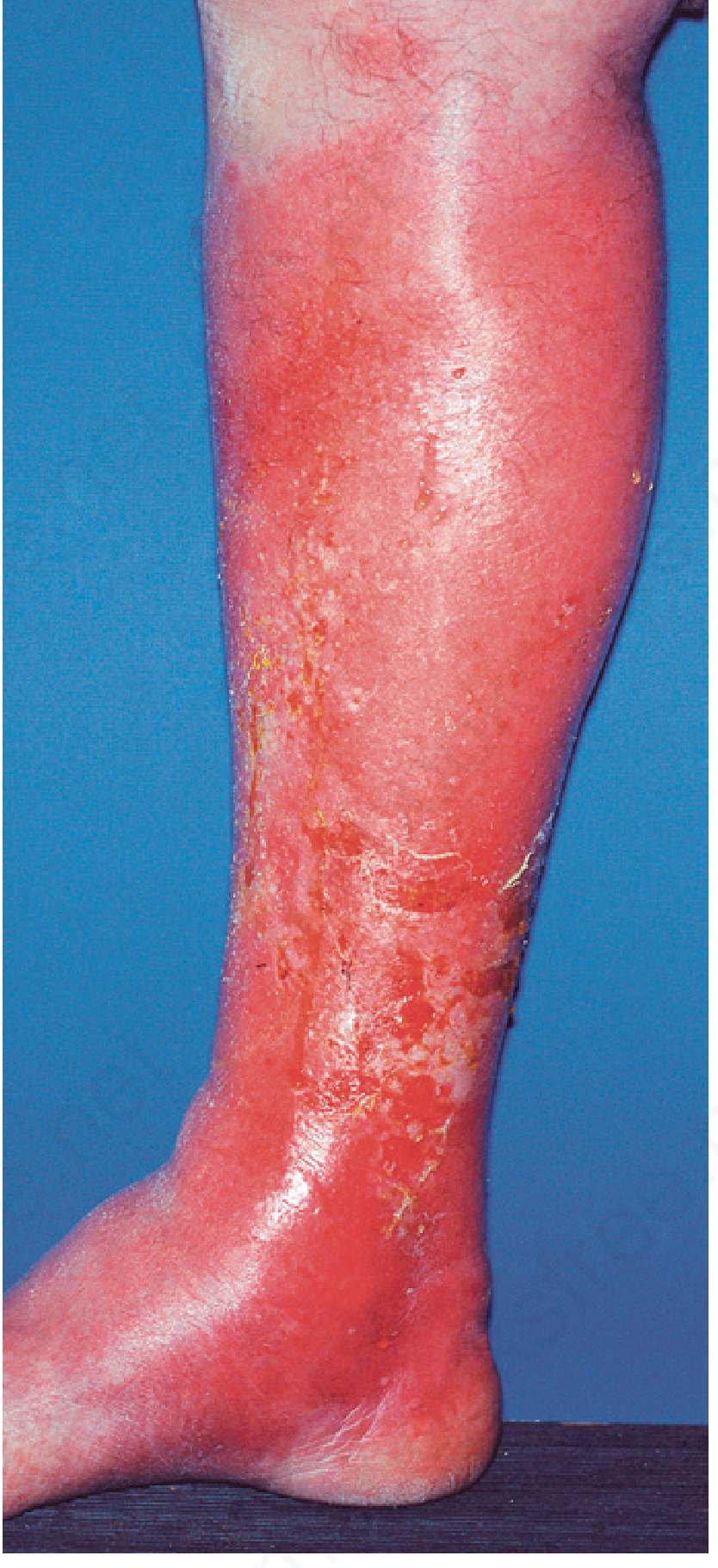
Definition
Cellulitis is an acute bacterial infection of the skin and subcutaneous tissue, typically developing after a break in the skin. It involves suppurative inflammation of the dermis and subcutaneous layers.
Causes (Microbiology)
- Streptococci (mainly Group A - S. pyogenes) account for ~75% of cases and typically cause nonpurulent cellulitis
- Staphylococcus aureus (including CA-MRSA) causes most purulent cellulitis
- Other less common causes: Vibrio vulnificus, Pseudomonas spp., Pasteurella multocida (bite wounds), Haemophilus influenzae
- CA-MRSA is the leading cause of purulent skin and soft tissue infections in emergency department patients
Risk Factors / Predisposing Conditions
- Break in the skin (wounds, abrasions, tinea pedis - a very common portal of entry on the leg)
- Venous insufficiency or stasis
- Lymphedema / impaired lymphatic drainage
- Obesity
- Diabetes mellitus
- Immunocompromised state (HIV, steroids, malignancy)
- Prior saphenous phlebectomy, lymphadenectomy, or radiation
- Alcoholism
Clinical Features
Local signs:
- Erythema, warmth, swelling, tenderness - the cardinal features
- The erythema rapidly spreads and intensifies
- Borders are poorly defined and irregular (key distinguishing point from erysipelas)
- The affected area may pit on pressure
- Vesicles or bullae can form when edema separates epidermal layers
Systemic signs:
- Fever and chills (common but not required for diagnosis)
- Malaise
- Lymphangitis - streaks extending proximally from the area along vascular tracts, especially in streptococcal cases
- Regional lymphadenopathy
Complications (especially in immunocompromised patients and children):
- Necrotizing fasciitis
- Metastatic abscesses
- Gangrene
- Sepsis / septic shock (cellulitis can be a cause of sepsis)
Erysipelas vs. Cellulitis
| Feature | Erysipelas | Cellulitis |
|---|---|---|
| Depth | Superficial skin + upper subcutaneous | Deeper subcutaneous tissue |
| Border | Well-demarcated, raised, palpable | Poorly defined, irregular |
| Cause | Usually S. pyogenes | Strep or Staph |
| Appearance | Bright red, shiny | Erythematous, may be dusky |
Diagnosis
Diagnosis is clinical - based on history and physical exam findings. Investigations are typically not needed for uncomplicated cases.
- Blood cultures: Not indicated for uncomplicated cellulitis; recommended for immunocompromised patients, suspected sepsis, or systemic illness
- Wound cultures: Needle aspiration, swabs, and skin biopsy are low-yield for nonpurulent cellulitis and are not recommended routinely; considered in purulent cases, immunocompromised patients, bite wounds, or immersion injuries
- Ultrasound: Useful to differentiate cellulitis (cobblestoning/reticular hypoechoic stranding) from abscess (fluid-filled cavity)
- Plain X-ray / CT: Used if foreign body, osteomyelitis, or necrotizing infection is suspected; CT with contrast is helpful when deeper infection is a concern
- MRI: Higher sensitivity than plain films for detecting underlying osteomyelitis
Differential Diagnosis
These conditions can mimic cellulitis ("pseudocellulitis"):
- Stasis dermatitis - no fever, no pain, may be bilateral, typically over medial malleoli
- Allergic contact dermatitis - itchy, not painful
- Eosinophilic cellulitis (Wells syndrome) - insect bite reaction, less pain, eosinophilia instead of neutrophilia
- Erythema migrans (Lyme disease) - red patch, typically less painful, circular border
- Deep vein thrombosis - swelling and redness without fever
Management
Severity-Based Approach
| Severity | Setting | Treatment |
|---|---|---|
| Mild (no systemic toxicity) | Outpatient | Oral antibiotics |
| Moderate | Hospital IV | Penicillin, ceftriaxone, cefazolin, or clindamycin |
| Severe (sepsis/shock) | ICU/Hospital | IV vancomycin + piperacillin/tazobactam |
Antibiotic Selection
Nonpurulent cellulitis (Strep predominant):
- First line: Cephalexin 500 mg QID x 5 days or equivalent (dicloxacillin, penicillin VK)
- Adding CA-MRSA coverage for uncomplicated nonpurulent cellulitis has shown no reduction in treatment failure and is not recommended
Purulent cellulitis (Staph / MRSA suspected):
- First line: TMP-SMX (highly effective against CA-MRSA) or clindamycin
- If MRSA risk factors present: include TMP-SMX or clindamycin
Parenteral MRSA coverage:
- Vancomycin is the recommended IV agent for MRSA
Novel agents (FDA-approved for skin/soft tissue infections):
- Oritavancin and dalbavancin - long-acting, single-dose or short-course parenteral options
Supportive Measures
- Elevation of the affected limb improves resolution of swelling
- Mark the borders of erythema with a pen to monitor spread or regression
Recurrent Cellulitis
Predisposing factors include tinea pedis, lymphedema, venous stasis, diabetes, immunodeficiency, and prior surgery in the area. Repeated episodes cause progressive lymphatic obstruction, ultimately leading to chronic lymphedema and fibrosis ("elephantiasis nostras").
- During active episodes: high-dose antibiotics
- Prophylaxis: low-dose penicillin or erythromycin for maintenance in recurrent cases
- Compression therapy helps reduce lymphedema and prevent recurrence
Recent Evidence
A 2024 network meta-analysis (PMID 39240378) evaluated first- and second-line antibiotics for cellulitis and erysipelas across randomized controlled trials, providing updated comparative efficacy data on antibiotic regimens - consistent with the beta-lactam first-line approach outlined above.
Sources: Andrews' Diseases of the Skin (Clinical Dermatology), Goldman-Cecil Medicine, Rosen's Emergency Medicine, Textbook of Family Medicine 9e
This is a shared conversation. Sign in to Orris to start your own chat.