
analyse_media
Here is the transcribed text from the notebook:
Left side:
To I & D done for (L) canal lymphadenitis
Right side:
- Dental op for Dental Car.
Decoded:
- I & D = Incision and Drainage (a surgical procedure to drain an abscess or infected fluid)
- (L) = Left
- Canal lymphadenitis = Inflammation/infection of the lymph nodes in the (left) canal region
- Dental op = Dental operation/procedure
- Dental Car. = Dental Caries (tooth decay)
The context (SRM Pharmacy form in the background) suggests this is a clinical/medical note from a hospital or dental setting, recording that an I&D procedure was done for left canal lymphadenitis, and a dental operation was planned/done for dental caries.
Undescended testis with
Reading File
Your query seems incomplete - "Undescended testis with..." What would you like to know? Let me know how you'd like to finish the question, for example:
- ...associated complications (malignancy, infertility, torsion)
- ...management/orchidopexy
- ...differential diagnosis
- ...pathology/histology
- ...a specific clinical scenario
Feel free to complete the question and I'll pull from authoritative medical textbooks for a thorough answer!
I want a type of undescended testis
The types of undescended testis (cryptorchidism) are based on the position/location of the testis. Let me pull the detailed classification from the medical textbooks.
Finding Sources
Finding Sources
Reading File
Reading File
Reading File
Now let me also fetch the diagram of ectopic testis sites for visual clarity:
Loading Image
Loading Image
Here is a complete classification of undescended testis (cryptorchidism):
Types of Undescended Testis
Broadly, the testis absent from the scrotum is classified into 3 main types:
1. True Undescended Testis (Incomplete Descent / Cryptorchidism)
The testis is arrested at any point along its normal path of descent - from the retroperitoneum down to the scrotum. Positions (in order from highest to lowest):
| Position | Location |
|---|---|
| Abdominal | Within the abdominal cavity (near kidney) |
| At internal ring | At the internal inguinal ring |
| Inguinal canal | Inside the inguinal canal (most common palpable site) |
| At external ring | At the external inguinal ring |
| High scrotal | Upper part of the scrotum but not fully descended |
The undescended testis is always smaller and less developed than its fellow in the scrotum. It may be associated with an inguinal hernia.
2. Ectopic Testis
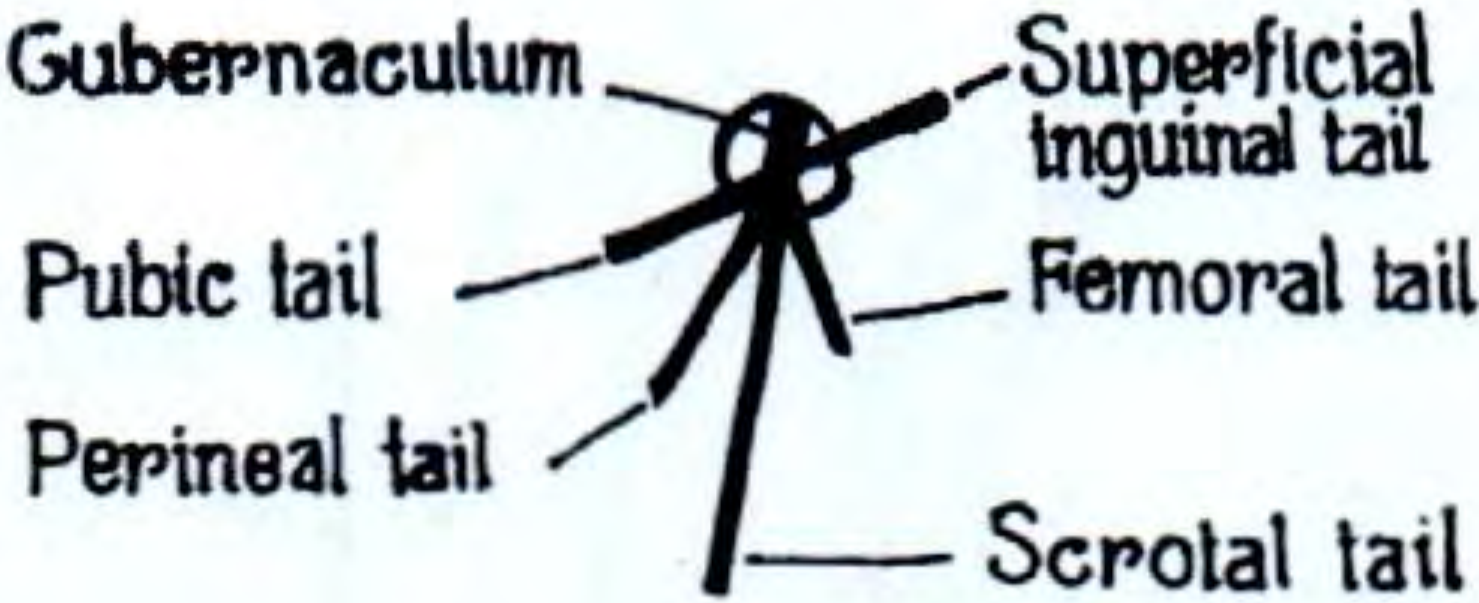
The testis has deviated from its normal path of descent after passing through the external ring. This occurs when one of the accessory tails of the gubernaculum becomes stronger than the scrotal tail, pulling the testis to an abnormal site.
Sites of ectopic testis (based on Lockwood's 5 tails of the gubernaculum):
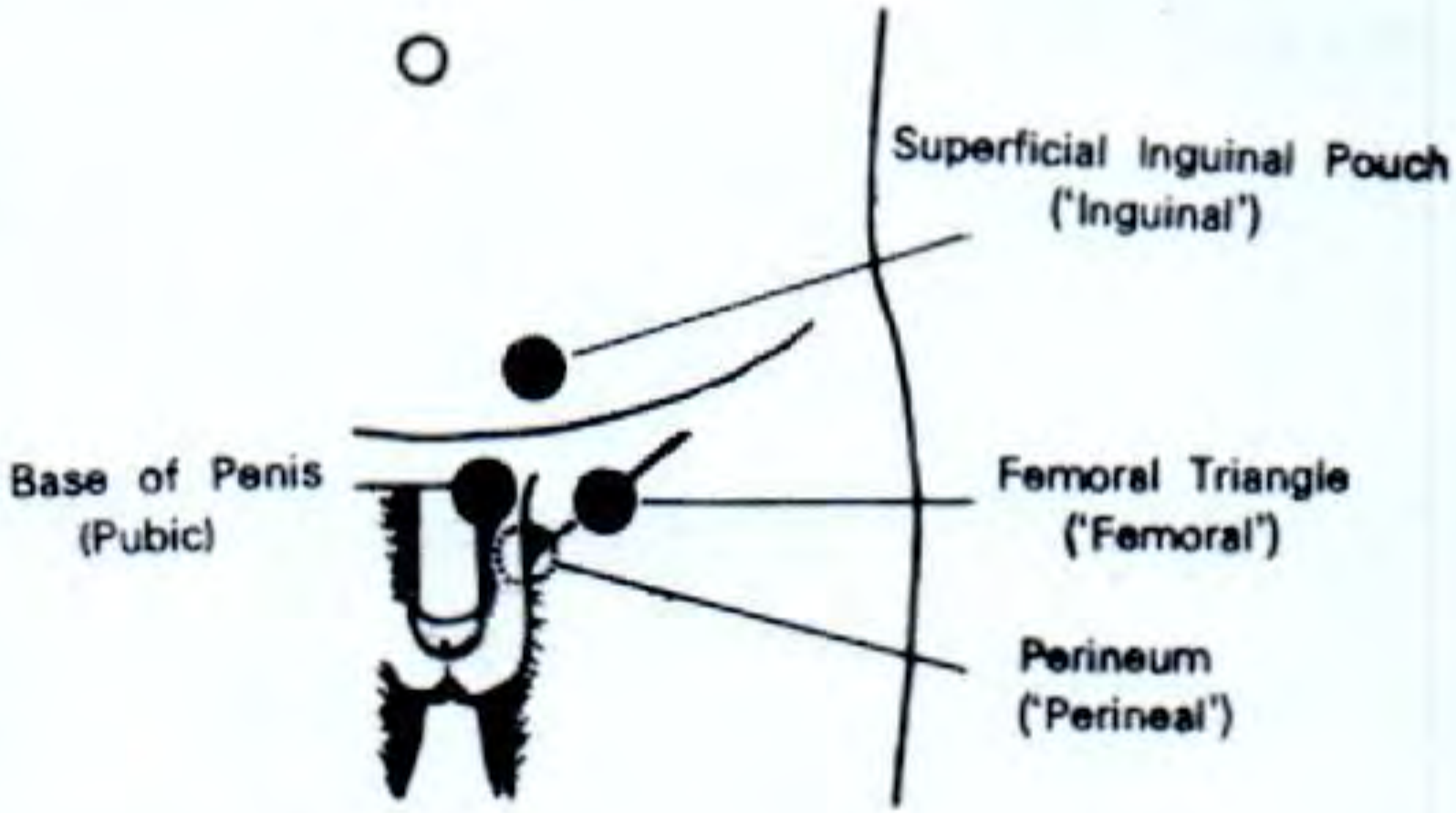
| Tail | Site |
|---|---|
| Scrotal (normal) | Scrotum - normal descent |
| Superficial inguinal | Superficial inguinal pouch - MOST COMMON ectopic site |
| Pubic | Root of the penis (pubic type) |
| Femoral | Upper & medial femoral triangle (rare) |
| Perineal | Perineum |
An ectopic testis is usually well-developed, unlike a true undescended testis.
Five tails of gubernaculum testis (Lockwood):
3. Retractile Testis
- Not a true undescended testis - caused by strong cremasteric muscle contraction pulling the testis up from the scrotum into the superficial inguinal pouch.
- The testis is well-developed, the scrotum is normally developed, and crucially, the testis can be manually milked down to the bottom of the scrotum.
- Diagnosed using the "Chair test" (Orr's test): the child sits with knees flexed tightly to the chest - this increases intra-abdominal pressure and brings the retractile testis down into the scrotum.
- Requires yearly follow-up as 2-50% risk of becoming an acquired undescended testis.
Key Distinguishing Points
| Feature | True Undescended | Ectopic | Retractile |
|---|---|---|---|
| Path | Along normal route, arrested | Deviated from normal path | Normal but pulled back up |
| Testis size | Small, underdeveloped | Well-developed | Well-developed |
| Scrotum | Underdeveloped | Empty on that side | Normal |
| Can be brought down manually? | No | No | Yes |
Source: S Das - A Manual on Clinical Surgery, 13th Edition; Bailey and Love's Short Practice of Surgery, 28th Edition.
This is a shared conversation. Sign in to Orris to start your own chat.