
Leopold’s Manuer
Reading File
Finding Sources
Finding Sources
Searching PubMed
"Leopold Maneuvers"
Searching the Web
Leopold maneuvers four steps fetal lie presentation official obstetrics
Reading File
Searching Images
Leopold's maneuvers diagram four abdominal palpation maneuvers fetal position
Reading Web Page
https://www.ncbi.nlm.nih.gov/books/NBK560814
Leopold’s maneuvers
A four-step abdominal palpation examination used in late pregnancy, usually from about 30 weeks onward, to determine:
- Fetal lie: longitudinal, transverse, or oblique
- Fetal presentation: cephalic, breech, or shoulder
- Location of the fetal back
- Descent or engagement of the presenting part
- With the fourth maneuver, fetal head flexion
Preparation
- Explain the examination and obtain consent.
- Ask the woman to empty her bladder.
- Position supine with knees slightly flexed and a small lateral tilt, especially in advanced pregnancy, to avoid supine hypotension.
- Warm hands and palpate gently, preferably between contractions.
The four maneuvers
| Maneuver | How it is done | What it determines |
|---|---|---|
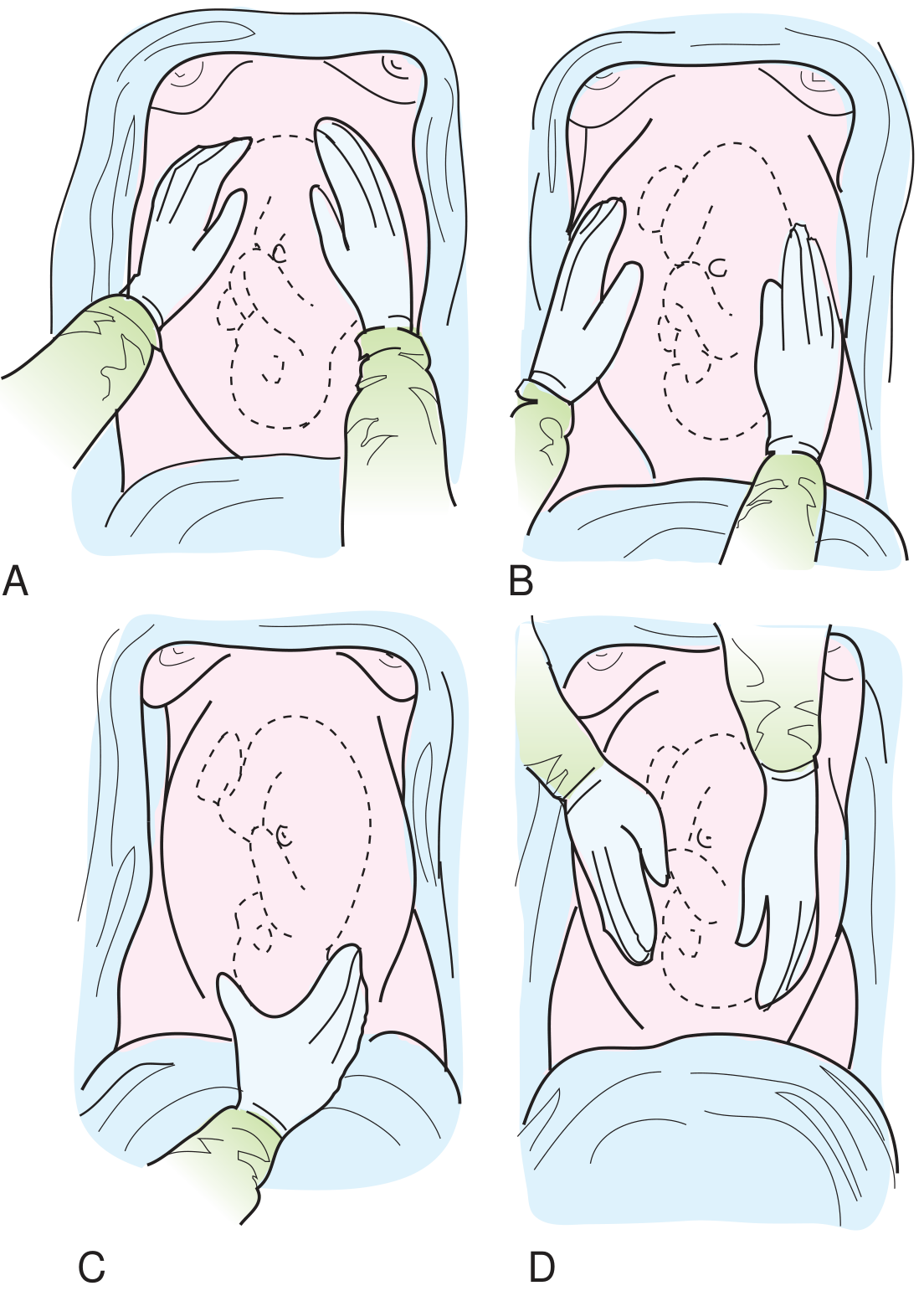
| 1. Fundal grip | Palpate the uterine fundus with both hands. | Which fetal pole lies in the fundus. A hard, round, ballotable mass suggests the head; a softer, broader, irregular mass suggests the breech. |
| 2. Lateral or umbilical grip | Place both hands on the sides of the uterus and palpate alternately. | Location of the back and small parts. The back feels smooth, firm, and continuous; limbs feel irregular, mobile, and nodular. |
| 3. Pawlik’s grip / first pelvic grip | With thumb and fingers just above the symphysis pubis, grasp the lower uterine pole. | Identifies the presenting part and whether it is mobile or entering the pelvic inlet. A freely movable head is not engaged. |
| 4. Second pelvic grip | Face the woman’s feet. Place both hands on either side of the lower uterus and move fingers toward the pelvic inlet. | Assesses descent and, in cephalic presentation, head flexion. The cephalic prominence is easier to feel on the side of the fetal limbs when the head is flexed. |
Typical interpretation
- Cephalic/vertex presentation: head in the lower uterus, breech in the fundus.
- Breech presentation: hard head felt in the fundus, softer breech over the pelvis.
- Transverse lie: head on one maternal side and breech on the other, with no presenting part clearly occupying the pelvis.
Fetal heart sounds are generally best heard over the fetal back, which can support the conclusion about fetal position. Textbook of Family Medicine 9e, p. 481.
Limitations
Accuracy can be reduced by maternal obesity, polyhydramnios or oligohydramnios, multiple gestation, abdominal tenderness, uterine fibroids, or an uncooperative/tensed abdominal wall. If lie or presentation is uncertain, or abnormality is suspected, confirm with ultrasound, which remains the reference method for fetal presentation. The NCBI clinical review also emphasizes ultrasound confirmation when clinical findings are uncertain.
Signs of pregnancy
Reading File
Finding Sources
Finding Sources
Searching PubMed
pregnancy diagnosis signs
Searching the Web
pregnancy signs presumptive probable positive diagnosis official clinical guideline
Reading File
Reading File
Reading File
Reading Web Page
https://www.ncbi.nlm.nih.gov/books/NBK615334/table/ch9.tab4
Signs of pregnancy
They are classically divided into presumptive, probable, and positive (diagnostic) signs.
| Category | Meaning | Examples |
|---|---|---|
| Presumptive signs | Felt or reported by the woman. They suggest pregnancy but can have other causes. | Amenorrhea, nausea and vomiting, fatigue, urinary frequency, breast tenderness/enlargement, skin pigmentation, and quickening. |
| Probable signs | Objective findings observed by an examiner, but not diagnostic by themselves. | Positive urine/serum hCG test, uterine enlargement, Chadwick sign, Goodell sign, Hegar sign, Braxton Hicks contractions, and ballottement. |
| Positive signs | Direct evidence of a fetus. These establish pregnancy. | Fetal cardiac activity heard by the examiner, fetal movements palpated by the examiner, and ultrasound visualization of an embryo or fetus. |
1. Presumptive signs
- Amenorrhea: missed menstrual period, often the earliest symptom.
- Morning sickness: nausea and vomiting, commonly in early pregnancy.
- Breast changes: tenderness, enlargement, darker areolae, Montgomery tubercles, and sometimes colostrum.
- Frequency of micturition: early due to pressure on the bladder, and may recur near term.
- Fatigue
- Quickening: maternal perception of fetal movement, usually around 16-20 weeks.
- Skin changes: chloasma, linea nigra, and increased pigmentation.
2. Probable signs
- Positive pregnancy test: detects hCG. It strongly supports pregnancy but does not prove the pregnancy is intrauterine or viable.
- Chadwick sign: bluish-violet discoloration of vagina and cervix due to increased vascularity.
- Goodell sign: softening of the cervix, usually from the second month.
- Hegar sign: softening and compressibility of the uterine isthmus, around the sixth week.
- Uterine and abdominal enlargement
- Braxton Hicks contractions: irregular, painless uterine contractions.
- Ballottement: rebound of the fetus when the lower uterine segment is tapped, typically appreciable during the fourth and fifth months.
3. Positive signs
- Fetal heart sounds heard by the examiner, using Doppler or fetoscope.
- Fetal movements palpated by the examiner. Maternal sensation of movement alone is only presumptive.
- Ultrasound demonstration of an intrauterine embryo/fetus, particularly with cardiac activity.
The textbook classification and details of amenorrhea, breast changes, quickening, Chadwick sign, Hegar sign, Goodell sign, Braxton Hicks contractions, and ballottement are described in The Essentials of Forensic Medicine and Toxicology, 36th ed., p. 386. A concise NCBI signs-of-pregnancy table lists the same three categories.
If there is a missed period or a positive home test, confirmation and early antenatal assessment are advisable. Seek urgent care for positive test with severe one-sided abdominal pain, fainting, shoulder-tip pain, or heavy bleeding, because these can occur with ectopic pregnancy.
This is a shared conversation. Sign in to Orris to start your own chat.