
Layers of scalp
Reading File
Finding Sources
Searching Images
layers of scalp anatomy diagram
Finding Sources
Loading Image
Reading File
Reading File
Reading File
Loading Image
The five layers of the scalp are neatly remembered by the mnemonic SCALP:
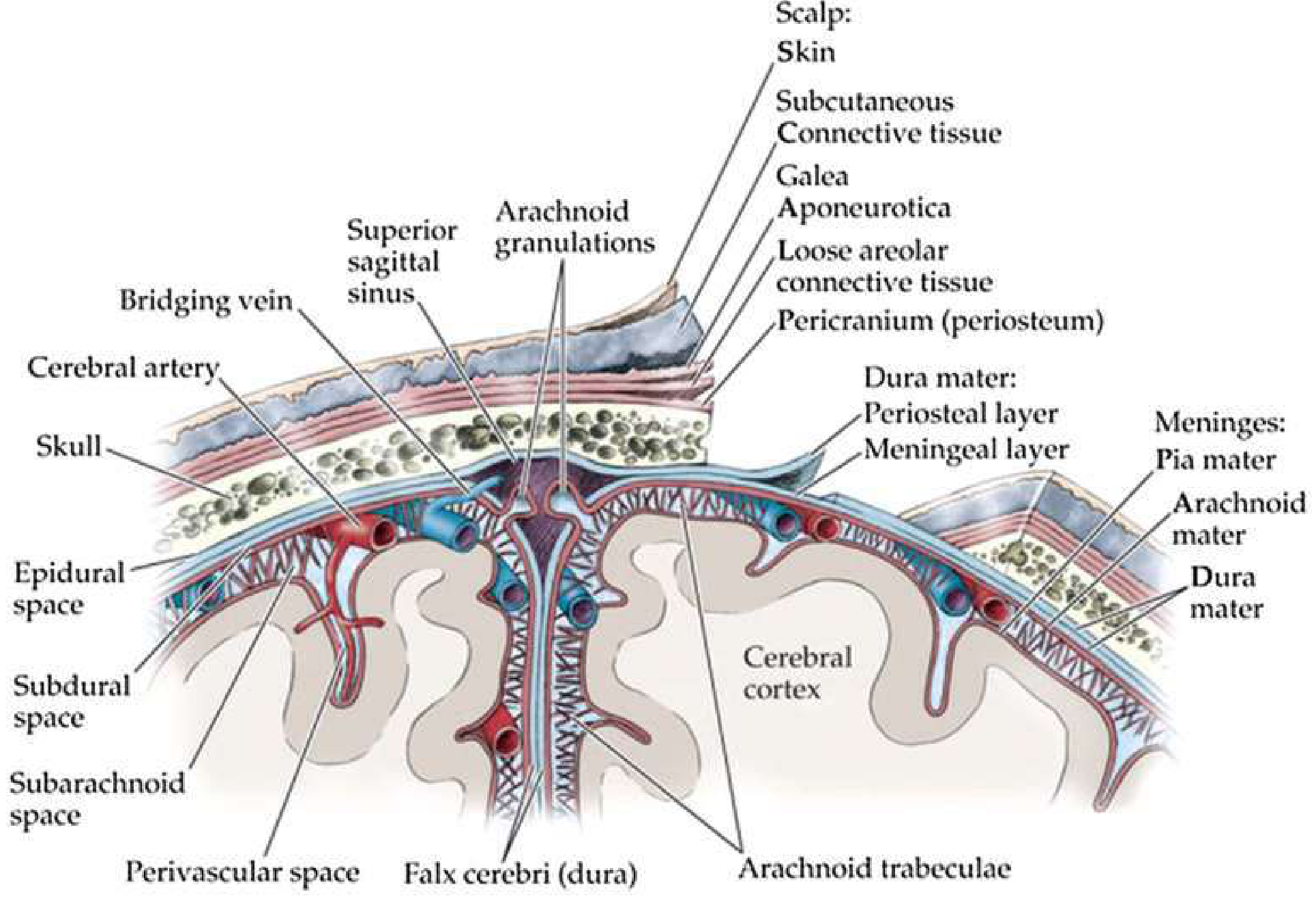
Layers of the Scalp (Superficial → Deep)
S — Skin
The outermost layer. It is thick (among the thickest skin on the body), hair-bearing, and richly supplied with sebaceous glands and hair follicles.
C — Connective Tissue (dense subcutaneous)
A layer of dense, fibrous, fatty tissue that firmly binds the skin to the galea below. It contains the main neurovascular structures of the scalp — arteries, veins, and nerves run within this layer. The fibrous septa in this layer are inelastic, which prevents cut blood vessels from retracting → explaining the profuse bleeding from even minor scalp lacerations.
A — Aponeurotic layer (Galea aponeurotica)
A tough, tendinous sheet that connects the frontalis muscle (anteriorly) and the occipitalis muscle (posteriorly), collectively forming the occipitofrontalis muscle. The temporoparietalis muscle also inserts here laterally. A wound that gapes open signifies laceration through the galea — clinically important, as galeal tears must be sutured separately.
The outer three layers (S, C, A) are firmly adherent to each other and move together as a single functional unit, called the scalp proper.
L — Loose areolar connective tissue (subaponeurotic / subgaleal layer)
A potential space of loose connective tissue that allows free movement of the scalp proper over the pericranium. This is:
- The layer where subgaleal hematomas (caput succedaneum, cephalhematoma-related spread) and scalp avulsions occur, as cleavage is easy here.
- Contains emissary veins that connect the scalp veins to the diploic veins of the skull and then to the dural venous sinuses → making this the "dangerous area" of the scalp, as infections here can spread intracranially, causing meningitis, osteomyelitis, or brain abscess.
P — Pericranium (periosteum)
The deepest layer — the periosteum of the calvaria. It is firmly adherent to the outer surface of the skull. It is thin and flimsy and cannot be sutured (often mistakenly identified as galea in a wound). It provides the osteogenic potential for skull healing.
Clinical Highlights
| Layer | Clinical Significance |
|---|---|
| Connective tissue (C) | Dense fibrous septa keep vessels open → profuse haemorrhage |
| Galea (A) | Laceration through it causes wound gaping; must be sutured |
| Loose areolar (L) | "Dangerous area" — emissary veins carry infection intracranially; site of subgaleal haematoma |
| Pericranium (P) | Osteogenic layer; cannot be sutured |
Sources: Gray's Anatomy for Students; Roberts and Hedges' Clinical Procedures in Emergency Medicine; Rosen's Emergency Medicine
This is a shared conversation. Sign in to Orris to start your own chat.