
Make a poster on ragi congi Added some point like ingredients making steps benefits what's give patient and not give patient cost vitamin minerals fat carbohydrates proteins this type add some information and make impressive posters for gating deep and correct information
ragi congee nutritional information vitamins minerals proteins benefits recipe
https://www.netmeds.com/c/health-library/post/ragi-nutrition…
A vibrant, professional medical nutrition poster titled "RAGI CONGEE — The Healing Superfood Porridge". The poster has a warm earthy color scheme (deep brown, golden yellow, forest green, cream white). It includes multiple organized sections with icons: 1) Ingredients section showing ragi flour, water/milk, jaggery/salt, cardamom, vegetables, ginger 2) Step-by-step preparation guide with numbered steps 3) Nutritional facts panel showing calories 320kcal per 100g, protein 7g, carbohydrates 67g, fiber 11g, calcium 364mg, iron 4.62mg, fat 1.5g 4) Key vitamins: B1 Thiamine, B2 Riboflavin, B3 Niacin, Folic Acid, Vitamin C, Vitamin E 5) Health benefits icons: bone health, diabetes control, weight loss, heart health, anemia prevention, digestion 6) "Who Should Eat" section (green checkmarks): diabetics, anemia patients, infants, elderly, pregnant women, athletes 7) "Who Should Avoid/Limit" section (red caution): kidney stone patients, people with high oxalate sensitivity 8) Cost section showing affordable price. The layout is clean and organized like a hospital nutrition education board with beautiful food photography style ragi bowl illustration at top center. Professional, modern, and informative design with clear typography.
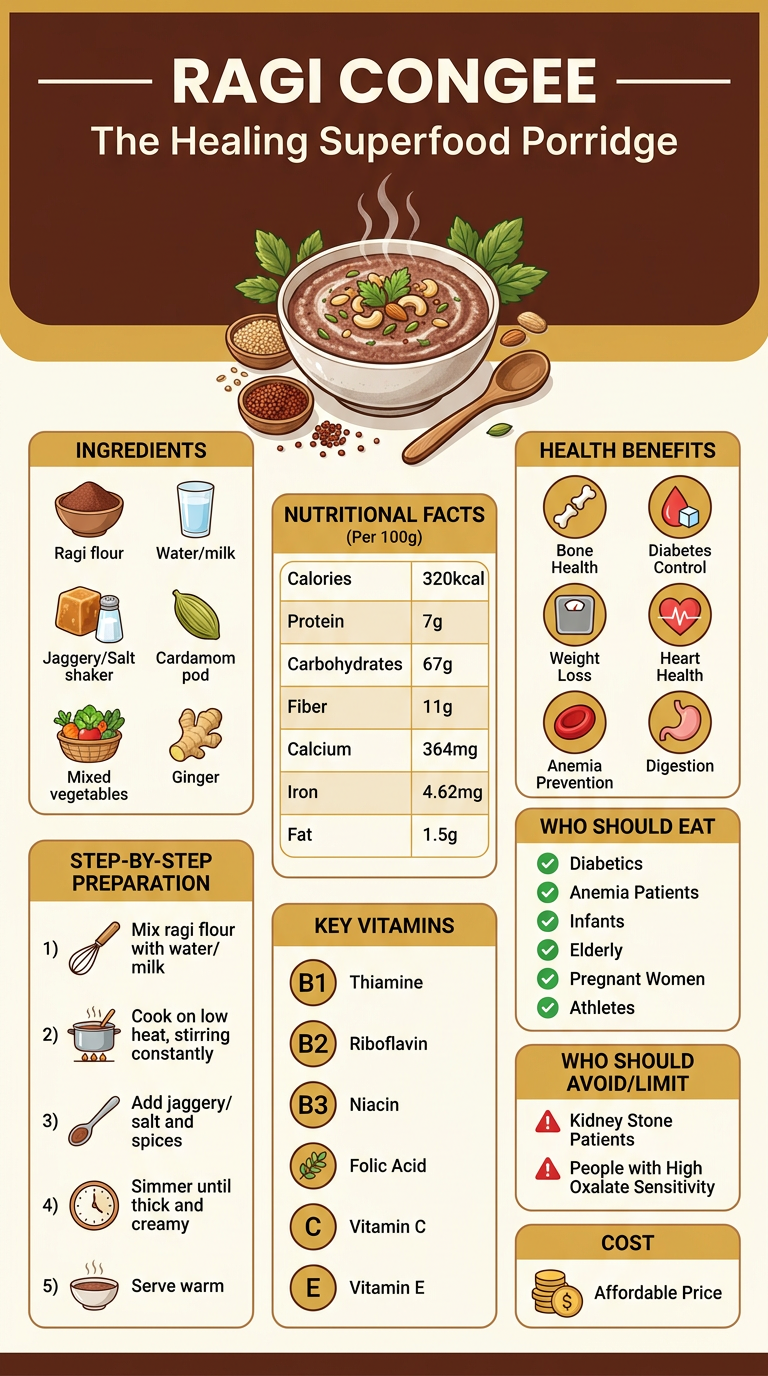
🌾 RAGI CONGEE — Complete Guide
📋 Ingredients
| Savory Version | Sweet Version |
|---|---|
| Ragi flour – 3 tbsp | Ragi flour – 3 tbsp |
| Water – 2 cups | Milk/water – 2 cups |
| Salt to taste | Jaggery – 1 tsp |
| Ginger (grated) – ½ tsp | Cardamom – a pinch |
| Vegetables (optional) | Banana (optional) |
👩🍳 Making Steps
- Dry roast ragi flour on low flame for 2–3 mins until aromatic
- Mix flour in ½ cup cold water — stir well to avoid lumps
- Boil remaining water/milk in a pan
- Pour the ragi mix slowly into boiling liquid, stirring continuously
- Cook on low flame 5–7 mins until thick and smooth
- Add salt/jaggery and flavoring; stir well
- Serve warm
💊 Nutritional Profile (per 100g Ragi)
| Nutrient | Amount |
|---|---|
| Energy | 320–385 kcal |
| Protein | 7 g |
| Carbohydrates | 67 g |
| Dietary Fiber | 11 g |
| Fat | 1.5 g (unsaturated, zero cholesterol) |
| Calcium | 364 mg (26% DV) |
| Iron | 4.62 mg (11% DV) |
| Potassium | 27% DV |
Vitamins
- Thiamine (B1) – 5% | Riboflavin (B2) – 7.6%
- Niacin (B3) – 3.7% | Folic Acid – 3%
- Vitamin C – 7% | Vitamin E – 4.6%
✅ Give To (Indicated Patients)
- Diabetic patients – low glycemic index controls blood sugar
- Anemia patients – rich in iron, boosts red blood cell production
- Infants & children – supports bone growth, muscle development
- Pregnant women – folic acid, calcium, and iron support
- Elderly patients – easy to digest, supports bone density
- Post-surgery / recovery – light on stomach, high nutrition
- Underweight / malnourished – calorie-dense and nutrient-rich
- Cardiac patients – zero cholesterol, lowers LDL
- Hypertension – negligible sodium content
❌ Limit / Avoid (Contraindicated)
- Kidney stone patients – high oxalate content, may worsen stones
- Renal failure patients – excess potassium/phosphorus load
- Hypothyroid patients – millets can inhibit thyroid function if consumed in excess
💰 Cost
- Ragi flour (1 kg): ₹40–₹80 (~very affordable)
- One serving cost: ₹5–₹10
- Highly accessible for low-income patients and hospital dietary programs