
Hamstring muscles anatomy
Reading File
Now let me search the medical library for hamstring anatomy content in parallel.
Finding Sources
Finding Sources
Good findings. Let me now read the best anatomy sources - Gray's Anatomy for Students (best for pure anatomy) and the Imaging Anatomy book (has MRI images).
Finding Sources
Reading File
Excellent content. Let me read more of the Gray's section and also check the imaging anatomy book for images.
Reading File
Reading File
Excellent content from both sources. Let me now read the Gray's section on the hamstring injury box and get the overview of the posterior compartment, plus fetch the key anatomy images.
Reading File
Loading Image
Excellent - I have a superb 3D anatomical image. Let me also get the Gray's section that covers the overall posterior compartment intro, the table, and the semimembranosus distal insertion.
Reading File
Loading Image
Now let me get the semimembranosus distal insertion detail and the table content, plus find any more images.
Reading File
Finding Sources
I have all the content I need. Let me fetch the posterior compartment diagram (Fig. 6.63) from Gray's.
Loading Image
I now have comprehensive content and two excellent images. Let me compose the full answer.
Hamstring Muscles - Anatomy
The hamstrings are three long muscles occupying the posterior compartment of the thigh: biceps femoris, semitendinosus, and semimembranosus. All three cross both the hip and knee joints (except the short head of biceps femoris, which only crosses the knee). As a group they flex the leg at the knee and extend the thigh at the hip, with rotatory roles at both joints.
- Gray's Anatomy for Students, p. 700
Posterior Compartment - Overview
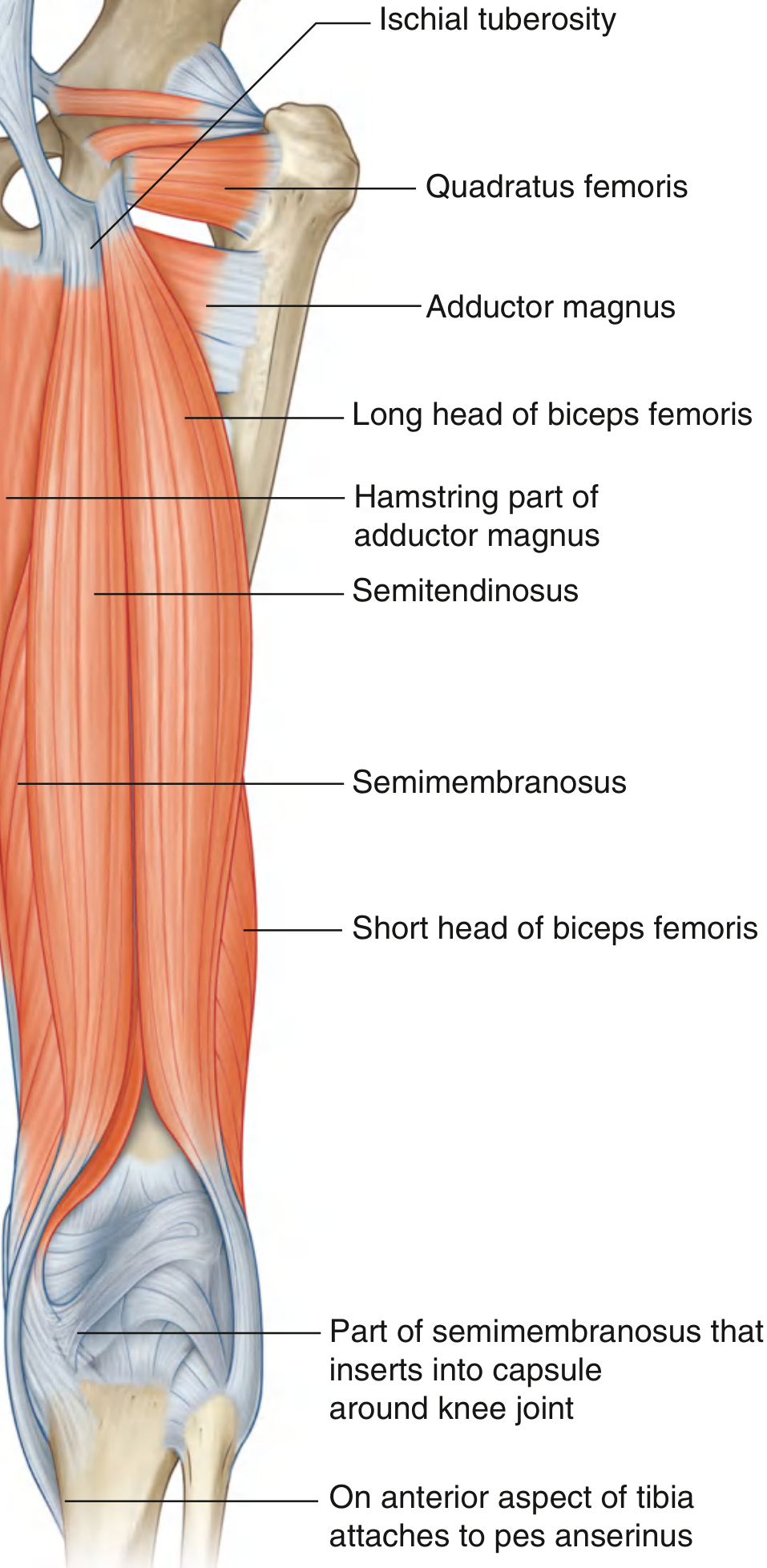
Fig. 6.63 - Posterior view of the hamstring muscles (Gray's Anatomy for Students)
Individual Muscles
1. Biceps Femoris
- Two heads - the only hamstring with a dual origin.
- Long head: originates from the inferomedial part of the upper ischial tuberosity (shared with semitendinosus). Innervated by the tibial division of the sciatic nerve.
- Short head: originates from the lateral lip of the linea aspera of the femur. Innervated by the common fibular (peroneal) division of the sciatic nerve. - This is the only hamstring NOT arising from the ischium and NOT crossing the hip joint.
- Insertion: both heads unite into a common tendon that inserts onto the lateral surface of the head of the fibula. Extensions blend with the fibular collateral ligament and lateral knee capsule.
- Function: flexes knee; long head extends and laterally rotates the hip; with knee partly flexed, laterally rotates the leg.
- Nerve supply: sciatic nerve (L5, S1, S2) - two divisions.
2. Semitendinosus
- Origin: inferomedial part of the upper ischial tuberosity, with the long head of biceps femoris (conjoined tendon). The conjoined tendon with biceps femoris long head divides at ~9-10 cm from the ischial tuberosity.
- Muscle belly: spindle-shaped, ends in the lower half of the thigh, becoming a long cord-like tendon that lies superficial to semimembranosus.
- Insertion: medial surface of the proximal tibia, just posterior to gracilis and sartorius tendons - all three form the pes anserinus ("goose's foot").
- Function: flexes knee, extends hip, medially rotates thigh (at hip) and leg (at knee).
- Nerve supply: tibial division of the sciatic nerve (L5, S1, S2).
3. Semimembranosus
- Origin: superolateral impression on the ischial tuberosity (separate from the conjoined tendon of the other two). Has the longest proximal tendon (~9 cm). The semimembranosus tendon runs anterior and medial to the other hamstring tendons.
- Location: lies deepest - beneath the semitendinosus.
- Insertion: groove and adjacent bone on the medial and posterior surfaces of the medial tibial condyle. Expansions from its tendon form and reinforce multiple structures around the knee (posterior capsule, oblique popliteal ligament).
- Function: flexes knee, extends hip, medially rotates thigh and leg (same as semitendinosus).
- Nerve supply: tibial division of the sciatic nerve (L5, S1, S2).
Summary Table
| Muscle | Origin | Insertion | Nerve | Key Function |
|---|---|---|---|---|
| Biceps femoris (long head) | Inferomedial ischial tuberosity (conjoined) | Head of fibula | Sciatic - tibial division (L5, S1, S2) | Knee flexion; hip extension + lateral rotation |
| Biceps femoris (short head) | Lateral lip of linea aspera | Head of fibula | Sciatic - common fibular division (L5, S1, S2) | Knee flexion; lateral rotation of leg |
| Semitendinosus | Inferomedial ischial tuberosity (conjoined) | Medial proximal tibia (pes anserinus) | Sciatic - tibial division (L5, S1, S2) | Knee flexion; hip extension; medial rotation |
| Semimembranosus | Superolateral ischial tuberosity | Medial tibial condyle (posteromedial groove) | Sciatic - tibial division (L5, S1, S2) | Knee flexion; hip extension; medial rotation |
- Gray's Anatomy for Students, Table 6.5, p. 701
Proximal Attachment Details (3D Illustration)
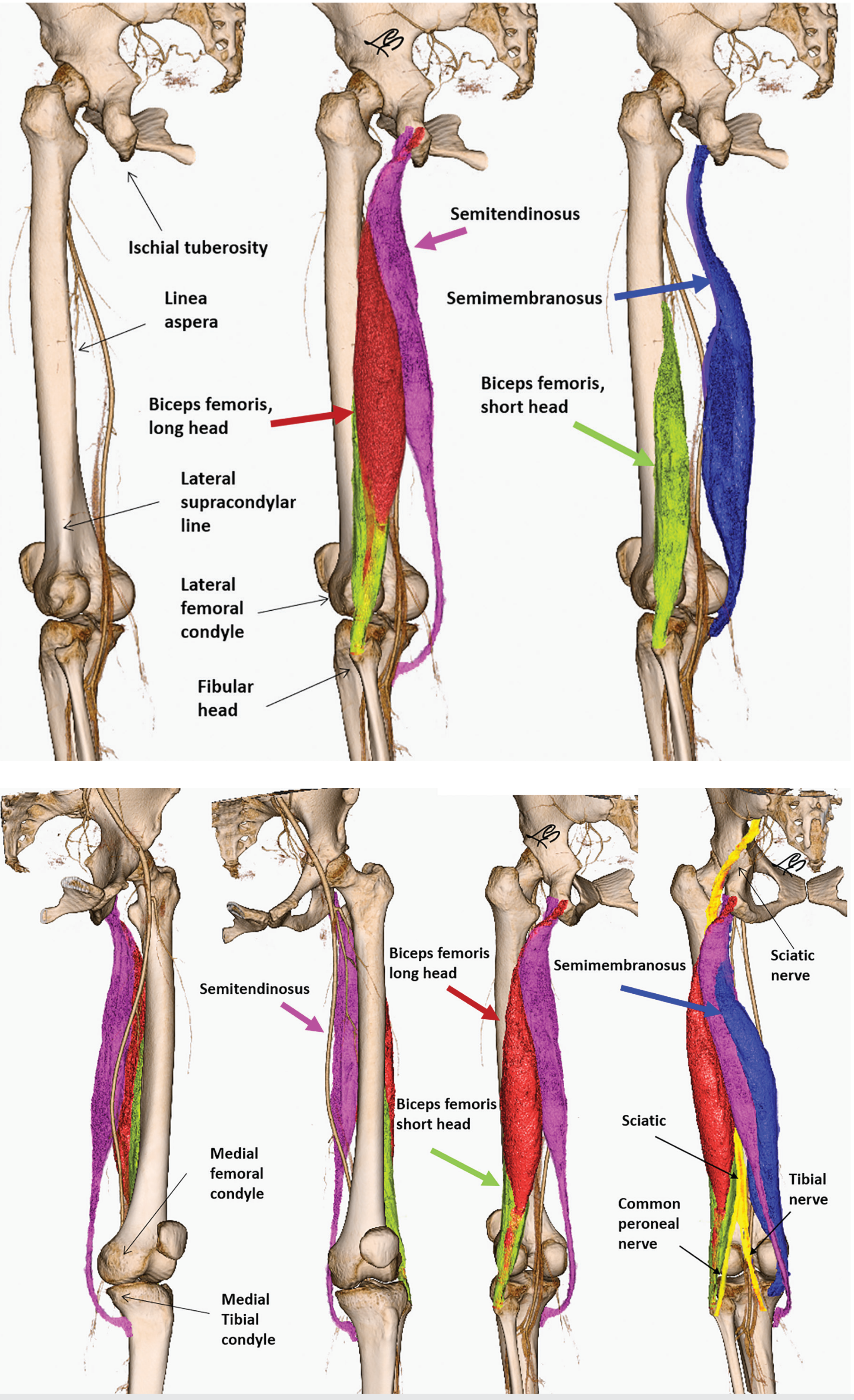
Fig. 9.49 - Color-coded 3D CT reconstruction of hamstring muscle attachments and relationship to the sciatic nerve (Imaging Anatomy: Bones, Joints, Vessels and Nerves)
Key points from this image:
- Pink = Semitendinosus: wide medial course, inserts on medial tibial condyle
- Red = Biceps femoris long head: crosses obliquely from medial to lateral
- Green = Biceps femoris short head: arises from linea aspera/lateral supracondylar line
- Blue = Semimembranosus: deepest and most medial, largest proximal tendon
- Yellow = Sciatic nerve: lies posterior to adductor magnus, between biceps femoris and semimembranosus distally, dividing into tibial and common peroneal nerves
The "Hamstring Part" of Adductor Magnus
The medial (hamstring) part of adductor magnus also shares ischial tuberosity origin and descends to insert at the adductor tubercle on the medial condyle of the femur. It is functionally similar to the hamstrings (hip extension) and is sometimes considered a functional fourth hamstring, though it does not cross the knee.
- Gray's Anatomy for Students, p. 699
Nerve Supply Summary
All hamstrings are supplied by the sciatic nerve (L5, S1, S2), with one important exception:
- The short head of biceps femoris is the only hamstring innervated by the common fibular (peroneal) division rather than the tibial division. This distinction is clinically important in localizing sciatic nerve lesions.
Blood Supply
The hamstrings are primarily supplied by perforating branches of the profunda femoris (deep femoral) artery, with additional contributions from the inferior gluteal artery proximally and genicular branches distally.
Clinical Relevance
- Hamstring strains: most common in athletes requiring explosive speed (sprinting, football). The muscle-tendon junction is the most vulnerable site in adults.
- Proximal hamstring avulsion: more common in adolescents, occurring at the ischial apophysis (the weakest link in skeletally immature individuals). Both ultrasound and MRI are used to assess - MRI also provides prognostic information.
- Pes anserinus: semitendinosus + gracilis + sartorius tendons converge on the medial tibia; this complex can become inflamed (pes anserine bursitis).
- Semimembranosus distal expansion contributes to the oblique popliteal ligament, relevant in posterior knee instability.
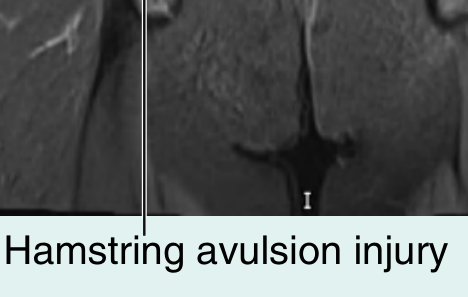
Fig. 6.64 - Coronal MRI showing hamstring avulsion injury (Gray's Anatomy for Students)
- Gray's Anatomy for Students, pp. 700-702
- Imaging Anatomy: Bones, Joints, Vessels and Nerves, pp. 283-284
This is a shared conversation. Sign in to Orris to start your own chat.