Now I have everything needed. Let me write the full 10-marks answer.
COMPOSITION AND FUNCTIONS OF BLOOD
[1st BHMS CBDC | Physiology | 10 Marks]
Reference: Sembulingam's Essentials of Medical Physiology, 9th Edition
INTRODUCTION
Blood is a specialized fluid connective tissue that circulates continuously throughout the body via the cardiovascular system. It acts as the primary medium of transport, communication, regulation, and defense in the human body. In an average adult, the total blood volume is approximately 5-6 litres (about 8% of body weight), or roughly 70-80 mL/kg body weight.
Blood is composed of two major components:
- Plasma - the liquid matrix (~55% of blood volume)
- Formed elements - the cellular components (~45% of blood volume)
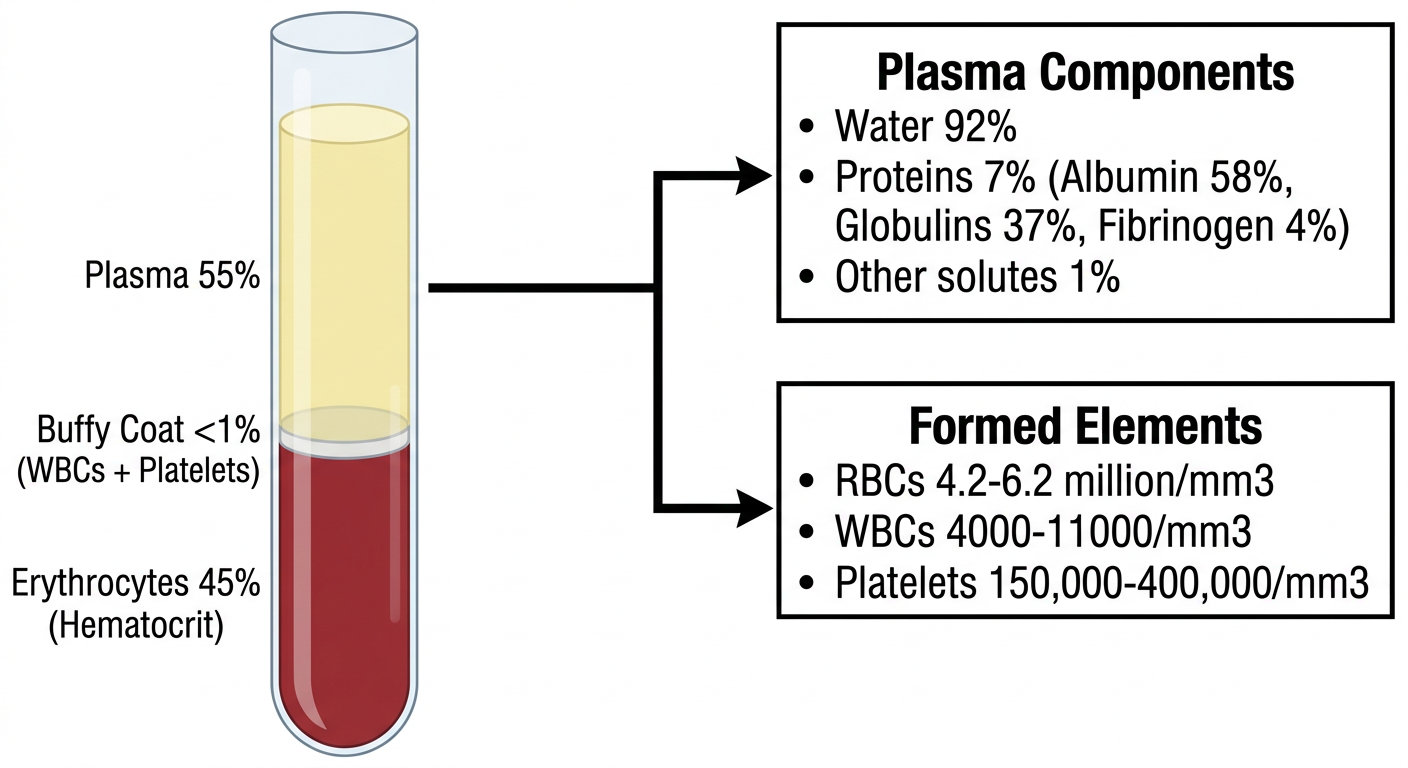
DIAGRAM 1: Composition of Whole Blood (Easy to Draw)
Fig. 1 - Composition of whole blood shown after centrifugation, illustrating plasma, buffy coat, and erythrocyte layers with their constituent components (ref: Junqueira's Basic Histology, 17e / Sembulingum concept)
PART I: COMPOSITION OF BLOOD
A. PLASMA (55% of Total Blood Volume)
Plasma is the straw-colored, liquid portion of blood. It is a pale-white watery solution of electrolytes, proteins, carbohydrates, lipids, and other dissolved substances. Normal plasma has a pH of 7.35-7.45.
Plasma consists of:
| Component | % of Plasma | Function |
|---|
| Water | ~92% | Solvent; maintains fluidity and osmolarity |
| Plasma proteins | ~7% | Oncotic pressure, transport, immunity, clotting |
| Other solutes | ~1% | Electrolytes, nutrients, gases, waste products |
1. Plasma Proteins (~7% of plasma by weight)
Total plasma protein concentration = 6-8 g/dL. They are synthesized mainly in the liver (except immunoglobulins, which are synthesized by plasma cells).
a) Albumin (3.5-5.5 g/dL) - 58% of plasma proteins
- Maintains colloidal osmotic (oncotic) pressure (~25 mmHg)
- Transport protein for fatty acids, bilirubin, drugs, hormones, calcium
- Contributes to blood viscosity
- Synthesized by liver; half-life ~20 days
b) Globulins (~37% of plasma proteins)
- Alpha (α) globulins: Transport lipids, some metal ions (e.g., ceruloplasmin carries copper; haptoglobin carries hemoglobin)
- Beta (β) globulins: Transport iron (transferrin) and lipids (LDL, VLDL)
- Gamma (γ) globulins (Immunoglobulins): IgG, IgA, IgM, IgE, IgD - function as antibodies in immune defense
c) Fibrinogen (~4% of plasma proteins, MW 340 kDa)
- Precursor of fibrin
- Essential for blood coagulation (clotting)
- Synthesized by the liver
d) Regulatory proteins (<1%)
- Includes enzymes, proenzymes (clotting factors), complement proteins, hormones
2. Other Solutes (~1% of plasma)
- Electrolytes: Na+, K+, Ca2+, Mg2+, Cl-, HCO3-, HPO42-. These maintain osmotic pressure, membrane potentials, and acid-base balance. Normal plasma osmolarity = 280-295 mOsm/L
- Nutrients: Glucose (70-110 mg/dL), amino acids, fatty acids, cholesterol, vitamins - act as energy sources
- Respiratory gases: O2 (~2% dissolved in plasma, 98% carried by Hb); CO2 (~7% dissolved, ~27% as carbaminohemoglobin, ~66% as HCO3-)
- Waste products: Urea (blood urea nitrogen), creatinine, lactic acid, bilirubin, ammonia - transported to excretory organs
Note (Sembulingam): Serum = Plasma minus Fibrinogen and other clotting factors. Serum is the yellowish fluid left behind after clot formation and retraction.
B. FORMED ELEMENTS (45% of Total Blood Volume)
The formed elements comprise red blood cells (erythrocytes), white blood cells (leukocytes), and platelets (thrombocytes).
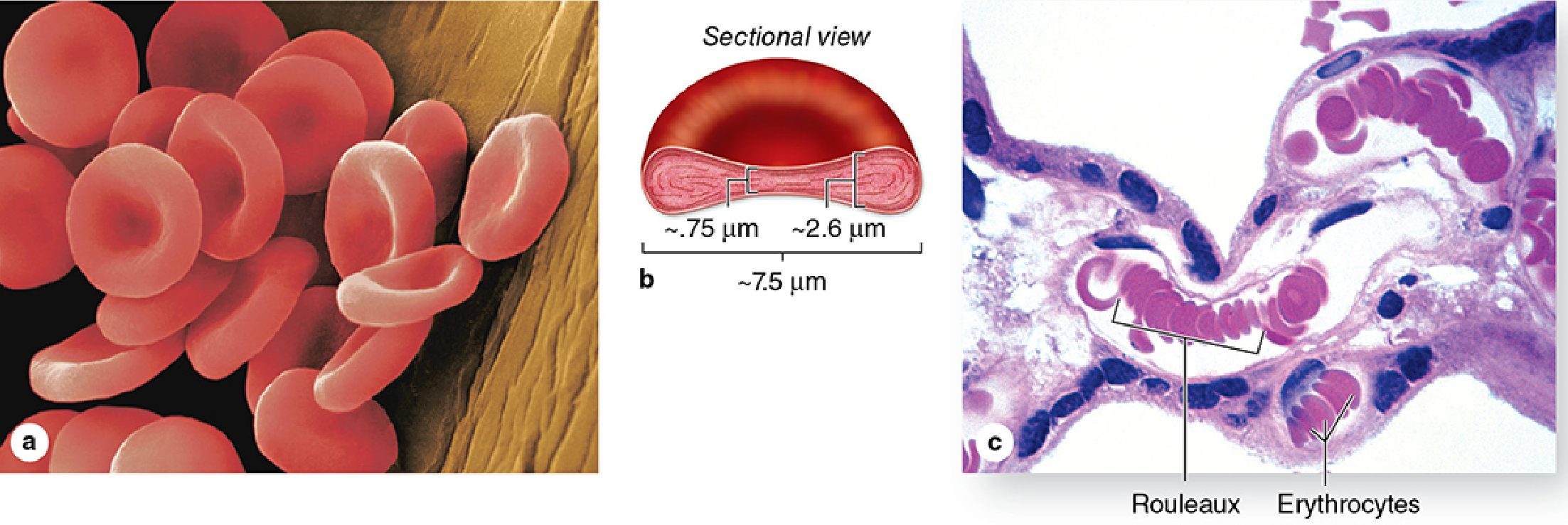
Textbook Image - Normal Human Erythrocytes (SEM + Diagram):
Fig. 2 - Normal human erythrocytes: (a) SEM micrograph showing biconcave disc, (b) sectional diagram with dimensions, (c) erythrocytes in tissue section showing rouleaux formation. From Junqueira's Basic Histology, 17e
1. ERYTHROCYTES (Red Blood Cells / RBCs)
- Count: Males: 4.5-5.5 million/mm³; Females: 3.8-5.0 million/mm³; Newborns: ~5.5-6 million/mm³
- Shape: Biconcave disc (7.5 μm diameter; 2.6 μm thick at rim, 0.75 μm at center)
- No nucleus, no organelles in mature form
- Hematocrit (PCV): Males ~45%; Females ~40%
- Life span: ~120 days; destroyed in spleen (graveyard of RBCs), liver, and bone marrow
- Contain hemoglobin (~33 g/dL of cells; normal Hb: males 13-17 g/dL; females 12-16 g/dL)
Functions of RBCs:
- Primary transport of O2 (via oxyhemoglobin) from lungs to tissues
- Transport CO2 from tissues to lungs
- Maintain acid-base balance via carbonic anhydrase
- Biconcave shape gives maximum surface area for gas exchange
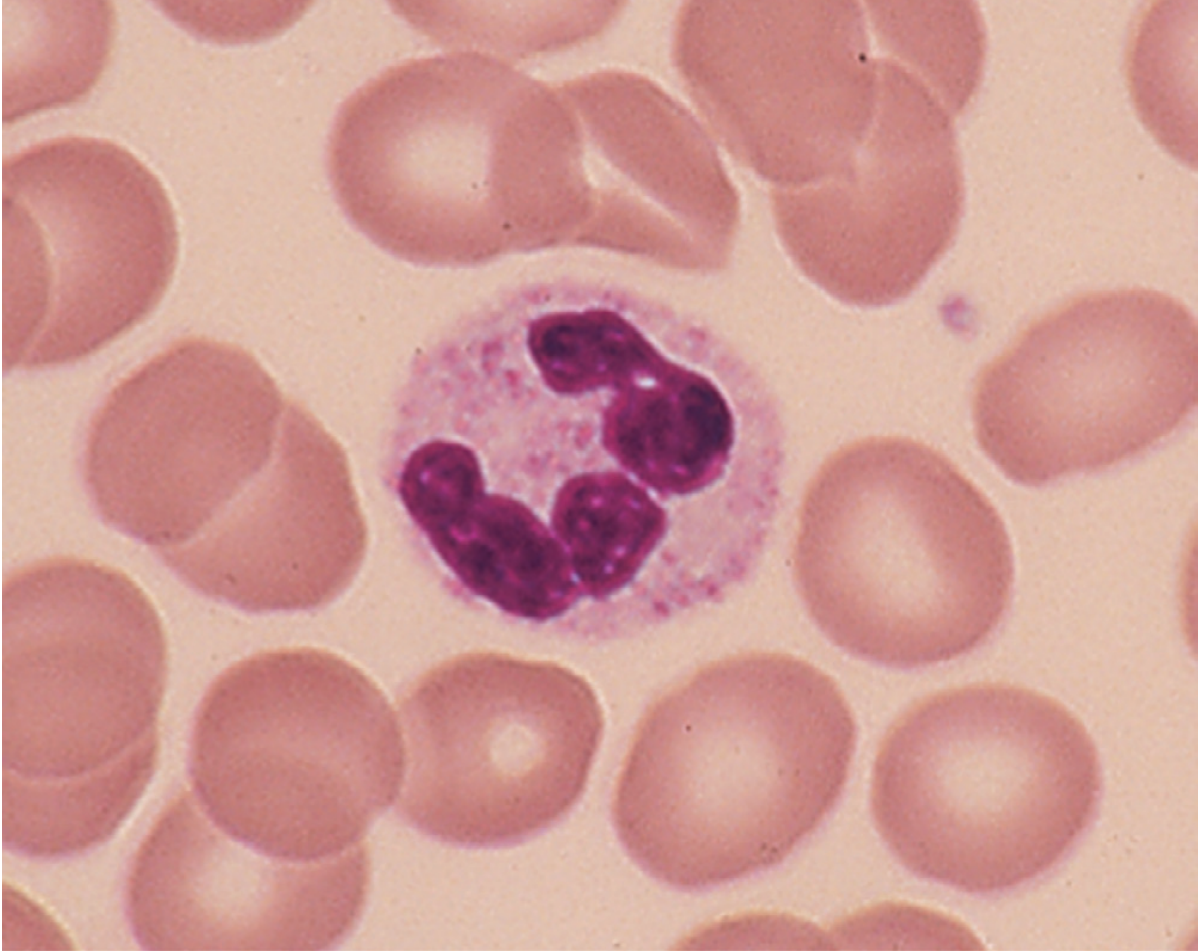
Microscopic image - Peripheral blood smear (Neutrophil among RBCs):
Fig. 3 - Peripheral blood smear: Neutrophil (multilobed nucleus) surrounded by erythrocytes. From Medical Physiology (Boron & Boulpaep)
2. LEUKOCYTES (White Blood Cells / WBCs)
- Count: 4,000-11,000/mm³ (Sembulingam: 4,000-10,000/mm³)
- Nucleated cells; can leave blood vessels (diapedesis) and enter tissues
- Form the buffy coat on centrifugation
Classification:
A) Granulocytes (Polymorphonuclear):
| Cell | % | Granules | Function |
|---|
| Neutrophils | 50-70% | Fine pink granules | Phagocytosis of bacteria; first line of defense |
| Eosinophils | 1-4% | Large orange-red granules | Allergic reactions; anti-parasitic activity |
| Basophils | 0.5-1% | Large dark purple granules | Release histamine and heparin; mediate inflammation |
B) Agranulocytes:
| Cell | % | Function |
|---|
| Lymphocytes | 20-40% | B cells (antibody production), T cells (cell-mediated immunity) |
| Monocytes | 2-8% | Phagocytosis; differentiate into macrophages in tissues |
3. PLATELETS (Thrombocytes)
- Count: 1,50,000-4,00,000/mm³ (1.5-4 lakh/mm³)
- Small, non-nucleated cell fragments (~2-4 μm)
- Derived from megakaryocytes in bone marrow
- Life span: 8-10 days; destroyed in spleen
Functions:
- Primary hemostasis - platelet plug formation at site of vessel injury
- Release clotting factors (ADP, thromboxane A2, serotonin)
- Maintain vascular integrity (angiotrophic function)
PART II: FUNCTIONS OF BLOOD
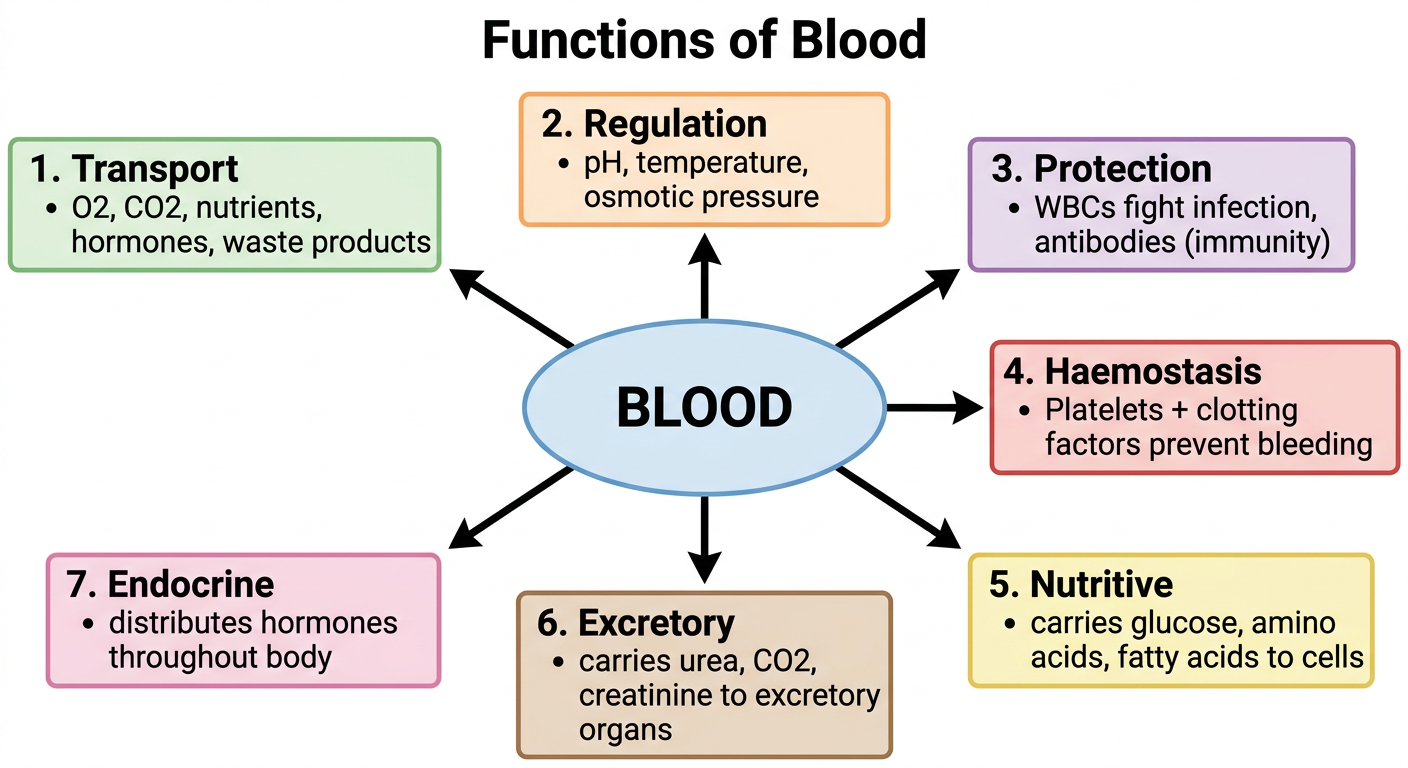
DIAGRAM 2: Functions of Blood (Mind Map - Easy to Draw)
Fig. 4 - Flowchart: Functions of Blood (ref: Sembulingam's Essentials of Medical Physiology, 9th Ed.)
Blood performs the following important functions (as per Sembulingam 9th Ed):
1. TRANSPORT FUNCTION
Blood is the principal transport medium of the body.
- Respiratory transport: Carries O2 from lungs to tissues (98% via oxyhemoglobin, 2% dissolved in plasma); carries CO2 from tissues to lungs (66% as HCO3-, 27% as carbaminohemoglobin, 7% dissolved in plasma)
- Nutritive transport: Absorbed nutrients (glucose, amino acids, fatty acids, vitamins) from intestine are carried via portal circulation and distributed to all tissues
- Hormonal transport: Blood distributes hormones from endocrine glands to their target organs (e.g., insulin from pancreas to liver and muscle cells)
- Waste transport: Metabolic wastes like urea, creatinine, uric acid, CO2, and bilirubin are carried to excretory organs (kidneys, lungs, liver, skin)
2. REGULATORY FUNCTION
Blood plays a vital role in maintaining homeostasis.
a) pH regulation: Blood maintains pH between 7.35-7.45 through:
- Protein buffers (albumin, hemoglobin)
- Bicarbonate buffer system (HCO3-/H2CO3)
- Phosphate buffer system
b) Temperature regulation:
- Blood absorbs heat generated by metabolic processes in active organs (e.g., liver, muscle)
- Carries heat to skin surface for dissipation (radiation, evaporation)
- Helps maintain core body temperature at ~37°C
c) Osmotic pressure regulation:
- Plasma proteins (mainly albumin) maintain colloid osmotic pressure (~25 mmHg)
- Electrolytes in plasma maintain crystalloid osmotic pressure
- Total plasma osmolarity maintained at 280-295 mOsm/L
3. PROTECTIVE / DEFENSE FUNCTION
Blood forms a critical defense against infection and disease.
- Leukocytes - WBCs perform phagocytosis of bacteria and foreign particles
- Neutrophils are the first responders in bacterial infection
- Lymphocytes produce antibodies (immunoglobulins) - humoral immunity (B cells); cell-mediated immunity (T cells)
- Monocytes differentiate into macrophages in tissues and perform phagocytosis
- Complement proteins in plasma assist in destroying microorganisms
- Natural killer (NK) cells destroy virus-infected cells and tumor cells
4. HAEMOSTATIC FUNCTION (Coagulation)
Blood has the inherent ability to arrest bleeding.
- Platelets adhere to damaged vessel walls and form a platelet plug (primary hemostasis)
- Coagulation cascade (intrinsic + extrinsic pathways) is activated, converting fibrinogen → fibrin
- Fibrin clot traps RBCs and seals the wound (secondary hemostasis / coagulation)
- Clot retraction and later fibrinolysis (by plasmin) restore normal circulation
5. NUTRITIVE FUNCTION
- Absorbed digested food materials (glucose, amino acids, lipids, vitamins, minerals) from the GI tract are carried in blood to all body cells
- Provides raw materials for cellular metabolism and tissue repair
- Carries nutrients from storage sites (e.g., glycogen from liver as glucose) to peripheral tissues during fasting
6. EXCRETORY FUNCTION
- Metabolic waste products produced by tissues are dissolved in blood and transported to organs of excretion:
- Kidneys: Urea, creatinine, uric acid, excess electrolytes
- Lungs: CO2
- Liver: Bilirubin, bile salts
- Skin: Small amounts of urea and lactic acid via sweat
7. ENDOCRINE / INTEGRATIVE FUNCTION
- Blood serves as the communication highway for the endocrine system
- Hormones secreted by glands (thyroid, adrenal, pituitary, pancreas) travel in blood to distant target organs
- This allows coordination of metabolic, reproductive, and developmental processes throughout the body
8. WATER BALANCE
- Blood plasma distributes water between the intravascular compartment and interstitial fluid/intracellular fluid
- Starling's forces (oncotic pressure vs. hydrostatic pressure) govern fluid movement across capillary walls
SUMMARY TABLE: Normal Values at a Glance (Sembulingam)
| Parameter | Normal Value |
|---|
| Total blood volume | 5-6 L (70-80 mL/kg) |
| Plasma | 55% of blood volume |
| Hematocrit (PCV) | Males 40-45%, Females 36-42% |
| RBC count | Males: 4.5-5.5 million/mm³; Females: 3.8-5.0 million/mm³ |
| Hemoglobin | Males: 13-17 g/dL; Females: 12-16 g/dL |
| WBC count | 4,000-11,000/mm³ |
| Platelet count | 1,50,000-4,00,000/mm³ |
| Plasma proteins | 6-8 g/dL (Albumin 3.5-5.5 g/dL) |
| Plasma pH | 7.35-7.45 |
| Plasma osmolarity | 280-295 mOsm/L |
EASY-TO-DRAW FLOWCHART: WBC Differential Count
        LEUKOCYTES (WBCs)
             |
    __________|____________
    |                     |
GRANULOCYTES         AGRANULOCYTES
    |                     |
  __|___________        __|___________
  |       |    |        |            |
Neutro- Eosino- Baso-  Lympho-    Mono-
phils   phils   phils   cytes      cytes
50-70%  1-4%  0.5-1%  20-40%     2-8%
CONCLUSION
Blood is a multifunctional fluid connective tissue. Its composition - plasma carrying proteins, electrolytes, and gases, along with the three formed elements (RBCs, WBCs, platelets) - is precisely tailored to fulfill its roles in transport, regulation, defense, coagulation, nutrition, excretion, and endocrine communication. A thorough understanding of blood composition and function forms the foundation of clinical physiology and is directly relevant to the diagnosis and management of hematological disorders.
References:
- Sembulingam K, Sembulingam P. Essentials of Medical Physiology, 9th Edition. Jaypee Brothers Medical Publishers, 2022 - Chapters on Blood (Ch. 12-18)
- Junqueira's Basic Histology, Text and Atlas 17th Ed. - Blood chapter, pp. 594-600
- Medical Physiology, Boron & Boulpaep - Chapter 18: Blood, pp. 628-632