
Venous pulling
Reading File
Venous pulling (also called the venous pull or venous milking technique) refers to a maneuver used in surgery/interventional procedures where a vein is gently stretched or manipulated to assist with cannulation, harvesting, or identification. The term is also used in the context of venous blood flow dynamics.
Searching sources...
Finding Sources
Searching the Web
venous pulling medical technique surgery
Finding Sources
Searching the Web
venous pulling technique varicose veins phlebectomy hook avulsion
Reading File
Reading File
Reading File
Reading File
Reading File
Loading Image
Here is a thorough explanation of venous pulling in the surgical context, based on authoritative textbook sources:
Venous Pulling (Ambulatory Phlebectomy - Hook Avulsion Technique)
"Venous pulling" refers to the physical act of pulling and rolling a varicose vein segment out through tiny skin incisions during ambulatory phlebectomy (also called stab avulsion phlebectomy). It is a core step in the removal of diseased superficial veins.
Overview
Ambulatory phlebectomy is an in-office surgical procedure designed for the complete removal of diseased venous segments by means of hook avulsion of the targeted vessel. It was developed in the 1950s by Swiss dermatologist Robert Mueller. All superficial veins except the groin termination of the great saphenous vein (GSV) may be avulsed using this technique.
- Dermatology 2-Volume Set 5e, p. 3140
Step-by-Step Technique
1. Preoperative marking
The varicose veins to be removed are outlined with an indelible marking pen with the patient in a standing position (upright). Then the patient lies down and the veins are re-marked with transillumination (e.g., Veinlite) to account for a positional shift of up to 1-2 cm. This "double-marking technique" is critical for accuracy.
2. Tumescent anesthesia
Local tumescent anesthesia (typically 0.05% lidocaine with 1:10,000 epinephrine) is infiltrated along the vein. This temporarily swells and firms the soft tissues, pressing the vein against the skin to make hooking easier. It also reduces blood loss, diminishes bruising, and improves postoperative comfort.
3. Microincisions
Microincisions of 1-3 mm in length are made with an 18- or 16-gauge needle or a #11 blade, parallel to the long axis of the extremity and along relaxed skin tension lines. Incisions are spaced 3-5 cm apart along the vein.
4. Exteriorization - the "pull"
A phlebectomy hook (Mueller-type or Goldman hook) is introduced into the microincision to catch the adventitia of the vein and bring it to the skin surface. Once exteriorized, the vein segment is clamped proximally and distally, then pushed or pulled (depending on operator preference) from each end until the vein is avulsed. A gentle rotation or rolling motion of the clamp, in the same and/or opposite direction, pulls and frees the vein from its secondary connective tissue sheath. This is the core "venous pulling" step.
5. Repetition
The process is repeated at 3-5 cm intervals along the entire marked vein until the diseased segment is fully removed or adequately interrupted.
- Dermatology 2-Volume Set 5e, p. 3140
Diagram of the Venous Pulling Technique
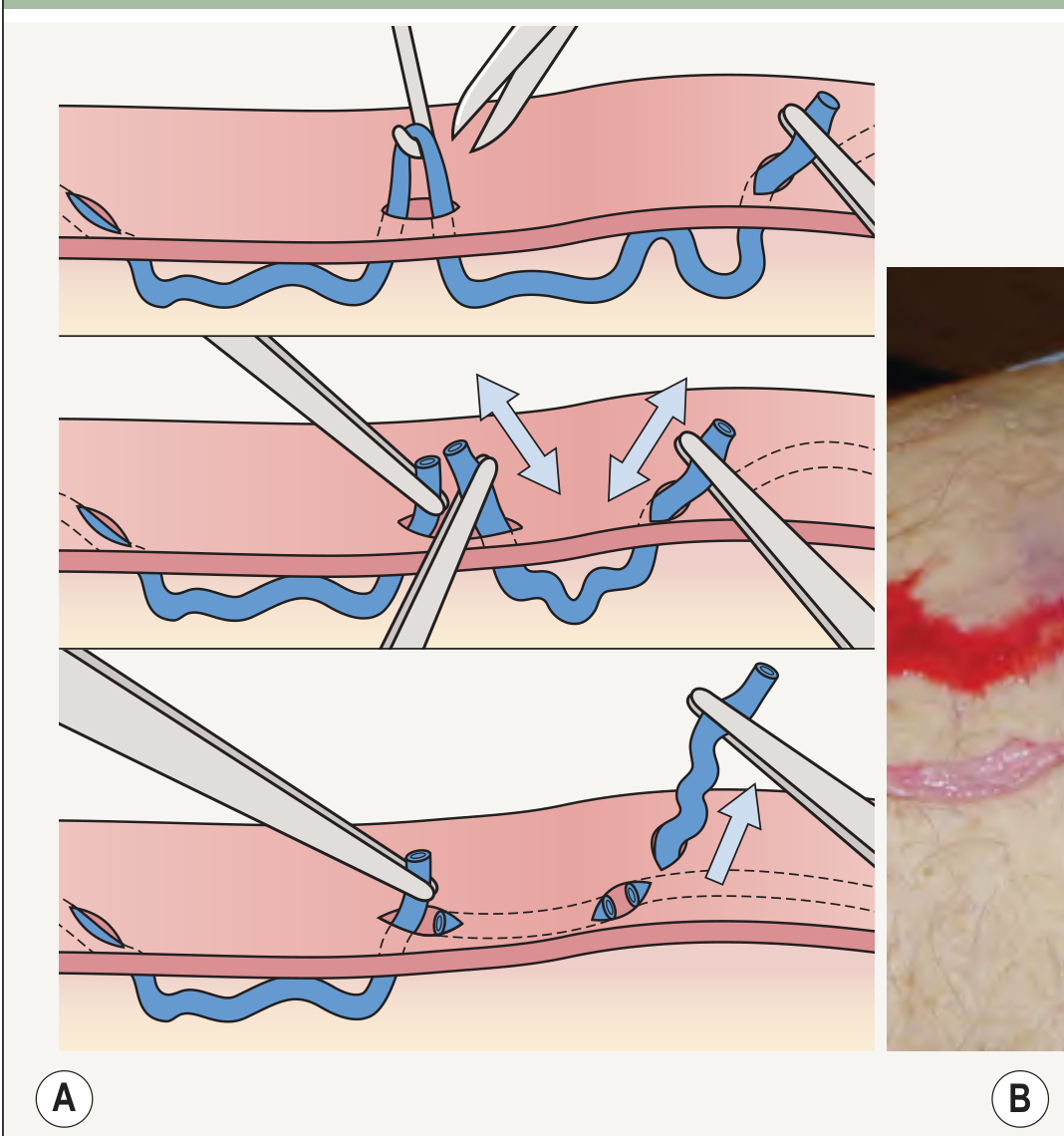
Fig. 155.16 - Ambulatory phlebectomy: avulsion of venous segments. The vein is hooked, clamped, and pulled/rolled out through microincisions.
Special Anatomic Considerations
-
Knees, ankles, and feet: Hooking should be gentle and slow. If the vein does not come out easily and requires a lot of traction, it is possible that a fascial strand (not a vein) has been hooked - the hook should be removed and re-introduced.
-
Ankle and foot: Aggressive hooking should be avoided to prevent swelling, hematoma, and lymphatic or nerve damage.
-
Pretibial area: Careful technique is needed due to the density of lymphatic vessels (risk of lymphocele).
-
Popliteal area: Particularly gentle technique is required because the skin of the back of the knee is soft and microincisions are easily enlarged by overzealous hooking.
-
Dermatology 2-Volume Set 5e, p. 3143
Comparison with Vein Stripping
| Feature | Venous Pulling (Hook Phlebectomy) | Vein Stripping |
|---|---|---|
| Anesthesia | Local tumescent (in-office) | General or spinal |
| Incision size | 1-3 mm microincisions | Larger groin/calf incisions |
| Vein removed | Branch varicosities, tributaries | Great saphenous vein axial trunk |
| Sutures needed | Rarely | Yes |
| Recurrence/neovascularization | Lower risk | >30% neovascularization rate |
| Recovery | Same-day, walk immediately | Days to weeks |
In traditional vein stripping, the pulling concept also applies: a Codman stripper is advanced through the GSV and the vein is inverted onto itself, then forcefully pulled out from groin to knee. This is the historical "venous pull" in open surgery.
- Sabiston Textbook of Surgery 7e, p. 2408
Postoperative Care
After venous pulling/phlebectomy, the leg is wrapped with cotton gauze and an elastic compression dressing from dorsum of foot to groin. The dressing is removed at 24 hours, then Class II (30-40 mmHg) graduated compression stockings are worn continuously for 1 week and during waking hours for 2-4 weeks. Walking is encouraged immediately to activate the calf muscle pump and reduce thromboembolic risk.
Key Takeaway
"Venous pulling" is the central maneuver of ambulatory phlebectomy - using a hook to exteriorize the vein through a microincision, then clamping and physically pulling/rolling the vein segment free from its adventitial attachments. It is a safe, effective, minimally invasive office procedure for varicose vein tributaries, with minimal scarring and rapid patient recovery.
This is a shared conversation. Sign in to Orris to start your own chat.