
Increase Aptt and reduced platelet
elevated aPTT thrombocytopenia causes differential diagnosis
Harrison's Principles of Internal Medicine, Twenty First Edition
Page 3481
prolonged aPTT low platelets coagulopathy DIC heparin antiphospholipid
Harrison's Principles of Internal Medicine, Twenty First Edition
Page 3482
Causes of Increased aPTT + Thrombocytopenia
1. Disseminated Intravascular Coagulation (DIC)
| Lab Finding | Result |
|---|---|
| aPTT | Prolonged |
| PT | Prolonged |
| Platelets | Low |
| Fibrinogen | Low |
| D-dimer / FDP | Elevated |
- Sepsis (most common)
- Trauma / burns
- Obstetric emergencies (abruption, amniotic fluid embolism, dead fetus syndrome)
- Acute promyelocytic leukemia (APL / AML-M3)
- Malignancy (solid tumors)
- Transfusion reactions
2. Heparin Therapy + Heparin-Induced Thrombocytopenia (HIT)
- Heparin directly prolongs aPTT (its intended action)
- HIT (Type II): immune-mediated platelet destruction via anti-PF4/heparin antibodies → thrombocytopenia (typically 50% drop from baseline, days 5–10 of therapy)
- Paradoxically pro-thrombotic despite low platelets
3. Antiphospholipid Syndrome (APS)
- aPTT is paradoxically prolonged in vitro (lupus anticoagulant interferes with phospholipid-dependent clotting assays) — yet the patient is pro-thrombotic
- Thrombocytopenia occurs in ~20–40% of cases (immune-mediated platelet destruction)
- Associated with: SLE, recurrent thrombosis, recurrent miscarriages
- Key test: mixing study (aPTT does NOT correct), confirm with dilute Russell viper venom time (dRVVT)
4. Severe Liver Disease
- Mechanism: Reduced synthesis of all clotting factors (prolonged aPTT) + platelet sequestration from portal hypertension/hypersplenism
- Unlike DIC, lab parameters change slowly (helpful distinguishing feature)
- D-dimer may be mildly elevated
- (Harrison's, p. 3481)
5. Thrombotic Thrombocytopenic Purpura (TTP)
- Thrombocytopenia is prominent (microangiopathic platelet consumption)
- aPTT/PT are usually normal in classic TTP, but can be prolonged in severe cases
- Key features: microangiopathic hemolytic anemia (MAHA), schistocytes on smear, neurological symptoms, renal impairment, fever
- ADAMTS13 activity markedly reduced (<10%)
- (Harrison's, p. 3481)
6. Massive Transfusion / Dilutional Coagulopathy
- Large-volume crystalloid or pRBC transfusion dilutes clotting factors → prolonged aPTT
- Dilutes platelets → thrombocytopenia
- Manage with FFP, cryoprecipitate, and platelet transfusion (1:1:1 protocol in trauma)
7. Factor Deficiencies Affecting the Intrinsic Pathway
- Hemophilia A or B + concurrent ITP or bone marrow failure
- Less common; usually context makes it clear
Diagnostic Approach
Prolonged aPTT + Low Platelets
        |
        ├─ Check PT, fibrinogen, D-dimer
        |       ├─ All abnormal → DIC
        |       └─ Normal PT → consider APS, HIT, liver disease
        |
        ├─ Mixing study
        |       ├─ Corrects → factor deficiency
        |       └─ Does NOT correct → inhibitor (lupus anticoagulant, factor inhibitor)
        |
        ├─ On heparin? → Check anti-PF4 antibody (4T score for HIT)
        |
        ├─ Schistocytes on smear? → TTP / HUS
        |
        └─ Chronic liver disease? → LFTs, imaging
Quick Reference Table
| Condition | aPTT | PT | Platelets | Fibrinogen | D-dimer | Key Feature |
|---|---|---|---|---|---|---|
| DIC | ↑ | ↑ | ↓ | ↓ | ↑↑ | Consumptive coagulopathy |
| APS / Lupus anticoagulant | ↑ | Normal | ↓ | Normal | Variable | Mixing study doesn't correct |
| HIT | ↑ (if on heparin) | Normal | ↓ | Normal | Normal | Anti-PF4 Ab positive |
| Liver disease | ↑ | ↑ | ↓ | ↓ | Mildly ↑ | Slow progression |
| TTP | Usually normal | Normal | ↓↓ | Normal | Normal | Schistocytes, ADAMTS13 ↓ |
| Massive transfusion | ↑ | ↑ | ↓ | ↓ | Variable | Transfusion history |
Inr increase in
elevated INR increased prothrombin time causes differential diagnosis
Harrison's Principles of Internal Medicine, Twenty First Edition
Page 9331
prolonged PT INR liver disease vitamin K deficiency warfarin coagulopathy
Evaluation of Abnormal Liver Chemistries
Page 4
Causes of Increased INR (Prolonged PT)
Major Categories
1. Liver Disease
- Mechanism: Hepatocytes synthesize all coagulation factors; hepatocellular dysfunction reduces factor production
- Seen in: hepatitis (acute/chronic), cirrhosis, acute liver failure, fatty liver disease
- PT prolonged >5 s above control that does not correct with parenteral vitamin K = poor prognostic sign in acute hepatitis
- INR is a component of the MELD score (along with bilirubin and creatinine) — used to assess severity of hepatic decompensation and liver transplant allocation
- (Harrison's, p. 9331)
2. Vitamin K Deficiency
- Mechanism: Factors II, VII, IX, X require vitamin K for gamma-carboxylation (activation)
- Causes:
- Malabsorption: fat malabsorption (Crohn's, celiac disease, short bowel syndrome)
- Cholestasis / Obstructive jaundice: bile salts needed for vitamin K (fat-soluble) absorption
- Poor dietary intake (prolonged fasting, malnutrition, ICU patients on antibiotics)
- Broad-spectrum antibiotics eliminating gut flora (which produce vitamin K2)
- Neonates (physiologic vitamin K deficiency → hemorrhagic disease of the newborn)
- Key test: INR corrects after IV/SC vitamin K administration → confirms deficiency
- (Evaluation of Abnormal Liver Chemistries, p. 4)
3. Anticoagulant Therapy
| Drug | Mechanism |
|---|---|
| Warfarin | Vitamin K antagonist → blocks activation of II, VII, IX, X |
| Heparin (bolus) | Potentiates antithrombin III → can prolong PT |
| Direct oral anticoagulants (DOACs) | Rivaroxaban/apixaban (anti-Xa) and dabigatran (anti-IIa) — variable effect on PT |
4. Disseminated Intravascular Coagulation (DIC)
- Consumptive coagulopathy → depletion of multiple clotting factors
- Both PT and aPTT prolonged
- Low fibrinogen, low platelets, elevated D-dimer
- Triggered by sepsis, trauma, malignancy, obstetric emergencies
5. Factor Deficiencies (Inherited or Acquired)
- Factor VII deficiency: isolated PT prolongation (aPTT normal) — factor VII has the shortest half-life (~4–6 hours)
- Factor V deficiency: both PT and aPTT prolonged
- Acquired inhibitors against specific factors (rare)
6. Hypothermia
- Enzymatic activity of clotting factors is temperature-dependent
- Core temperature <35°C impairs coagulation cascade
- Common in major trauma (lethal triad: hypothermia + acidosis + coagulopathy)
- (Evaluation of Abnormal Liver Chemistries, p. 4)
7. Other Causes
- Massive transfusion — dilutional coagulopathy
- Amyloidosis — factor X adsorption onto amyloid fibrils
- Antiphospholipid syndrome — occasionally prolongs PT
- Disseminated malignancy
Diagnostic Algorithm
Elevated INR
      |
      ├─ On warfarin / heparin? → Drug effect (therapeutic or supratherapeutic)
      |
      ├─ Correct with Vitamin K?
      |       ├─ YES → Vitamin K deficiency (malabsorption, cholestasis, dietary)
      |       └─ NO → Liver disease (hepatocellular dysfunction) or inhibitor
      |
      ├─ Check aPTT
      |       ├─ aPTT also prolonged → Common pathway defect, DIC, liver disease
      |       └─ aPTT normal → Factor VII deficiency (isolated), early warfarin
      |
      ├─ Fibrinogen ↓ + D-dimer ↑ + Platelets ↓ → DIC
      |
      └─ Liver function tests → Hepatocellular vs. cholestatic pattern
Quick Reference Table
| Cause | PT/INR | aPTT | Platelets | Corrects with Vit K? | Key Clue |
|---|---|---|---|---|---|
| Liver disease | ↑ | ↑ | ↓ | Partial/No | LFTs abnormal, MELD score |
| Vitamin K deficiency | ↑ | ↑ (if severe) | Normal | Yes | Malabsorption, cholestasis, antibiotics |
| Warfarin | ↑ | Normal/↑ | Normal | Yes | Medication history |
| DIC | ↑ | ↑ | ↓ | No | Fibrinogen ↓, D-dimer ↑↑ |
| Factor VII deficiency | ↑ | Normal | Normal | No | Isolated PT prolongation |
| Hypothermia | ↑ | ↑ | ↓ | No | Low core temperature |
B lines on usg
B lines lung ultrasound findings causes significance
Bedside General and Cardiac Ultrasonography in the Evaluation of Critically Ill Patients: Part I
Page 13
B lines lung ultrasound comet tail artifacts
Hugging Face pmc clinical VQA raw
Page 0
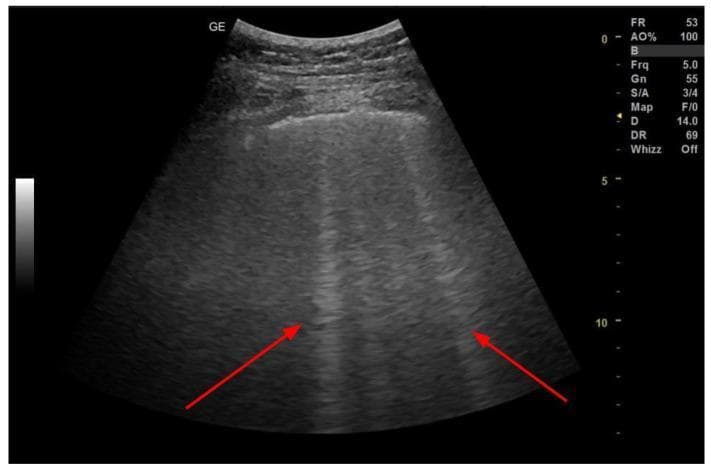
B-Lines on Lung Ultrasound
What Are B-Lines?
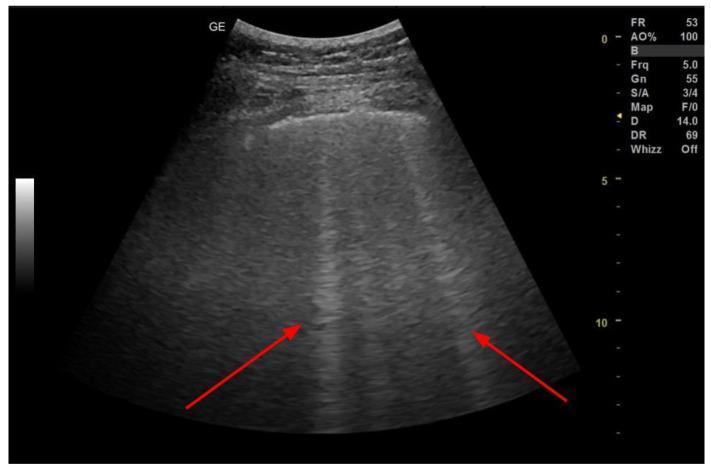
Defining Features
| Feature | Description |
|---|---|
| Origin | Arise from the pleural line |
| Direction | Vertical (perpendicular to pleura) |
| Extent | Reach the bottom of the screen without fading |
| Movement | Slide with respiration (move with lung) |
| Acoustic shadow | Obliterate A-lines |
Normal lung: shows horizontal A-lines (reverberation artifacts) — absence of B-lines. ≥3 B-lines in a single intercostal space = interstitial syndrome (pathological)
Mechanism
Causes Based on B-Line Pattern
| Pattern | Spacing | Cause |
|---|---|---|
| Discrete B-lines | ~7 mm apart | Interstitial syndrome (early pulmonary edema, ILD) |
| Irregular / asymmetric B-lines | Variable spacing | Pneumonia, contusion |
| Confluent / coalescent B-lines | <3 mm apart (nearly merged) | Severe pulmonary edema, confluent bronchopneumonia |
Clinical Conditions Causing B-Lines
Cardiac / Cardiogenic
- Acute decompensated heart failure (most common) — bilateral, symmetric, diffuse B-lines
- Cardiogenic pulmonary edema
- Fluid overload
Pulmonary / Non-Cardiogenic
- Pneumonia — focal, unilateral, asymmetric B-lines
- ARDS — bilateral but heterogeneous/patchy distribution
- Interstitial lung disease (ILD/UIP/NSIP) — bilateral, predominantly basal, chronic
- Pulmonary contusion — post-trauma, focal
- COVID-19 pneumonitis — bilateral, patchy
Other
- Pleural disease — subpleural consolidation
- Post-radiotherapy fibrosis — localized
B-Lines: Cardiogenic vs. Non-Cardiogenic Differentiation
| Feature | Cardiogenic Pulmonary Edema | Pneumonia / ARDS |
|---|---|---|
| Distribution | Bilateral, symmetric, diffuse | Focal, asymmetric, patchy |
| Pleural line | Smooth | Irregular, thickened |
| Consolidation | Absent or basal | Often present |
| Pleural effusion | Common (bilateral) | Uncommon or unilateral |
| Response to diuresis | B-lines reduce rapidly | Persist |
BLUE Protocol (Bedside Lung Ultrasound in Emergency)
Dyspnea / Respiratory failure
          |
    Anterior zones bilateral
          |
     B-lines present?
     /            \
   YES              NO (A-lines)
   |                    |
Pulmonary edema     Check DVT / PE
(heart failure)     or COPD / asthma
          |
  Focal B-lines / consolidation?
          → Pneumonia
Key Clinical Pearls
- B-lines are dynamic — they decrease with diuresis in heart failure (useful for monitoring treatment response)
- Bilateral diffuse B-lines + reduced LV function on cardiac echo = cardiogenic pulmonary edema until proven otherwise
- B-lines cannot distinguish all causes alone — always correlate with clinical history, cardiac echo (EF, E/e'), and other zones
- Absence of B-lines with presence of A-lines + absent lung sliding = pneumothorax