
Laminectomy defination anatomy at lumbar level approach layers dissected structures removed pt positioning and things to look prepare for the case to be operated today
Reading File
Finding Sources
Finding Sources
Reading File
Reading File
Finding Sources
Finding Sources
Finding Sources
Finding Sources
Finding Sources
Reading File
Reading File
Reading File
Reading File
Finding Sources
Searching Images
lumbar laminectomy surgical technique anatomy posterior approach
Loading Image
Loading Image
Finding Sources
Lumbar Laminectomy — Complete Surgical Reference
1. Definition
Laminectomy is the surgical excision of one or more vertebral laminae (along with the spinous process and, where needed, the medial facet joints) to decompress the spinal canal and its neural contents. At the lumbar level it is the standard operation for spinal stenosis, disc herniation, tumour, or any pathology causing posterior neural compression. A hemilaminectomy removes only one side; a laminotomy creates a smaller fenestration/window without full lamina removal. Laminectomy differs from laminotomy in that the lamina is removed as a unit rather than fenestrated.
"Lumbar laminotomy and laminectomy are commonly employed for decompressing the neural elements of the lumbar spine." — Miller's Anesthesia 10e
2. Relevant Anatomy
Bony Elements (what you will encounter)
| Structure | Detail |
|---|---|
| Spinous process | Midline projection; first palpable landmark |
| Lamina | Flat posterior arch of the vertebra connecting spinous process to pedicle |
| Pedicle | Connects posterior arch to vertebral body; upper/lower limit of laminectomy |
| Facet joint (zygapophyseal) | Superior + inferior articular processes form the facet; medial portion removed in full laminectomy |
| Pars interarticularis | Junction between superior and inferior articular processes; the key landmark for placing the burr trough |
| Transverse process | Lateral projection at pedicle level; important for pedicle screw placement |
| Ligamentum flavum | Yellow ligament spanning between adjacent laminae on the inner surface; must be removed to access the canal |
| Interspinous / supraspinous ligaments | Connect spinous processes; divided in midline approach |
Neural Structures
- Thecal (dural) sac with cauda equina at lumbar levels (cord ends at L1–L2)
- Nerve roots exiting through foramina (pedicle above to pedicle below = one motion segment)
- Epidural fat and epidural venous plexus — valveless veins that bleed significantly if abdominal pressure is raised
Cross-Sectional Relations (lumbar)
From posterior → anterior: skin → subcutaneous fat → thoracolumbar (lumbodorsal) fascia → erector spinae/paraspinal muscles → spinous processes/laminae → ligamentum flavum → epidural space → thecal sac/nerve roots → posterior longitudinal ligament → disc/vertebral body.
3. Approach: Layers Dissected Step-by-Step
Incision
Straight midline skin incision centred over the target spinous process(es), length depending on number of levels.
Layer-by-Layer Dissection
| Layer | Action |
|---|---|
| 1. Skin & subcutaneous fat | Incised with scalpel |
| 2. Thoracolumbar fascia | Incised in midline with electrocautery |
| 3. Paraspinal (erector spinae) muscles | Subperiosteally stripped bilaterally off spinous processes and laminae using Cobb elevator — stay in the plane between the two segmentally-innervated erector spinae muscle groups to minimise denervation |
| 4. Spinous processes + laminae | Exposed with self-retaining retractors (Taylor / Weitlaner) |
| 5. Ligamentum flavum | Removed with Kerrison rongeur after the lamina is taken — provides direct canal entry |
| 6. Epidural fat / venous plexus | Coagulated/controlled; fat marks the canal |
| 7. Thecal sac + nerve roots | Gently retracted medially to expose the offending disc or pathology |
4. Structures Removed
- Supraspinous ligament (midline)
- Interspinous ligaments (between spinous processes)
- Spinous process (at target level/s)
- Bilateral laminae — from pedicle above to pedicle below, using high-speed burr or Kerrison punch
- Ligamentum flavum — completely excised
- Medial facet joints (bilateral, ~1/3 to ½ of each facet) — only as needed for adequate decompression; excessive removal risks iatrogenic instability
Key surgical steps (Rockwood & Green's Fractures): The pars interarticularis is identified at the laminectomy level → bilateral longitudinal troughs are made with a high-speed burr several millimetres medial to the pars and along the medial facet → the spinous process, bilateral laminae, and medial facet joints are removed as a unit.
5. Surgical Images
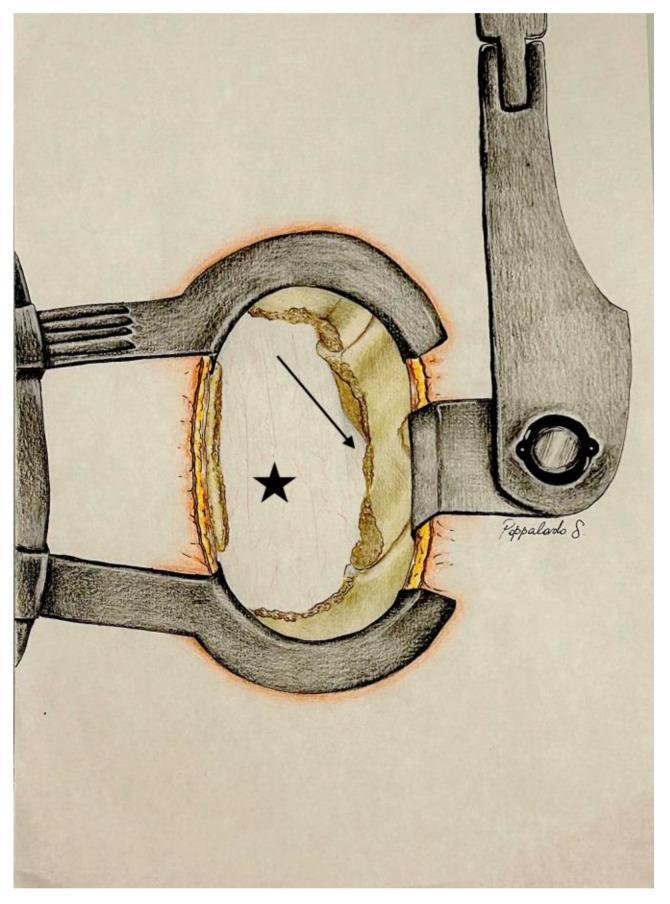
Intraoperative illustration — after laminectomy: dural sac (★) exposed with nerve root (arrow) visible
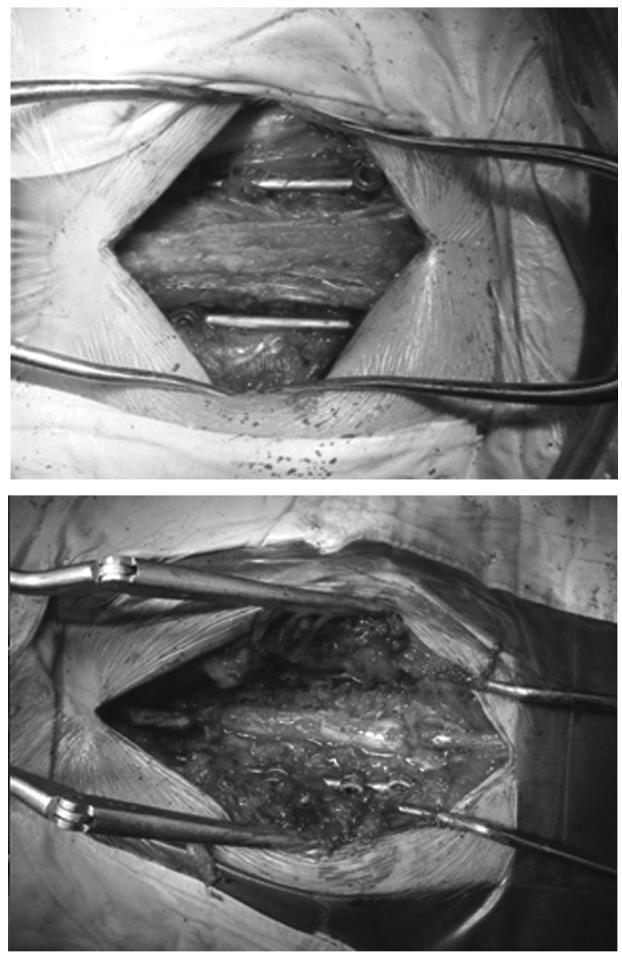
Comparison: Minimally invasive TLIF (top — intact posterior column) vs. traditional open laminectomy (bottom — spinous processes and laminae removed)
6. Patient Positioning
Standard Position: Prone
- Patient transferred prone onto the operating table after induction
- Frame/support options: Wilson frame, Jackson table, Relton frame, gel/foam bolsters
- Weight distributed on thoracic cage and bony pelvis
- Abdomen must hang freely — compression raises intra-abdominal pressure → transmits to valveless epidural veins → increases bleeding and can reduce cardiac output via IVC compression
- Arms: abducted < 90° at shoulder, elbows flexed, forearms pronated on arm boards
- Chest supports: placed along clavicles to iliac crests; not beyond iliac crests (risk of femoral vessel/nerve compression)
- Breasts: displaced medially to the supports
- Male genitalia: checked to be free of compression
- Eyes: must be checked frequently — no direct pressure on globes (risk of postoperative vision loss / POVL); head neutral or slightly above heart level
- Knees: padded; slight hip flexion restores lumbar lordosis → opens the interlaminar space
- Lower legs/feet: padded, heels free
"During posterior spinal surgery, relatively low venous pressure is desirable to minimise bleeding and to facilitate surgical exposure." — Miller's Anesthesia 10e
7. Pre-Operative Checklist: What to Prepare for a Same-Day Lumbar Laminectomy
Workup & Documentation
- MRI lumbar spine reviewed — confirm level(s), pathology (stenosis, disc, tumour)
- Plain X-rays (AP/lateral) — assess instability, scoliosis, spondylolisthesis
- Confirm consent: decompression ± instrumented fusion if instability found intraoperatively
- Baseline neurological exam documented
- Bloods: FBC, U&E, coagulation (PT/INR/APTT), group & screen (T&S 0 for 1–2 level; crossmatch 2 units for >2 levels)
- Stop anticoagulants/antiplatelets per protocol (7–10 days for aspirin; check with surgeon)
- Pre-operative prophylactic antibiotics (typically cefazolin 1–2 g IV within 60 min of incision)
- DVT prophylaxis plan: TED stockings + pneumatic compression devices intraoperatively; LMWH timing post-op discussed
Patient Factors to Flag
- BMI — heavy patients increase abdominal pressure in prone position and increase blood loss
- Diabetes — glucose management; wound healing risk
- Osteoporosis — fracture risk during positioning, poor screw purchase if fusion planned
- Prior lumbar surgery — scar tissue/adhesions alter anatomy; inform scrub team
- Anticoagulation or bleeding disorder
- Allergy to latex or betadine
Anaesthesia Considerations
- General anaesthesia (GA) is standard; neuraxial avoided (surgical field)
- Endotracheal intubation before prone turn
- Maintain MAP ≥ 65–70 mmHg intraoperatively; avoid hypotension (risk of POVL and cord ischaemia)
- Controlled hypotension can reduce bleeding but must be balanced against neural perfusion
- Intraoperative neurophysiological monitoring (IONM) — SSEPs ± MEPs for multilevel or deformity cases; notify anaesthesia to avoid volatile agents if MEPs used (prefer TIVA)
- Foley catheter for multi-level / long cases
Surgical Set-Up & Equipment
- C-arm fluoroscopy available (mandatory for level confirmation — never rely on counting alone)
- High-speed burr (Midas Rex / Anspach) + Kerrison rongeurs (2, 3, 4 mm up-biting)
- Pituitary rongeurs (disc fragments)
- Cobb elevators, Taylor retractors or self-retaining (Caspar/Williams/McCulloch)
- Bipolar and monopolar cautery
- Bone wax, Gelfoam, Surgicel/Hemostatic agents
- Loupes/microscope or endoscope if minimally invasive planned
- Pedicle screw set on standby if fusion may be needed (especially spondylolisthesis cases)
- Drain (e.g., suction drain) if multi-level
Team Communication
- Confirm patient identity, consent, surgical site marking (level)
- WHO surgical safety checklist: time-out before incision
- Radiographer briefed for intraoperative fluoroscopy
- Neuromonitoring team present if ordered
8. Key Complications to Anticipate
| Complication | Prevention |
|---|---|
| Wrong-level surgery | Fluoroscopy + palpate landmarks; mark skin pre-incision |
| Dural tear / CSF leak | Careful Kerrison use; Valsalva test after closure; repair immediately with prolene |
| Nerve root injury | Gentle retraction; decompress pedicle-to-pedicle |
| Epidural haematoma | Meticulous haemostasis; low abdominal pressure; drain if needed |
| Iatrogenic instability | Preserve > 50% of facet bilaterally; if >50% facetectomy, add fusion |
| Postoperative vision loss | Head neutral/level with heart; avoid hypotension; check eyes frequently |
| Positioning injuries | Pad all bony prominences; check genitalia, breasts, femoral vessels |
Sources: Rockwood & Green's Fractures in Adults 10e • Miller's Anesthesia 10e • Miller's Review of Orthopaedics 9e • Gray's Anatomy for Students • Schwartz's Principles of Surgery 11eThe answer above covers everything needed for the case. Quick summary of the key points:
Definition — Removal of one or more laminae ± spinous process ± medial facets to decompress the spinal canal.
Anatomy encountered — Spinous process → lamina → pars interarticularis → facet joint → ligamentum flavum → epidural space → thecal sac → nerve roots.
Approach — Straight midline posterior incision, thoracolumbar fascia opened, paraspinal muscles subperiosteally stripped off the spinous processes bilaterally.
Structures removed — Supraspinous + interspinous ligaments, spinous process, bilateral laminae (pedicle-to-pedicle), ligamentum flavum, medial facets (as needed).
Positioning — Prone on Wilson frame or Jackson table; abdomen free, arms < 90° abduction, eyes protected, genitalia/breasts free of compression.
For today's case:
- Confirm MRI level, fluoroscopy on standby, WHO timeout
- Bloods: group & screen for 1–2 levels
- Antibiotics within 60 min of incision
- Pedicle screw set on standby (in case instability found)
- IONM team if multi-level or deformity
- Flag high BMI, prior surgery, anticoagulants — all affect your approach and blood loss
This is a shared conversation. Sign in to Orris to start your own chat.