
Atopsy of a asfixa case
Reading File
Now let me search the medical library for autopsy findings in asphyxia cases, running parallel queries:
Finding Sources
Finding Sources
Searching the Web
autopsy findings asphyxia forensic pathology
Finding Sources
Finding Sources
Reading Web Page
https://emedicine.medscape.com/article/1988699-overview
Finding Sources
Finding Sources
Finding Sources
Finding Sources
Searching Images
asphyxia autopsy petechiae conjunctival hemorrhage
Searching PubMed
mechanical asphyxia autopsy findings
Loading Image
Loading Image
Here is a comprehensive overview of autopsy findings in asphyxia cases (from the forensic pathology literature):
Autopsy of an Asphyxia Case
Asphyxia (from Greek asphyxia — stopping of the pulse) refers to death caused by inadequate oxygen delivery to the body, most commonly from mechanical obstruction of the airway or thorax. There are no pathognomonic signs specific to asphyxia alone — the diagnosis integrates external, internal, and circumstantial findings.
Types of Mechanical Asphyxia
| Type | Mechanism |
|---|---|
| Hanging | Neck compression by ligature under body weight |
| Strangulation (ligature or manual) | External neck compression |
| Smothering / Suffocation | Oronasal occlusion |
| Choking | Internal airway obstruction |
| Positional / Postural | Chest wall restricted from expanding |
| Traumatic (Perthes syndrome) | Sudden severe thoracoabdominal compression |
External Autopsy Findings
1. Cyanosis
- Dusky blue-purple discoloration of face, lips, nail beds
- Results from deoxygenated blood pooling above the obstruction
- In traumatic/compressive asphyxia: classic "mask" distribution above the level of compression
2. Petechiae (Tardieu's Spots)
- Fine pinpoint hemorrhages from rupture of small vessels under elevated venous pressure
- Conjunctival petechiae (most characteristic) — on the palpebral and bulbar conjunctiva
- Facial/scleral petechiae — forehead, cheeks, periorbital skin
- Serosal petechiae — visceral pleura (Tardieu's spots), pericardium, thymus
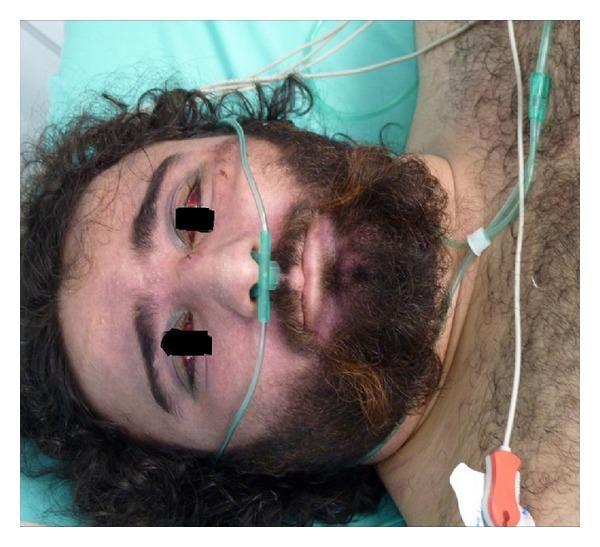
Traumatic asphyxia (Perthes syndrome): facial cyanosis, bilateral subconjunctival hemorrhage, and dense petechiae in "mask" distribution
3. Facial/Neck Edema
- Facial puffiness and congestion from venous hypertension in the SVC territory
- Subconjunctival hemorrhage (bright red blood under conjunctiva)
4. Ligature / Strangulation Marks
- Ligature mark: circumferential or partial groove on neck, may show parchmentization
- Manual strangulation: fingertip bruises, crescentic nail abrasions on neck
- Abrasions/bruises around the mouth/nose in smothering
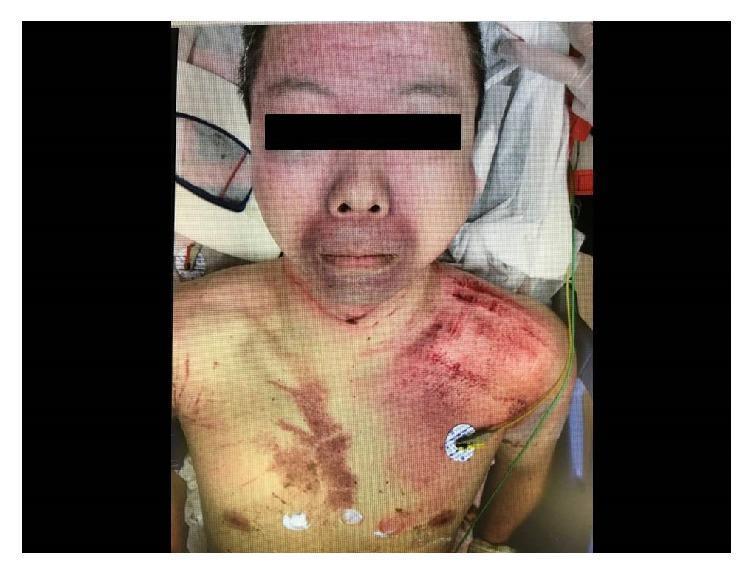
Linear strangulation marks, facial petechiae, and subcutaneous hemorrhage in compressive asphyxia
5. Livor Mortis
- Dark blue-purple (due to high deoxygenated Hb)
- Pronounced and early-appearing in asphyxia
6. Froth / Foam
- Fine white or blood-tinged foam around mouth/nostrils
- Forced air through mucus and edema fluid
Internal Autopsy Findings
Neck Dissection (Layer-by-Layer)
- Strap muscle hemorrhage — key sign of strangulation; requires careful layered dissection
- Hyoid bone fracture — more common in manual strangulation (older adults with calcified hyoid); uncommon in hanging
- Thyroid cartilage fracture — superior cornua fracture suggests manual strangulation
- Carotid artery intimal tears — rare but important
- Amussat's sign: tearing of the intima of the carotid artery
Respiratory System
- Pulmonary congestion and edema — heavy, dark, engorged lungs
- Sub-pleural petechiae (Tardieu's spots) — on the visceral pleural surfaces, especially diaphragmatic and interlobar surfaces
- Pulmonary emphysema — especially in children (smothering)
Cardiovascular
- Pericardial petechiae
- Right heart dilatation (from acute cor pulmonale)
- Dark, liquid blood — (not specific, also seen in other rapid deaths)
Brain
- Cerebral congestion and edema
- Petechrous ridge (petrous bone) hemorrhage — seen in traumatic asphyxia (Perthes syndrome) without skull fracture
Other Organs
- Thymus petechiae (especially in infants)
- Conjunctival and retinal hemorrhages
Special Considerations by Type
| Asphyxia Type | Key Distinguishing Finding |
|---|---|
| Hanging | Ligature groove angled upward, internal neck hemorrhage, hyoid fracture rare |
| Manual strangulation | Fingertip bruises, hyoid/thyroid fracture, bilateral strap hemorrhage |
| Ligature strangulation | Horizontal ligature mark, strap hemorrhage |
| Smothering | Often minimal findings; bruises around mouth/nose in adults; nearly silent in infants |
| Traumatic (Perthes) | "Mask" cyanosis, petrous ridge hemorrhage, bilateral subconjunctival hemorrhage, rib/sternal fractures |
| Positional | Context-dependent; look for body position, body habitus (obesity), alcohol/drugs |
Histological (Microscopic) Findings
- No single histological marker is diagnostic
- Alveolar edema and capillary congestion in lungs
- Attempts to use miRNA expression, FTIR spectroscopy, and biochemical markers (e.g., serotonin, hypoxanthine) are under active research but not yet definitive for diagnosis
- Microscopy is most useful in decomposed bodies or when external signs are absent
Key Limitations
- None of these signs are pathognomonic — petechiae also occur in congestive heart failure, coagulopathy, CPR artifact, etc.
- Decomposition rapidly destroys external signs
- Vulnerable victims (infants, elderly, intoxicated): compression sufficient to asphyxiate may leave no external marks
- The forensic diagnosis requires integration of autopsy, scene, toxicology, and medical history
Recent Literature (2024–2025)
- Qin G & Zhao P (2025): Fatal mechanical asphyxia: a comprehensive forensic review with illustrative case — J Forensic Leg Med [PMID: 41032957]
- Sacco MA & Aquila I (2024): Post Mortem Molecular Biomarkers of Asphyxia — Int J Mol Sci [PMID: 39519158] — reviews miRNA and biochemical markers
- Blandino A et al. (2025): Mechanical asphyxia by hanging: evidence-based review — Forensic Sci Int [PMID: 40633279]
Summary: The autopsy of an asphyxia case centers on finding the triad of facial/conjunctival petechiae, visceral (subpleural/pericardial) petechiae, and pulmonary congestion/edema, combined with mechanism-specific findings (ligature marks, neck dissection, bone fractures). No single sign is definitive — the conclusion rests on a full systematic autopsy correlated with scene investigation and toxicology.
This is a shared conversation. Sign in to Orris to start your own chat.