
What is resting membrane potential? Also, write the mechanism for maintaining RPM in simple language.
Reading File
Now let me search the medical library for resting membrane potential content.
Finding Sources
Finding Sources
Excellent results. Let me now read the most relevant sections from Costanzo Physiology and Guyton & Hall simultaneously.
Reading File
Reading File
Let me read the "Origin of the Normal Resting Membrane Potential" section from Guyton and fetch the diagram image.
Reading File
Loading Image
I have all the information I need. Let me also fetch the resting potential diagram from Guyton (Fig 5.5).
Loading Image
I now have everything needed for a thorough, well-illustrated answer. Here it is:
Resting Membrane Potential (RMP)
What Is It?
The resting membrane potential (RMP) is the electrical voltage difference that exists across the membrane of an excitable cell (nerve or muscle) when the cell is at rest - that is, between action potentials. By convention, the potential inside the cell is expressed relative to the outside.
- In large nerve fibers: -70 mV (Costanzo) to -90 mV (Guyton & Hall)
- The minus sign means the inside of the cell is negatively charged compared to the outside
"The resting membrane potential is the potential difference that exists across the membrane of excitable cells such as nerve and muscle in the period between action potentials."
- Costanzo Physiology, 7th Edition
Why Does It Exist? (The Ionic Basis)
The RMP arises because ions are distributed unequally across the cell membrane, and the membrane is selectively permeable to certain ions.
Key ion concentrations at rest (Guyton & Hall):
| Ion | Outside the cell | Inside the cell |
|---|---|---|
| Na+ | 142 mEq/L | 14 mEq/L |
| K+ | 4 mEq/L | 140 mEq/L |
- K+ is highly concentrated inside the cell (35x more inside than outside)
- Na+ is highly concentrated outside the cell (10x more outside than inside)
- At rest, the membrane is 100x more permeable to K+ than to Na+
Because K+ can leak out easily (through "leak channels"), and Na+ mostly cannot enter, the net result is a negative interior.
Mechanism of Maintaining RMP - Step by Step (Simple Language)
Think of the cell as a room with a leaky door for potassium:
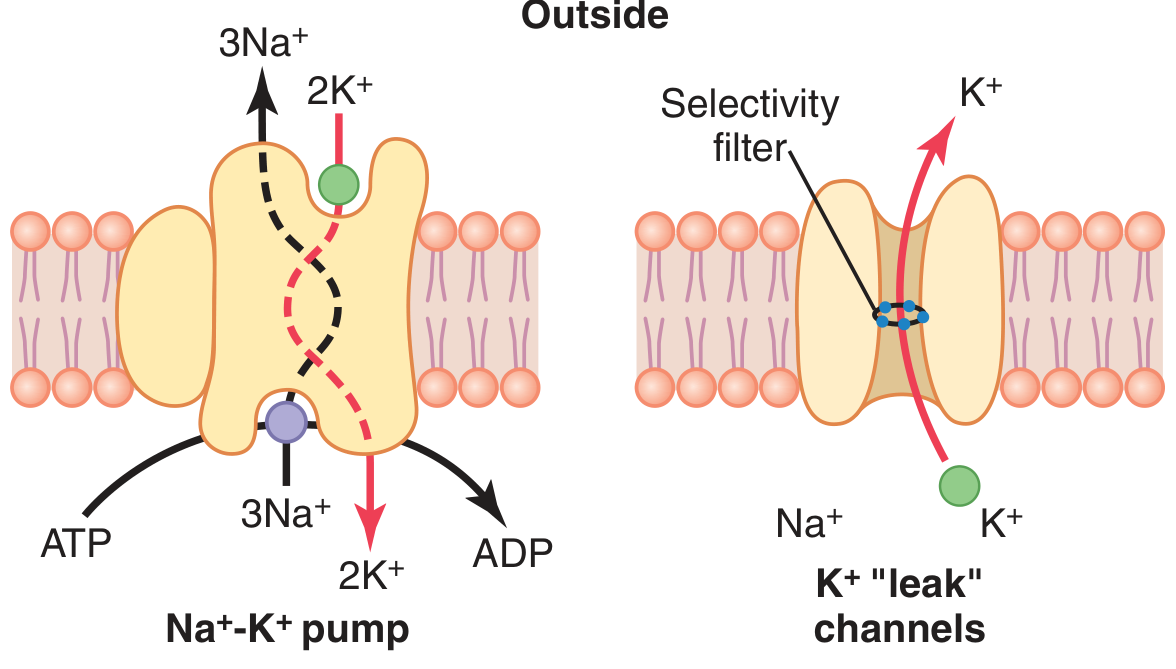
Step 1 - The Na+-K+ Pump Sets Up the Gradient
The Na+-K+ ATPase pump (an active transporter that uses ATP energy) constantly works like a security guard:
- Kicks 3 Na+ ions OUT of the cell
- Brings 2 K+ ions IN to the cell
- Net result: more positive charges leave than enter → inside becomes negative
- This creates a high K+ concentration inside and high Na+ concentration outside
Step 2 - K+ Leaks Out Through "Leak Channels"
The resting membrane has always-open K+ leak channels. Since K+ is packed 35x higher inside, it naturally tries to escape down its concentration gradient.
As K+ (positive ions) leak out, the inside gets more and more negative.
Step 3 - An Electrical Force Pulls K+ Back In
As the inside becomes negative, it starts electrically attracting K+ back in (opposites attract). Eventually, two opposing forces balance each other:
- Chemical force pushing K+ out (concentration gradient)
- Electrical force pulling K+ back in (negative interior)
This balance point is the K+ equilibrium potential = -94 mV.
Step 4 - A Small Na+ Leak Shifts the Balance
The membrane is slightly permeable to Na+ as well. Na+ trickles inward (attracted by both its high outside concentration AND the negative interior), which nudges the membrane potential a bit less negative - from -94 mV toward -86 mV.
Step 5 - The Na+-K+ Pump Adds a Final Touch
The pump's unequal exchange (3 Na+ out, 2 K+ in) directly contributes an additional -4 mV of negativity. This is called the electrogenic contribution of the pump.
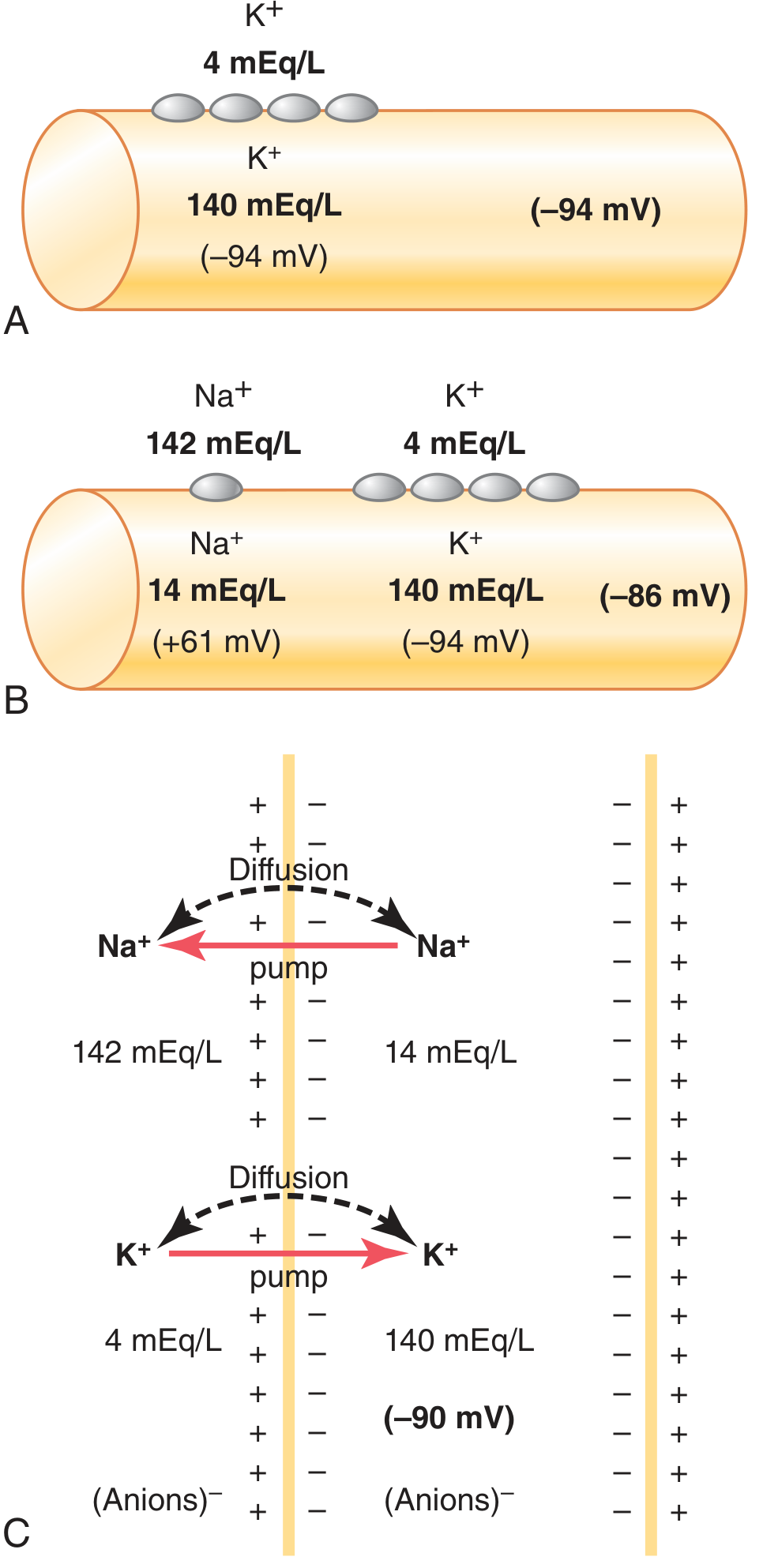
Summary Table
| Contributor | Effect on RMP | Magnitude |
|---|---|---|
| K+ diffusion out (leak channels) | Makes inside more negative | -94 mV (K+ alone) |
| Na+ leaking in (slight permeability) | Makes inside slightly less negative | Shifts to -86 mV |
| Na+-K+ ATPase pump (electrogenic) | Directly adds more negativity | ~-4 mV extra |
| Final RMP | ~-70 to -90 mV |
Two Roles of the Na+-K+ ATPase
- Direct (electrogenic): Pumping 3 Na+ out vs. 2 K+ in directly makes the inside ~4 mV more negative
- Indirect (most important): Maintains the K+ concentration gradient across the membrane, which drives the K+ diffusion potential that is the primary source of the RMP
"The Na+-K+ ATPase is necessary to create and maintain the K+ concentration gradient, which establishes the resting membrane potential."
- Costanzo Physiology, 7th Edition
Sources: Guyton and Hall Textbook of Medical Physiology, pp. 78-79; Costanzo Physiology, 7th Ed., pp. 26-27
In easy language
Resting Membrane Potential - Super Simple Version
What Is It? (The Big Picture)
Imagine a cell as a tiny bag sitting in salty fluid. Both inside the bag and outside the bag, there are charged particles called ions (like Na+ and K+).
At rest, the inside of the cell has a slight negative charge compared to the outside. This charge difference is called the Resting Membrane Potential (RMP).
- Value: about -70 mV (the minus means inside is negative)
That's it. Simple definition: a cell's inside is negatively charged at rest.
Why Is the Inside Negative?
Think of it like this:
You have a room (the cell). The room has a revolving door that only lets certain people out. Mostly, the K+ guys (potassium) can leave through the door. The Na+ guys (sodium) cannot easily enter.
Here's what happens:
- There are lots of K+ inside the cell (140 units inside vs. only 4 outside)
- K+ wants to escape - like people rushing out of a crowded room
- K+ is positively charged, so when it leaves, the inside becomes more negative
- Eventually, the inside gets so negative that it starts pulling K+ back in
- The two forces (K+ wanting to leave vs. negative charge pulling it back) balance out
- That balance point is the resting membrane potential
The Main Characters
| Ion | Where it's found more | Can it cross at rest? |
|---|---|---|
| K+ (Potassium) | Mostly INSIDE | Yes - leaks out freely |
| Na+ (Sodium) | Mostly OUTSIDE | Barely - almost blocked |
Because K+ leaks out and Na+ cannot get in, positive charges are lost from inside - making the inside negative.
How Is It Maintained? (The Na+-K+ Pump)
Think of the Na+-K+ pump as a security guard working 24/7 at the cell's gate.
Every second, this guard does one job over and over:
"Throw 3 Na+ OUT, let 2 K+ IN"
That's it. 3 out, 2 in. All day, every day.
Why does this matter?
- 3 positive charges leave but only 2 positive charges enter
- So 1 extra positive charge is removed each cycle
- This keeps the inside slightly more negative
- It also keeps K+ stocked up inside and Na+ stocked up outside, ready for the next round of leaking
The Full Story in 4 Lines
- The Na+-K+ pump packs K+ inside and Na+ outside
- K+ leaks out through open channels (because there's so much of it inside)
- This makes the inside negative
- The pump keeps refilling K+ inside so the negativity is always maintained
A Simple Analogy
Think of a leaky bucket (the cell):
- The pump is someone constantly pouring water back in (K+)
- The leak channels are holes in the bucket letting water (K+) drip out
- The system never fully empties or overflows - it just stays at a steady level
- That steady level = the Resting Membrane Potential
As soon as you block the pump (e.g., no ATP/energy), K+ leaks out and is never replaced, the gradient is lost, and the RMP disappears. This is why cells need constant energy just to stay alive and ready to fire.
Mechanism of action potential in skeletal muscle
Finding Sources
Finding Sources
Finding Sources
Finding Sources
Finding Sources
I found a dedicated "MUSCLE ACTION POTENTIAL" section in Guyton & Hall and "NEURON ACTION POTENTIAL" too. Let me read these along with the Costanzo action potential section.
Reading File
Reading File
Now let me fetch the action potential graph image and the T-tubule/SR diagram.
Loading Image
Reading File
Let me fetch the T-tubule SR diagram and the neuromuscular junction section from Guyton.
Loading Image
Finding Sources
Reading File
I now have all the content needed for a complete, easy-language answer. Let me compose it.
Action Potential in Skeletal Muscle - Easy Language
The action potential in skeletal muscle is a rapid electrical signal that travels along the muscle fiber and ultimately triggers it to contract. The whole story has two parts: (1) how the nerve fires the muscle and (2) what happens inside the muscle fiber itself.
Part 1 - The Nerve Fires the Muscle (Neuromuscular Junction)
Think of the nerve as a delivery truck and the muscle as a warehouse.
Step-by-step at the neuromuscular junction:
- Nerve impulse arrives at the nerve terminal (the motor end plate)
- This opens voltage-gated Ca2+ channels in the nerve terminal
- Ca2+ rushes in → causes acetylcholine (ACh) vesicles to fuse with the nerve membrane and dump ACh into the synaptic cleft (the tiny gap between nerve and muscle)
- ACh binds to nicotinic receptors on the muscle membrane → opens ion channels
- Na+ rushes in → muscle membrane depolarizes → this is the end-plate potential (EPP)
- If EPP is big enough to cross threshold (~-55 mV), a muscle action potential fires
- ACh is quickly destroyed by acetylcholinesterase so the signal doesn't last too long
Part 2 - The Action Potential in the Muscle Fiber Itself
Once triggered, the muscle action potential goes through 4 stages:
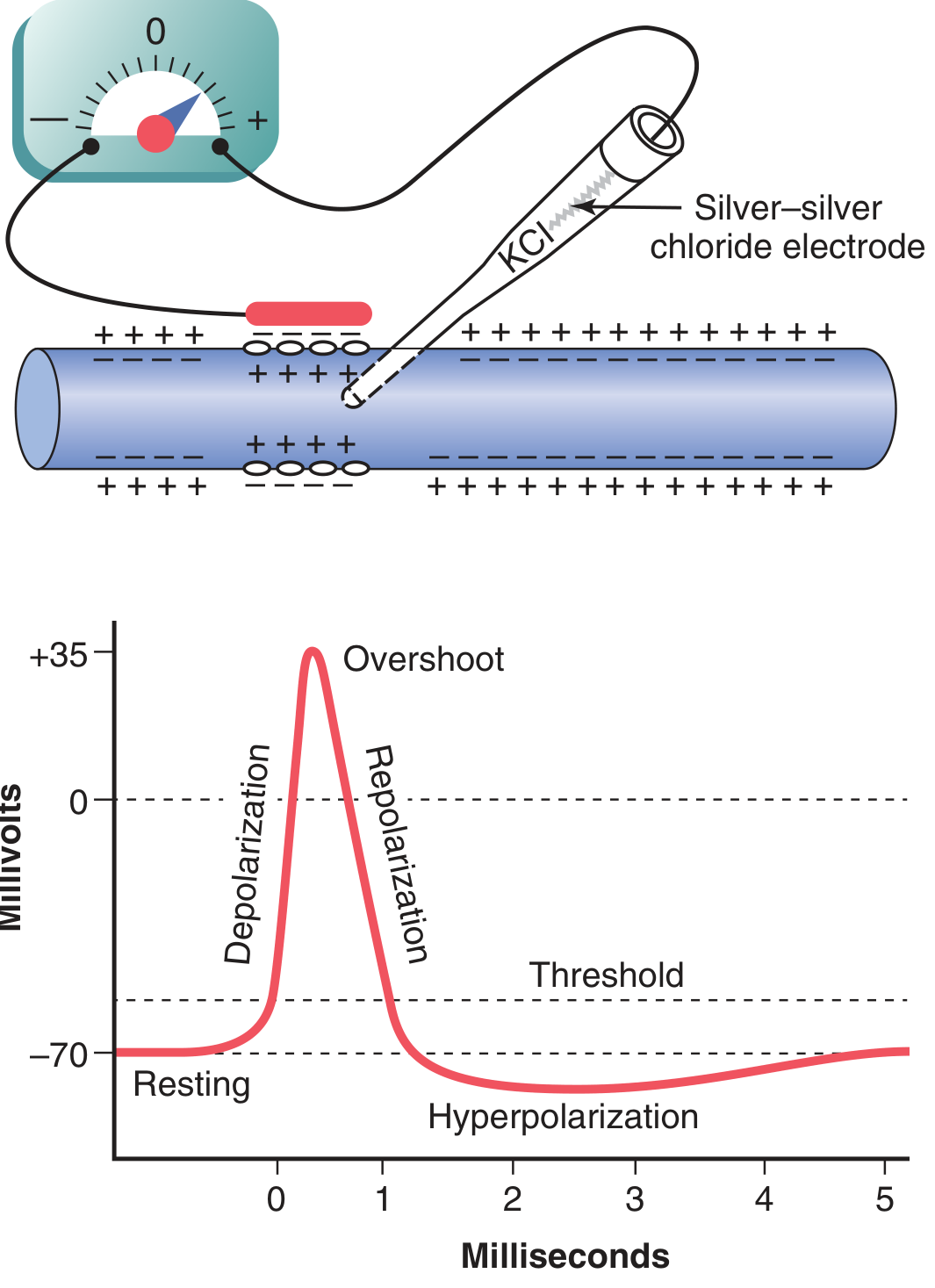
Stage 1 - Resting (-80 to -90 mV)
The muscle fiber sits at rest, negatively charged inside. Voltage-gated Na+ channels are closed but ready (like a coiled spring).
Skeletal muscle RMP is about -80 to -90 mV - slightly more negative than neurons (-70 mV).
Stage 2 - Depolarization (the "upstroke")
- Stimulus pushes membrane to threshold (~-55 mV)
- Voltage-gated Na+ channels SNAP OPEN
- Na+ floods into the cell (Na+ is packed outside, positively charged)
- Inside goes from -80 mV → rushes past 0 mV → reaches +35 mV
- This is called the overshoot - the inside briefly becomes positive
Think of it like opening a dam - water (Na+) floods in all at once.
Stage 3 - Repolarization (coming back down)
- Na+ channels automatically inactivate (they have a gate that snaps shut)
- Voltage-gated K+ channels NOW OPEN
- K+ rushes out of the cell (K+ is packed inside)
- Positive charges leave → inside becomes negative again
- Membrane returns toward -80 mV
Stage 4 - Hyperpolarization (brief undershoot)
- K+ channels stay open a tiny bit too long
- Too much K+ leaves → inside briefly goes more negative than resting (e.g., -90 mV)
- This is called hyperpolarization or the "undershoot"
- K+ channels then close → membrane returns to normal resting potential
Key numbers for Skeletal Muscle:
| Property | Value |
|---|---|
| Resting membrane potential | -80 to -90 mV |
| Threshold | ~-55 mV |
| Peak (overshoot) | ~+35 mV |
| Duration of action potential | 1 to 5 milliseconds |
| Conduction velocity | 3-5 m/sec |
Part 3 - From Electrical Signal to Contraction (T-tubules & SR)
Here is where skeletal muscle is unique. The action potential must reach the deep interior of the muscle fiber to trigger contraction. This is done via the T-tubule system.
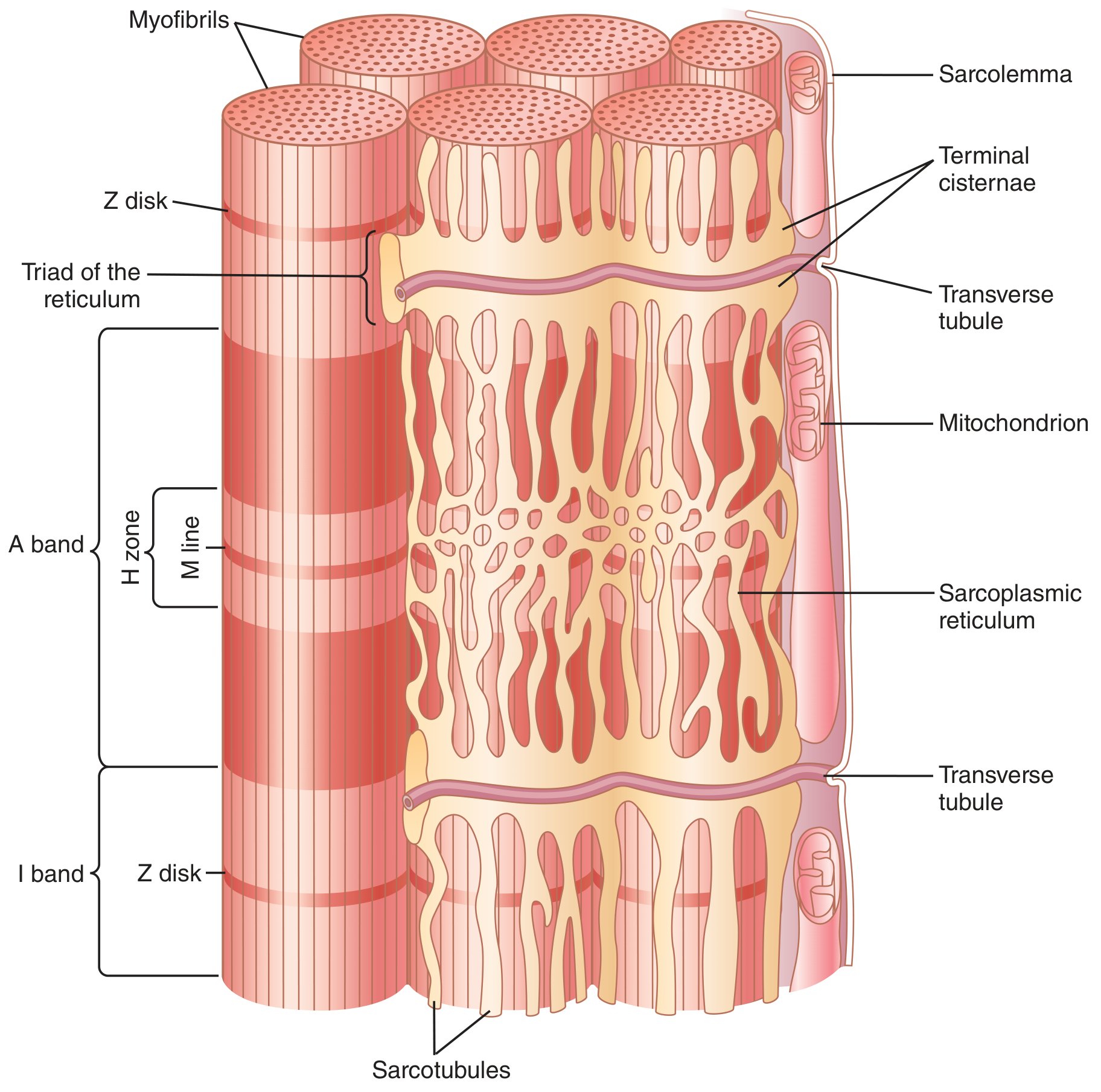
How it works (Excitation-Contraction Coupling):
- Action potential spreads along the sarcolemma (muscle surface membrane)
- It dives deep inside via T-tubules (transverse tunnels that open to the outside and run through the whole fiber)
- T-tubule has dihydropyridine (DHP) receptors that sense the voltage change
- DHP receptors are physically linked to ryanodine receptors (RyR) on the sarcoplasmic reticulum (SR)
- RyR channels open → Ca2+ is released from the SR in a flood
- Ca2+ binds troponin → moves tropomyosin off actin → muscle contraction begins
- After contraction, SERCA pump (Ca2+-ATPase) pumps Ca2+ back into the SR → muscle relaxes
The Whole Story in One Simple Chain:
Nerve impulse
      ↓
ACh released into synapse
      ↓
ACh binds nicotinic receptors on muscle
      ↓
Na+ enters → End-plate potential
      ↓
Threshold reached → Voltage-gated Na+ opens
      ↓
DEPOLARIZATION (inside goes positive)
      ↓
Na+ channels inactivate + K+ channels open
      ↓
REPOLARIZATION (inside goes negative again)
      ↓
K+ channels close → slight HYPERPOLARIZATION → back to rest
      ↓
Action potential travels along sarcolemma + into T-tubules
      ↓
DHP receptor → Ryanodine receptor → Ca2+ floods out of SR
      ↓
Ca2+ + Troponin → MUSCLE CONTRACTS
      ↓
SERCA pump removes Ca2+ → MUSCLE RELAXES
Sources: Guyton and Hall Textbook of Medical Physiology, pp. 80, 108-110; Costanzo Physiology, 7th Edition, pp. 26-27
This is a shared conversation. Sign in to Orris to start your own chat.