
Right humerus bone lower part
Reading File
Finding Sources
Searching Images
distal humerus anatomy lower part
Reading File
Finding Sources
Reading File
Finding Sources
Loading Image
Searching Images
humerus bone anatomy labeled capitulum trochlea epicondyle fossa
Reading File
Loading Image
Loading Image
Here is a comprehensive overview of the distal (lower) end of the right humerus — its anatomy, key bony landmarks, articular surfaces, fossae, and related structures.
Distal Humerus — Anatomy
The distal humerus is the lower portion of the arm bone that forms the elbow joint, articulating with both the radius (laterally) and the ulna (medially).
Structural Overview — The Two Columns
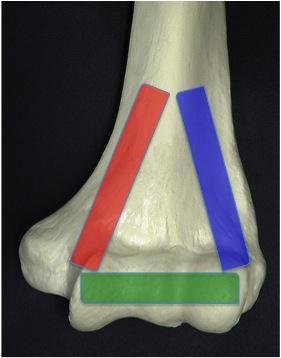
As the humeral shaft descends distally, it becomes triangular in cross-section and bifurcates into two divergent cortical columns:
| Column | Direction | Termination | Divergence Angle |
|---|---|---|---|
| Medial column | Diverges ~45° from shaft (coronal plane) | Medial epicondyle | Stays in line in sagittal plane |
| Lateral column | Diverges ~20° from shaft (coronal plane) | Capitellum (curves 35–40° anteriorly in sagittal plane) | Curves anteriorly |
Together with the articular surface (the "base"), these two columns form a triangular (delta) configuration — the structural foundation of the distal humerus.
Articular Surfaces
1. Capitulum (Capitellum)
- Hemispherical projection forming the anterior and inferior surface of the lateral aspect
- Articulates with the radial head
- The articular surface encompasses approximately 180° arc in the sagittal plane
- Located at the terminus of the lateral column
2. Trochlea
- Spool- or pulley-shaped structure (Greek: "pulley") forming the medial articular surface
- Articulates with the trochlear notch of the ulna
- Covered by articular cartilage anteriorly, inferiorly, and posteriorly — an arc of nearly 270°
- Has a central sulcus matching the central ridge of the ulna's greater sigmoid notch
- Located more distally than the capitellum → creates 4–8° of valgus alignment in the coronal plane
The capitellar-trochlear sulcus is a small groove dividing the two articular surfaces.
Epicondyles (Non-articular projections)
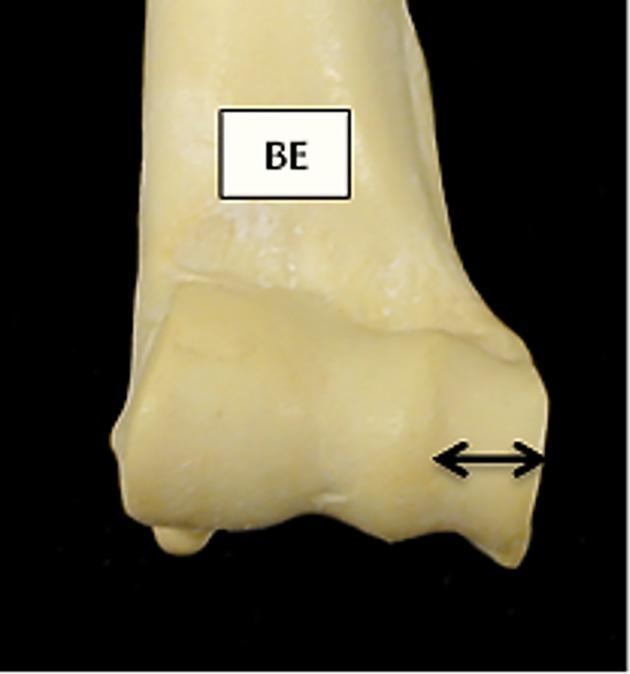
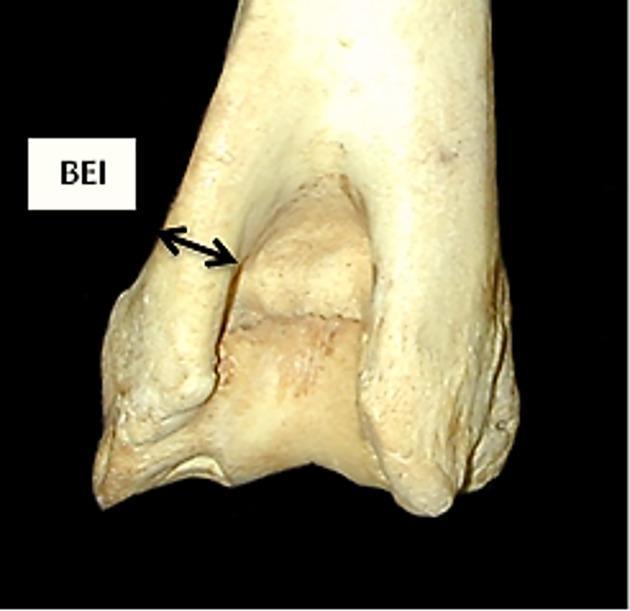
Medial Epicondyle
- Blunt projection at the medial aspect of the distal humerus
- Terminus of the medial column
- The smooth posterior surface carries the ulnar nerve in a shallow sulcus (cubital tunnel) as it passes into the forearm
- Origin of the MCL (medial collateral ligament) — anterior bundle inserts on the sublime tubercle of the coronoid
- Site of origin for flexor-pronator muscle group
Lateral Epicondyle
- Occupies the non-articular aspect of the distal humeral condyle
- Gives rise to the lateral supracondylar ridge superiorly
- Origin of the LCL (lateral collateral ligament) complex — from an isometric point on the lateral epicondyle
- Site of origin for the superficial extensor muscles of the forearm
Fossae
Two hollow depressions lie between the two columns, separated by a thin bony septum (occasionally absent = septal aperture):
| Fossa | Surface | Accommodates | During |
|---|---|---|---|
| Olecranon fossa | Posterior | Olecranon of ulna | Elbow extension |
| Coronoid fossa | Anterior | Coronoid process of ulna | Elbow flexion |
| Radial fossa | Anterior (lateral) | Radial head | Elbow flexion |
Important: Screws must not be placed through the fossae — impingement will restrict elbow range of motion.
Alignment Angles
| Parameter | Value |
|---|---|
| Valgus alignment (trochlea vs. capitellum) | 4–8° in coronal plane |
| Carrying angle (full elbow) | 10–17° valgus in extension |
| Anterior tilt of articular surface | 35–40° in sagittal plane |
| Internal rotation of articular surface | 3–8° axially |
Key Neurovascular Relations
- Ulnar nerve — travels behind the medial epicondyle; the Arcade of Struthers (present in ~70%) is a compression point ~8 cm proximal to the medial epicondyle
- Radial nerve — at risk anterolaterally along the supracondylar ridge
- Median nerve — crosses anterior to the elbow
Ligament Attachments
- MCL (medial collateral ligament) — anterior bundle from medial epicondyle to sublime tubercle; primary restraint against valgus stress
- LCL complex — radial collateral ligament, LUCL (lateral ulnar collateral ligament), and annular ligament; restraint against varus and posterolateral rotatory instability
- Annular ligament — encircles the radial head, attaching to anterior and posterior margins of the lesser sigmoid notch
Sources: Imaging Anatomy: Bones, Joints, Vessels and Nerves (Vol. 3), p. 92–93; Rockwood and Green's Fractures in Adults, 10th ed., Chapter 39 (Distal Humerus)
This is a shared conversation. Sign in to Orris to start your own chat.